
Four lovers, a magic flower, a weaver with an ass's head … retold in modern English verse.
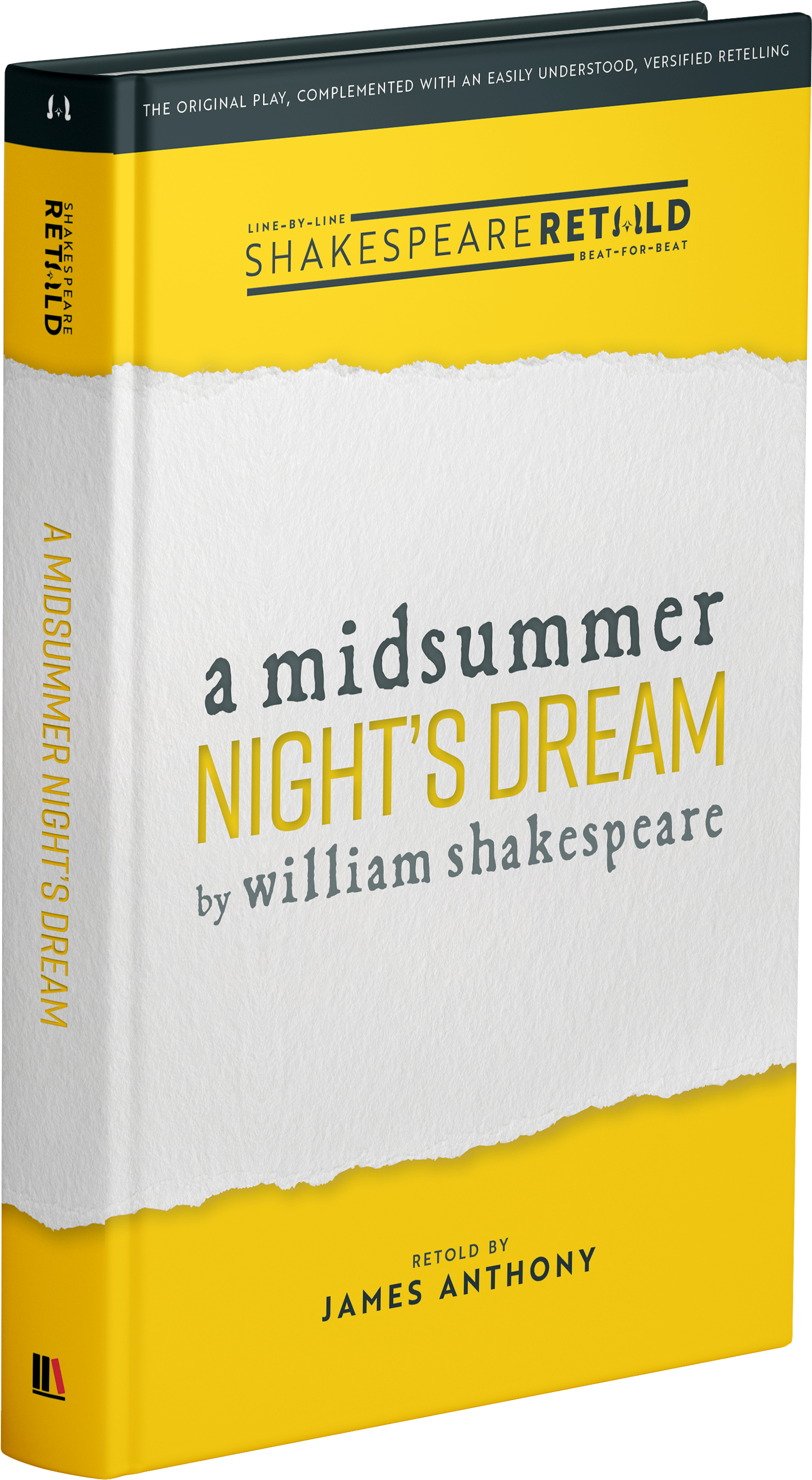
The complete study guide to A Midsummer Night’s Dream – every line translated; every rhythm kept; every scene, character and theme explored – free for students, teachers, actors, and theatregoers.
A Midsummer Night's Dream Overview
A Midsummer Night's Dream Deep Dive
-
ACT 1
-
A Midsummer Night's Dream – Act 1 Scene 1
A wedding and a daughter's refusal
A Midsummer Night's Dream Act 1, Scene 1 retold in modern English verse: Egeus invokes the law; four lovers plan to flee.
-
A Midsummer Night's Dream – Act 1 Scene 2
Bottom wants every part
A Midsummer Night's Dream Act 1, Scene 2 retold in modern English verse: Quince casts Pyramus and Thisbe for the duke's wedding.
-
-
ACT 2
-
A Midsummer Night's Dream – Act 2 Scene 1
"Ill met by moonlight, proud Titania"
A Midsummer Night's Dream Act 2, Scene 1 retold in modern English verse: the fairy quarrel and the magic flower.
-
A Midsummer Night's Dream – Act 2 Scene 2
The wrong Athenian is anointed
A Midsummer Night's Dream Act 2, Scene 2 retold in modern English verse: Titania charmed, Lysander anointed by mistake.
-
-
ACT 3
-
A Midsummer Night's Dream – Act 3 Scene 1
Bottom is translated
A Midsummer Night's Dream Act 3, Scene 1 retold in modern English verse: the rehearsal, the ass's head, and Titania in love.
-
A Midsummer Night's Dream – Act 3 Scene 2
"Lord, what fools these mortals be!"
A Midsummer Night's Dream Act 3, Scene 2 retold in modern English verse: both men love Helena, and the four lovers quarrel.
-
-
ACT 4
-
A Midsummer Night's Dream – Act 4 Scene 1
Waking from the dream
A Midsummer Night's Dream Act 4, Scene 1 retold in modern English verse: Titania released, the lovers found, and Bottom's Dream.
-
A Midsummer Night's Dream – Act 4 Scene 2
Bottom returns
A Midsummer Night's Dream Act 4, Scene 2 retold in modern English verse: the workmen mourn Bottom, and he walks in with orders.
-
-
ACT 5
Frequently asked questions about A Midsummer Night's Dream
What is A Midsummer Night's Dream about?
A Midsummer Night's Dream is the story of one night in the wood outside Athens. Duke Theseus is about to marry Hippolyta, the Amazon queen he defeated in war, when Egeus demands that his daughter Hermia marry Demetrius; she loves Lysander, and the two run away through the wood, followed by Demetrius and by Helena, who loves him. In the same wood the fairy king Oberon and queen Titania are quarrelling over a changeling boy, and six Athenian workmen are rehearsing a play for the duke's wedding. Oberon sends his servant Puck for a flower whose juice makes the sleeper love the first creature it sees. Puck anoints the wrong man, so that both young men abandon Hermia for Helena; he gives Bottom the weaver an ass's head; and Titania wakes to fall in love with him. By morning the spells are undone, Theseus overrules the father, three couples marry, the workmen perform their tragedy of Pyramus and Thisbe, and the fairies bless the house.
When was A Midsummer Night's Dream written?
A Midsummer Night's Dream was probably written in 1595 or 1596, at about the same time as Romeo and Juliet, whose lovers the workmen's Pyramus and Thisbe turn into farce. The only firm evidence is that Francis Meres listed it among Shakespeare's comedies in 1598. It was first printed in 1600, with a title page saying it had been acted publicly by the Lord Chamberlain's Men, Shakespeare's own company, and it appeared again in the First Folio of 1623. Because it ends with three weddings and a blessing of the marriage beds, scholars have long suspected it was written for an aristocratic wedding, possibly in 1595 or 1596, but no document proves it. Shakespeare built the play from Chaucer's Knight's Tale, Plutarch's life of Theseus, Ovid's Metamorphoses, Apuleius's Golden Ass and English fairy lore, but the plot itself is his own, which is rare for him.
Is A Midsummer Night's Dream a comedy?
Yes, and one of the purest Shakespeare wrote: nobody dies, everyone marries, and the only deaths on stage are Pyramus and Thisbe's, acted by a weaver and a bellows-mender in front of a court that laughs. It follows the shape Northrop Frye called the green-world comedy, in which the action begins in a rigid normal world, moves into a wood where the rules lapse and the confusions are worked out, and returns transformed. But the comedy has an edge that students are asked to notice. The framing marriage was made by conquest, the law that opens the play would kill a disobedient daughter, one of the three marriages is made by a fairy flower nobody removes, and Titania is drugged into loving a monster and never told. Critics since Jan Kott in the 1960s have read the wood as a place of desire and cruelty as much as delight, and productions have followed them.
Why is it called A Midsummer Night's Dream when the play is set in May?
It is a fair question, and editors have asked it since Samuel Johnson in 1765. Theseus, finding the lovers asleep, supposes they rose early to observe the rite of May, and nothing in the text says it is midsummer. The best answer is that the title names a mood rather than a date. Midsummer Eve was the night when English folk belief said the fairies were abroad and young people went mad with love; May Day was the festival of going out into the woods before dawn. Shakespeare seems to have combined the two, and the title tells the audience what kind of night to expect. The word dream matters as much as the season: the lovers, Titania and Bottom all call what happened to them a dream, and Puck's epilogue invites the audience to do the same.
What level is A Midsummer Night's Dream studied at?
A Midsummer Night's Dream is one of the most widely taught of all Shakespeare's plays. It is a set text at Key Stage 3 and GCSE in the UK, studied at A-Level, AP English Literature in the US, the IB Diploma, and on undergraduate courses, and it is usually the first Shakespeare play a student meets. Puck's epilogue, Helena's speech on love looking with the mind, Titania's speech on the ruined harvest, Bottom's Dream and Theseus's lines on the lunatic, the lover and the poet are standard audition and classroom pieces. This study guide is written to support all of these levels, with modern English translation, scene-by-scene analysis, character profiles, theme guides, and key quotes.
What are the most famous lines in A Midsummer Night's Dream?
A Midsummer Night's Dream gives the language "The course of true love never did run smooth", "Lord, what fools these mortals be!", "Ill met by moonlight, proud Titania", "I know a bank where the wild thyme blows", "Love looks not with the eyes, but with the mind", "And though she be but little, she is fierce", "The lunatic, the lover and the poet", "The best in this kind are but shadows" and, from Puck's epilogue, "If we shadows have offended". Each is analysed in depth, with its modern verse translation, on the key quotes page.