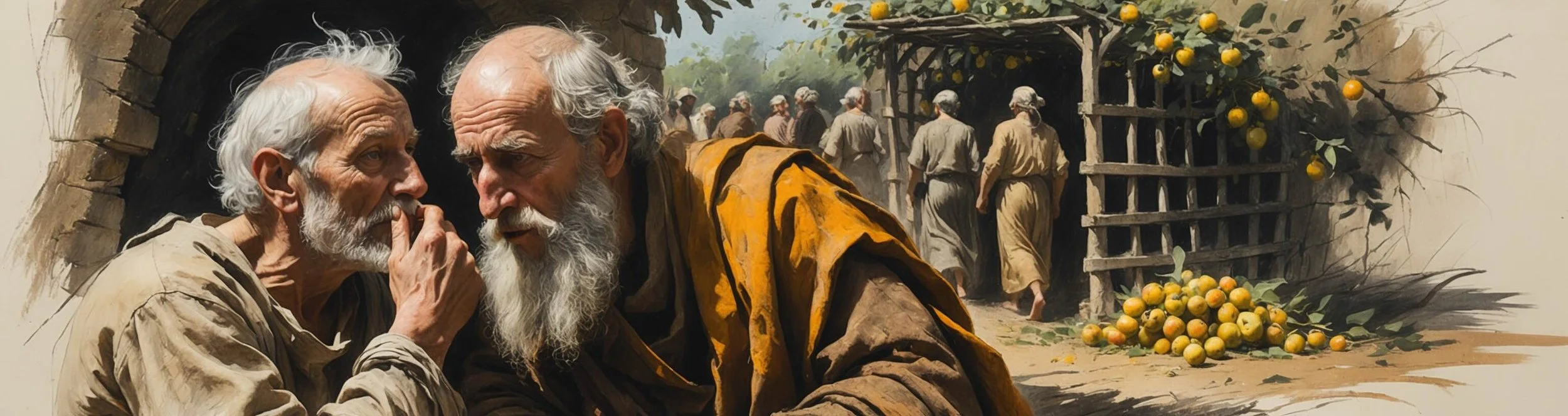
Scene Profile – At a Glance
- Location: A room in Leonato’s house, as the household prepares the evening’s revels.
- What Happens: Antonio tells Leonato that a servant overheard the prince say he loves Hero and will declare himself at the dance. Leonato decides to treat it as a dream until it happens, but to prepare Hero with an answer.
- Key Characters: Leonato, Antonio.
- Dramatic Function: The play’s first misreport. A servant has half-heard the prince’s plan to woo Hero for Claudio, and the household now expects the prince to woo for himself; the scene plants the error Don John will exploit at the ball.
- Famous Quote:
"No, no; we will hold it as a dream till it appear itself..."
(Leonato, Act 1, Scene 2) - Why It Matters: Twenty-five lines in which the play shows how news travels in Messina: overheard in an orchard, garbled by a servant, believed by a governor, and passed to a daughter as her cue.
Scene Summary
Leonato meets his brother Antonio and asks where his nephew is and whether he has arranged the music. Antonio says he is busy with it, and has strange news that Leonato has not dreamt of. Asked whether it is good, Antonio says that depends how it turns out, but it looks well on the outside: the prince and Count Claudio were walking in a thick-pleached alley in his orchard, and a man of his overheard the prince tell Claudio that he loved Hero and meant to acknowledge it that night at the dance, and, if he found her willing, to take the moment by the top and break with Leonato at once.
Leonato asks whether the fellow who reported it has any wit, and Antonio says he is a good sharp fellow and offers to send for him. Leonato declines: they will hold it as a dream until it appears, but he will acquaint his daughter with it so that she may be the better prepared for an answer if it proves true, and sends Antonio to tell her. Attendants enter, and Leonato gives his orders for the busy evening.
They Show Well Outward
The scene is a report of a report, and the play makes it wrong on purpose: the servant in the orchard heard the prince say he loved Hero and missed the part about Claudio.
Original
As the event stamps them: but they have a good cover; they show well outward. The prince and Count Claudio, walking in a thick-pleached alley in mine orchard, were thus much overheard by a man of mine: the prince discovered to Claudio that he loved my niece your daughter and meant to acknowledge it this night in a dance: and if he found her accordant, he meant to take the present time by the top and instantly break with you of it.
(Antonio, Act 1, Scene 2)
Shakespeare Retold (Modern Verse)
That depends how it turns out: but if you judge a book by its cover, it looks good. The prince, Don Pedro, and Count Claudio were walking through a leafy tunnel in my orchard, when a servant of mine overheard them: the prince disclosed to Claudio that he loves my niece, your daughter, and plans to let her know this evening at the dance; and if he finds that she reciprocates, he plans to grab the moment by immediately breaking the news to you.
Antonio’s caution, that the news is as good as the event makes it but shows well outward, is the play’s method announced in its second scene: everything in Messina shows well outward, and the event will stamp it. What the servant heard was true, the prince did say he would woo Hero; what he missed was the purpose, and the omission turns a favour into a courtship. Leonato’s response is the governor’s, to treat it as a dream until it appears and meanwhile to prepare his daughter’s answer, and the audience should notice what that means: Hero is to be told that a prince may propose to her tonight, and to be ready to say yes. The theme of deception and noting has not yet had a deceiver; it has had an eavesdropper and a father, and that is enough to put a false expectation into the house. Don John, in the next scene, will get the same news accurately, and at the ball he will tell Claudio the garbled version, which the household already half believes. The theme of courtship and marriage is visible in Leonato’s one decision. He does not ask Hero what she thinks of the prince; he arranges her answer.
Language and Technique
- Report within report: Antonio tells Leonato what a servant told him that the prince told Claudio: the news arrives at three removes, and each remove is a place for error. The scene’s structure is the play’s warning about hearsay.
- Prose: The brothers speak in prose, as the household does when it is doing business; the scene is a practical exchange between two old men with a party to run, and the news is handled like a catering problem.
- Dream: Leonato will hold the news as a dream till it appear itself: the word turns a rumour into something to be waited for rather than checked, and the household goes to the ball believing it.
- Show well outward: Antonio’s phrase for the news is the play’s phrase for everything: a good cover, a fair appearance, an outside that the event will stamp as true or false. The scene uses the vocabulary of seeming before anyone has deceived anyone.
Key Quotes from Act 1, Scene 2
Quote 1
He is very busy about it. But, brother, I can tell you strange news that you yet dreamt not of.
(Antonio, Act 1, Scene 2)
Shakespeare Retold (Modern Verse)
He’s busy sorting it. But, brother, let me tell you some strange news that you’d never have dreamed of.
Quote Analysis: Antonio’s announcement: strange news Leonato has not dreamt of. The modern verse keeps the dream. The word will be Leonato’s too, a few lines later, when he decides to hold the news as a dream till it appears; the scene is bracketed by dreaming, and the audience knows the news is half a dream already.
LEONATO: Hath the fellow any wit that told you this?
ANTONIO: A good sharp fellow: I will send for him; and
question him yourself.
(Act 1, Scene 2)
Shakespeare Retold (Modern Verse)
LEONATO: Is the chap that told you this perceptive?
ANTONIO: He’s a very smart fellow: I’ll ask him to come here, and
you can question him yourself.
Quote Analysis: Leonato asks whether the informant is to be trusted, and Antonio offers to produce him. The modern verse keeps the offer. It is the one moment in the scene where the report could be checked, and Leonato declines; the play’s first chance to note carefully is passed over by the man who will pay most for not noting.
but I will acquaint my daughter withal, that she may be the better prepared for an answer, if peradventure this be true. Go you and tell her of it.
(Leonato, Act 1, Scene 2)
Shakespeare Retold (Modern Verse)
but I will let my daughter know, so that she can be prepared with an answer, if perhaps this is true. Go and tell her about it.
Quote Analysis: Leonato’s decision: tell Hero, so that she is prepared with an answer if the prince proposes. The modern verse keeps the preparation. The answer is to be prepared by her father, and the scene does not say what it is; in Act 2, Scene 1 he will remind her of it in a sentence, and she will not need it.
Key Takeaways
- The first misreport: A servant overheard half the prince’s plan; the household now expects the prince to woo Hero himself, and the error will be used at the ball.
- A dream till it appear: Leonato declines to question the informant and decides to wait; the play’s first chance to check a rumour is not taken.
- Hero’s answer is prepared: Leonato’s one decision is to ready his daughter’s reply to a prince; nobody asks what she wants, and the play’s theme of courtship is set in a sentence.
Study Questions and Analysis
What is the purpose of this short scene?
To put a false expectation into Leonato’s house before the ball, and to show how easily it gets there. At the end of Act 1, Scene 1 the prince proposed to woo Hero in disguise on Claudio’s behalf and then hand her over; Antonio’s servant, in the orchard, heard the first half and not the second, so Antonio tells Leonato that the prince loves Hero and will declare himself at the dance. Leonato decides to treat the news as a dream until it happens and to prepare Hero with an answer. The household goes to the ball expecting a prince’s proposal, and when Don John tells Claudio at the ball that the prince woos for himself, the lie matches what everyone already half believes.
LEONATO: Are they good?
ANTONIO: As the event stamps them: but they have a good
cover; they show well outward. The prince and Count
Claudio, walking in a thick-pleached alley in mine
orchard, were thus much overheard by a man of mine:
the prince discovered to Claudio that he loved my
niece your daughter and meant to acknowledge it
this night in a dance...
(Act 1, Scene 2)
Shakespeare Retold (Modern Verse)
LEONATO: Is it good news?
ANTONIO: That depends how it turns out: but if you judge a book
by its cover, it looks good. The prince, Don Pedro, and Count
Claudio were walking through a leafy tunnel in my
orchard, when a servant of mine overheard them:
the prince disclosed to Claudio that he loves my
niece, your daughter, and plans to let her know
this evening at the dance...
The scene is also the first of the play’s overhearings, and the play is built on them. Jean E. Howard (1987) read the play as a contest over who may control what others see and believe, and the servant in the thick-pleached alley is the first contestant, an anonymous man of Antonio’s whose half-hearing shapes what a governor expects. Bertrand Evans (1960) measured the play by the audience’s advantage over the characters, and the advantage begins here: the house heard the prince’s whole plan in the previous scene and now watches it arrive at Leonato garbled. The theme of deception and noting needs no villain for its first move; a thick hedge and an inattentive servant will do.
Why does Leonato not question the servant who overheard the prince?
Because the news is welcome. A prince proposing to his daughter is the best thing that could happen to Leonato’s house, and a man who wants news to be true is slow to check it. Antonio offers to send for the sharp fellow who heard it; Leonato says no, they will hold it as a dream till it appears, and goes straight to the practical consequence, that Hero should be prepared with an answer. The decision is a father’s and a host’s, and it is the first instance of a habit the play will punish: Leonato takes reports at their face value in this scene, at the ball, and in the church.
A good sharp fellow: I will send for him; and question him yourself.
(Antonio, Act 1, Scene 2)
Shakespeare Retold (Modern Verse)
He’s a very smart fellow: I’ll ask him to come here, and you can question him yourself.
Samuel Johnson (1765), on Leonato in the church, noted that men overpowered with distress eagerly close with every scheme and believe every promise; the credulity here is of the opposite kind, a man overpowered with good fortune believing a rumour, and it is the same man. William Hazlitt (1817) thought the serious part of this play the most prominent, and the serious part begins with a small comic error about who loves whom, which nobody troubles to correct. The theme of courtship and marriage is handled by Leonato as an arrangement to be prepared for, and the preparation is his daughter’s answer, not her opinion.
How does this scene prepare for the masked ball?
It arms the ball with a misunderstanding on the household’s side to match Don John’s lie on the other. The audience knows the prince will woo Hero for Claudio; Leonato and Hero now believe he may woo her for himself; and Don John, in the next scene, will learn the truth from Borachio and use the household’s version to deceive Claudio. At the ball the prince takes Hero aside as planned, Leonato reminds her of her answer, Don John tells Claudio the prince is enamoured of her, and everything Claudio sees confirms the lie, because the house has been expecting it for a scene. The error is corrected only when the prince hands Hero over, and by then Claudio has already given her up in a soliloquy.
The sequence is a demonstration of how the play’s deceptions work: not by a villain inventing something, but by a true plan half-heard, a false expectation prepared, and a watcher who sees what he has been told to see. August Wilhelm Schlegel (1808) found the play’s drollery in the symmetry of its deceptions, and the symmetry begins in these three scenes, with the same conversation overheard twice, once wrongly by Antonio’s man and once rightly by Borachio. Gail Kern Paster notes that the actions to make and to break the play’s nuptials employ the same theatrical means, and the ball will be the first place where the means are used for both. The theme of deception and noting is seeded in a scene with no deceiver in it, which is the play’s point about Messina.