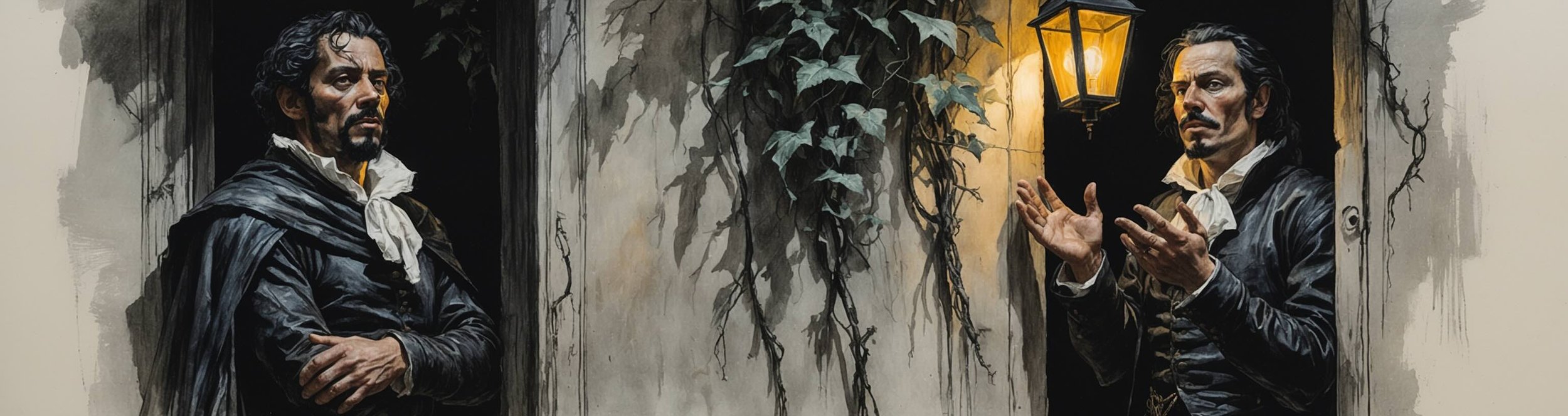
Scene Profile – At a Glance
- Location: A hall in Leonato’s house, after the ball.
- What Happens: Borachio tells Don John how to break Claudio’s marriage: have Margaret appear at Hero’s window at night, call her Hero, and bring the prince and Claudio to watch. Don John promises a thousand ducats.
- Key Characters: Don John, Borachio.
- Dramatic Function: The villain’s plot is designed. The scene gives the audience the whole mechanism of the slander before it is used, so that the window, which is never shown, is understood when it is reported.
- Famous Quote:
"Any bar, any cross, any impediment will be medicinable to me..."
(Don John, Act 2, Scene 2) - Why It Matters: It is the scene that proves Don John has no plan of his own: the window, the names, the audience and the timing are all Borachio’s, and the prince’s brother pays for them.
Scene Summary
Don John has learned that Claudio will marry Leonato’s daughter, and Borachio says he can cross it. Any bar, cross or impediment will be medicine to Don John, who is sick with displeasure at Claudio and takes anything that thwarts his affection as his own. Borachio’s method is not honest, but it will be so covert that no dishonesty will appear in him. He reminds Don John that Margaret, Hero’s waiting gentlewoman, is in his favour, and that he can have her look out of her lady’s chamber window at any unseasonable hour of the night. Don John asks what life is in that to be the death of the marriage.
Borachio lays it out. Don John must go to the prince and tell him he has wronged his own honour by marrying the renowned Claudio to a contaminated stale such as Hero; asked for proof, Borachio promises proof enough to misuse the prince, vex Claudio, undo Hero and kill Leonato. Don John wants nothing but to spite them and will attempt anything. The plan: find a time when the prince and Claudio are alone, tell them that Hero loves Borachio, pretend zeal for the prince’s honour and Claudio’s reputation, say they are about to be cozened by the semblance of a maid, and, since they will hardly believe it without trial, offer them instances. They will see Borachio at her chamber window, hear him call Margaret Hero and hear Margaret call him Claudio, the very night before the wedding; Borachio will arrange for Hero to be absent; and the seeming truth of her disloyalty will turn jealousy into assurance and overthrow the wedding. Don John will put it in practice whatever comes of it, and offers a thousand ducats for cunning in the working. Borachio asks only that Don John be constant in the accusation, and Don John goes to learn the day of the marriage.
So Covertly That No Dishonesty Shall Appear
The scene is a job interview, and the applicant has the plan. Don John supplies the appetite, the rank and the money; Borachio supplies everything else, and says plainly what kind of work it is.
Original
Not honestly, my lord; but so covertly that no dishonesty shall appear in me.
(Borachio, Act 2, Scene 2)
Shakespeare Retold (Modern Verse)
Not honestly, my lord; but with so much secret trickery that I won’t look as though I’ve been dishonest.
The whole of the villainy is in Borachio’s first answer: not honest, but so covert that the dishonesty will not show. The play’s deceivers all work by seeming, and Borachio’s is the frankest account of it, offered to an employer who does not care how it is done. Don John’s own contribution is a sentence of pure malice, any bar, any cross, any impediment will be medicine, and a confession that he is sick in displeasure to Claudio; he has no idea how to cross the marriage and asks twice. The theme of deception and noting is introduced here as a trade with a price, and the trade is between a bastard who wants to hurt and a servant who knows how. Margaret is the material. Borachio mentions her favour towards him as a man mentions a tool, and the window as the place the tool can be used at any unseasonable instant of the night.
The Semblance of a Maid
Borachio’s plan is laid out in one long speech, and it is a director’s plan: who is to be told what, by whom, in what tone, and what they will see.
Original
Go, then; find me a meet hour to draw Don Pedro and the Count Claudio alone: tell them that you know that Hero loves me; intend a kind of zeal both to the prince and Claudio, as, – in love of your brother's honour, who hath made this match, and his friend's reputation, who is thus like to be cozened with the semblance of a maid, – that you have discovered thus. They will scarcely believe this without trial: offer them instances; which shall bear no less likelihood than to see me at her chamber-window, hear me call Margaret Hero, hear Margaret term me Claudio; and bring them to see this the very night before the intended wedding, – for in the meantime I will so fashion the matter that Hero shall be absent, – and there shall appear such seeming truth of Hero's disloyalty that jealousy shall be called assurance and all the preparation overthrown.
(Borachio, Act 2, Scene 2)
Shakespeare Retold (Modern Verse)
Go on, then; find me a suitable time to get Don Pedro and Count Claudio alone. Tell them that you know that Hero loves me. Feign a kind of concern for both the prince and Claudio, for – based on your love of your brother’s honour, who has set up this marriage, and his friend Claudio’s reputation, who is about to be deceived by someone who only pretends to be a virgin – you have found this out. They will hardly believe this without proof: give them examples, and have them observe the unlikely sight of me at Hero’s bedroom window, where they’ll hear me call Margaret ‘Hero’, and Margaret call me ‘Claudio’; and bring them to witness this on the very night before the planned wedding. In the meantime, I will arrange it so that Hero will be absent, and it will look so convincingly true that Hero has been disloyal, and their jealousy will thus assure that all the wedding preparations are cancelled.
Everything that happens in Act 3, Scene 2 and Act 4, Scene 1 is here. Don John is to approach the prince and Claudio alone, pretend zeal for their honour, say that Hero loves Borachio, and offer instances; the instances are a man at a window calling a maid Hero and a maid calling him Claudio; the timing is the night before the wedding; and the effect is named exactly, that seeming truth will be called assurance and the wedding overthrown. The phrase that matters is the semblance of a maid, which is what Claudio will throw at Hero in church, the sign and semblance of her honour, and the theme of honour and shame is here engaged as a weakness to be exploited: Borachio knows that a prince’s honour and a count’s reputation are the levers, and that men protecting those will believe a sight. Jealousy shall be called assurance is the play’s own analysis of how its catastrophe works, delivered by the man who built it. Don John’s reply, grow this to what adverse issue it can, is the only line he speaks in the scene that is his own, and it is an abdication: he will do whatever comes of it. The fee is a thousand ducats, and Borachio asks only that his master be constant in the accusation.
Language and Technique
- Prose: The scene is in prose, like every scene Don John is in; villainy in this play has no verse, and the planning of the catastrophe is done in the register of business.
- Medical imagery: Impediment is medicinable, Don John is sick in displeasure, and Borachio’s plan has a poison that Don John must temper: the plot is described as a cure for the villain and a dose for everyone else.
- The script within the play: Borachio’s long speech is a set of stage directions: tell them this, in this tone, bring them here, let them see this. The window is written before it is played, and the audience holds the script.
- Semblance: The semblance of a maid, seeming truth, no dishonesty shall appear: the scene’s vocabulary is the vocabulary of appearance, and every word in it will be used again in the church.
- The price: A thousand ducats, named at the end as a fee for cunning: the scene closes on money, and Borachio will repeat the sum, drunk, to the watch.
Key Quotes from Act 2, Scene 2
Quote 1
I can, at any unseasonable instant of the night, appoint her to look out at her lady's chamber window.
(Borachio, Act 2, Scene 2)
Shakespeare Retold (Modern Verse)
I can, at any ungodly hour of the night, have her look out of Hero’s bedroom window.
Quote Analysis: Borachio’s asset: Margaret, who will look out of Hero’s window whenever he asks. The modern verse keeps the ungodly hour. The line turns a gentlewoman’s affection into the instrument of her mistress’s ruin, and Margaret is never shown agreeing to any of it; the play lets Borachio speak for her here and clears her in the last act.
Proof enough to misuse the prince, to vex Claudio, to undo Hero and kill Leonato. Look you for any other issue?
(Borachio, Act 2, Scene 2)
Shakespeare Retold (Modern Verse)
You’ll have enough proof to deceive the prince, to rile Claudio, to shame Hero, and kill Leonato. What more could you want?
Quote Analysis: The four effects Borachio promises: the prince misused, Claudio vexed, Hero undone, Leonato killed. The modern verse keeps the list and its order. It is a complete forecast of Acts 4 and 5, with one error; Leonato is not killed, but he wishes his daughter dead, which Borachio did not foresee.
Grow this to what adverse issue it can, I will put it in practise. Be cunning in the working this, and thy fee is a thousand ducats.
(Don John, Act 2, Scene 2)
Shakespeare Retold (Modern Verse)
Whatever harm this may grow into, I will put it into practice. Be shrewd and cunning as you do this, and I’ll pay you a thousand gold coins.
Quote Analysis: Don John’s acceptance and the price. Whatever harm comes of it, he will put it in practice, and cunning will be paid a thousand ducats. The modern verse keeps both the recklessness and the sum. It is the villain’s whole character: an appetite for harm with no interest in its shape, and money to buy the shape from someone else.
Key Takeaways
- Borachio’s plot, Don John’s money: The window, the names, the audience and the timing are all the servant’s; the prince’s brother supplies malice and a thousand ducats.
- The script is written here: Everything the prince and Claudio will see and say in Act 3, Scene 2 and Act 4, Scene 1 is laid out in Borachio’s instructions.
- Semblance is the weapon: Borachio names the lever, the semblance of a maid and seeming truth called assurance, and the church scene will use his words.
- Margaret is a tool: Her favour towards Borachio is mentioned as an asset; she is never consulted, and the play will later clear her.
Study Questions and Analysis
Whose plot is the window, Don John’s or Borachio’s?
Borachio’s, entirely. Don John opens the scene knowing only that Claudio will marry Hero and wanting it stopped; he asks twice how it can be done, and when Borachio explains the window he asks what life is in that to be the death of the marriage. The method, the names, the choice of the night before the wedding, the instruction to approach the prince and Claudio alone with a pretence of zeal, and the forecast of its effects are all Borachio’s. Don John’s part is to be constant in the accusation and to pay. The scene is designed to show that the villain of the play has no cunning of his own, only an appetite and a purse.
DON JOHN: What life is in that, to be the death of this marriage?
BORACHIO: The poison of that lies in you to temper.
(Act 2, Scene 2)
Shakespeare Retold (Modern Verse)
DON JOHN: How would that stop this marriage from going ahead?
BORACHIO: The poison in that is yours to mix.
Samuel Taylor Coleridge (1818) called Don John the main-spring of the plot and noted that he is merely shown and then withdrawn, which is exactly what this scene does with him; the spring is wound by someone else. The Folger editors describe him as a virulent force rather than a character, acting with the kind of malice that strikes out at whatever promises to make someone else happy, and the scene confirms it: any bar, any cross, any impediment will do. Gail Kern Paster notes that Shakespeare assigns the function of destroyer with evident symmetry to the prince’s brother, and the symmetry includes this, that the prince makes his match with help from Leonato and Hero, and the bastard breaks it with help from a servant and a maid. The theme of deception and noting belongs, in the end, to the people who can do it, and Borachio can.
Why does the plan work, according to Borachio himself?
Because the prince and Claudio will be defending their honour, and men defending their honour believe what they are shown. Borachio’s instructions are precise about this. Don John is not to accuse Hero coldly but to pretend zeal for his brother’s honour, which made the match, and for Claudio’s reputation, which is about to be cozened by the semblance of a maid; the accusers are to be made to feel that doubting the charge would be a failure of care. Then the instance, a man at a window and a maid answering to the wrong name, on the night before the wedding, and the result Borachio predicts in a phrase: jealousy shall be called assurance.
The phrase is the play’s own account of the church scene, given in advance. Carol Cook (1986) argued that masculine privilege in this play depends on the legibility of women and that an illegible woman is a threat to be destroyed; Borachio’s plan is to make Hero illegible on purpose, a seeming maid, and let the men’s need for certainty do the rest. Gail Kern Paster observes that the play takes pains to construct Claudio as inexperienced, and the plan is built for an inexperienced man, who will not ask questions of a sight. The theme of honour and shame is the lever, and Borachio names it; he does not need the prince and Claudio to be fools, only to be honourable in the way Messina understands.
What is Margaret’s role in the plan, and does she know?
She is to look out of Hero’s window at night, be called Hero by Borachio, and call him Claudio; that is all the plan asks of her, and the scene does not say what she is told. Borachio mentions her favour towards him as a fact he reported to Don John a year ago, and says he can appoint her to the window at any hour. Whether she knows the purpose, or thinks it a lover’s game, or is told nothing at all, the play never shows; the window itself is never staged, and the next the audience hears of it is Borachio’s drunken account to Conrade in Act 3, Scene 3.
I think I told your lordship a year since, how much I am in the favour of Margaret, the waiting gentlewoman to Hero.
(Borachio, Act 2, Scene 2)
Shakespeare Retold (Modern Verse)
I think I told you a year ago, my lord, how much Margaret is attracted to me, and she is the lady-in-waiting to Hero.
The play’s later verdicts are consistent with innocence. Borachio tells the prince in Act 5, Scene 1 that she knew not what she did when she spoke to him and has always been just and virtuous; Leonato in the last scene says she was in some fault, but against her will. Gail Kern Paster remarks how little the play asks of Margaret, who allows herself to be courted as Hero in Hero’s clothes and is never required to explain, and Harry Berger Jr. (1982) observed that in Messina women are responsible for their sins but men are not, a rule Margaret’s small reprimand seems to confirm and her escape from any worse to qualify. The theme of gender and patriarchy is present in this scene by her absence: she is discussed as an instrument by two men, and she will not be heard from until she is teasing Beatrice in Act 3, Scene 4, knowing nothing.