
Hamlet: Characters
Hamlet character analysis for all 10 main characters — Hamlet, Claudius, Gertrude, Ophelia, Polonius, Laertes, Horatio and more. Each profile explores the character's psychology, motivation, and tragic flaw, supported throughout by a modern verse translation and key quotes.
A complete character study guide and revision resource for GCSE, A-Level, AP English, IB, and undergraduate Shakespeare — equally useful to teachers and actors. Select a character below to begin.

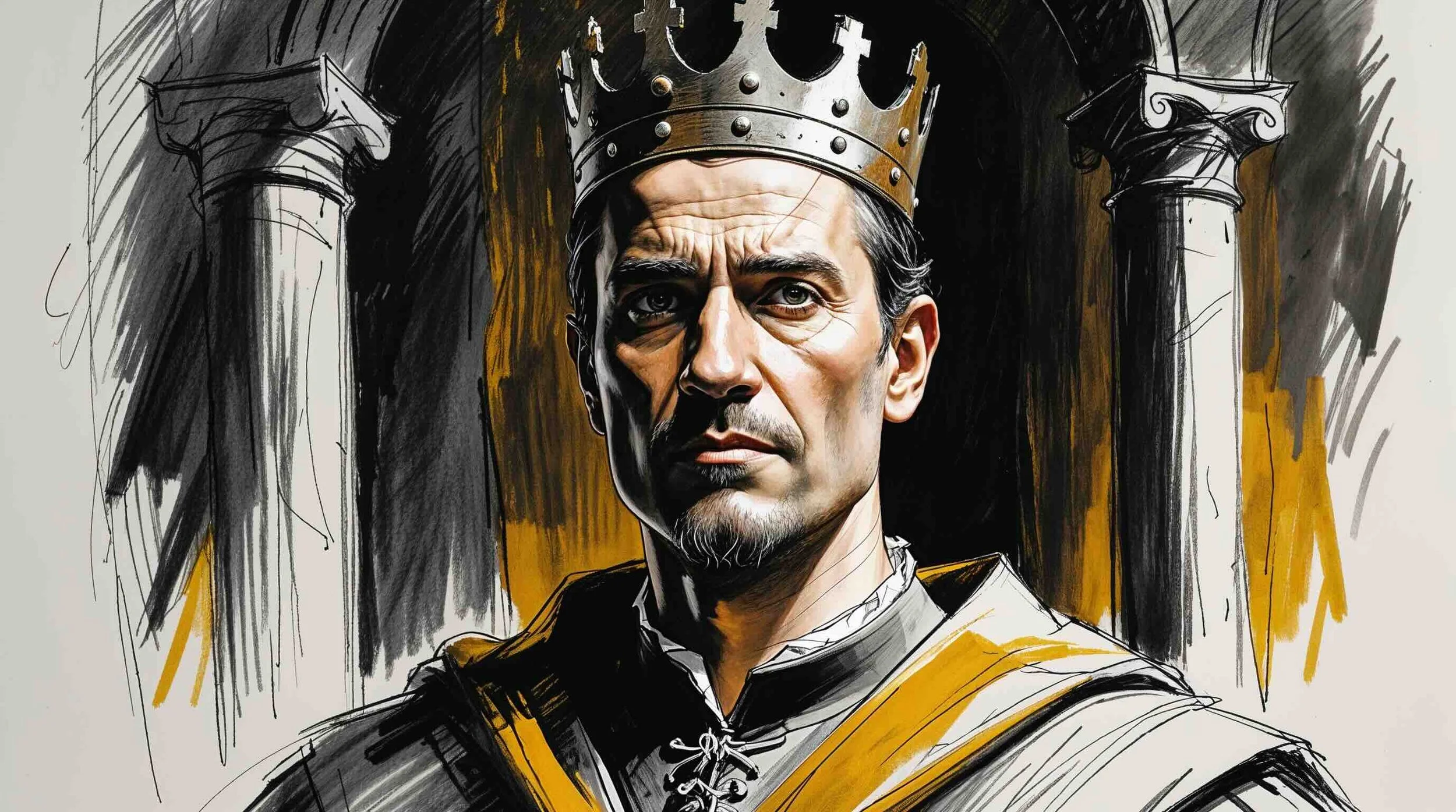
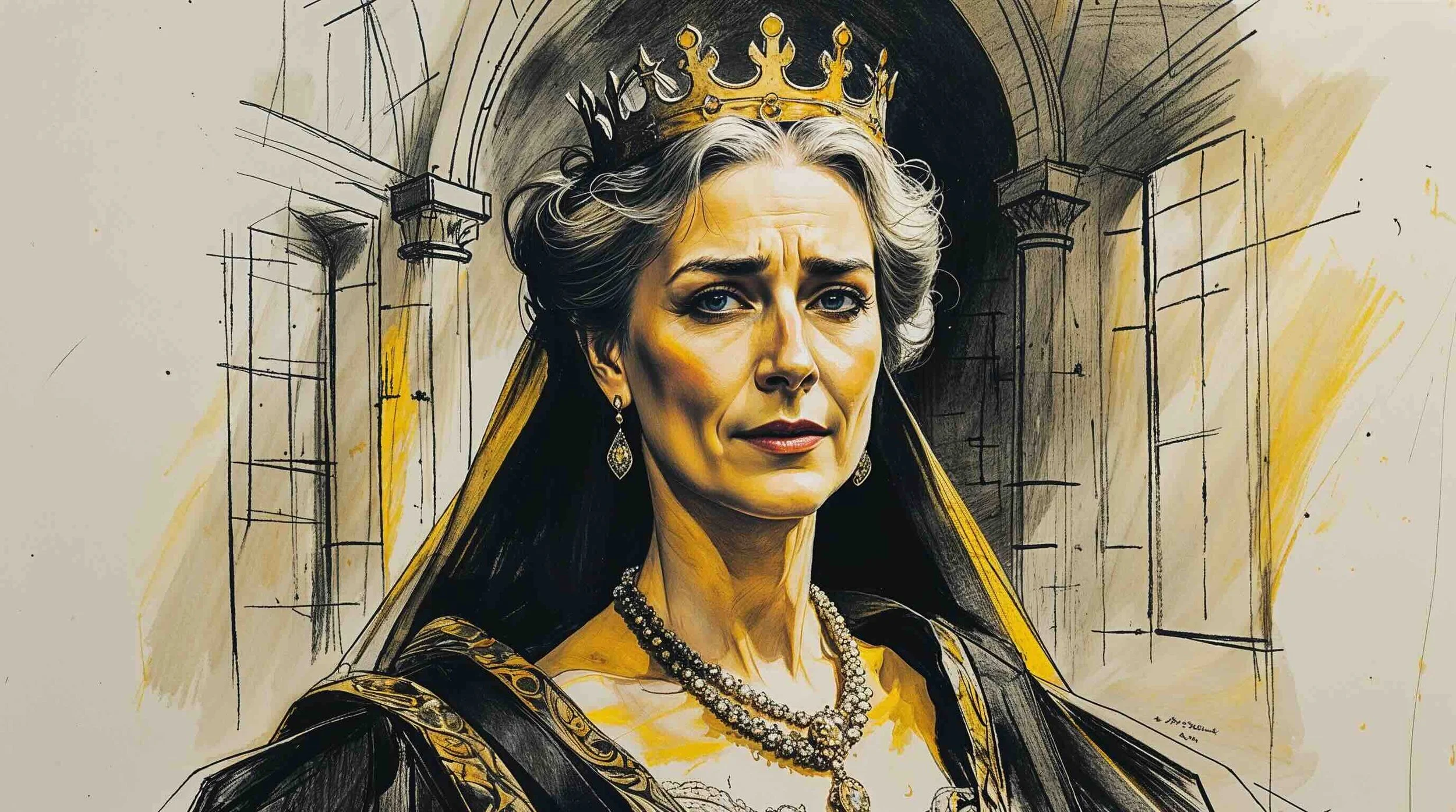




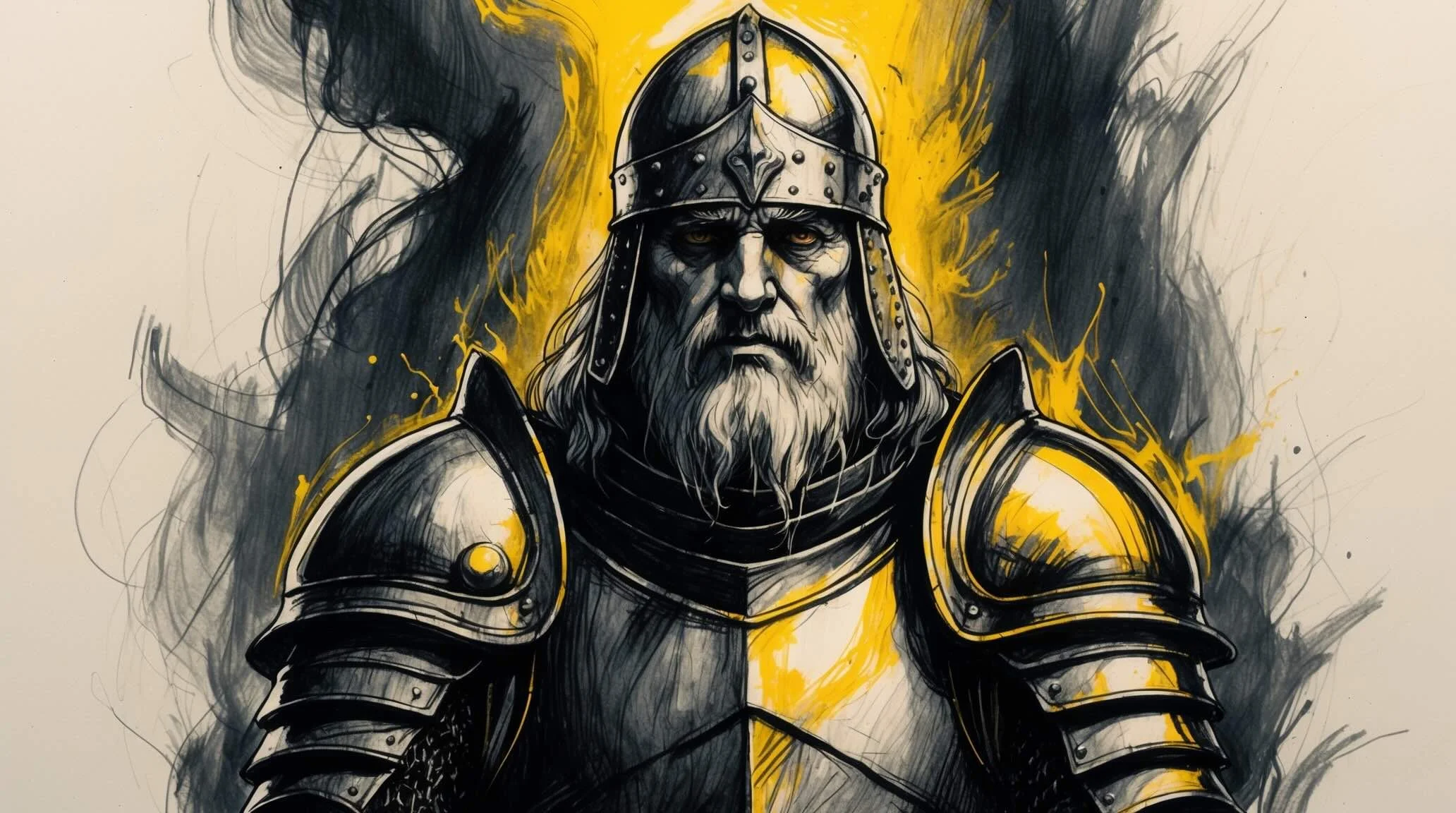

Rosencrantz & Guildenstern
Childhood friends of Prince Hamlet, summoned to the Danish court by King Claudius to spy on him.
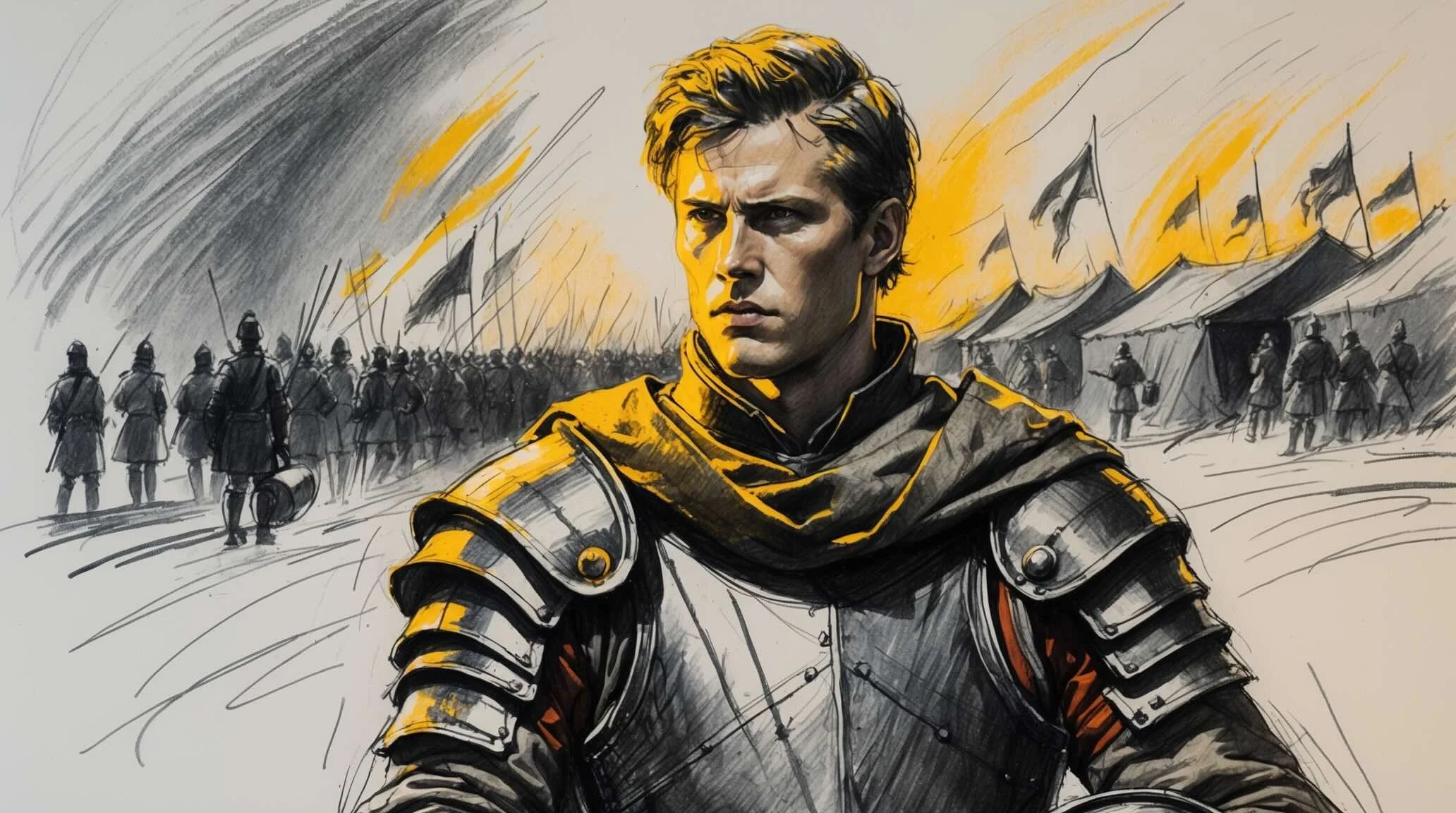
Fortinbras
Prince of Norway, nephew to the ailing King of Norway, and the ultimate successor to the Danish throne.
Supporting Cast
Beyond the ten figures who carry the main action, Hamlet is populated by sentinels, courtiers, travelling players, gravediggers, and foreign envoys whose presence shapes the play in ways the central drama does not always make explicit. The wider cast is grouped below by their function within the world of Elsinore and beyond.
The Watch
Francisco
The sentinel relieved by Bernardo in the play's opening lines. His "'Tis bitter cold, / And I am sick at heart" before any plot event has occurred sets the atmospheric register of the entire play in eight words.
Bernardo
The officer who has seen the Ghost twice before the play begins and who narrates the apparition's first appearance to Horatio in 1.1. His relief that an educated witness has now corroborated what the watch had been seeing is the play's earliest piece of writing on credibility and testimony.
Marcellus
The officer whose "Something is rotten in the state of Denmark" gives the play one of its most-quoted lines. His presence on the platform across 1.1 and 1.4–1.5 establishes the political-military context in which the Ghost's appearance has to be interpreted.
The Danish Court
Voltemand
Ambassador to Norway who carries Claudius's diplomatic message to Old Norway in 1.2 and returns in 2.2 with the Polish-campaign solution that defuses the early Fortinbras threat. The regime's most operationally successful courtier.
Cornelius
Voltemand's silent companion on the Norwegian embassy. His named-but-wordless role is one of the play's most economical pieces of writing on the depersonalisation of court service.
Osric
The affected courtier sent in 5.2 to deliver the King's wager on the fencing match. His elaborate verbal mannerisms — Hamlet mocks him for them mercilessly — make him the regime's most polished and least substantial functionary.
Reynaldo
Polonius's servant, sent in 2.1 to spy on Laertes in Paris. The instruction-scene — Polonius forgets what he was saying halfway through — is the play's most direct piece of writing on the senility creeping into the Lord Chamberlain's surveillance operation.
The Gentleman
The courtier who in 4.5 advises Gertrude that Ophelia should be admitted, "for she may strew dangerous conjectures in ill-breeding minds." His brief speech is the dramaturgical pivot that brings the mad scene to the stage.
The Lord
The courtier who in 5.2 carries the King's request that Hamlet "play with Laertes" at the fencing match. The procedural mechanism by which the final catastrophe is set in motion.
The Players
The First Player
The veteran actor whose moving Pyrrhus speech in 2.2 prompts Hamlet's "rogue and peasant slave" soliloquy, and who plays the Player King in The Mousetrap. His professional command of grief Hamlet cannot match is the structural rebuke that turns Hamlet toward the play-within-a-play strategy.
The Player King
The figure within The Mousetrap whose rhetorical formulations on the unreliability of resolve are pointed at Hamlet himself: "Our wills and fates do so contrary run / That our devices still are overthrown."
The Player Queen
The figure whose protestations of fidelity — "None wed the second but who killed the first" — draw Gertrude's only direct piece of self-aware commentary on her remarriage: "The lady doth protest too much, methinks."
Lucianus
"Nephew to the king" in The Mousetrap performance. The structural pivot of the trap: by casting the poisoner as the king's nephew rather than as his brother, Hamlet has been forced either to announce his own intentions or to rest on the precise role the regicide is meant to expose.
At Ophelia's Grave
The First Gravedigger
The riddling clown who sings as he digs, banters with Hamlet over Yorick's skull, and delivers one of Shakespeare's most sustained meditations on mortality. His unsentimental philosophy is the structural counterweight to the play's elaborate self-questioning about death.
The Second Gravedigger
The First Gravedigger's companion in 5.1, sent off early in the scene to fetch a "stoup of liquor"; his straight-man role lets the First Gravedigger's riddles land.
The Priest
The clergyman who presides at Ophelia's "maimed rites" in 5.1, refusing the full Christian burial that her suspected suicide forbids. His confrontation with Laertes — "I tell thee, churlish priest, / A ministering angel shall my sister be" — stages the institutional Church's response to the catastrophe.
Outside Denmark
The Norwegian Captain
The officer Hamlet encounters on the plain in 4.4 leading Fortinbras's army toward Poland. His honest assessment — that the army marches "to gain a little patch of ground / That hath in it no profit but the name" — is the trigger for Hamlet's "How all occasions do inform against me" soliloquy.
The English Ambassadors
The figures who arrive in 5.2 to report that "Rosencrantz and Guildenstern are dead" — closing the loop on the substituted commission Hamlet had executed at sea. Their arrival timing, after the Danish royal house has destroyed itself, is one of the play's most brutal pieces of structural irony.
The Sailors
The seamen who carry Hamlet's letter to Horatio in 4.6, reporting his return from the English voyage. The operational mechanism by which the play's geographic excursion to the sea is resolved.
Others
The Messengers
The unnamed figures who carry word between the play's locations: the messenger in 4.5 announcing Laertes's mob to Claudius, the messenger in 4.7 delivering Hamlet's letter from England. Each delivers plot but has no character of his own.
The Danes
The unnamed citizens who follow Laertes into the castle in 4.5 shouting "Choose we! Laertes shall be king!" Their off-stage chorus is the play's only direct evidence of popular feeling against Claudius — a brief, terrifying glimpse of the regime's political fragility.
Frequently asked questions about the characters in Hamlet
Who are the main characters in Hamlet?
The play has ten significant figures. Hamlet is the Prince of Denmark, the play's protagonist, and the longest single role in any Shakespearean tragedy. Claudius is his uncle, the new king of Denmark, and the play's antagonist — the man who murdered Hamlet's father to seize the throne. Gertrude is Hamlet's mother and Claudius's new wife, the figure whose hasty remarriage triggers Hamlet's most exposed grief. Ophelia is Polonius's daughter and the woman Hamlet loved, whose madness and death in Acts 4 and 5 are one of the play's most-discussed sequences. Polonius is the chief counsellor to the new regime, father to Ophelia and Laertes, and the figure Hamlet kills behind the arras in 3.4.
Laertes is Polonius's son, Ophelia's brother, and the principal foil to Hamlet as the avenger who acts on impulse rather than reflection. Horatio is Hamlet's closest friend and the play's surviving witness, the Stoic intellectual to whom Hamlet entrusts the responsibility of telling his story. Rosencrantz and Guildenstern are Hamlet's former university friends, recruited by Claudius to spy on him, and treated by the play as a paired structural unit rather than two distinct characters. Fortinbras is the Prince of Norway, the third avenging son of the play, and the figure who inherits Denmark in the final scene. The Ghost of Hamlet's father is the figure whose 1.5 revelation sets the entire tragic action in motion.
The four central figures — Hamlet, Claudius, Gertrude, and Ophelia — carry most of the play's verse; the other six figures provide the structural foils, antagonists, and dramaturgical mechanisms through which the play's questions about action, mortality, and political legitimacy operate.
Who is the protagonist of Hamlet?
Hamlet is, by every conventional measure, the play's protagonist. He has the longest single role in any Shakespearean play — approximately 1,495 lines, around a third of the play's total — and the most soliloquies of any tragic figure. The famous seven soliloquies of Acts 1-4, from "O that this too too solid flesh would melt" (1.2) through "To be or not to be" (3.1) to "How all occasions do inform against me" (4.4), are the play's principal mechanism for staging interiority, and Hamlet's psychological complexity is the play's central dramatic interest.
The protagonist's tragic arc is, in Bradley's 1904 reading, the study of how reflection disables action — the gap between his understanding of what must be done and his ability to do it. His struggle to avenge his father's murder by his uncle Claudius is complicated by grief, religious doubt about the Ghost's nature, philosophical scepticism about the meaning of revenge, and his characteristic tendency to think when action is required. Coleridge's observation in Table Talk — "I have a smack of Hamlet myself, if I may say so" — captured the central recognition that has organised modern criticism: Hamlet's paralysis is not a defect peculiar to him but a condition of intellectual modernity.
T.S. Eliot, in his 1919 essay "Hamlet and His Problems," called the character "the Mona Lisa of literature" — the figure whose ambiguity has organised more critical commentary than any other in the Shakespearean canon. Modern criticism has largely confirmed Hamlet's status as the play's protagonist while continuing to debate the nature of the paralysis that makes his arc tragic rather than triumphant.
Who is the antagonist of Hamlet?
Claudius is the play's antagonist by every conventional measure: he is the figure whose actions create the tragic situation Hamlet must respond to, the figure whose continued survival the protagonist needs to undo, and the figure whose 3.3 confession ("O, my offence is rank") gives the audience the moral framework within which his political crime is to be judged. Having murdered his brother (Old Hamlet) by pouring poison into his ear while he slept in the orchard, Claudius has seized the throne and married the queen — the dynastic-incest combination that converts political murder into a multiple violation of Danish moral order.
His political strategy across the play is sequential and increasingly violent. First, surveillance — through Polonius's spying, Rosencrantz and Guildenstern's investigation, and his own observation of the players' performance in 3.2. Second, exile — the diplomatic mission to England in Act 4 designed to displace the problem geographically. Third, when exile fails and Hamlet returns, assassination — the poisoned-sword and poisoned-cup plot of 5.2, in which Claudius weaponises Laertes's legitimate grievance against Hamlet for the killing of Polonius.
The structural complication is that Claudius is also a competent ruler — the play's first court scene establishes his command of diplomacy, his political authority, and his rhetorical fluency. He is not a tyrant in the manner of Macbeth, and the play takes some care to distinguish his political crime (regicide-and-usurpation) from his administrative practice (which is, by the play's evidence, broadly effective). The contradiction is one of the play's most carefully managed structural tensions: the antagonist of a revenge tragedy who is, in administrative terms, a more capable king than the protagonist would have made.
Why does Hamlet delay his revenge?
The question is the play's most-debated critical puzzle, and modern criticism has produced at least five distinct frameworks for answering it. The first is the moral framework: Hamlet delays because revenge is itself a violation of the moral order he is being asked to defend. The 1.5 demand from the Ghost requires him to commit a murder; his Christian-humanist training has equipped him to recognise this as morally indefensible; the delay is the gap between the demand and his ability to violate his own ethics in response to it.
The second framework is theological: the Ghost may be a demon in disguise, and Hamlet cannot be sure whether the revelation is authentic until he has tested it. The 2.2 "play within a play" scheme — using the players to stage a re-enactment of the murder and observe Claudius's response — is a piece of theological epistemology, not narrative procrastination. Dover Wilson's 1935 What Happens in Hamlet gives the fullest account of this reading; Greenblatt's 2001 Hamlet in Purgatory updates it for modern audiences within the Catholic-Protestant context of the play's composition.
The third framework is psychological: Bradley's 1904 reading identifies the condition under which thought disables action; subsequent critics have variously diagnosed melancholy, depression, oedipal complex (Ernest Jones, Hamlet and Oedipus, 1949), or political resignation. The fourth is structural — the play needs Hamlet to delay because the tragedy depends on the gap between knowing and acting that the soliloquies dramatise. The fifth is dramaturgical: Shakespeare's revision of the older "Ur-Hamlet" tradition deliberately transformed a straightforward revenge narrative into a meditation on the very possibility of revenge in a world the Reformation has destabilised. The question, as the diversity of frameworks suggests, does not have a single answer — and the play's continued critical productivity is largely because it does not.
Who are the foils to Hamlet?
Hamlet has three principal foils, and the structural symmetry between them is one of the play's most studied pieces of comparative dramaturgy. Laertes is the first — Polonius's son, Ophelia's brother, and the avenger whose father is killed by Hamlet himself in 3.4. Where Hamlet thinks, Laertes acts: returning from Paris to Denmark in 4.5, raising a faction in the streets, confronting Claudius directly, and entering the duel of 5.2 with murderous intent. The structural contrast is exact — both are young men avenging fathers; both have legitimate grievances; one delays for four acts, the other moves within hours.
Fortinbras is the second foil, and the most structurally distant. The Prince of Norway has his own avenging-the-father plot (the recovery of land lost by his father to Old Hamlet), but Fortinbras pursues it through calculated military strategy rather than personal violence — first attempting reconquest, then accepting diplomatic redirection toward Poland, then arriving in Denmark in 5.2 to find the Danish royal house has destroyed itself. His 4.4 army marching across the stage produces Hamlet's seventh and final soliloquy ("How all occasions do inform against me"), in which Hamlet uses the contrast to indict his own paralysis.
Horatio is the third foil and the structural opposite — not an avenger but a witness, not active but observant, not paralysed but stoic. He is, in Hamlet's own 3.2 description, "a man that fortune's buffets and rewards / Hast ta'en with equal thanks" — the figure Hamlet admires for the equanimity he himself cannot achieve. Where the other two foils show Hamlet what failure of action looks like in different registers, Horatio shows him what successful philosophical composure looks like. He survives the play's catastrophe to deliver Hamlet's story to Fortinbras and the audience — the structural mechanism by which the protagonist's failed life is converted into the play's continuing critical conversation.
Who dies in Hamlet?
The play ends with eight of its named characters dead — the highest body count of any Shakespearean tragedy, and the structural reason it has been studied for four centuries as the genre's defining text. Polonius is the first significant death, killed by Hamlet behind the arras in 3.4 — the moment that converts Hamlet from contemplative protagonist to actual murderer, and that gives Laertes the legitimate grievance the closing duel will weaponise. Ophelia dies offstage between Acts 4 and 5 — whether by accident or suicide is left deliberately ambiguous in 4.7, and the 5.1 gravedigger scene returns to the question.
Rosencrantz and Guildenstern die offstage in England, executed under the substituted commission Hamlet has forged on the voyage — a death the play reports almost casually, and which has been the centre of modern criticism's interest in the figures (Tom Stoppard's 1966 play Rosencrantz and Guildenstern Are Dead is the canonical creative engagement). Then the closing-scene catastrophe of 5.2: Gertrude dies first, having drunk from the poisoned cup intended for Hamlet; Laertes dies after the duel's poisoned-sword exchange; Claudius dies when Hamlet finally kills him, with both poisoned sword and poisoned cup; Hamlet dies last, from the wound Laertes had given him.
Only Horatio and Fortinbras survive among the named figures — Horatio because Hamlet has explicitly forbidden him from following the protagonist into death, charging him with the responsibility of telling the story; Fortinbras because his army arrives precisely at the moment the Danish royal house has annihilated itself, and his inheritance is the play's structural conclusion. Bradley's 1904 reading frames this structural pattern — the figure who inherits is structurally less than the figure whose death has cleared the way — as the characteristic tragic outcome.
How does the Hamlet character set compare to Shakespeare's other tragedies?
Hamlet has the largest principal cast of any Shakespearean tragedy — ten significant named figures, compared to Othello's eight, Macbeth's eight, or the comparable counts in Julius Caesar and Romeo and Juliet. The size reflects the play's structural ambition: where the other tragedies operate on a single core relationship (Othello-Iago-Desdemona, Macbeth-Lady Macbeth, Romeo-Juliet), Hamlet stages a complete court — protagonist and antagonist, parents and children, friends and foils, surveillance and reaction — and the size of the cast is the precondition for the play's complexity.
The character set is also unusual in its structural use of parallels. The three avenging-sons (Hamlet, Laertes, Fortinbras) are the most extensively developed foil structure in any Shakespearean tragedy. The play also stages two father-figures (the Ghost and Polonius) and two female-grief patterns (Gertrude and Ophelia), each pairing operating as a piece of structural commentary on the other. Rosencrantz and Guildenstern are themselves a paired unit, treated by the play as a single dramaturgical entity — Tom Stoppard's 1966 play recognises this by giving them their own existential register.
The largest principal cast in Shakespearean tragedy supports the largest principal text. Hamlet is the longest of Shakespeare's plays (approximately 4,000 lines in the conflated text), the longest single role (Hamlet himself, at around 1,495 lines), and the play that has accumulated the most extensive critical commentary in the four centuries since its first performance — Bradley, Hazlitt, Coleridge, Goethe, T.S. Eliot, Freud, Jones, Bloom, Greenblatt, and the modern psychoanalytic, historicist, and theological readings have all taken Hamlet as the test case. The character set is the structural mechanism that makes that productivity possible.