
Macbeth: Plot Summary
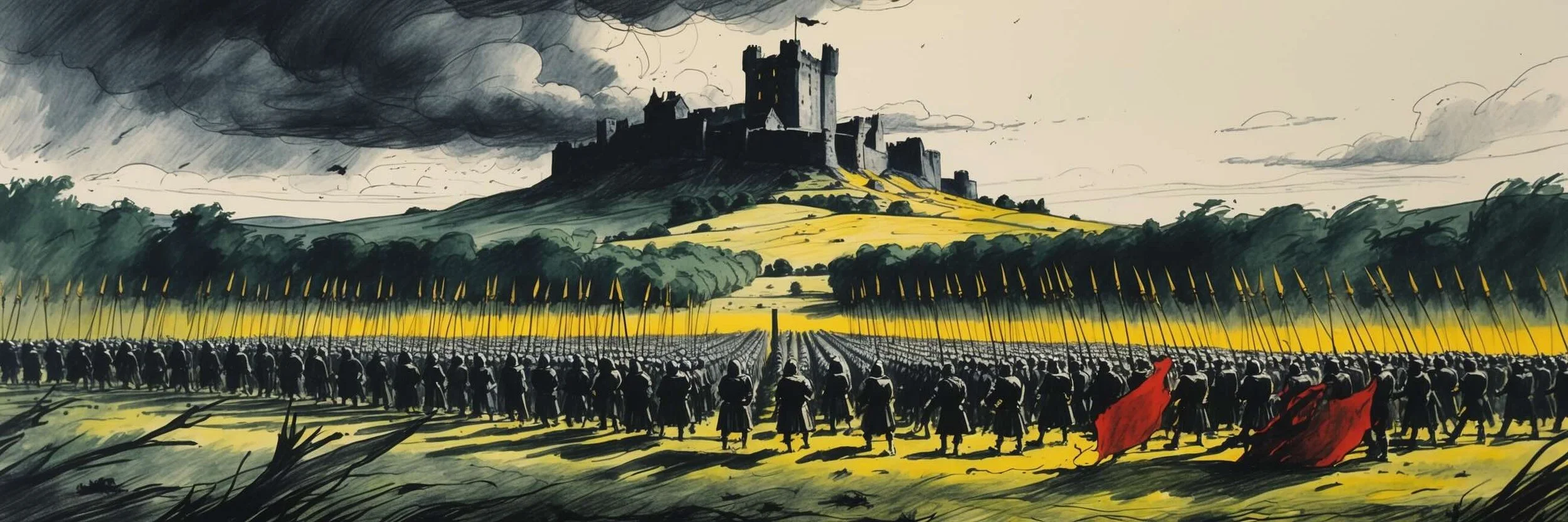
Plot Profile – At a Glance
- The Setting: Eleventh-century Scotland, with brief scenes in England.
- The Protagonist: Macbeth.
- The Antagonist: Macduff, the nobleman who finally destroys him, with the Witches as the supernatural force that sets the tragedy moving.
- The Inciting Incident: Three Witches prophesy that Macbeth will become King of Scotland.
- The Core Conflict: Macbeth's ambition for the crown against his conscience and his bonds of loyalty.
- The Climax: The murder of Banquo and the appearance of his ghost at the banquet, where Macbeth's guilt breaks into the open.
- The Outcome: A coalition army takes Dunsinane; Macduff kills Macbeth, and Malcolm is restored as the rightful king.
- Genre: Tragedy.
Macbeth, a brave Scottish general, hears three witches promise him the crown. Spurred on by his wife, he murders King Duncan and seizes the throne, then kills again and again to keep it. Guilt and paranoia drive both Macbeth and Lady Macbeth towards madness, until the nobleman Macduff and Duncan's son Malcolm raise an army, fulfil the witches' riddling prophecies, and destroy him. It is Shakespeare's shortest and bleakest tragedy, a tight study of ambition turning a good man into a tyrant.
Act 1: Prophecies & Dark Designs
Returning in triumph from battle, the generals Macbeth and Banquo meet three Witches on a bleak heath. The Witches hail Macbeth as Thane of Cawdor and as a future king, and promise Banquo that his sons will be kings. When King Duncan makes Macbeth Thane of Cawdor that very day, the first prophecy comes true and ambition takes hold. Reading her husband's letter, Lady Macbeth fears he is "too full o' the milk of human kindness" to seize the crown, and when Duncan comes to stay at their castle she steels Macbeth to murder him that night.
Act 2: The Bloody Deed
Haunted by a vision of a floating, bloody blade – "Is this a dagger which I see before me" – Macbeth goes to Duncan's chamber and stabs the sleeping king. He comes back shaken, still clutching the murder weapons, and Lady Macbeth has to carry them back herself to smear the sleeping guards with blood. At dawn the loyal Macduff discovers the body. Duncan's sons, Malcolm and Donalbain, flee the country in fear, which throws suspicion onto them, and Macbeth is crowned King of Scotland.
Act 3: Paranoia & The Ghost
Now king, Macbeth cannot forget that the Witches promised the throne to Banquo's children, not his own. He hires murderers to kill Banquo and his son Fleance as they ride out; Banquo is killed, but Fleance escapes into the dark. That evening, at a great state banquet, Banquo's blood-covered ghost appears in Macbeth's own seat, visible only to him. His wild, terrified behaviour in front of his lords begins to give his guilt away.
Act 4: Apparitions & Slaughter
Desperate for certainty, Macbeth returns to the Witches, who raise apparitions to answer him. They tell him to beware Macduff, yet reassure him that "none of woman born" can harm him, and that he will not be beaten until "Great Birnam wood to high Dunsinane hill" comes against him – both, he believes, impossible. Hearing that Macduff has fled to England to join Malcolm, a ruthless Macbeth orders the slaughter of Macduff's defenceless wife and children.
Act 5: Madness & Retribution
Guilt finally overwhelms Lady Macbeth, who sleepwalks through the castle trying to scrub imaginary blood from her hands – "Out, damned spot!" – before taking her own life. The English and Scottish armies gather, and the soldiers cut branches from Birnam Wood to hide their numbers as they march on Dunsinane, and the impossible prophecy comes true. In the final battle Macduff reveals that he was not born normally but was "from his mother's womb / Untimely ripped", and so kills the tyrant. Malcolm is hailed as the rightful King of Scotland.
Key Takeaways
- The Witches light the fuse: Their prophecy plants the ambition that drives everything.
- Lady Macbeth pushes hardest: She talks a hesitant Macbeth into killing Duncan.
- One murder leads to many: To keep the crown, Macbeth kills Banquo and Macduff's family.
- Guilt destroys them both: It drives Lady Macbeth to suicide and Macbeth to ruin.
- The prophecies come true in twisted ways: Birnam Wood "moves", and Macduff was not "of woman born".
Macbeth Plot Summary – Frequently Asked Questions
How does Macbeth end?
The play ends with Macbeth's defeat and death. The English and Scottish armies reach Dunsinane disguised with branches cut from Birnam Wood, fulfilling the prophecy that he was safe until the wood itself moved against him. With his wife dead and his support gone, Macbeth fights on, still trusting that "none of woman born" can kill him.
That last comfort fails too. When he faces Macduff, Macduff reveals that he was delivered by what we would now call caesarean section – not "born" in the ordinary sense at all. He kills Macbeth in single combat, and Duncan's son Malcolm is hailed as the rightful King of Scotland, restoring the natural order the murder had overturned.
What is the climax of Macbeth?
The turning point is the banquet scene in Act 3, where the ghost of the murdered Banquo appears in Macbeth's seat, visible only to him. Up to this point Macbeth has kept a public mask of innocence; here it shatters. He raves at an empty chair in front of his most powerful lords, and Lady Macbeth cannot cover for him.
From this moment Macbeth's grip slips. The nobles grow suspicious, he turns to the Witches for false comfort, and his rule curdles into open tyranny. The banquet is the hinge between Macbeth the cunning murderer and Macbeth the doomed tyrant the rest of the play hunts down.
How many acts and scenes does Macbeth have?
Macbeth is divided into five acts containing twenty-eight scenes in total: seven scenes in Act 1, four in Act 2, six in Act 3, three in Act 4, and eight in Act 5. The structure moves swiftly from the Witches' prophecy and Duncan's murder, through Macbeth's paranoia and the killing of Banquo, to the apparitions and the final assault on Dunsinane.
It is by far Shakespeare's shortest tragedy, around half the length of Hamlet. That speed is part of its power: there is little subplot and almost no let-up, so the play drives towards its bloody end with relentless momentum.
Why does Macbeth kill King Duncan?
The immediate spark is the Witches' prophecy that Macbeth will be king. When the first part of it – that he will be Thane of Cawdor – comes true at once, the promise of the crown stops feeling like fantasy and starts feeling like a plan. Ambition does the rest.
But Macbeth does not act alone or easily. He is wracked with doubt, knowing Duncan is a good king and a guest under his roof, and he very nearly backs out. It is Lady Macbeth who pushes him over the edge, questioning his courage and his manhood until he agrees. The murder is the product of his ambition and her will together, which is why the guilt later destroys them both.
What are the Witches' prophecies in Macbeth?
The Witches deliver their prophecies in two stages. In Act 1 they hail Macbeth as Thane of Glamis, then Thane of Cawdor, then "king hereafter", and they tell Banquo that he will father a line of kings even though he will never reign himself. The swift truth of the Cawdor title is what makes Macbeth take the rest seriously.
In Act 4 they raise three apparitions: a warning to beware Macduff, a promise that "none of woman born" shall harm him, and an assurance that he is safe until "Great Birnam wood to high Dunsinane hill" comes against him. Macbeth hears these as guarantees of safety, but each one comes true in a way he never expected – the Witches tell the truth in order to deceive.
Why does Macbeth have Banquo murdered?
Banquo is a threat because of the other half of the prophecy. The Witches promised that Banquo's descendants, not Macbeth's, would inherit the throne. Having murdered Duncan to become king, Macbeth cannot bear the thought that he has done so only to hand the crown to Banquo's children, so he resolves to break the prophecy by killing both Banquo and his son Fleance.
Banquo is also dangerous because he was there on the heath and knows what the Witches said. He has begun to suspect that Macbeth "play'dst most foully" for the crown. The murder half-succeeds: Banquo is killed, but Fleance escapes, so Macbeth's fear is not even quieted – and Banquo's ghost returns to torment him at the banquet that same night.