
Othello: Plot Summary
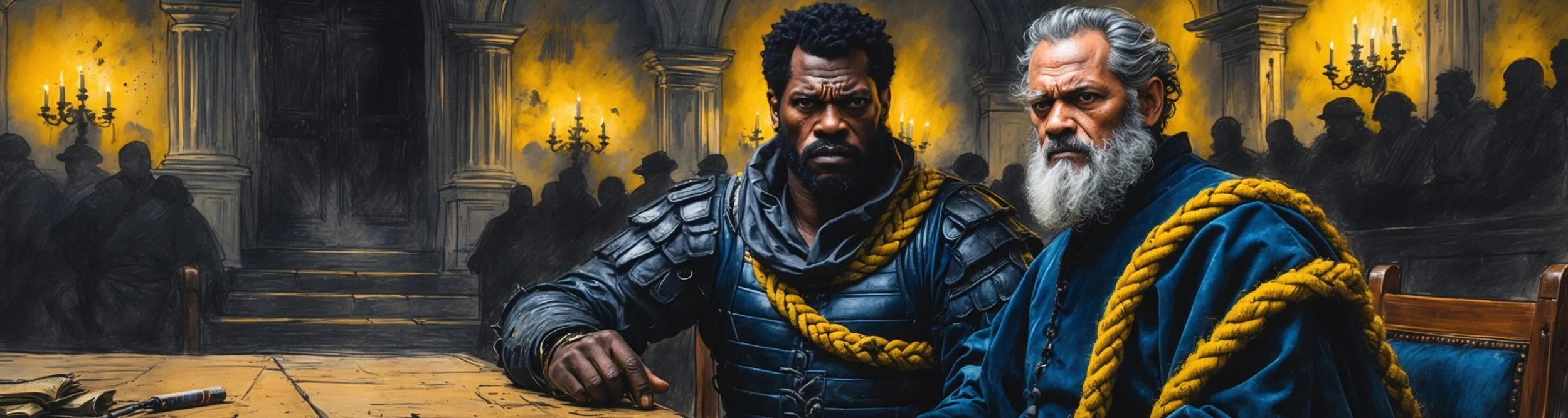
Plot Profile – At a Glance
- The Setting: Venice, then the island of Cyprus.
- The Protagonist: Othello, a Moorish general in the Venetian army.
- The Antagonist: Iago, Othello's ensign.
- The Inciting Incident: Passed over for promotion, Iago vows to destroy Othello and begins poisoning his mind against Desdemona.
- The Core Conflict: Othello's love and trust against Iago's manipulation and the jealousy it breeds.
- The Climax: In the great temptation scene, Iago convinces Othello of Desdemona's guilt, and Othello vows to kill her.
- The Outcome: Othello smothers Desdemona, learns she was innocent, and kills himself; Iago is unmasked and arrested.
- Genre: Tragedy.
Othello, a celebrated Moorish general in Venice, secretly marries Desdemona, the daughter of a senator. His trusted ensign Iago, furious at being passed over for promotion, sets out to ruin him. Through lies and a planted handkerchief, Iago convinces Othello that Desdemona has been unfaithful, until the maddened general smothers his innocent wife and, learning the truth too late, takes his own life. It is Shakespeare's most intimate tragedy, a close study of jealousy, trust, and the poison of a single lie.
Act 1: A Secret Marriage
In Venice, the ensign Iago and the gentleman Roderigo wake Senator Brabantio with the news that his daughter Desdemona has secretly married Othello, the Moorish general, and Iago hurls racist taunts to inflame him. Brabantio accuses Othello of bewitching her before the Senate, but Desdemona testifies that she married for love, and the Duke, who needs Othello to fight the Turks, sends him to defend Cyprus. From the very start Iago, who hides his hatred behind a mask of honesty, confides to the audience that "I am not what I am".
Act 2: Cyprus and the First Seeds
The Venetian fleet reaches Cyprus to find the Turkish threat scattered by a storm, and the island turns to celebration. Iago begins to weave his plot. He gets Cassio, Othello's new lieutenant, drunk and provokes a brawl, so that Othello strips Cassio of his rank. Then Iago persuades the disgraced Cassio to ask Desdemona to plead his case to her husband – the first thread in the trap, since Cassio's closeness to Desdemona can later be twisted to look like guilt.
Act 3: The Temptation
This is the turning point. As Desdemona innocently presses Othello to forgive Cassio, Iago drips poison into his ear, hinting that her interest in Cassio is more than kindness and warning him to beware "the green-eyed monster" of jealousy. Tormented, Othello demands "the ocular proof", and Iago supplies it: Desdemona's handkerchief, Othello's first gift to her, planted in Cassio's room. By the end of the scene Othello's love has curdled into a vow to kill, and he cries that "Othello's occupation's gone".
Act 4: Jealousy Unleashed
Jealousy now rules Othello completely. Iago stages a conversation about Cassio's mistress which Othello, watching from a distance, takes as proof of Desdemona's betrayal. Othello strikes Desdemona in public and humiliates her, while she remains bewildered and loyal. He resolves to smother her in the very bed she is supposed to have dishonoured, and Iago promises to deal with Cassio.
Act 5: Murder and Truth
The plot moves to its bloody end. Iago has Roderigo ambush Cassio in the dark, but the attack half-fails, and Iago silences Roderigo himself. In the bedchamber, Othello kills Desdemona – "Put out the light, and then put out the light" – only moments before Emilia reveals the truth about the handkerchief and exposes her husband's lies. Iago stabs Emilia and is seized. Realising he has murdered an innocent wife, Othello speaks of himself as "one that loved not wisely but too well" and kills himself, falling beside Desdemona.
Key Takeaways
- Iago's motive is murky: Passed over for promotion, he destroys Othello with a hatred that seems far larger than its cause.
- The handkerchief is everything: A tiny prop becomes the false "proof" of betrayal.
- Jealousy is the poison: Iago feeds Othello's insecurity until trust turns to murder.
- Desdemona is innocent: She stays loyal to the very end, which deepens the tragedy.
- The truth comes too late: Emilia exposes the lie only after Desdemona is dead.
Othello Plot Summary – Frequently Asked Questions
How does Othello end?
The play ends in Desdemona's bedchamber. Convinced by Iago that she has been unfaithful, Othello smothers her in her bed, even as she protests her innocence. Almost immediately the truth begins to unravel: Emilia, Iago's wife and Desdemona's maid, reveals that it was she who found the handkerchief and gave it to Iago, exposing the whole plot.
As the deception collapses, Iago stabs Emilia to silence her and is captured. Overwhelmed by the realisation that he has murdered a faithful wife on the strength of a lie, Othello speaks of himself as a man who "loved not wisely but too well", stabs himself, and dies kissing Desdemona. Iago, refusing to explain himself, is led away to be tortured and punished, and Cassio is left to govern Cyprus.
Why does Iago hate Othello?
Iago gives several reasons, though none feels quite large enough to explain the destruction he causes. The clearest is professional jealousy: Othello has promoted Cassio to lieutenant over him, and Iago is left as a mere ensign despite his longer service. He resents being passed over and despises Cassio as a bookish soldier with little battlefield experience.
He also throws out other motives as he goes – a dark suspicion that Othello has slept with his own wife Emilia, a more general envy of those happier or nobler than himself, and at times sheer pleasure in his own cunning. Because his stated reasons keep shifting and never seem to match the scale of his malice, Iago has become one of literature's most unsettling villains: a man who may not fully understand his own evil.
What is the significance of the handkerchief?
The handkerchief is the single most important object in the play. It was Othello's first gift to Desdemona, embroidered with strawberries and, he tells her, woven with a kind of magic, so it stands for their love and his trust in her. When it goes missing, Iago turns it into the "ocular proof" of betrayal that Othello has demanded.
What makes it so powerful dramatically is how flimsy it really is. Emilia finds it by chance and gives it to Iago, who plants it in Cassio's room; on this scrap of cloth alone Othello condemns his wife to death. The handkerchief shows how Iago manufactures evidence out of almost nothing, and how a jealous mind will seize on a trivial object and read it as certainty.
How many acts and scenes does Othello have?
Othello is divided into five acts containing fifteen scenes in total: three scenes in Act 1, three in Act 2, four in Act 3, three in Act 4, and two in Act 5. The first act takes place in Venice; everything from Act 2 onwards unfolds on the island of Cyprus.
The structure is notable for its concentration. After the move to Cyprus the action is tightly focused on a small group of characters, and Iago's plot drives forward with very little let-up. The long central scene of Act 3, in which Iago turns Othello's love to jealousy, is one of the most sustained and gripping single scenes in all of Shakespeare.
Why does Othello kill Desdemona?
Othello kills Desdemona because he has been convinced, falsely, that she has committed adultery with Cassio. Iago feeds him hints, half-truths and staged "evidence" – above all the planted handkerchief – until Othello believes beyond doubt that his wife has betrayed him. In his mind the murder is not mere revenge but a kind of grim justice, a punishment for a sin she never committed.
He even frames it that way to himself, telling himself he must kill her so that she will not betray more men, and trying to make the killing solemn rather than savage. That is part of the horror: Othello acts not in a blind rage alone but in the conviction that he is doing something necessary and almost noble, which shows just how completely Iago has corrupted his judgement.
What is the "green-eyed monster" in Othello?
The "green-eyed monster" is jealousy. The phrase is Iago's, who warns Othello to beware of it even as he is deliberately stirring it up – a piece of breathtaking hypocrisy, since the very thing he pretends to caution against is the weapon he is using. The image pictures jealousy as a creature that toys with its victim, as a cat plays with a mouse.
The phrase has become part of everyday English, but in the play it names the central theme. Othello's jealousy, once awakened, grows until it blots out reason, love and trust. By giving the feeling a monstrous, almost living shape, Shakespeare captures how jealousy seems to take on a life of its own inside Othello and devour him from within.