
Iago
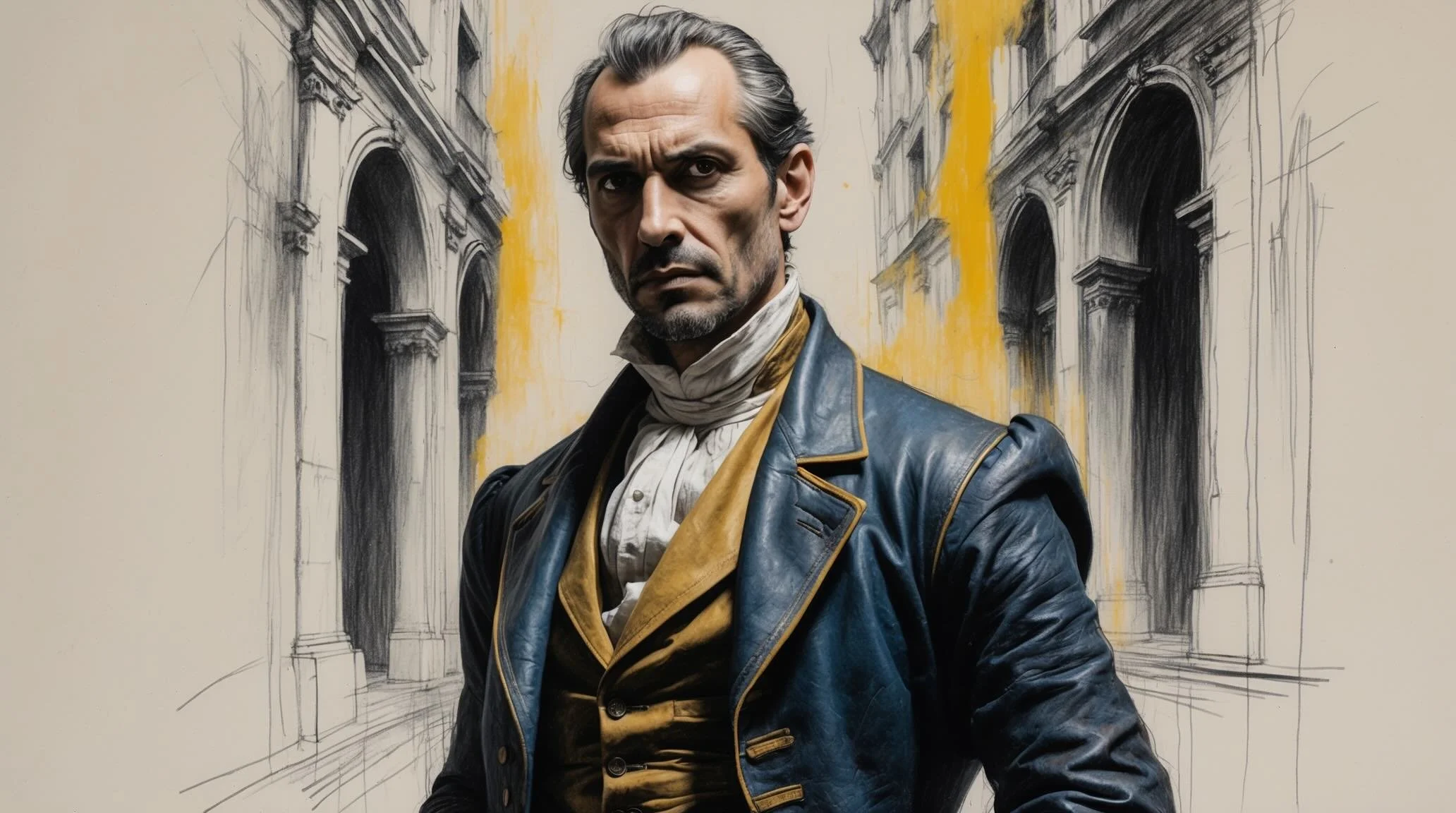
Character Profile – At a Glance
- Role: Othello’s ensign and trusted "honest Iago"; the play’s villain, plot-maker, and the figure whose voice Shakespeare gives more lines to than any character besides Hamlet.
- Key Traits: Plain-spoken in private, slippery in public; intelligent, observant, sexually obsessed, racially contemptuous, and entirely indifferent to the suffering he produces.
- The Core Conflict: A man passed over for promotion, who half-suspects his commander of sleeping with his wife, and who decides – for reasons that keep multiplying as the play goes on – that the answer is to engineer the death of everyone around him.
- Key Actions: Wakes Brabantio with Roderigo in A1S1; manipulates Cassio into the brawl in A2S3; engineers the handkerchief plot in A3S3 with Emilia’s unwitting help; stages the eavesdropping scene in A4S1; orchestrates Roderigo’s attack on Cassio in A5S1; kills Roderigo and Emilia; refuses to explain himself when exposed.
- Famous Quote:
"I am not what I am."
(Act 1, Scene 1) - The Outcome: Stabbed but not killed by Othello, exposed by Emilia, arrested by Lodovico, and led off to be tortured. His final spoken decision is to refuse explanation: he vows never to speak again, and the play ends without the answer it has been straining toward for five acts.
The Statement of Method
Iago’s first scene in the play is also the play’s first masterclass in his method. Speaking to Roderigo on a Venetian street, before any audience knows who he is, he gives one of the most famous statements of duplicity in Shakespeare – and an unusually direct one.
Original
For when my outward action doth demonstrate
The native act and figure of my heart
In compliment extern, ’tis not long after
But I will wear my heart upon my sleeve
For daws to peck at: I am not what I am.
(Act 1, Scene 1)
Shakespeare Retold (Modern Verse)
For if my outer actions represented
The way I really felt within my heart
So one could see it for themselves, then not long
After I’d worn my heart upon my sleeve,
The crows would peck it; I’m not who I seem.
The statement is structurally extraordinary. "I am not what I am" is a deliberate inversion of God’s self-naming in Exodus 3:14 – "I am that I am" – and Shakespeare lets the blasphemy stand without comment. Iago is announcing, in his first major speech, that the relationship between his inner self and his public face is not merely strained but inverted. He is telling Roderigo this because he believes Roderigo is too foolish to do anything with the information. He is also, by extension, telling the audience exactly what to expect – and the audience, like every character in the play, will spend the next four acts forgetting it. The whole tragedy can be read out of this five-word line.
The Plot Engendered
By the end of A1S3, Iago has talked Roderigo out of suicide, taken his money, and arrived alone on stage to do something he will do repeatedly throughout the play: speak directly to the audience about what he is about to do. The closing soliloquy is the first full statement of his plan, delivered in the relaxed, worldly idiom of a man explaining a business proposition.
Original
Thus do I ever make my fool my purse…
I have’t. It is engendered. Hell and night
Must bring this monstrous birth to the world’s light.
(Act 1, Scene 3)
Shakespeare Retold (Modern Verse)
That’s how I always make cash out of fools…
I’ve got it; it will happen. Merry hell
Must help my heinous plan occur as well.
Two things are remarkable about this soliloquy. The first is the casualness – Iago has just decided to destroy his commander’s marriage by suggesting, falsely, that Cassio is sleeping with Desdemona, and he announces this in the same register he uses to describe milking Roderigo for cash. The second is the multiplicity of motives. Within twenty lines, Iago names three: he hates the Moor; he suspects Othello of sleeping with Emilia; he wants Cassio’s job. None of these reasons fits the other. None of them, on its own, is sufficient to justify what he is about to do. The reasons are not the cause of the action; they are the running commentary of a man who has already decided.
The Public Performance
The line that runs through everyone’s mouth in the play – "honest Iago" – is the joke at the centre of every scene. Othello believes him. Cassio believes him. Desdemona believes him. Emilia, for most of the play, believes him. Iago’s most successful manipulations are not the lies he tells but the ones he refuses to tell – the moments when, asked what he is thinking, he hesitates, demurs, suggests it would be wrong of him to say. A3S3, the temptation scene, is the play’s longest and most devastating example.
Original
Good name in man and woman, dear my lord,
Is the immediate jewel of their souls:
Who steals my purse steals trash; ’tis something, nothing;
’Twas mine, ’tis his, and has been slave to thousands:
But he that filches from me my good name
Robs me of that which not enriches him
And makes me poor indeed.
(Act 3, Scene 3)
Shakespeare Retold (Modern Verse)
A man or woman’s decent reputation
Is the most precious thing they ever own:
If someone steals my wallet, they get rubbish;
That cash was mine and thousands more before that;
But he that steals my decent reputation
Takes something that won’t make him any richer
And leaves me destitute.
The speech is a small masterpiece. Iago, who has just told Othello there are things he cannot in good conscience repeat, now delivers a moralising aria on the value of "good name." The speech is true on its surface – reputation is precious, slander is theft – and entirely false in its position in the conversation, where it is being deployed to make Othello believe Iago is too honourable to slander Cassio. The technique is recognisable to anyone who has ever been manipulated: the person hesitates, performs scruple, raises the cost of speaking, and thereby raises the credibility of what they eventually do say. By the end of the scene, Othello is asking for proof of his wife’s adultery and Iago is "honest Iago" still.
The Refusal
The final scene of the play strips the mask off and Iago, exposed, does the thing none of his pursuers expects. He goes silent.
Original
Demand me nothing: what you know, you know:
From this time forth I never will speak word.
(Act 5, Scene 2)
Shakespeare Retold (Modern Verse)
Don’t ask me anything: you’ll know no more.
From this day forth, I’ll never speak again.
The silence is the play’s most calculated provocation. Iago has spoken more lines than any character in Othello – more, by some counts, than any Shakespearean villain anywhere – and he ends the play by refusing to speak at all. The refusal is the play’s last refutation of the comforting idea that villainy can be explained. Othello asks him directly why he has done what he has done. Iago does not answer. Lodovico threatens torture; Iago does not answer. The play declines to give the audience the explanation it has been straining toward for five acts, and it leaves the question of motive – already exposed across the soliloquies as a hunt rather than a cause – permanently unanswered. Given a final chance to make sense of himself in front of the people he has destroyed, he chose silence. That choice is its own kind of last word.
"The remainder—Iago’s soliloquy—the motive-hunting of a motiveless malignity—how awful it is!"
— Samuel Taylor Coleridge, The Literary Remains, 1836
Key Quotes
Quote 1Were I the Moor, I would not be Iago:
In following him, I follow but myself…
(Act 1, Scene 1)
Shakespeare Retold (Modern Verse)
If I were him, I’d not want to be me.
By working for him, I work for myself.
Divinity of hell!
When devils will the blackest sins put on,
They do suggest at first with heavenly shows,
As I do now.
(Act 2, Scene 3)
Shakespeare Retold (Modern Verse)
That’s Satan’s view!
When devils do the most atrocious sins,
They start by making things seem wonderful,
As I do now.
O, beware, my lord, of jealousy;
It is the green-eyed monster which doth mock
The meat it feeds on.
(Act 3, Scene 3)
Shakespeare Retold (Modern Verse)
My lord, you must beware of jealousy,
A green-eyed monster mocking those it feeds on…
Trifles light as air
Are to the jealous confirmations strong
As proofs of holy writ.
(Act 3, Scene 3)
Shakespeare Retold (Modern Verse)
Frivolous things,
When seen by jealous folk, are as compelling
As words within the bible.
Key Takeaways
- The Plot-Maker: Iago’s plot is the engine of the entire tragedy; every other character’s actions, including Othello’s, are responses to a situation Iago has constructed.
- The Multiplicity of Motives: Across his soliloquies, Iago gives at least three reasons for hating Othello – passed-over promotion, suspected adultery with Emilia, generalised resentment – and the play declines to settle which is true.
- The Public Mask: "Honest Iago" is the play’s central irony; the man whose self-description is "I am not what I am" is the man everyone insists on calling honest.
- The Final Silence: His refusal to explain himself when exposed is the play’s most calculated denial of closure, and the most exact statement of what Coleridge called "motiveless malignity."
Study Questions and Analysis
What is Iago’s real motive?
The play deliberately refuses to settle the question. Across his soliloquies, Iago names at least three motives: he has been passed over for promotion in favour of Cassio; he suspects Othello of sleeping with his wife Emilia; and he resents Cassio for having "a daily beauty in his life that makes me ugly." None is internally consistent with the others, and none is proportionate to the destruction he engineers.
Samuel Taylor Coleridge, in the marginalia he wrote in his copy of the play around 1818 and which were published posthumously in The Literary Remains in 1836, gave the most influential reading of this pattern. He called it "the motive-hunting of motiveless malignity" – meaning that Iago’s motives are not the cause of his action but rationalisations supplied after the decision to act has already been made.
Modern critics have offered alternatives. Stephen Greenblatt’s 1980 Renaissance Self-Fashioning sees Iago as a self-fashioner who improvises on the materials others supply. Harold Bloom’s 1998 Shakespeare: The Invention of the Human calls his evil aesthetic, the work of a "moral pyromaniac" – a phrase Bloom borrows from Harold C. Goddard’s 1951 The Meaning of Shakespeare. Feminist critics, including Coppélia Kahn’s 1981 Man’s Estate, emphasise the misogyny that runs through every motive he names. The play allows all these readings and confirms none, and Iago’s silence in the final scene is its last refusal to choose.
How does Iago manipulate Othello in the temptation scene?
A3S3, the longest scene in the play, is one of Shakespeare’s most-studied demonstrations of manipulation, and Iago’s method is more architectural than rhetorical. He does not lie outright. He hesitates, demurs, withholds, suggests it would be wrong of him to speak, and allows Othello’s imagination to fill the gaps he has carefully left open. The single most lethal line in the scene is also one of the shortest.
She did deceive her father, marrying you;
And when she seemed to shake and fear your looks,
She loved them most.
(Act 3, Scene 3)
Shakespeare Retold (Modern Verse)
She cheated on her father, marrying you;
And when she seemed to fear the way you look,
She actually just loved you.
He does not invent the suspicion; he picks up Brabantio’s parting warning from A1S3 ("She has deceived her father, and may thee") and feeds it back to Othello as observation rather than insinuation. The framework Othello is asked to operate within is one his father-in-law has already supplied. Fintan O’Toole’s 2002 Shakespeare Is Hard, But So Is Life captures the broader technique: "Iago’s brilliance lies not in what he puts into Othello’s mind, but what he draws out of it." The poison comes from inside Othello; Iago provides the conditions for its emergence – the technique now called gaslighting.
Why does Iago hate Othello?
The reasons proliferate as the play goes on. The first, named in the opening scene, is professional: Othello has promoted Cassio over him. The second, named in his first soliloquy, is sexual: he suspects Othello of having slept with Emilia, though he admits he has no evidence.
I hate the Moor:
And it is thought abroad, that ’twixt my sheets
He has done my office: I know not if’t be true;
But I, for mere suspicion in that kind,
Will do as if for surety.
(Act 1, Scene 3)
Shakespeare Retold (Modern Verse)
I hate that Moor:
And there are rumours that, within my bedroom,
He screwed my wife. I don’t know if it’s true,
But merely from suspicion that it happened,
Assume that it is true.
The phrasing is itself diagnostic. Iago does not believe the suspicion; he admits as much in the same breath. He simply intends to treat it as if it were true – the operational logic of the whole play in miniature. The third motive, harder to name and more consistent across the play, is racial: Iago refers to Othello as "the Moor," "an old black ram," "a Barbary horse," and "the thicklips," and his contempt for the marriage is inseparable from his contempt for the man. The fourth, sometimes overlooked, is a generalised envy of a competence he cannot match. The play does not arrange these motives in order of importance; it lets them accumulate, and then, in the final scene, denies the audience the relief of being told which one is real.
How does Iago’s relationship with Emilia work?
The marriage is one of Shakespeare’s quietest portraits of a relationship organised around mutual suspicion. Iago suspects Emilia of sleeping with Othello and, separately, with Cassio; Emilia, in the willow scene of A4S3, gives speeches that suggest she has long since accepted the worldly philosophy that wives cheat because husbands fail them. The two have lived together long enough to have stopped expecting honesty from each other, and the silence Iago counts on – her silence about the handkerchief, her habit of obeying him in small things – is partly built on this.
The play offers almost no scene of marital intimacy. Every interaction is transactional: Iago demands the handkerchief, Emilia supplies it; Iago issues instructions, Emilia complies. What Iago has not counted on is what happens when the small things become large. Emilia’s exposure of him in A5S2 is a betrayal of years of compliance, and Iago, faced with it, kills her. The act is the completion of the marriage’s logic: she has finally said the thing he depended on her not saying, and he silences her in the only way he has left. The man who organises his external manipulations around the principle "I am not what I am" has organised his marriage around the same principle.
How does Iago use racism against Othello?
Iago is the play’s most relentless supplier of racial language. In the opening scene he stands outside Brabantio’s window and shouts Othello into the racial register the play will spend the next five acts operating within.
Even now, now, very now, an old black ram
Is topping your white ewe. Arise, arise;
Awake the snorting citizens with the bell,
Or else the devil will make a grandsire of you…
(Act 1, Scene 1)
Shakespeare Retold (Modern Verse)
For at this very moment, an old black ram
Is sleeping with your white ewe. So, get up;
Wake all the sleeping people with your bell,
Or else the devil will make you a granddad.
The vocabulary is set within the play’s first hundred lines: Othello as ram, as Barbary horse, as "lascivious Moor." When Brabantio takes the case to the Senate, Iago disappears from view, but the racial vocabulary he has put into circulation does not – Brabantio uses it, and Othello himself, by A3S3, has begun to use it about himself. Iago does not invent the racism of Othello’s world, but he is its most efficient operator. The deeper reading, developed by Karen Newman in her 1987 essay "‘And wash the Ethiop white’" and Ania Loomba in her 1989 Gender, Race, Renaissance Drama, is that the racial framework operates as the play’s structural infrastructure rather than the prejudice of any one character – what later criticism would call structural racism.
Is Iago a psychological realist or a stage villain?
The question has divided criticism for two centuries. The realist reading treats Iago as a psychologically coherent figure with recognisable resentments who acts on them with disproportionate but explicable force. A. C. Bradley’s 1904 Shakespearean Tragedy argues this version, treating his soliloquies as the working-out of a damaged psychology. The stage-villain reading, descended from Coleridge through Harold Bloom’s 1998 Shakespeare: The Invention of the Human, treats Iago as closer to a personification – evil that wears a human face but is not reducible to ordinary human motives. Bloom calls him a "moral pyromaniac." W. H. Auden’s 1962 essay "The Joker in the Pack" takes the view further still, reading Iago as a practical joker "of a peculiarly appalling kind", an experimenter for whom the destruction itself is the point. Iago himself supplies the position the stage-villain reading depends on.
Virtue! a fig! ’tis in ourselves that we are thus or thus. Our bodies are our gardens, to the which our wills are gardeners.
(Act 1, Scene 3)
Shakespeare Retold (Modern Verse)
Moral strength! What rubbish! We can decide how we behave. Our bodies are our gardens and we decide what we will plant and care for.
The speech is in prose – Shakespeare uses the lower register because Iago is talking to Roderigo, not the audience – but the philosophical position is starkly stated. Virtue is a fiction; the will is sovereign; what a person does is what a person chooses to do. The argument is one the realist reading can accommodate and one the stage-villain reading can equally claim. The play makes both available without endorsing either. What it does insist on is that whatever Iago is, the people around him are not equipped to detect it – and that, more than the question of his nature, is the source of the catastrophe.
Why does Shakespeare give Iago the play’s final silence?
The choice is one of Shakespeare’s most calculated denials of closure. Iago has more lines in the play than Othello does, and the audience has spent five acts inside his head, so the expectation by the final scene is that he will explain himself. He does not. "Demand me nothing: what you know, you know: / From this time forth I never will speak word" is the play’s last refusal to translate evil into reason.
Some readings take the silence as defiance – Iago’s last act of control, depriving his captors of an answer. Others take it as confirmation of Coleridge’s "motive-hunting" thesis: there is no answer, and the silence is the most honest thing Iago says. Either way, the silence completes the "I am not what I am" formula that opened the play: the figure who announced in A1S1 that his outer self was the inverse of his inner self ends by refusing to allow the inner self to be articulated at all. Where Hamlet, King Lear and Macbeth end with speeches that organise the catastrophe’s meaning, Iago’s silence is the structural refusal of that convention, and the withholding is the play’s last word.
