Roderigo
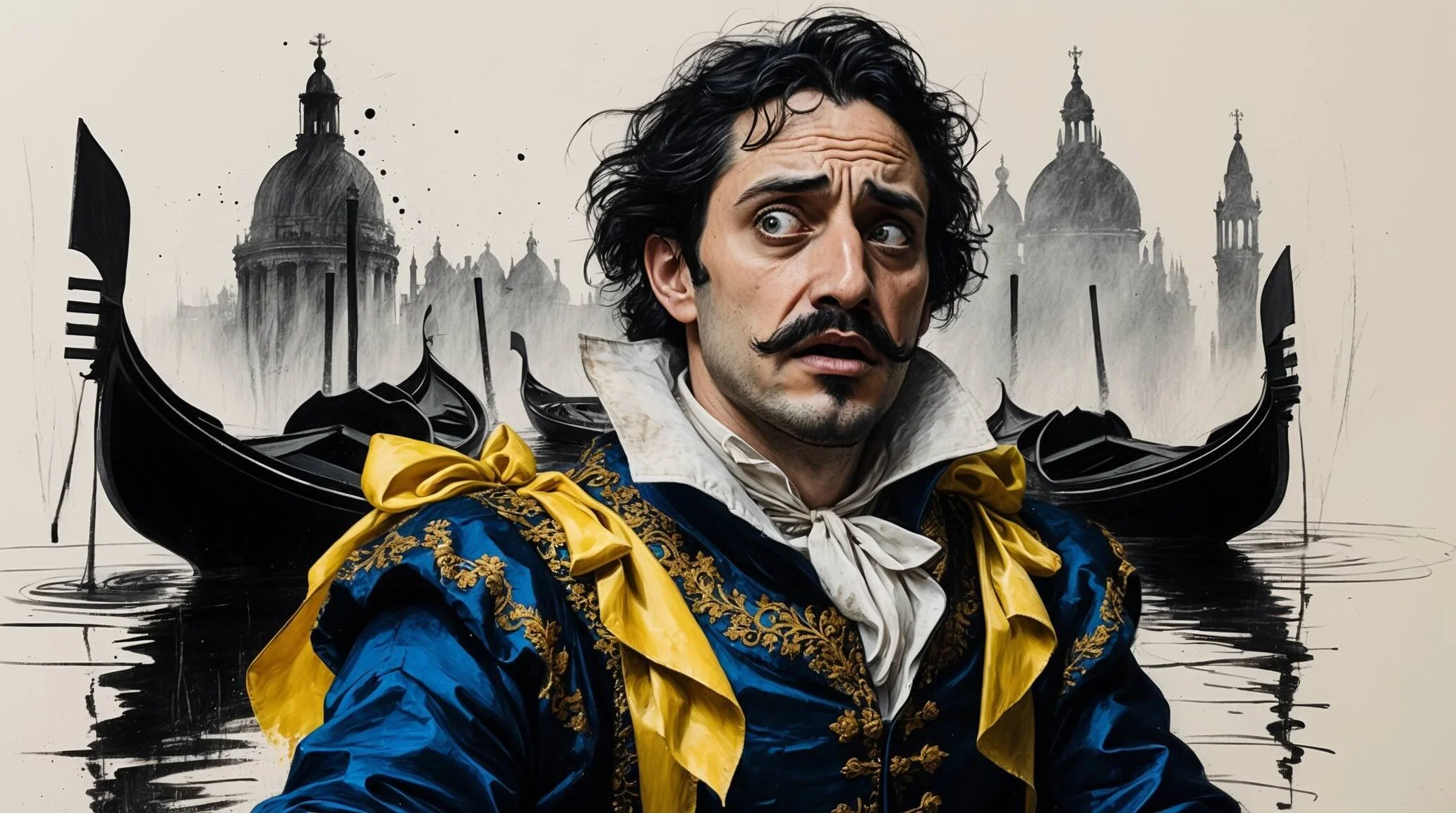
Character Profile – At a Glance
- Role: A wealthy Venetian gentleman, rejected suitor for Desdemona, and the first and longest-serving of Iago’s dupes.
- Key Traits: Lovesick, gullible, vain, and easily led – a man whose money and jealousy make him the perfect tool, and whose dawning suspicion comes far too late.
- The Core Conflict: A man who pays Iago to win him a woman who will never have him, and who slowly realises he has been robbed and used – in the same instant that he is murdered for knowing it.
- Key Actions: Helps Iago rouse Brabantio in A1S1; funds Iago’s schemes and is told to "put money in thy purse"; provokes Cassio into the A2S3 brawl; is set on to attack Cassio in A5S1, where Iago wounds and then kills him.
- Famous Quote:
"O damned Iago! O inhuman dog!"
(Act 5, Scene 1) - The Outcome: Stabbed by Iago in the dark of A5S1 to silence him; the letters found in his pocket help expose Iago’s plot in the final scene – the dupe’s last, involuntary act of truth-telling.
The Funded Fool
Roderigo exists, from the play’s first scene, to be used. He has been paying Iago to help him win Desdemona, and when he learns she has married Othello he collapses into self-pity, threatening to end it all – which is exactly the mood Iago needs to keep him paying.
Original
I will incontinently drown myself.
(Act 1, Scene 3)
Shakespeare Retold (Modern Verse)
I’ll drown myself at once.
The threat is pure melodrama, and Iago treats it as such, talking Roderigo out of suicide only to talk him out of his money in the same breath – "put money in thy purse," he repeats, until the lovesick fool is funding his own deception. Roderigo’s function is established here: he is a purse with a pulse, kept alive by hope and emptied by instalments. The relationship is a miniature of Iago’s whole method – find a man’s strongest desire, promise to satisfy it, and feed on him for as long as the promise can be strung out.
The Dying Curse
By A5S1 Roderigo has been used to the end of his usefulness. Set on to murder Cassio in the dark, he bungles it, is wounded, and is then stabbed by Iago himself – the accomplice silenced before he can talk. In his last breath, the truth he has missed for five acts finally arrives.
Original
O damned Iago! O inhuman dog!
(Act 5, Scene 1)
Shakespeare Retold (Modern Verse)
Damn you, Iago! You inhuman dog!
The recognition comes one knife-stroke too late. Roderigo dies understanding, at last, that the man he trusted has been his destroyer all along – the same recognition Othello and Emilia will reach in the next scene, and always after the damage is done. There is a grim economy in it: Iago kills Roderigo to keep him quiet, but the letters in the dead man’s pocket survive to accuse him. The dupe who never saw the truth in life ends up carrying the evidence that helps expose it.
Key Quotes
Quote 1What a full fortune does the thicklips owe
If he can carry’t thus!
(Act 1, Scene 1)
Shakespeare Retold (Modern Verse)
How lucky old big-lips is then if he
Can carry this one off!
I do not find that thou dealest justly with me.
(Act 4, Scene 2)
Shakespeare Retold (Modern Verse)
I don’t think you are fairly treating me.
Key Takeaways
- The Original Dupe: Roderigo is the first person Iago manipulates and the template for the method – find the man’s desire, promise to satisfy it, and feed on him.
- Money and Jealousy: His wealth funds Iago’s schemes and his envy of Othello makes him pliable; "put money in thy purse" is the refrain of his exploitation.
- Casual Prejudice: His opening slur, "the thicklips," shows that the racism Iago weaponises is already ordinary in Venice, not Iago’s invention.
- Too Late to See: Roderigo recognises Iago’s treachery only as he is murdered for it, and the letters on his body help expose the plot he never understood in life.
Study Questions and Analysis
What is Roderigo’s role in the play?
Roderigo is Iago’s instrument and his bankroll. From the opening scene he is the means by which Iago does things he cannot be seen to do himself: it is Roderigo who helps rouse Brabantio, Roderigo who provokes Cassio into the brawl, and Roderigo who is set on to murder Cassio in the final act. He is also the source of the money and jewels that fund the whole enterprise.
Dramatically, he is the play’s demonstration model. Before Iago works his slow poison on Othello, we watch him work the same technique on Roderigo in plain sight – flattery, false promises, redirected suspicion – so that by the time he turns on Othello we already know exactly how the method operates. Roderigo is the rehearsal for the tragedy: the same manipulation, played first as something close to farce, then for keeps.
Why does Roderigo keep trusting Iago?
Because Iago sells him the one thing he cannot give up: hope of Desdemona. Every time Roderigo’s patience runs out, Iago revives the fantasy – she will tire of Othello, the marriage cannot last, a little more money and a little more time will win her – and the desire overrides the mounting evidence that he is being robbed. Roderigo is not stupid so much as captured; his wanting is stronger than his judgement.
The relationship is a study in willed self-deception. Roderigo half-knows he is being cheated – he says so to Iago’s face – but knowing it and acting on it are different things, and the wanting always wins. The play uses him to show that Iago’s victims are not simply fooled; they collaborate in their own deception because the lie gives them something the truth would take away.
How does Iago exploit Roderigo financially?
Relentlessly, and almost openly. The refrain "put money in thy purse" runs through their first long exchange, as Iago persuades Roderigo to sell his land and turn it into cash to fund the pursuit of Desdemona. Roderigo also hands over jewels meant as gifts for her – jewels Iago simply keeps. By the time Roderigo confronts him in A4S2, he has, as he says, wasted himself out of his means: the money is gone and Desdemona is as far away as ever.
The financial exploitation is the most literal version of what Iago does to everyone. He takes what people value – Roderigo’s money, Cassio’s reputation, Othello’s peace – and converts it into fuel for his plot, giving nothing real in return. With Roderigo the theft is just easiest to see, because it is counted in coins and jewels rather than in trust or sanity.
What is the significance of Roderigo’s death?
Roderigo is murdered by the man he trusted, in the dark, to stop him talking – and his death is the moment Iago’s plot begins to come apart. Iago needs Cassio dead and Roderigo silenced; he gets neither cleanly. Cassio survives wounded, and although Roderigo dies, the letters found in his pocket become physical evidence of the conspiracy when Lodovico reads them in the final scene.
There is a bleak justice in it. Roderigo spends the play unable to see the truth about Iago, and dies the instant he finally grasps it – "O damned Iago! O inhuman dog!" But the truth he could not act on in life outlives him on paper. The dupe who was used as a tool throughout becomes, in death, the involuntary witness who helps bring his manipulator down.
Is Roderigo a purely comic figure, or something more?
He begins close to comic – the gulled lover, the purse with a pulse, the man threatening to drown himself over a woman who has just married someone else. His scenes with Iago have a knockabout quality, and an audience laughs at how transparently he is being played. But the comedy darkens as the play goes on.
By the end, Roderigo is not funny at all: he is a man who has been stripped of his money, used to do real harm, and finally knifed in an alley by his supposed friend. The arc from melodramatic suicide threat to genuine murder is deliberate. Roderigo lets the play show Iago’s method first as farce and then as fatality, and the movement between the two is part of how the tragedy tightens. The fool we laughed at dies for the same gullibility that amused us, and the laughter curdles.