
Home → Plays → Twelfth Night → Context
Twelfth Night: Context & Background
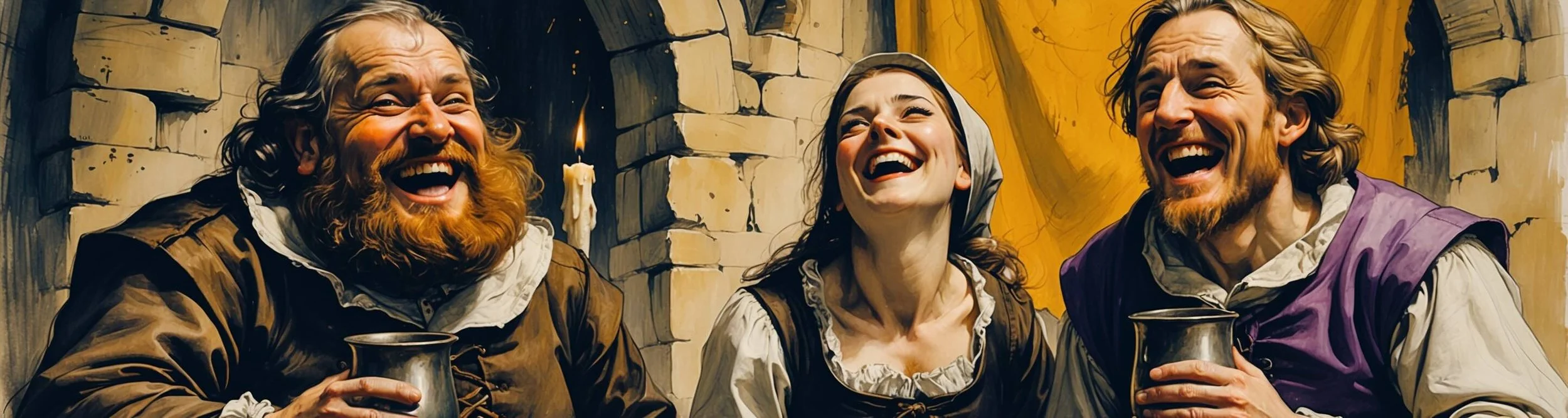
Context Profile – At a Glance
- Date Written: Around 1601–1602, in the reign of Elizabeth I.
- Genre: Comedy (a festive, romantic comedy).
- Primary Source: Barnabe Riche's tale "Of Apolonius and Silla" (1581), itself drawn from Italian comedy.
- The Feast of Twelfth Night: The title points to the riotous Epiphany holiday of misrule, on the 6th of January.
- Boy Actors: All female roles were played by boys, adding an extra twist to Viola's male disguise.
- Puritan Tension: Malvolio reflects a growing Puritan hostility to theatre and festivity.
The Origins: Riche, Italy and the Twins
Like most of his plays, Twelfth Night is built from older material. Shakespeare's most direct source was Barnabe Riche's prose tale "Of Apolonius and Silla", from his collection Riche his Farewell to Militarie Profession (1581), which already contains a shipwrecked heroine who disguises herself as a man, serves the duke she loves, and is wooed by a countess.
Behind Riche lies a longer European tradition, especially the Italian comedy Gl'Ingannati ("The Deceived"), full of twins, disguises and mistaken identity. Shakespeare blends these romantic-comedy conventions with the entirely home-grown subplot of Malvolio, Sir Toby and Maria, which seems to be his own invention. The mixture of inherited romance and original English comedy is part of what gives the play its distinctive flavour.
Exam tip: The useful contrast is between the inherited and the invented. The Viola plot follows a well-worn romance tradition, but the Malvolio subplot is Shakespeare's own. Noting that the play's darker, more uncomfortable comedy is the part he added lets you argue that he deliberately complicated a conventional love story.
The Feast of Twelfth Night and the World of Misrule
The title names a holiday. Twelfth Night was the twelfth night after Christmas, the eve of Epiphany on the 6th of January, and the climax of the Christmas festivities. It was a time of feasting, music, drinking and games, when ordinary rules were turned upside down and a "Lord of Misrule" might preside over the merrymaking.
That spirit of festive inversion runs all through the play, which opens in a haze of music and desire – "If music be the food of love, play on" – and delights in disguise, role-reversal and excess. Servants outwit masters, a woman plays a man, and revelry defies sobriety. The critic C. L. Barber, in his influential 1959 study Shakespeare's Festive Comedy, argued that plays like this one work like a holiday, releasing the audience into licensed misrule before returning them, refreshed, to everyday order.
Exam tip: Use the holiday idea as a lens. If the play stages a world of "misrule" where normal rules are suspended, then disguise, cross-dressing and the mockery of Malvolio all become part of a festive release. Framing the comedy this way lets you explain why order is restored at the end – the holiday, like the play, must eventually finish.
Boy Actors and the Games of Gender
On the Elizabethan stage, women were not allowed to act, so every female part was played by a boy or young man. This ordinary fact of the theatre gives Twelfth Night an extra layer of playfulness that its first audiences would have keenly felt.
When Viola disguises herself as the boy Cesario, the audience was watching a boy actor playing a woman who is pretending to be a man – and then being courted by a woman (Olivia, also played by a boy). The result is a dizzying game with gender and desire. Viola hints at the knot herself when she insists "I am not that I play". The play teases at the idea that love can leap across the boundaries of gender and that identity itself can be a kind of performance, which is one reason it speaks so strongly to modern audiences.
Exam tip: Remember the boy actor when you write about gender. The disguise is not only a plot device; on the original stage it created layers of male and female that complicate every love scene. Pointing out that an Elizabethan audience saw a boy-as-Viola-as-Cesario lets you discuss desire and identity as performance, not just romance.
Malvolio, Puritanism and the War on Festivity
The steward Malvolio is more than a comic snob; he carries a sharp contemporary charge. His name suggests "ill will", and the play hints that he is "a kind of Puritan". The Puritans were a growing religious movement who disapproved of theatre, drinking, music and holiday excess – the very things Twelfth Night celebrates – and who would, decades later, succeed in closing the playhouses.
By making the festivity-hating Malvolio the butt of the joke, Shakespeare sets the world of "cakes and ale" against the sober killjoy who would forbid it. When Sir Toby demands whether, because Malvolio is virtuous, there shall be "no more cakes and ale", he speaks for holiday pleasure against Puritan restraint. Yet the play is not wholly comfortable: the cruelty of Malvolio's punishment, and his bitter exit, hint at the real and growing conflict between the theatre and its enemies.
Exam tip: Read the Malvolio plot as a clash of values, not just a prank. He stands for Puritan disapproval of pleasure; Sir Toby and the others for festive licence. Connecting their quarrel to the real Puritan campaign against the theatres – which eventually shut them – gives the comedy a serious historical edge and helps explain why his humiliation feels uneasy.
Key Takeaways
- The romance is borrowed: Shakespeare reworked Barnabe Riche's tale and the Italian twin-comedy tradition.
- The title names a holiday: Twelfth Night was the feast of misrule, a time of revelry and inversion.
- Boys played the women: Viola's disguise added real layers of gender play on the Elizabethan stage.
- Malvolio is a Puritan figure: His war on festivity reflects a real threat to the theatre.
- Joy edged with unease: The festive comedy carries a darker thread in Malvolio's downfall.
Twelfth Night Context – Frequently Asked Questions
What was Shakespeare's source for Twelfth Night?
Shakespeare's most direct source was an English prose tale, "Of Apolonius and Silla", by Barnabe Riche, published in 1581. It already contains the core of the romantic plot: a young woman, separated from her twin brother by a shipwreck, disguises herself as a man, serves the duke she loves, and is wooed by a countess who mistakes her for a man.
Behind Riche stretches a longer European tradition of comedies about twins and disguise, especially the Italian play Gl'Ingannati ("The Deceived"). What Shakespeare adds is the whole comic underworld of the play – Sir Toby, Sir Andrew, Maria, Feste and above all Malvolio – which appears to be his own creation. He fuses a conventional romance with an original, and rather darker, English comedy of household mischief.
Why is the play called "Twelfth Night"?
The title refers to the feast of Twelfth Night, the twelfth night after Christmas and the eve of Epiphany on the 6th of January. In Shakespeare's England this was the high point of the Christmas season, a holiday of feasting, music, games and general misrule, often presided over by a mock "Lord of Misrule" who turned the normal order upside down. The play may well have been written for or performed at such a festive occasion.
The name sets the mood rather than describing the plot: the play is full of the holiday spirit of revelry, disguise and inversion. The critic C. L. Barber, in Shakespeare's Festive Comedy (1959), influentially argued that comedies like this one mirror the rhythm of a holiday, granting a temporary release into misrule before everyday order is restored at the close. The play's alternative title, What You Will, reinforces this sense of carefree, anything-goes celebration.
Why were female parts played by boys, and why does it matter?
In Elizabethan England it was not respectable, and effectively not permitted, for women to perform on the public stage, so all female roles were taken by boys or young men whose voices had not yet broken. This was simply how the theatre worked, and audiences were entirely used to it.
In Twelfth Night, though, the convention becomes part of the fun. Viola, a female character played by a boy actor, disguises herself as the young man Cesario, and is then courted by Olivia, another female character played by a boy. The layers of pretended gender pile up, and the play openly enjoys the confusion, with Viola admitting "I am not that I play". For modern readers this makes the comedy unusually rich for discussions of gender, identity and desire as forms of performance rather than fixed facts.
Is Malvolio a Puritan, and why does that matter?
The play explicitly raises the idea: Maria says Malvolio is "a kind of Puritan", before backing off the label. Whether or not he is one strictly, he clearly embodies Puritan attitudes – self-righteous, humourless, disapproving of drinking, singing and festivity, and convinced of his own superior virtue. His very name suggests "ill will".
This mattered a great deal in 1601. The Puritans were a rising force who condemned the theatre as immoral and wanted to suppress holiday revels and playhouses alike; some decades later, during the Civil War, they would in fact close the theatres. By making Malvolio, the enemy of "cakes and ale", the target of the play's mockery, Shakespeare stages a contest between festive pleasure and Puritan restraint. The discomfort many feel at Malvolio's cruel treatment partly reflects how real and serious that conflict was.
Is Twelfth Night purely a comedy, or is it darker than it looks?
On the surface it is a classic romantic comedy, ending in music, recognition and marriage. But many readers find a persistent thread of melancholy and unease running beneath the laughter. The play is preoccupied with grief, loss and the passing of time: Olivia is in mourning, Viola believes her brother drowned, and Feste's closing song turns wistful, reminding us that "the rain it raineth every day".
Above all there is Malvolio. The trick played on him starts as fun but becomes genuinely cruel, ending with him imprisoned, tormented and publicly humiliated, and he leaves the stage not reconciled but vowing revenge on "the whole pack" of them. That sour note, left deliberately unresolved at the very end of a comedy, is why the play is often grouped among Shakespeare's more bittersweet works rather than his purely sunny ones.