
Home → Plays → Twelfth Night → Plot Summary
Twelfth Night: Plot Summary
Plot Profile – At a Glance
- The Setting: Illyria, a fictional seacoast kingdom.
- The Protagonist: Viola, a shipwrecked young woman who disguises herself as a man.
- The Antagonist: No single villain – the obstacles are disguise, mistaken identity and one-sided love, with the steward Malvolio as the target of the comic subplot.
- The Inciting Incident: Shipwrecked and believing her twin brother drowned, Viola disguises herself as a boy, "Cesario", and enters Duke Orsino's service.
- The Core Conflict: A tangle of one-sided loves sprung from Viola's disguise: she loves Orsino, who loves Olivia, who falls for "Cesario".
- The Climax: The arrival of Viola's twin Sebastian throws everyone into confusion, until the twins meet and the disguise is revealed.
- The Outcome: The lovers are correctly paired and married; only the humiliated Malvolio leaves unreconciled.
- Genre: Comedy.
Shipwrecked in the strange land of Illyria and believing her twin brother drowned, Viola disguises herself as a young man and takes service with Duke Orsino. She quickly falls in love with him, but he sends her to woo the Countess Olivia on his behalf – and Olivia falls for the disguised Viola instead. The love-knot only loosens when Viola's twin Sebastian reappears, leading to a happy reshuffle of couples. Alongside the romance runs a riotous subplot in which the pompous steward Malvolio is tricked and mocked. It is one of Shakespeare's best-loved comedies, mixing joy with a thread of melancholy.
Act 1: Shipwreck and Disguise
The play opens with the lovesick Duke Orsino sighing for the Countess Olivia, who has vowed to mourn her dead brother for seven years and will not hear his suit. Nearby, Viola is washed ashore from a shipwreck, fearing her twin brother Sebastian has drowned. Alone in a strange land, she asks the sea-captain to "Conceal me what I am" and disguises herself as a young man, Cesario, to serve the Duke. Charmed by his new page, Orsino sends "Cesario" to carry his love-messages to Olivia.
Act 2: Cross-Purposes and a Cruel Trick
Complications multiply. Olivia, far from softening towards Orsino, falls in love with his messenger Cesario, not realising Cesario is a woman. Meanwhile Sebastian, also alive, comes ashore elsewhere. In Olivia's house, her riotous uncle Sir Toby Belch, the foolish Sir Andrew Aguecheek and the sharp-witted maid Maria plot revenge on the kill-joy steward Malvolio, who has scolded their late-night revelry – Sir Toby demanding whether, because Malvolio is virtuous, there are to be "no more cakes and ale". Maria forges a letter to convince Malvolio that Olivia secretly loves him.
Act 3: Tangles and Yellow Stockings
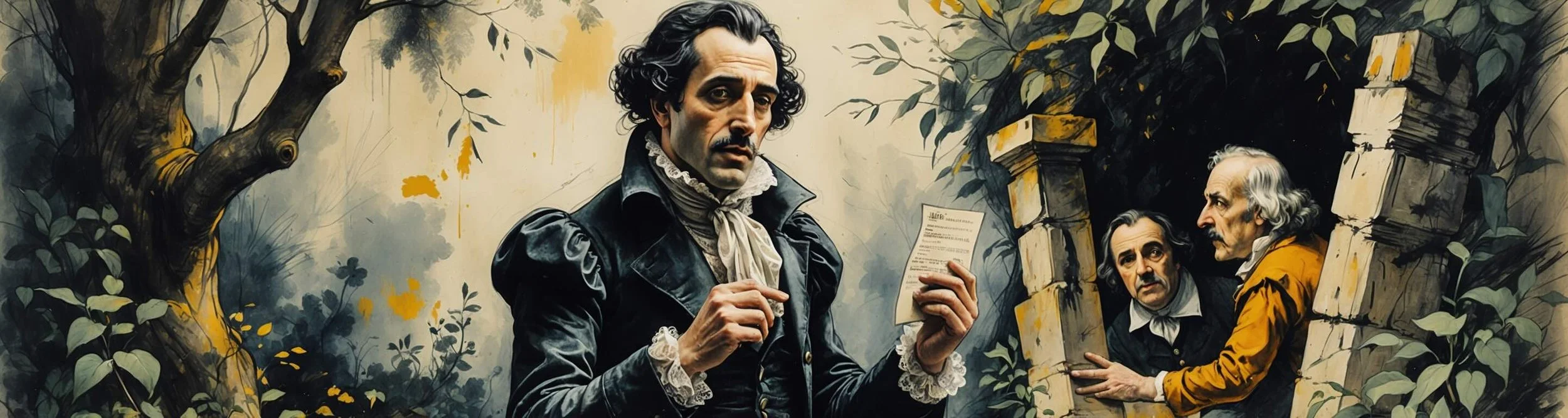
The disguise plot tightens. Olivia openly courts Cesario, who can only gently refuse, still secretly loving Orsino. The jealous Sir Andrew is goaded into challenging Cesario to a duel. Meanwhile the forged letter works perfectly: Malvolio, persuaded that "some have greatness thrust upon them", appears before a baffled Olivia grinning, cross-gartered and in absurd yellow stockings. Olivia thinks he has lost his mind, which is exactly what the plotters had hoped.
Act 4: Mistaken Identity
Mistaken identity reaches its peak. Sebastian arrives in the town and is promptly taken for Cesario – first challenged by Sir Andrew, then swept up by Olivia, who, delighted that "Cesario" has at last said yes, marries him on the spot. Sebastian is bewildered but happy to go along with it. The imprisoned Malvolio, now treated as a dangerous lunatic, is tormented further by Feste the clown, who pretends to be a priest.
Act 5: Revelations and Reunion
All the confusions collide and resolve. Orsino, Olivia, Viola and Sebastian are finally in the same place at once, and when the twins see each other the disguise unravels. Olivia discovers she has happily married Sebastian, not Cesario; Orsino, learning that Cesario is really Viola, turns his love to her and proposes. The couples are paired and the lovers reconciled – but Malvolio, released and publicly humiliated, storms off vowing to "be revenged on the whole pack of you", a sour note at the edge of the happy ending.
Key Takeaways
- Disguise drives everything: Viola's male disguise creates the central love-triangle.
- Love is a tangle: Viola loves Orsino, Orsino loves Olivia, and Olivia loves "Cesario".
- The twins resolve it: Sebastian's return untangles the knot and pairs the couples.
- The subplot mocks Malvolio: The forged letter and yellow stockings are the comic highlight.
- Comedy with a shadow: Malvolio's humiliation leaves a note of cruelty amid the joy.
Twelfth Night Plot Summary – Frequently Asked Questions
How does Twelfth Night end?
The play ends with the great untangling. For most of the action Viola has been disguised as the boy Cesario, which has tied the lovers into knots. The arrival of her twin brother Sebastian, who looks just like her, causes a final flurry of confusion until the two twins finally appear on stage together. Seeing them side by side, everyone realises the truth.
The couples are then sorted out happily: Olivia, who married Sebastian thinking he was Cesario, is content with her real husband, and Orsino, discovering that his page Cesario is really a woman, asks Viola to marry him. Sir Toby marries Maria as a reward for the Malvolio plot. The one discordant note is Malvolio, who has been cruelly tricked and imprisoned; released at last and made to look a fool, he leaves in fury, vowing revenge, which keeps the comedy from ending in pure happiness.
Why does Viola disguise herself as a man?
Viola disguises herself out of vulnerability and practicality. She has been shipwrecked on the coast of Illyria, a country she does not know, and believes her twin brother Sebastian has drowned. Alone, unprotected and grieving, she needs a safe way to survive in a strange place.
Her solution is to dress as a young man, "Cesario", and take service with Duke Orsino, asking the sea-captain to "Conceal me what I am". As a woman alone she would be exposed; as a man she can move freely, earn a position and bide her time. The disguise is meant only as temporary protection, but it quickly becomes the engine of the whole plot, since both Orsino and Olivia respond to Cesario in ways Viola never intended.
What is the trick played on Malvolio?
Malvolio is Olivia's self-important, kill-joy steward, who has angered Sir Toby, Sir Andrew and the maid Maria by scolding their late-night drinking and revelry. To take revenge, Maria, whose handwriting closely resembles her mistress's, forges a love letter and leaves it where Malvolio will find it, written so that he will believe Olivia secretly adores him.
The letter instructs him to prove his love by smiling constantly, behaving haughtily to the other servants, and wearing yellow stockings, cross-gartered – all things Olivia actually detests. Convinced that "some have greatness thrust upon them", Malvolio obeys to the letter, appears before a horrified Olivia grinning in absurd costume, and is taken for mad. He is shut up in a dark room as a lunatic, and the prank, funny at first, tips into real cruelty.
How many acts and scenes does Twelfth Night have?
Twelfth Night is divided into five acts containing eighteen scenes in total: five scenes in Act 1, five in Act 2, four in Act 3, three in Act 4, and a single long scene in Act 5. The famous final scene gathers nearly every character together for the unmasking and the resolution of all the confusions.
The structure interweaves two plots throughout: the romantic main plot of Viola, Orsino and Olivia, and the comic subplot of Malvolio, Sir Toby and Maria. Shakespeare cuts between the two, so that the high romance and the broad comedy play off against each other, before bringing both strands together in the long closing scene.
Who marries whom at the end of Twelfth Night?
By the close there are three matches. Viola, no longer disguised, is to marry Duke Orsino, whose affection for his "page" turns naturally into love once he learns Cesario is really a woman. Olivia, who had fallen for Cesario, ends up married to Viola's identical twin Sebastian, and is perfectly happy with the swap once the confusion is explained.
The third pairing is comic: Sir Toby Belch marries Maria, the clever maid who masterminded the trick on Malvolio. These neat couplings are the traditional happy ending of romantic comedy. The deliberate exception is Malvolio, who is left isolated and vengeful, and the lovesick Sir Andrew and the solitary Antonio, who are quietly left out of the general happiness.
Is there a villain in Twelfth Night?
Not really, which is part of what makes it a comedy rather than a tragedy. There is no scheming Iago or murderous tyrant; the trouble comes from disguise, mistaken identity and people falling in love with the wrong person, rather than from genuine evil. The "obstacles" are largely accidents and misunderstandings that sort themselves out.
The closest thing to a villain is Malvolio, the pompous steward who tries to spoil others' fun – but even he is more victim than villain, since the trick played on him is arguably crueller than anything he does. Some productions treat Sir Toby and his crew as the real source of unkindness. The play's lack of a true villain, and its uneasy treatment of Malvolio, are part of why it feels both joyful and faintly melancholy.