Malvolio
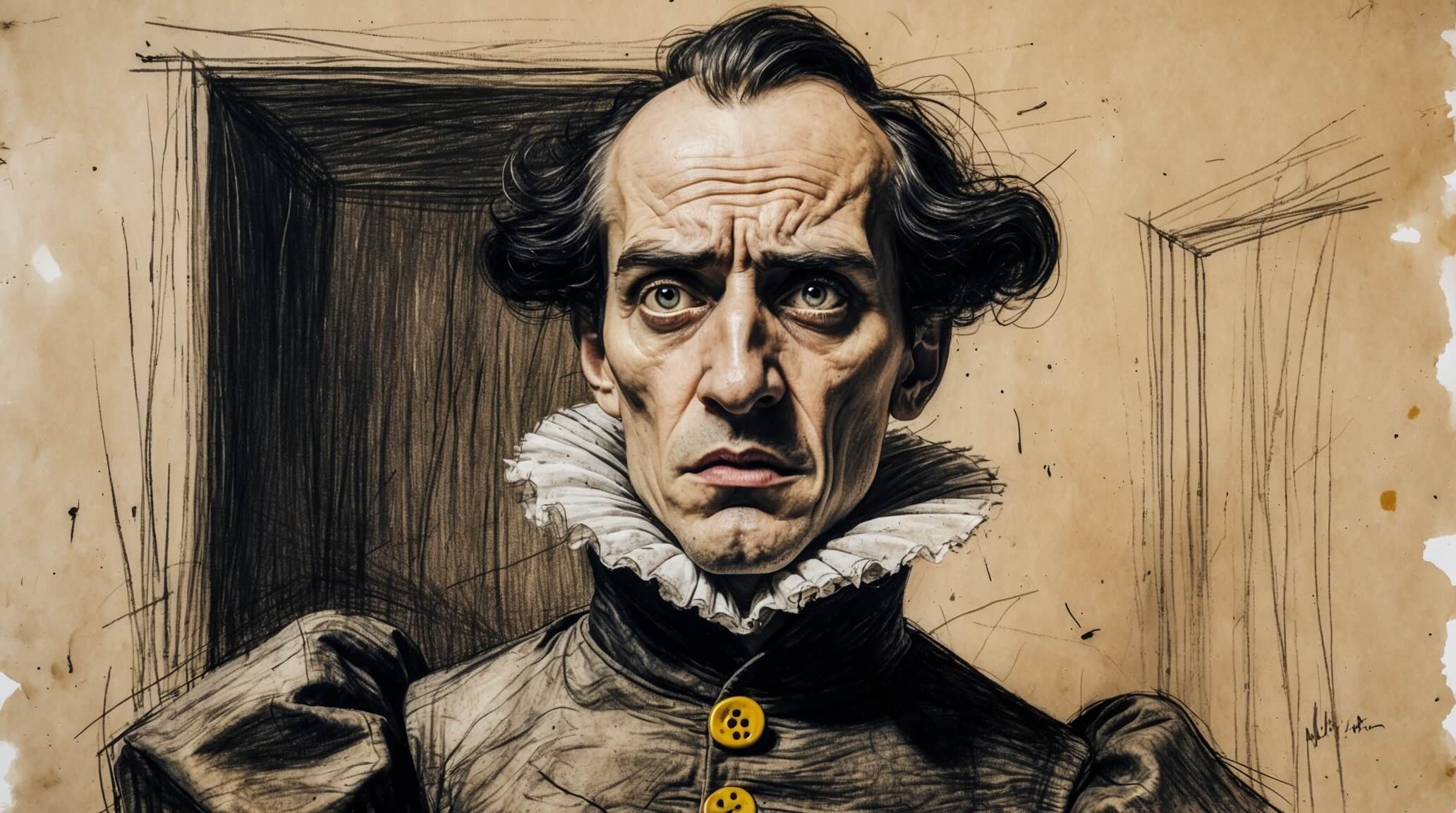
Character Profile – At a Glance
- Role: Olivia’s steward, the head servant who runs her household and keeps its order. He is the play’s chief moralist, and its most disturbing figure: a man whose treatment by the household goes beyond what comic vengeance can absolve.
- Key Traits: Self-important, formally efficient, and openly contemptuous of the household’s fun. He is secretly ambitious to marry his mistress, and quick to read flattering meanings into ambiguous evidence. At his lowest, he produces the play’s most painful line of raw feeling.
- The Core Conflict: A man with real authority but no social standing. His contempt for the household’s revelry provokes a comic revenge, and his vanity makes him perfectly vulnerable to a forged letter. His punishment, confinement in a dark room as a madman, escalates far beyond the offence.
- Key Actions: Dismisses Feste as "a barren rascal" in A1S5 and is rebuked by Olivia for being "sick of self-love". He returns the ring to Cesario in A2S2 and interrupts the late-night carousing in A2S3. He reads Maria’s forged letter in A2S5, appears cross-gartered before Olivia in A3S4, and is imprisoned in a dark room in A4S2. In A5S1 he learns the truth and exits with "I’ll be revenged on the whole pack of you."
- Famous Quote:
"Some are born great, some achieve greatness, and some have greatness thrust upon ’em."
(Act 2, Scene 5) - The Outcome: Released from the dark room, shown the forged letter, and told the truth of the gulling, he is given no marriage and no settlement. He exits promising revenge, and the line is one of Shakespeare’s most exposed pieces of unaccommodated feeling in any of the comedies.
The Barren Rascal and the Sick of Self-Love
Malvolio’s first scene is A1S5, and his opening line establishes both the offence that will trigger the gulling and the diagnosis that will, by Act 5, have proved entirely accurate. He has been watching Olivia laugh at Feste’s catechism, and his contempt is unconcealed.
Malvolio sneers, and Olivia’s reply is immediate:
Original
MALVOLIO: I marvel your ladyship takes delight in such a barren rascal: I saw him put down the other day with an ordinary fool that has no more brain than a stone. …
OLIVIA: Oh, you are sick of self-love, Malvolio, and taste with a distempered appetite.
(Act 1, Scene 5)
Shakespeare Retold (Modern Verse)
MALVOLIO: My Lady, I’m amazed you take enjoyment from this unfunny twerp. I saw him flummoxed the other day by a pathetic fool whose brain was made of stone. …
OLIVIA: You are so vain, Malvolio, you’re tainted by poisoned taste.
The exchange is one of Shakespeare’s most economical pieces of character-establishment. Malvolio’s contempt for Feste is not casual – it is the position of a man whose authority within the household has been threatened by a comic figure who has just earned his employer’s laughter. Olivia’s response is one of the play’s sharpest single-line diagnoses. "Sick of self-love" is not a casual insult; it is a medical-philosophical formulation that names Malvolio’s whole character. The phrase has become, in the four centuries since the play, the foundational critical reading of his condition. He is a man who loves himself more than he loves anything else, and the love is "sick" not because it is monstrous but because it is sufficient – he requires no external validation for what he already believes about his own worth. The conditions for the gulling are now in place. Maria, who is on stage for this exchange, will name the diagnosis again in A2S3, and her forged letter will be calibrated precisely to it.
The Box-Tree Letter
A2S5 is the play’s most-celebrated comic set-piece, and the centre of Malvolio’s catastrophe. He has been walking in the garden, soliloquising aloud about his ambitions, when he finds the forged letter Maria has thrown into his path. The letter is calibrated to his vanity with such precision that the deception requires no acting on its author’s part – Malvolio supplies, in his reading of it, every interpretation the letter needs.
Original
In my stars I am above thee; but be not afraid of greatness: some are born great, some achieve greatness, and some have greatness thrust upon ’em. Thy Fates open their hands; let thy blood and spirit embrace them; and, to inure thyself to what thou art like to be, cast thy humble slough and appear fresh. … Remember who commended thy yellow stockings, and wished to see thee ever cross-gartered.
(Act 2, Scene 5)
Shakespeare Retold (Modern Verse)
I am above you, but do not fear greatness. Some are born great, some achieve greatness, and some have greatness thrust upon them. Good fortune shines on you; embrace it with your mind and body, And so, prepare for who you will become, discarding all your lowly ways; be strong. … Remember who admired your yellow stockings, and who wished you wore them criss-crossed.
The "some are born great, some achieve greatness, and some have greatness thrust upon ’em" formulation is the most-quoted line in the play, and it has become, in its afterlife, one of the most-quoted lines in any of Shakespeare’s comedies. The three-part construction is one of his most economical pieces of rhetoric: greatness as inheritance, as accomplishment, and as accident, each clause a single phrase, the whole arranged in ascending order of unlikelihood. The line operates simultaneously as the letter’s bait, as Malvolio’s flattering self-reading, and as the play’s quietest piece of philosophical commentary on social ascent. The letter offers Malvolio the third category – greatness thrust upon him by Olivia’s love – and Malvolio receives it as confirmation of what he has already, in his own private reasoning, concluded. There is, even here, a current of sympathy running under the comedy. The audience watches Malvolio fall into a trap calibrated to his vanity, and the watching is comic precisely to the extent that the audience can pretend the fall is harmless. By Act 4 the pretence will become harder to sustain.
The Cross-Gartered Steward
A3S4 contains the gulling’s public reveal. Olivia has summoned Malvolio in the middle of more pressing concerns; he arrives wearing yellow stockings, cross-gartered, and smiling – three things the letter has instructed him to do, and three things that, to anyone who does not know about the letter, will look like signs of madness.
Malvolio enters beaming, to a baffled Olivia:
Original
MALVOLIO: Sweet lady, ho, ho.
OLIVIA: Smilest thou?
I sent for thee upon a sad occasion.
MALVOLIO: Sad, lady! I could be sad: this does make some obstruction in the blood, this cross-gartering; but what of that? If it please the eye of one, it is with me as the very true sonnet is, 'Please one, and please all.'
OLIVIA: Why, how dost thou, man? What is the matter with thee?
MALVOLIO: Not black in my mind, though yellow in my legs.
(Act 3, Scene 4)
Shakespeare Retold (Modern Verse)
MALVOLIO: Sweet lady, ho ho!
OLIVIA: What’s with the smile?
I asked you here in sadness.
MALVOLIO: In sadness, lady? Yes, I could be sad, for these cross-gartered laces block the blood, but who would care? For if it pleases one, for me it’s from that sonnet: ‘Please one, and please all.’
OLIVIA: Well, what on earth, man? What is wrong with you?
MALVOLIO: There’s nothing wrong, although my legs are yellow.
The scene is the gulling at its most visually exposed. Malvolio is, by his own conviction, performing the dress and demeanour of a man who has been encouraged to woo his mistress; Olivia, who knows nothing of the letter, is watching a household steward inexplicably arrive smiling and yellow-stockinged in the middle of her own emotional crisis. The collision of two true accounts is the scene’s whole comic mechanism. Malvolio thinks he is being seductive; Olivia thinks he is mad. The audience knows both. By the scene’s end, Olivia has instructed Maria to "let some of my people have a special care of him" – which is, in the household’s grammar, the order to confine him as a lunatic. Sir Toby seizes the opportunity to extend the gulling into the dark-room imprisonment. The transition from comic embarrassment to actual confinement is the play’s most consequential narrative shift. What began in A2S5 as a piece of festive vengeance against Malvolio’s vanity has, by the end of A3S4, become a piece of legal restraint against a man Olivia believes to be mentally ill.
The Dark Room
A4S2 is the play’s most morally contested scene. Feste, dressed as Sir Topas the curate, visits Malvolio in his dark cell. The exchange that follows is one of Shakespeare’s most concentrated pieces of psychological torment, and Malvolio – for the first time in the play – is the figure whose dignity the audience is asked to take seriously.
Feste, disguised as Sir Topas the curate, interrogates the darkness:
Original
FESTE: Sayest thou that house is dark?
MALVOLIO: As hell, Sir Topas.
FESTE: Why it hath bay windows transparent as barricadoes, and the clearstores toward the south north are as lustrous as ebony; and yet complainest thou of obstruction?
MALVOLIO: I am not mad, Sir Topas: I say to you, this house is dark.
FESTE: Madman, thou errest: I say, there is no darkness but ignorance…
(Act 4, Scene 2)
Shakespeare Retold (Modern Verse)
FESTE: You say this place is dark?
MALVOLIO: As dark as hell, Sir Topas.
FESTE: But there are windows that are clear like railings, and upper windows open north and south, shine out like ebony, yet you complain you can’t see anything?
MALVOLIO: Sir Topas, I’m not mad; it’s dark in here.
FESTE: Madman, you’re wrong. There is no darkness here, except your ignorance…
Malvolio’s line "I am not mad, Sir Topas" is one of the play’s most-discussed single sentences. The man imprisoned in the dark room is, by every available measure, not mad; he is the victim of a coordinated piece of household theatre, and he is now being told – by a fool dressed as a priest – that the darkness he can see is his own ignorance. The scene is the point at which many readers stop laughing. The figure in the dark room is, in any straightforward reading, no longer comic. The turn depends on the recognition that Malvolio’s offence (moralising vanity) and his punishment (confinement as a lunatic with priestly visitation) have ceased to be proportionate. The play does not punish Malvolio for any crime he has committed; it punishes him for being the kind of person he is. Modern productions have increasingly chosen to play A4S2 with that tragic weight, and the scene has become, in its afterlife, one of the principal pieces of evidence that Twelfth Night is the darkest of Shakespeare’s mature comedies.
"I’ll Be Revenged on the Whole Pack of You"
A5S1 contains Malvolio’s release and the play’s most exposed line. The letter has been read aloud; Maria’s authorship has been named; Feste has delivered the "whirligig of time" line, naming the comic mechanism that has produced the catastrophe. Malvolio responds.
Original
I’ll be revenged on the whole pack of you.
(Act 5, Scene 1)
Shakespeare Retold (Modern Verse)
I’ll get revenge on every one of you!
The line is one of Shakespeare’s most exposed pieces of writing in any of the comedies. Seven words. No verb of feeling, no acknowledgement of the explanation that has just been offered, no exit speech of the kind the comedy’s other figures have been given. Malvolio simply names what he will do, and what he will do is not part of the play’s available action. The comedy is over; the marriages are about to be celebrated; Orsino sends officers to "pursue him, and entreat him to a peace." Malvolio does not, in the text the play provides, return. He exits the stage with the line, and his absence from the closing scene is the play’s most direct acknowledgement of what comic resolution cannot do. The marriages of A5S1 distribute fortune, partner, and ending to Viola, Orsino, Olivia, Sebastian, Sir Toby, and Maria. Malvolio receives none of this. The play does not, in any meaningful sense, resolve him. He leaves the stage, the household, and the comedy carrying the residue of unaccommodated feeling that the comedy has produced, and the audience is left with the recognition that the comic vengeance against his vanity has cost the comedy its own equanimity. The tragic undertow of his exit is the play’s deepest acknowledgement of what has happened. The comedy survives Malvolio’s departure; he does not survive the comedy unchanged.
"I confess that I never saw the catastrophe of this character, while Bensley played it, without a kind of tragic interest."
— Charles Lamb, On Some of the Old Actors, 1822
Key Quotes
Quote 1
My masters, are you mad? Or what are you? Have ye no wit, manners, nor honesty, but to gabble like tinkers at this time of night?
(Act 2, Scene 3)
Shakespeare Retold (Modern Verse)
Good lord, are you all mad? What’s this? Don’t you have manners or decency to not all bellow like drunkards late at night?
Quote Analysis: Malvolio breaking up the late-night carousing of Sir Toby, Sir Andrew and Feste, and the moment that earns him the household’s revenge. As a steward he has a real point – the noise is genuinely disorderly – but the tone is pure contempt, and it lands in a household that runs on exactly the revelry he is trying to suppress. The line is the mismatch in miniature: a man speaking the language of moral order into a world built for pleasure, and making an enemy of everyone in the room.
To be Count Malvolio!
(Act 2, Scene 5)
Shakespeare Retold (Modern Verse)
Imagine this: I’m Count Malvolio.
Quote Analysis: Spoken aloud in the garden before he has even found the letter, this is Malvolio’s ambition in its naked form. He is not reacting to evidence here; he is rehearsing a fantasy of rank, trying the title in his own mouth. The moment is what makes the gulling possible: the letter does not plant the desire to marry Olivia and rise above his station, it simply confirms a fantasy Malvolio is already entertaining in private. His vanity has done most of Maria’s work before the letter is even read.
Go, hang yourselves all! You are idle shallow things: I am not of your element: you shall know more hereafter.
(Act 3, Scene 4)
Shakespeare Retold (Modern Verse)
Go hang yourselves, the lot of you! You’re lazy and insignificant. I’m not like you. You’ll come to learn more soon.
Quote Analysis: Malvolio at the height of his delusion, dismissing Sir Toby and the others now that he believes himself all but married to his mistress. "I am not of your element" is the line’s centre – the class contempt he has carried all along, now spoken openly because he thinks his elevation is assured. The dramatic irony is total: he believes he is rising above them at the exact moment they are arranging his confinement. The confidence is what makes the fall so steep.
Madam, you have done me wrong,
Notorious wrong.
(Act 5, Scene 1)
Shakespeare Retold (Modern Verse)
You’ve done me wrong, madam,
A terrible injustice.
Quote Analysis: Released at last, Malvolio does not rage immediately; he states his case to Olivia with a wounded, almost legal dignity. The word "notorious" is exact – the wrong has been public, performed, witnessed – and Olivia herself will use the same word moments later when she agrees he has been "most notoriously abused." For a few lines the play lets Malvolio be entirely in the right, and the accusation stands unanswered before it curdles into the threat of revenge that ends his part.
Key Takeaways
- The Tragic-Comic Borderline: Malvolio’s downfall carries a weight the comic structure cannot fully absorb. His suffering in the dark room pulls the play toward tragedy even as the marriages gather around it.
- Sick of Self-Love: Olivia’s A1S5 diagnosis is the play’s sharpest single-line reading of him. Malvolio loves himself enough to need no outside approval, and the A2S5 letter scene confirms it with comic precision.
- The Greatness Speech: "Some are born great, some achieve greatness, and some have greatness thrust upon ’em" is the most-quoted line in the play and a famous statement of social ascent.
- The Unreconciled Exit: The A5S1 line "I’ll be revenged on the whole pack of you" is one of Shakespeare’s most exposed refusals of comic resolution. Malvolio does not forgive, and the play does not require him to.
Study Questions and Analysis
Is Malvolio a tragic figure trapped in a comedy?
The question has been one of the most-discussed in criticism since Charles Lamb’s 1822 essay made the case explicitly. Lamb, watching the actor Bensley perform Malvolio, argued that the catastrophe of the character produced "a kind of tragic interest" that the comic structure could not fully absorb. The case Lamb makes turns on the disproportion between offence and punishment. Malvolio’s original offence – moralising contempt for the household’s pleasures and a vanity sufficient to make him imagine Olivia’s love – is real, but it is a comic offence, the kind for which embarrassment in the box-tree scene would be adequate vengeance. The punishment that Sir Toby and Feste escalate to – confinement in a dark room with mock-clerical visitation – has ceased to be proportionate by A4S2, and the audience has, by then, begun to sympathise with the prisoner against the gaolers. Modern criticism has largely accepted Lamb’s reading. Harold Bloom, in Shakespeare: The Invention of the Human (1998), calls Malvolio "a personality so humanly persuasive" that the comedy’s treatment of him exposes the limits of the comic frame. C. L. Barber’s Shakespeare’s Festive Comedy (1959) reads the gulling’s later movements as "post-festive" – the comic vengeance has crossed a threshold beyond which the festive structure cannot absorb its own consequences. The play does not, finally, integrate Malvolio into its resolution. He exits with the promise of revenge, and the comedy proceeds without him. The tragic reading is, in this sense, structurally exact. Malvolio is not a tragic figure in the technical sense – he does not die, does not have a fall from greatness, does not achieve self-knowledge – but he is the figure on whom the comedy’s structural limits become visible.
Why does Maria’s letter work so completely on Malvolio?
The letter’s success is one of Shakespeare’s most exact pieces of comic engineering, and the credit belongs largely to Maria’s diagnostic precision rather than to any particular subtlety in the document itself. Maria’s reading of Malvolio in A2S3 names the qualities the letter will exploit: "the best persuaded of himself, so crammed, as he thinks, with excellencies, that it is his grounds of faith that all that look on him love him." The diagnosis is exact, and the letter is calibrated to it. The letter is also, on careful reading, remarkably unsubtle. Its central riddle is barely a code at all:
M, O, A, I, doth sway my life.
(Act 2, Scene 5)
Shakespeare Retold (Modern Verse)
M.O.A.I. doth sway my life.
The "M, O, A, I" puzzle does not, in any reasonable construction, spell Malvolio. The instructions ("yellow stockings, cross-gartered") are arbitrary and request behaviours Olivia has elsewhere said she dislikes. The cumulative absurdity is what the letter relies on. A reader approaching the text neutrally would notice the inconsistencies; a reader approaching it from a position of pre-existing vanity would supply, in his reading of it, every interpretation needed to make the text say what he wants it to say. Malvolio does the second. The genius of Maria’s writing is that it requires no genius to write – it requires only an accurate understanding of who will be reading it. William Hazlitt’s 1817 Characters of Shakespeare’s Plays felt the scene’s pull toward sympathy rather than mockery, owning a "regard for Malvolio" even as the trap closes.
What does "sick of self-love" mean?
The phrase is Olivia’s, delivered to Malvolio in A1S5 as her immediate response to his contempt for Feste. "Self-love" in early modern usage carries the specific medical-philosophical sense of philautia – the disposition, identified in the classical and Renaissance moral tradition, of loving oneself excessively at the expense of one’s capacity to value other people. "Sick" sharpens the medical register: self-love, the line argues, has reached the kind of intensity that a physician would diagnose as pathological. The phrase is the play’s sharpest single-line reading of Malvolio’s character, and it has carried in English criticism as the standard label for his disposition. Several things are happening at once. First, Olivia is naming the condition that will make Malvolio susceptible to Maria’s letter four scenes later – a man who loves himself sufficiently to require no external validation will accept any flattering interpretation of ambiguous evidence. Second, she is diagnosing the condition before the comedy’s machinery has had the chance to expose it – the gulling will, in effect, be the laboratory experiment that confirms the diagnosis. Third, she is anticipating the play’s structural verdict on Malvolio. He cannot be reconciled at the play’s end because his self-love prevents him from accepting the explanation that would require him to revise his estimate of himself. The phrase "sick of self-love" is the comedy’s most economical statement of why some figures cannot, finally, be absorbed into comic resolution.
How does the play balance comedy and cruelty in the gulling of Malvolio?
The balance is uneven, and the unevenness is part of what makes the gulling one of the play’s most-discussed pieces of stage business. Barber offers the most useful framework here, distinguishing between the "festive" movement of comic vengeance – recognisably comic, proportionate to the offence, absorbable into the comic structure – and the "post-festive" movement, in which the vengeance has crossed a threshold beyond which the festive structure cannot absorb its own consequences. The first movement of the gulling, the letter and the yellow-stockings reveal of A2S5 through A3S4, is recognisably festive: Malvolio’s vanity is exposed, the household laughs, no permanent damage is done. The second movement, the dark-room imprisonment of A4S2, is post-festive: Feste playing Sir Topas to a man who is, by every available measure, not mad has crossed the threshold from comic vengeance to psychological torment. Even Sir Toby, the architect of the prank, has by this point begun to want out of it:
I would we were well rid of this knavery.
(Act 4, Scene 2)
Shakespeare Retold (Modern Verse)
I would like to stop all this tomfoolery.
The play does not resolve the tension. Olivia, on Malvolio’s release, calls the treatment "notorious", but the play does not, finally, repair the damage. Malvolio exits with the promise of revenge; the marriages proceed without him. The result is one of the most ambivalent comic endings in Shakespeare. The comedy survives Malvolio’s departure as a comedy; the audience leaves the theatre with the recognition that the comic vengeance has cost the comedy its own equanimity. Modern productions have increasingly chosen to honour this ambivalence rather than smooth it over.
Is Malvolio a Puritan?
The play uses the word "puritan" twice in connection with Malvolio. Maria in A2S3 floats the description and immediately takes it back:
Marry, sir, sometimes he is a kind of puritan.
(Act 2, Scene 3)
Shakespeare Retold (Modern Verse)
Sometimes he’s strict and morally conformist.
She then qualifies it sharply: "the devil a puritan that he is, or any thing constantly, but a time-pleaser; an affectioned ass." The qualification is the play’s own resistance to a simple religious reading. Malvolio’s behaviour resembles the social register associated with English Puritans of the period – moral severity, contempt for revelry and music, ambition for respectability – but his motives are not religious. Maria’s diagnosis is more exact: Malvolio is "a time-pleaser; an affectioned ass", a man whose moral severity is the performance of a social register rather than the expression of a theological commitment. Bloom sharpens this further, arguing that Malvolio is "a parodistic portrait of Ben Jonson" – Shakespeare’s friend and rival, whose own dramatic practice combined moral severity with personal ambition. The reading is structurally suggestive. Jonson’s comedies prosecute their characters for moral failings; Shakespeare’s comedies absorb their characters into marriages; the figure of Malvolio sits at the intersection. Modern productions vary considerably on the Puritan question. Some play Malvolio as a recognisable Puritan with the politically inflected severity the period associated with the movement; others play him as a purely social-climbing steward whose moralism is a status performance. The text supports both readings. What it does not support is the reading that Malvolio’s principal offence is religious. Olivia’s diagnosis – "sick of self-love" – names a moral disposition, not a theological one.
Why does the play give Malvolio no marriage and no settlement?
The structural decision is one of Shakespeare’s most pointed. Every other significant figure in the comedy is paired off in A5S1: Orsino with Viola, Olivia with Sebastian, Sir Toby with Maria. Antonio is given no marriage but is reunited with Sebastian; Sir Andrew is given no marriage but is allowed to retain his eccentric status. Malvolio alone is given nothing – no marriage, no reconciliation, no acknowledgement of the genuine wrong that has been done to him, no return into the household. Feste frames the whole episode as a settling of scores:
And thus the whirligig of time brings in his revenges.
(Act 5, Scene 1)
Shakespeare Retold (Modern Verse)
And so, what goes around will come around.
The decision matters because it makes Malvolio the figure on whom the comedy’s structural exclusions become visible. Comedies of marriage resolution require that the figures who cannot be married off be either reconciled (like Antonio) or removed (like Malvolio); the comedy’s pleasures depend on the structural neatness of the redistribution. Malvolio’s refusal to be reconciled is the play’s most direct admission that the redistribution has, in some cases, not been earned. The "whole pack of you" he names in his exit line includes everyone the comedy has rewarded. The line is the comedy’s own quietest acknowledgement that the rewards have come at a cost, and that Malvolio is the figure who is paying it. Modern criticism has read this ending as one of the principal pieces of evidence that Twelfth Night is the darkest of Shakespeare’s mature comedies, and that the play knows it.
How does Malvolio compare to other Shakespearean villains?
The comparison requires care because Malvolio is not technically a villain – he does not pursue anyone’s destruction, does not engage in deception against the household, does not act on his ambition through any unethical means. What he does is hold a high opinion of himself, behave with moral severity, and read a forged letter generously. The classification matters because Shakespeare’s actual villains – Iago, Edmund, Richard III, Don John – are figures of active malice who design suffering for others. Malvolio designs suffering for no one. He is, in this sense, structurally closer to figures like Shylock in The Merchant of Venice or Angelo in Measure for Measure – characters whose moral severity makes them ill-fitted for the comic worlds they inhabit, and who pay disproportionate prices for the mismatch. The Shylock comparison is the closest analytical fit. Both figures are positioned by their respective plays as obstacles to the comic resolution; both are punished beyond what the comic structure can comfortably justify; both exit their plays with the audience’s sympathy partially recovered and the comic community’s victory partially undercut. The difference is consequential. Shylock is destroyed – stripped of fortune, religion, daughter, and dignity – by a comic structure that requires his removal; Malvolio is merely humiliated and confined, by a comic structure that requires only his temporary exclusion. The lighter punishment is one reason Twelfth Night absorbs into the comic canon more easily than The Merchant of Venice does. But the structural mechanism – the comic community’s collective vengeance on a figure whose principal offence is being unable to fit – is recognisable in both plays.