Sir Toby Belch
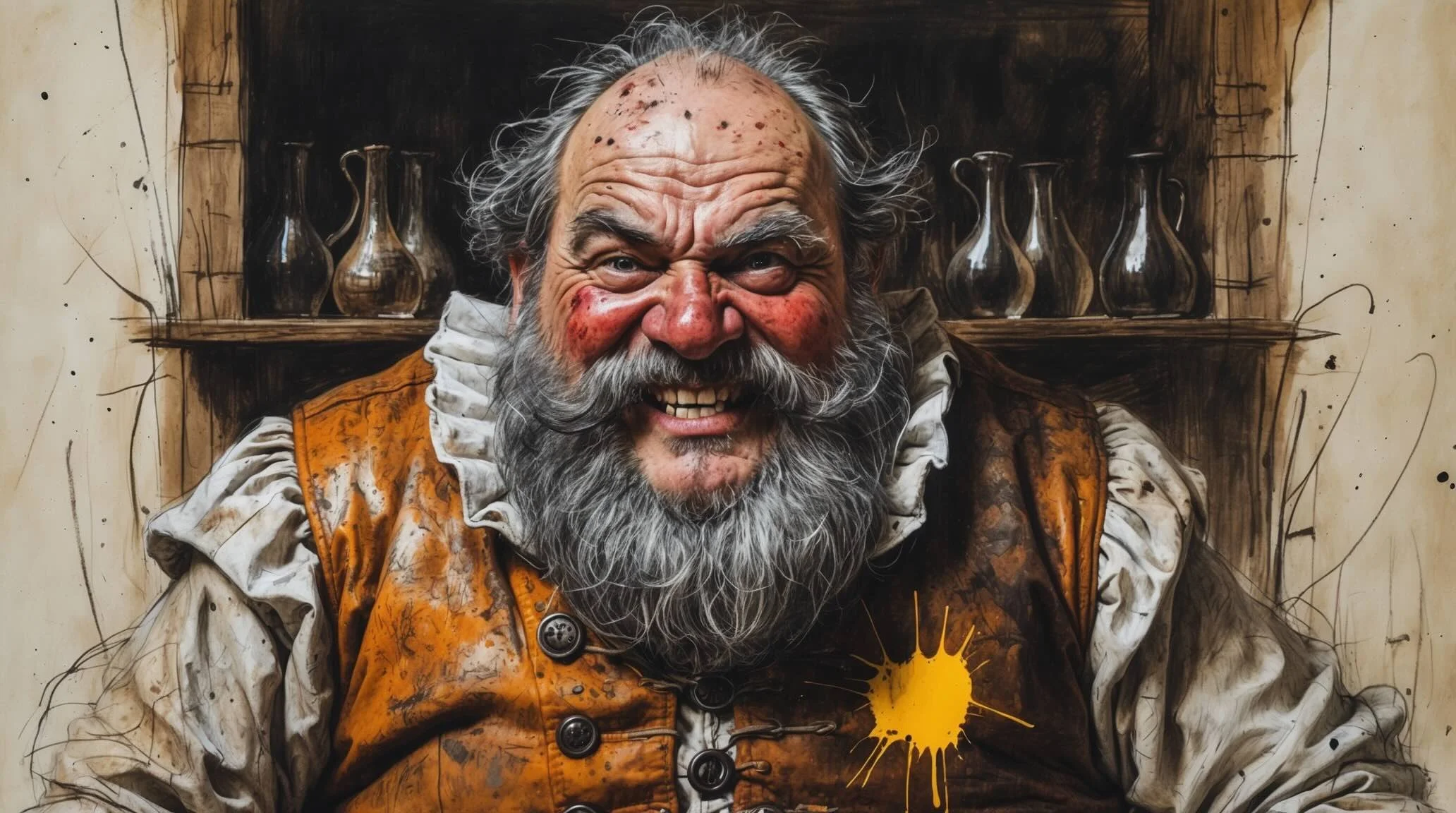
Character Profile – At a Glance
- Role: Olivia’s kinsman, her late father’s brother, who has installed himself in her household as a permanent guest. He is the play’s Falstaffian uncle, the agent of its revelry, and the co-architect, with Maria, of the gulling of Malvolio.
- Key Traits: Drunken, witty, and generous with other people’s money. He loves singing and catches, and is openly contemptuous of moralising. Beneath the comic surface, he is the most calculating exploiter of Sir Andrew in the play.
- The Core Conflict: A drinking-uncle living off his niece’s hospitality, financing his pleasures with Sir Andrew’s three thousand ducats a year. He rules the household by sheer comic personality, until the broken-head scene of A5S1 exposes what his pleasures have cost everyone around him.
- Key Actions: Opens A1S3 with his comic dismissal of Olivia’s mourning and introduces Sir Andrew to Maria. He leads the carousing in A2S3, hides in the box-tree in A2S5, and orchestrates Sir Andrew’s challenge to Cesario in A3S4. He engineers Malvolio’s dark-room imprisonment in A4S2, then returns bloodied in A5S1 and dismisses Sir Andrew as "a thin-faced knave, a gull".
- Famous Quote:
"Dost thou think, because thou art virtuous, there shall be no more cakes and ale?"
(Act 2, Scene 3) - The Outcome: He marries Maria offstage, as Olivia reports in A5S1. He exits the play with a broken head, a new wife, and the implication that his welcome in the house is no longer indefinite. The most line-rich character in the play, and one of Shakespeare’s most fully drawn comic patriarchs.
The Uncle in Residence
Sir Toby’s first line in the play is the line that establishes everything about him – register, philosophy, and structural function – in twenty words.
Original
What a plague means my niece, to take the death of her brother thus? I am sure care’s an enemy to life.
(Act 1, Scene 3)
Shakespeare Retold (Modern Verse)
Why does my niece lament her brother’s death as though it were the plague? It can’t be healthy.
The line is one of Shakespeare’s most efficient pieces of character-establishment. Sir Toby has heard about Olivia’s seven-year mourning vow, and his immediate response is comic dismissal – "care’s an enemy to life", the philosophical maxim of a man who has organised his entire existence around the avoidance of care. The line also establishes the household’s domestic geometry. Sir Toby is on the premises of his niece’s house, has views about how that niece should be conducting her affairs, and is articulating those views over a drink. The pattern will run through every scene he appears in. By the end of the same scene, he has flattered Sir Andrew into staying another month, secured the household’s continued supply of three thousand ducats a year for his drinking, and converted Maria’s rebuke about his hours into a joke about confinement. The audience’s response is, for four acts, a kind of affection. The man is, by any sober measure, a freeloader and a manipulator; the play makes him so entertaining that the moral verdict has to be postponed until the final scene.
The Carousing Scene and "Cakes and Ale"
A2S3 is Sir Toby’s most-celebrated set-piece, and it contains what many regard as the comic peak of the play. He is drinking through the night with Sir Andrew and Feste; Maria has tried to quiet them; Malvolio has arrived to scold them. Sir Toby’s response is one of the play’s most-quoted single sentences.
Original
Art any more than a steward? Dost thou think, because thou art virtuous, there shall be no more cakes and ale? … Go, sir, rub your chain with crumbs. A stoup of wine, Maria!
(Act 2, Scene 3)
Shakespeare Retold (Modern Verse)
Are you more than just a servant? And, as you are good, do you believe all others can’t have fun? … Go polish up your necklace with some breadcrumbs. Now, a jug of wine, Maria!
The "cakes and ale" line has become, in the four centuries since the play, the most-quoted single sentence in any of Shakespeare’s comedies on the subject of festivity. Its power is that it is, in argument, unanswerable. Malvolio has the formal authority of the steward; Sir Toby has only the kinsman’s privilege and the cultural weight of the household’s right to its own pleasures. The line converts the kinsman’s privilege into a philosophical position. Virtue, the line argues, does not have the authority to abolish the small pleasures – cakes, ale, ginger hot in the mouth – by which ordinary domestic life is sustained. The "Art any more than a steward?" opening sharpens this by reminding Malvolio of his actual social position; the closing instruction to Maria ("A stoup of wine") demonstrates that the carousing will continue regardless. The scene is also the immediate trigger for the gulling plot. Within sixty further lines, Maria will have proposed the forged letter, Sir Toby will have agreed ("If I do not gull him into a nayword…"), and the play’s most consequential comic engine will have been set in motion. The "cakes and ale" line is the play’s articulation of the principle the gulling will be designed to defend.
The Architect of the Duel
By A3S4 Sir Toby has moved from defending the household’s pleasures to engineering its cruelties. He has persuaded Sir Andrew that "Cesario" is a rival for Olivia’s affection, has read Sir Andrew’s badly-written challenge and decided to deliver it orally instead, and is now setting up the comic duel between two figures – Sir Andrew and "Cesario" – neither of whom has any business holding a sword.
Original
Now will not I deliver his letter: for the behaviour of the young gentleman gives him out to be of good capacity and breeding; his employment between his lord and my niece confirms no less: therefore this letter, being so excellently ignorant, will breed no terror in the youth: he will find it comes from a clodpole. But, sir, I will deliver his challenge by word of mouth; set upon Aguecheek a notable report of valour...
(Act 3, Scene 4)
Shakespeare Retold (Modern Verse)
Now I won’t send his letter, for the conduct of that young man implies that he’s a good man and well bred; his interactions with his lord and with my niece confirm that. And so, this letter – such an idiotic note – won’t frighten him. He will think it’s written by a dimwit. But, sir, I’ll recount the challenge to him by word of mouth, describing Aguecheek as full of courage...
The speech is Sir Toby at his most theatrically calculating, and the play’s clearest demonstration that the cynicism the carousing-scenes have suggested is operational rather than rhetorical. He is reading Viola’s social register accurately; he is reading Sir Andrew’s capacity to compose a challenge accurately; and he is converting both readings into a plan that will produce a comic duel by terrifying both parties with reports of the other’s prowess. The plan works. Within sixty further lines, both Viola and Sir Andrew are shaking with fear and trying to flee. The duel is averted only by Antonio’s arrest. The structural achievement is impressive and the moral position is bleak. Sir Toby is using Sir Andrew’s infatuation with Olivia to manufacture an entertainment at the expense of two innocent figures, and the play makes clear – although it does not yet press the point – that the entertainment is being paid for, financially and physically, by the participants rather than the orchestrator.
The Broken Head and the Dismissal
A5S1 is the play’s reckoning, and Sir Toby’s reckoning is the harshest in the comedy that allows him to survive. He has been beaten by Sebastian off-stage; he returns bleeding from the head; Sir Andrew, also bleeding, calls to him for help; Sir Toby’s response is the play’s most exposed piece of unkindness.
Sir Andrew calls to him, and Sir Toby turns on him:
Original
SIR ANDREW: I'll help you, Sir Toby, because well be dressed together.
SIR TOBY: Will you help? An ass-head and a coxcomb and a knave, a thin-faced knave, a gull!
(Act 5, Scene 1)
Shakespeare Retold (Modern Verse)
SIR ANDREW: I’ll help, Sir Toby. We’ll be bandaged up together.
SIR TOBY: How will you help? You’re just a clot, a fool, a simple-minded idiot.
The line is the play’s most direct demonstration that the friendship Sir Toby has been performing for four acts has never existed on the terms Sir Andrew believed it did. Sir Toby’s flattery in A1S3, his loyalty in A2S3, his strategic patronage in A3S4 – all of it has been the apparatus by which Sir Andrew’s three thousand ducats a year have funded the household’s drinking. The A5S1 line strips the apparatus away. With Sir Andrew now beaten, bloodied, and visibly useless, Sir Toby – bleeding himself, in pain, and no longer in command of the situation – drops the performance and names the relationship for what it has always been. The dismissal is not redeemed. The play does not give Sir Toby a final scene with Sir Andrew in which to apologise or to acknowledge what has been done; Sir Toby exits the stage on Olivia’s instruction to be put to bed, and the next reference to him is Olivia’s announcement that he has married Maria. The marriage to Maria is the comedy’s rough justice: Sir Toby ends the play with a new wife who is, the audience knows, sharper than he is, and with a niece who has finally been given evidence of the cost of his welcome. The household’s drinking days are, by implication, numbered.
"What can be better than Sir Toby’s unanswerable answer to Malvolio, ’Dost thou think, because thou art virtuous, there shall be no more cakes and ale?’"
— William Hazlitt, Characters of Shakespeare’s Plays, 1817
Key Quotes
Quote 1
Confine! I’ll confine myself no finer than I am...
(Act 1, Scene 3)
Shakespeare Retold (Modern Verse)
Confines? I’m only confined by my clothing.
Quote Analysis: Sir Toby’s answer to Maria’s warning that he must keep himself within "the modest limits of order". He hears the word "confine" and refuses it outright: the only thing that confines him, he jokes, is his own clothing, which is "good enough to drink in". The line is the cleanest statement of his governing principle, that he will accept no restraint on his pleasures, and it sets up the collision with Malvolio that drives the whole comic plot. Order, for Sir Toby, is the enemy.
Am not I consanguineous? Am I not of her blood?
(Act 2, Scene 3)
Shakespeare Retold (Modern Verse)
Aren’t I related? Aren’t we family?
Quote Analysis: Sir Toby’s defence of his place in the household, thrown back at Malvolio in the carousing scene. The mock-grand word "consanguineous" – of the same blood – is the whole of his claim: he is Olivia’s kinsman, and kinship, not employment, is what entitles him to be in the house. The line exposes the social fault-line the play keeps pressing. Sir Toby has blood but no real authority; Malvolio has authority but no blood, and the two men are permanently at odds over which counts for more.
To the gates of Tartar, thou most excellent devil of wit!
(Act 2, Scene 5)
Shakespeare Retold (Modern Verse)
Off to the gates of hell, you splendid prankster!
Quote Analysis: Sir Toby’s delighted tribute to Maria after the box-tree scene, watching Malvolio swallow the forged letter whole. "Tartar" is the classical underworld, and the hyperbole is admiring rather than alarmed: Maria’s wit is so sharp it seems almost diabolical, and Sir Toby loves her for it. The line is the clearest sign of where his real affection in the play lies, and it quietly prepares the offstage marriage that will reward Maria for the very cleverness he is praising here.
Go, write it in a martial hand; be curst and brief...
(Act 3, Scene 2)
In the Shakespeare Retold modern verse: Go write it in a warlike style. Be short and rude...
Quote Analysis: Sir Toby coaching Sir Andrew to write a challenge to "Cesario", urging him to fill the letter with insults and lies. The instruction is pure manipulation. Sir Toby has no interest in Sir Andrew’s honour; he wants the entertainment of a duel between two terrified incompetents, and he is stage-managing it from behind the scenes. The relish in "be curst and brief" is the relish of a man arranging other people’s humiliation for sport, and the speech is the engine of the A3S4 duel that follows.
Key Takeaways
- The Cakes and Ale Defender: "Dost thou think, because thou art virtuous, there shall be no more cakes and ale?" is the play’s most-quoted defence of festivity, and the case against the killjoy in a single sentence.
- The Falstaffian Uncle: Sir Toby has more speeches than any other figure in the play (152), and he is one of Shakespeare’s most fully drawn comic patriarchs, drinking, manipulating, and ruling the household by force of comic personality.
- The Cynical Patron: The flattery of Sir Andrew across four acts is the play’s most sustained portrait of a transactional friendship, and the A5S1 dismissal, "an ass-head and a coxcomb and a knave", is its exposed conclusion.
- The Married Survivor: The offstage marriage to Maria is the comedy’s rough justice. Sir Toby ends the play with a sharper wife and a niece who has finally been given evidence of what his welcome has cost the household.
Study Questions and Analysis
Is Sir Toby Belch a Falstaffian figure?
The comparison has been one of the most-discussed in criticism of the play, and it is partly accurate and partly misleading. The accuracies are obvious. Sir Toby is, like Falstaff, a fat, drinking, witty, cynical older man attached to a younger gentleman whose money he is partly fleecing; both figures organise their existence around the avoidance of work and the pursuit of small pleasures; both speak in prose of remarkable verbal facility; both are openly contemptuous of moralising authority figures (Malvolio for Sir Toby, the Lord Chief Justice for Falstaff); both are eventually rebuffed by the social order they have been exploiting. The misleadings are more interesting. Falstaff is a knight without a household, attached to Prince Hal as a kind of comic father-substitute; Sir Toby is a kinsman with a household, attached to Olivia as her late father’s brother, and is operating from a position of family privilege rather than borrowed grace. Falstaff is a battlefield figure as well as a tavern figure; Sir Toby never leaves the domestic register. Falstaff is given the great rejection scene in Henry IV, Part 2 – Hal’s "I know thee not, old man" – and the play stages it as tragedy; Sir Toby is given the small rejection of the broken-head scene and a quiet offstage marriage to Maria, and the play stages it as comic rough justice. The most useful answer is probably that Sir Toby is what one critic has called a "minor-league Falstaff" – a figure recognisably drawn from the same archetype, working at a smaller scale in a domestic register, and demonstrating Shakespeare’s interest in revisiting the type of comic patriarch he had developed five years earlier in the history plays.
Why does Sir Toby exploit Sir Andrew?
The exploitation is one of the play’s most sustained portraits of cynical patronage, and Sir Toby’s reasons are clear from his first scene. Sir Andrew has three thousand ducats a year – a substantial gentleman’s income – and no idea how to manage it. Maria diagnoses the situation in A1S3 with characteristic precision:
He’s a very fool and a prodigal.
(Act 1, Scene 3)
Shakespeare Retold (Modern Verse)
He’s foolish with his money, over-lavish.
Sir Toby’s response, when Maria presses the point, is the kind of self-revelation Shakespeare permits him only once: he is keeping Sir Andrew at the house because Sir Andrew’s money is funding his drinking. The exploitation is also, the play makes clear, structural rather than personal. Sir Toby does not particularly dislike Sir Andrew; he simply does not particularly like him. The friendship is operating on the terms Sir Toby has set for it: company, drinking, the pretended prospect of marriage to Olivia, and the corresponding flow of money. What changes in A5S1 is that the friendship’s terms are no longer producing benefit. Sir Andrew, having been beaten by Sebastian, is now a liability – he has no further use as a duel-volunteer, his prospect of marriage to Olivia is permanently destroyed by her marriage to Sebastian, and the cost of maintaining the friendship now exceeds the return. Sir Toby drops the performance immediately. The line "an ass-head and a coxcomb and a knave" is not a betrayal of friendship; it is the cancellation of a contract that has stopped paying.
How does the marriage to Maria fit Sir Toby’s character?
The marriage is reported, not performed, and the report – Olivia’s lines in A5S1 – frames it as a transaction:
The letter at Sir Toby’s great importance;
In recompense whereof he hath married her.
(Act 5, Scene 1)
Shakespeare Retold (Modern Verse)
The letter at Sir Toby’s instigation,
And in return for that, he married her.
The phrasing makes the marriage a reward for Maria’s authorship of the forged letter that humiliated Malvolio. Within Sir Toby’s economy, the marriage is recognisable as a small piece of structural sense. Sir Toby has been living off Sir Andrew’s money for four acts; that source is now exhausted; Maria is sharp, capable, and visibly attached to him; the marriage gives him a new domestic partner who can manage his affairs more competently than he can. The contrast with Maria’s situation is illuminating. She gains social ascent – the waiting-gentlewoman becomes a knight’s wife – and she gains a husband she has been visibly fond of since A1S3. He gains a household manager and the implicit acknowledgement that his welcome in Olivia’s house is no longer indefinite. The marriage’s quietest comic note is that Maria, the more intelligent of the two, will now be the de facto head of the household – Sir Toby has acquired a wife who knows him better than he knows himself, and the play implies that this is exactly what he needs. The "minor-league Falstaff" reading finds its proper conclusion here: Sir Toby is not, like Falstaff, rejected and broken. He is, in the play’s comic generosity, married off to a woman who will keep him alive.
Is the gulling of Malvolio Sir Toby’s responsibility or Maria’s?
The honest answer is that they share the design and divide the execution. The forged letter is Maria’s invention – she proposes the plot in A2S3, she writes the letter, she throws it into Malvolio’s path in A2S5 – and the credit for the comic engine is hers. The dark-room imprisonment of Acts 4 and 5 is Sir Toby’s escalation. The letter scene is, in C. L. Barber’s Shakespeare’s Festive Comedy (1959), recognisably comic; the imprisonment is darker, and Sir Toby – who has by this point acquired the additional confederate Feste – extends the gulling into territory the original plot did not require. The shift is visible in the play’s text. Maria proposes the letter; Sir Toby proposes the imprisonment ("he is now in a dream, and when the image of it leaves him he must run mad"); Feste performs the role of Sir Topas. By A4S2 even Sir Toby has begun to want the prank over:
I would we were well rid of this knavery.
(Act 4, Scene 2)
Shakespeare Retold (Modern Verse)
I would like to stop all this tomfoolery.
The line acknowledges that the gulling has gone further than it should have, and that the consequences for Olivia if the truth emerges may exceed the benefits of the comic vengeance. The most useful answer, then, is that the gulling has two architects with different ranges. Maria designed an elegant piece of comic vengeance; Sir Toby took it past the point of elegance into something approaching cruelty. The marriage between them at the play’s end is partly the comedy’s structural acknowledgement that both of them have, between them, produced the play’s most consequential comic action.
What does "care’s an enemy to life" mean?
The line is Sir Toby’s opening philosophical statement, delivered in A1S3 as his immediate response to Olivia’s seven-year mourning vow for her brother. The proverb is older than the play – versions appear in Renaissance commonplace books – but Sir Toby’s use of it gives it the meaning it has carried in English since. "Care" in early modern usage carries both modern senses (anxiety, sorrow) and a slightly stronger one (the cultivation of solemnity as a way of life). Sir Toby is arguing that grief, prolonged into permanent disposition, is not just unhealthy but actively hostile to the act of being alive. The line is partly self-justification – Sir Toby’s drinking is, in his own framing, life-affirming rather than dissipative – and partly the play’s quiet philosophical position. Olivia’s seven-year vow is, the play implies, an excessive response to grief; Orsino’s luxuriating in unrequited love is similarly excessive; Viola’s "patience on a monument" speech in A2S4 will name the dignified middle position the extremes cannot reach. Sir Toby’s line, in this reading, is the comic-cynical version of an argument the play takes seriously. Care is real, and grief is real, but neither has the authority to abolish the life it is responding to. The "cakes and ale" speech in A2S3 will give the same argument a more festive formulation, and the play’s marriages at the end will give it the structural endorsement of comic resolution.
How does Sir Toby compare to Falstaff?
The comparison is one of the most-discussed in criticism, and it works in both directions. Both figures are fat, drinking, witty, cynical older men attached to younger figures whose money or grace they are partly exploiting; both speak prose of remarkable verbal facility; both produce comic philosophy in defence of their own conduct ("care’s an enemy to life" for Sir Toby, "honour is a mere scutcheon" for Falstaff); both are eventually rebuffed by the social order they have been operating within. What distinguishes them is the register and the consequence. Falstaff operates at the scale of national politics – his rejection by Hal at the end of Henry IV, Part 2 is a public act, witnessed by the court, and it kills him; Sir Toby operates at the scale of a domestic household, and his rejection of Sir Andrew in A5S1 is a private moment that the play absorbs into its comic resolution. Falstaff’s writing has the scale of tragedy folded into comedy – his "We have heard the chimes at midnight" speech in Henry IV, Part 2 is one of Shakespeare’s most affecting elegies for a wasted life; Sir Toby has nothing comparable. The brevity of his interior life is the play’s deliberate choice. Twelfth Night is calibrated for comic resolution, and a Falstaff-scale interior on its drinking-uncle would unbalance the play. The "minor-league Falstaff" description is, in this reading, a structural rather than evaluative judgement. Sir Toby is what the play needs him to be – a comic patriarch large enough to dominate the household and small enough to be married off in the final scene.
Does the play punish or forgive Sir Toby?
The honest answer is that it does both, lightly. The broken-head scene of A5S1 is the play’s most direct piece of physical comeuppance – Sir Toby has spent four acts orchestrating other people’s brawls, and now he is bleeding from one himself. The dismissal of Sir Andrew ("an ass-head and a coxcomb and a knave") is the play’s exposure of what the friendship has been, and it costs Sir Toby the audience’s sympathy in the moment of its delivery. Olivia orders him away to be cared for, the household closing over the damage he has caused:
Get him to bed, and let his hurt be looked to.
(Act 5, Scene 1)
Shakespeare Retold (Modern Verse)
Put him to bed, and let his wounds be looked at.
The marriage to Maria is the play’s rough justice – Sir Toby is married off to a sharper-minded partner who will, the play implies, manage him more competently than he has been managing himself. What the play withholds is the kind of large-scale punishment Falstaff receives in Henry IV, Part 2. Sir Toby is not expelled from Olivia’s house; he is not bankrupted; he does not die. He exits the stage with a broken head, a new wife, and the implicit acknowledgement that his welcome is no longer indefinite. The forgiveness is in the comic structure itself. Twelfth Night is a play that absorbs its difficulties – the gulling of Malvolio, the silence of Antonio, the exclusion of Sir Andrew – into a marriage-resolution structure that processes them rather than resolving them. Sir Toby is one of the figures the structure processes. He is given enough comic punishment to make the comedy’s moral arithmetic plausible, and enough comic generosity to keep him alive in the household at the play’s end. William Hazlitt’s 1817 Characters of Shakespeare’s Plays gives the audience’s final response: a lingering "friendship for Sir Toby". The man has done a great deal of damage; the comedy has allowed him to survive it; the audience, having laughed with him for four acts, is invited to let him go to bed.