Antonio
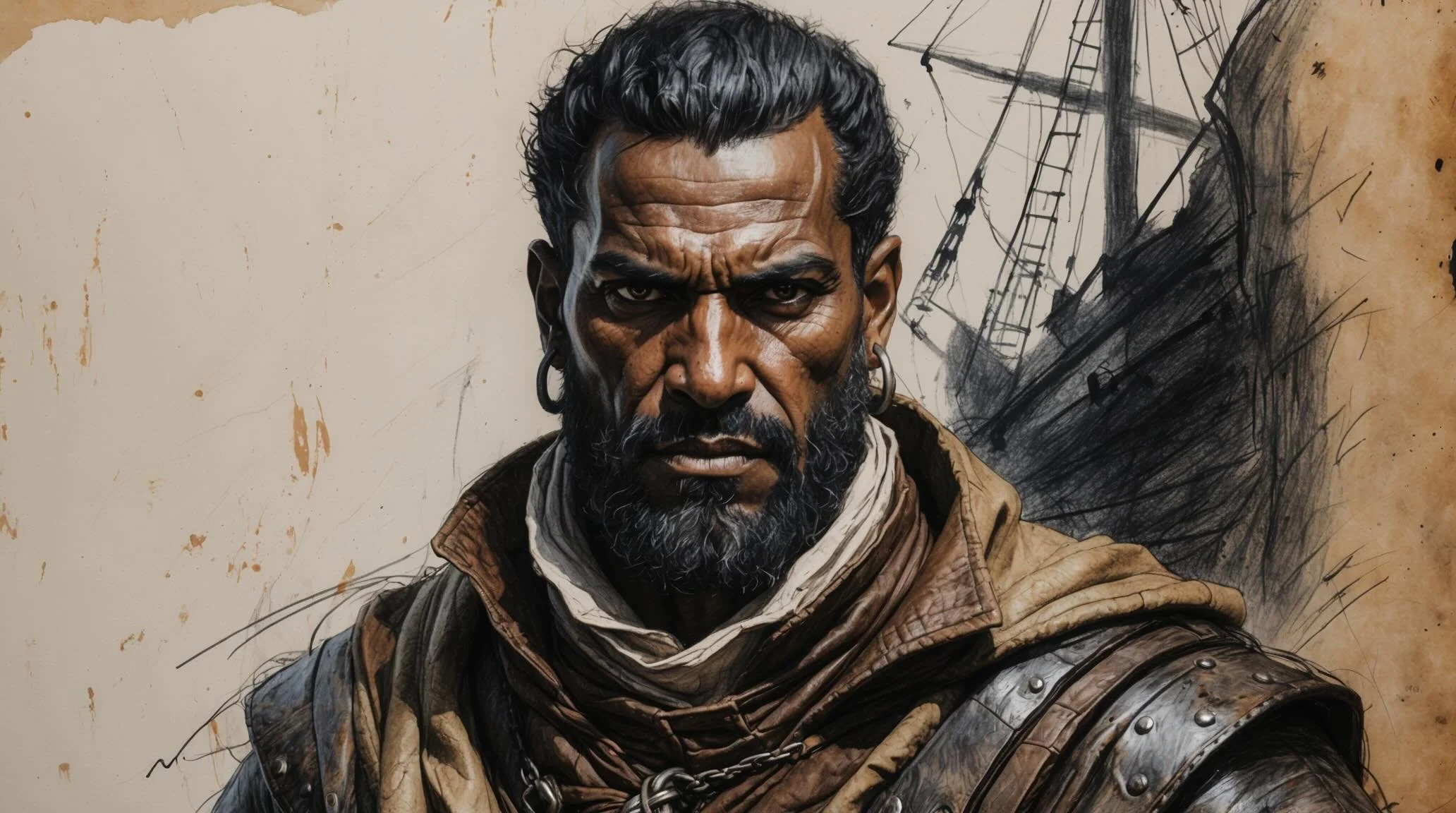
Character Profile – At a Glance
- Role: A sea captain and former enemy of Orsino, the rescuer and devoted companion of Sebastian. He is the play’s most articulate voice of unconditional love, and his devotion makes him both the most generous and the most exposed figure in Illyria.
- Key Traits: Loyal, courageous, openly devoted, and generous to the point of self-endangerment. When he believes himself betrayed, he is capable of one of Shakespeare’s most painful protests against ingratitude.
- The Core Conflict: A wanted man in Orsino’s territory who follows Sebastian into the city anyway, gives him his purse, and fights for him in a street brawl. He is then arrested and, as it seems, denied by the very person he has saved – except that the person denying him is Viola in disguise, mistaken for her twin.
- Key Actions: Insists on accompanying Sebastian ashore in A2S1 despite his enemies in Orsino’s court, and gives him his purse for safekeeping in A3S3. He intervenes in the duel between Sir Andrew and "Cesario" in A3S4 and is arrested, then is devastated when Viola, believing she is Sebastian, appears to deny him. He speaks the "witchcraft drew me hither" speech to Orsino in A5S1, sees the twins reunited, and vanishes from the play without a final line.
- Famous Quote:
"But, come what may, I do adore thee so,
That danger shall seem sport, and I will go."
(Act 2, Scene 1) - The Outcome: He survives the play but is left structurally alone. Sebastian is reunited with Viola and pledged to Olivia; Antonio’s last spoken lines are the witchcraft speech in A5S1; he is given no exit speech, no pairing, and no resolution. The silence at the end is one of the play’s most-discussed structural choices.
The Decision to Follow
Antonio’s first scene is a small structural masterpiece. He has rescued Sebastian from the wreck that drowned the young man’s sister; Sebastian, in grief and gratitude, is preparing to leave for Orsino’s court alone; and Antonio – knowing that the court is dangerous to him – must decide whether to let Sebastian walk into Illyria unprotected.
Original
The gentleness of all the gods go with thee!
I have many enemies in Orsino’s court,
Else would I very shortly see thee there.
But, come what may, I do adore thee so,
That danger shall seem sport, and I will go.
(Act 2, Scene 1)
Shakespeare Retold (Modern Verse)
The gentleness of all the gods go with you!
I’ve enemies in Count Orsino’s court;
If not, I’d see you there again quite soon.
But, whatever the outcome, I adore you,
And though there’s danger, I will go there for you.
The five-line soliloquy is one of Shakespeare’s most efficient pieces of character-establishment. Antonio has a real, named, immediate reason not to enter Illyria – his enemies in the court will arrest him on sight – and he goes anyway, because he loves Sebastian. The verb is exact: not "I love" but "I do adore thee so." The construction places adoration above prudence, and the closing rhyme – "sport" with "court", "so" with "go" – gives the decision its proverbial weight. This scene is the first demonstration of what is, by common agreement, the most openly avowed love in the play. It does not pretend to be anything other than what it is, and Antonio does not pretend either. He has done the calculation; danger is on one side and adoration on the other; adoration wins.
The Purse
By A3S3, the two have reached the city. Antonio, who must keep out of sight, stays at the Elephant inn while Sebastian sees the town. The exchange that closes the scene is one of Shakespeare’s quietest demonstrations of unstinting generosity.
Original
It doth not fit me. Hold, sir, here’s my purse.
In the south suburbs, at the Elephant,
Is best to lodge: I will bespeak our diet,
Whiles you beguile the time and feed your knowledge
With viewing of the town: there shall you have me.
(Act 3, Scene 3)
Shakespeare Retold (Modern Verse)
It’s not a good idea. Wait, here’s my purse.
The Elephant hotel, south of the city,
Will be the best to stay at. I’ll get food,
While you can take your time and learn about
The sights within the town. I’ll meet you there.
The purse is the play’s most direct gift of trust. Antonio hands over what is, by his own admission a few lines later, almost everything he has – and does so on the assumption that Sebastian will keep their rendezvous and that Antonio’s caution about being recognised in the streets is the more pressing risk. The action is small, almost domestic, and structurally enormous. Within the next hour of stage time, Antonio will be in the street fighting for someone who looks exactly like Sebastian, will be arrested by Orsino’s officers, will ask for the purse back, and will be – as it appears to him – denied. The whole catastrophe of his arrest scene depends on the trust this scene establishes. The purse is not just money; it is the proof that Antonio’s love is unguarded, and unguardedness, in the Illyria the play depicts, is what gets you arrested.
"Will You Deny Me Now?"
A3S4 contains Antonio’s most extended and most painful speech. Sir Andrew has challenged "Cesario" – actually Viola in disguise – to a duel; Antonio, recognising the figure as the man he loves, intervenes and is immediately arrested by Orsino’s officers. He turns to "Sebastian" – actually Viola – and asks for his purse back. She does not know him.
Original
Will you deny me now?
Is’t possible that my deserts to you
Can lack persuasion? Do not tempt my misery,
Lest that it make me so unsound a man
As to upbraid you with those kindnesses
That I have done for you.
…
But O how vile an idol proves this god
Thou hast, Sebastian, done good feature shame.
In nature there’s no blemish but the mind;
None can be called deformed but the unkind:
Virtue is beauty, but the beauteous evil
Are empty trunks o’erflourished by the devil.
(Act 3, Scene 4)
Shakespeare Retold (Modern Verse)
Will you disown me now?
How can you, after all I’ve done for you,
Not help me out? Don’t make me more upset
In case I’m forced to do an awful thing
Reminding you of all the acts of kindness
I’ve done for you.
…
But oh, how awful has my hero proven!
Sebastian, you’ve pilloried your good looks.
There’s nothing bad in nature, but the mind;
For nothing’s bad except being unkind.
Now beauty’s beautiful, but evil beauty
Is just an empty shell, the devil’s duty.
The speech is one of Shakespeare’s most concentrated images of betrayed love, and the audience knows what Antonio does not: that the figure denying him is not Sebastian but Sebastian’s twin sister, who has never met Antonio, and who is telling the truth when she says she does not know him. The dramatic irony is the play’s whole structural point. Antonio is not actually being denied; he is the victim of a misidentification that the play’s geometry has produced. But within his experience of the moment, the betrayal is total – and the speech he delivers is a small masterclass in how love, when it believes itself denied, converts into the language of moral condemnation. Sebastian is no longer beautiful; he is "an idol", "an empty trunk o’erflourished by the devil". The progression from "will you deny me now?" to "in nature there’s no blemish but the mind" is one of Shakespeare’s most painful tracks of an emotion in real time. Antonio loves; Antonio believes he is denied; Antonio converts the love into a curse; Antonio is led off to prison. The audience watches each step, knowing the misunderstanding, and unable to correct it.
The Witchcraft Speech
By Act 5, the comedy’s machinery is moving toward resolution: Sebastian and Viola are converging, the disguises are starting to crack, and the various lovers are about to find their pairings. Antonio, brought before Orsino in chains, gives the speech that names the depth of what he believes he has lost.
Original
A witchcraft drew me hither:
That most ingrateful boy there by your side,
From the rude sea’s enraged and foamy mouth
Did I redeem; a wreck past hope he was:
His life I gave him and did thereto add
My love, without retention or restraint,
All his in dedication; for his sake
Did I expose myself, pure for his love,
Into the danger of this adverse town...
(Act 5, Scene 1)
Shakespeare Retold (Modern Verse)
Deception brought me here.
That most ungrateful boy that stands beside you
I rescued from tempestuous rough seas.
I saved him; he had no chance of survival.
I gave him life and then I gave my love
Without commitment or an obligation,
And dedicated everything to him.
For him, and out of love, I risked it all
By coming to this dangerous, hostile town.
The speech is Antonio’s last sustained moment in the play, and it is also the play’s most direct articulation of the kind of love that has no marriage available to it. Every other major figure in the comedy will pair off in the final scene – Orsino with Viola, Olivia with Sebastian, Sir Toby with Maria – and Antonio will not. He will see Sebastian recognised, see the misidentification explained, see the lovers reunited; and then the play will simply move past him. The "witchcraft" he names is the bewilderment of having loved without limit and finding, when the geometry resolves, that the limit was always there. The phrase "without retention or restraint" is Antonio’s own description of what he has given Sebastian, and the comedy’s structure cannot quite accommodate it. Marriage is the form in which the play resolves love; Antonio’s love, the play implies, is real and unmarriageable. The silence that surrounds him in the final scene is the play’s quietest acknowledgement of the cost of its own happy ending.
"The strongest and most direct expression of homoerotic feeling in Shakespeare’s plays."
— Bruce R. Smith, Homosexual Desire in Shakespeare’s England, 1991
Key Quotes
Quote 1
If you will not murder me for my love, let me be your servant.
(Act 2, Scene 1)
Shakespeare Retold (Modern Verse)
If, for my love, you will not murder me, then let me be your servant.
Quote Analysis: Antonio’s first sustained line to Sebastian, and a piece of language with no obvious equivalent elsewhere in the play. The construction – "murder me for my love" – equates being sent away with being killed, and the request to "be your servant" places Antonio in a position of voluntary subordination. The line is hyperbolic by ordinary standards and exact by his. He is asking, in fifteen words, to organise his life around Sebastian’s, and offering to absorb whatever cost that organisation requires.
I could not stay behind you: my desire, more sharp than filed steel, did spur me forth...
(Act 3, Scene 3)
Shakespeare Retold (Modern Verse)
I couldn’t stay behind once you had gone.
My wish, as sharp as steel, did spur me onwards...
Quote Analysis: Antonio explaining why he could not let Sebastian walk into Illyria alone. The image is physical and urgent – his longing is "more sharp than filed steel", a spur driving him forward against his own better judgement about the danger of the town. The line is the clearest statement of the involuntary quality of his devotion: he does not decide to follow so much as find himself unable not to. It is the impulse that the purse, the brawl, and the arrest will all follow from.
This youth that you see here I snatched one half out of the jaws of death, relieved him with such sanctity of love...
(Act 3, Scene 4)
Shakespeare Retold (Modern Verse)
This youth you see
I saved from half-way down the jaws of death,
And brought him comfort from the love I gave him...
Quote Analysis: Antonio’s account of the rescue, delivered to the officers arresting him while the figure he saved – actually Viola – stands silent and unrecognising. The phrase "sanctity of love" raises the rescue from a sailor’s good deed to something close to devotion, and it lands in the cruellest possible context: he is describing his love for Sebastian to the very face that has just appeared to deny him. The speech is both a defence to the officers and an appeal to the person he believes has abandoned him, and neither lands.
To-day, my lord; and for three months before, no interim, not a minute’s vacancy, both day and night did we keep company.
(Act 5, Scene 1)
Shakespeare Retold (Modern Verse)
Today, my lord; and for the past three months,
Without a single moment spent apart,
Each day and night we’ve spent the time together.
Quote Analysis: Antonio’s answer when Orsino asks how long he has known the youth, and the most precise measure of the bond the play gives us. "Not a minute’s vacancy" is the language of someone counting the hours – three months of unbroken company, named with the exactness of a man for whom that time was the whole of his life. The line sits in A5S1, moments before the play declines to give him any further place in it, and the contrast between the fullness it describes and the silence that follows is part of what makes his ending so quietly bleak.
Key Takeaways
- The Most Articulate Lover: Antonio’s love for Sebastian is named more directly than any other affection in the play, and the openness of that declaration is what makes him the comedy’s most exposed figure.
- The Generous to the Point of Endangerment: He follows Sebastian into Orsino’s territory knowing it will get him arrested, gives him his purse, and intervenes in his fight – and the play makes clear that each of these acts is freely chosen.
- The Victim of the Plot’s Geometry: The A3S4 betrayal scene is one of Shakespeare’s most painful pieces of dramatic irony – Antonio is denied not by Sebastian but by Sebastian’s twin sister, who has never met him.
- The Unpaired Survivor: Of the play’s named figures with significant roles, Antonio is the only one whose love is real and whose ending is structurally alone – the silence around him in A5S1 is one of the play’s most-discussed final notes.
Study Questions and Analysis
Is Antonio’s love for Sebastian romantic or merely a friendship?
The question has been one of the most-discussed in modern criticism of the play, and the answer depends partly on what frame one applies. Within the conventions of Renaissance male friendship – what early modern English culture called "amitié", the idealised bond between two men of similar standing – Antonio’s devotion to Sebastian is intelligible as the highest form of friendship. Sidney’s Arcadia and Montaigne’s essay "Of Friendship" both describe such bonds in language that overlaps significantly with Antonio’s. Within modern critical readings, however, the language of Antonio’s speeches has struck most readers as more direct and embodied than the friendship convention quite accommodates. Bruce Smith’s Homosexual Desire in Shakespeare’s England (1991) calls the relationship "the strongest and most direct expression of homoerotic feeling in Shakespeare’s plays", and Joseph Pequigney’s 1992 essay "The Two Antonios and Same-Sex Love in Twelfth Night and The Merchant of Venice" argued at length that the relationship is unmistakably erotic. Later critics, including Casey Charles in his 1997 essay "Gender Trouble in Twelfth Night", have refined this by warning against "unproblematically applying contemporary constructions of sexual identity to an early modern culture in which the categories of homo- and bisexuality were neither fixed nor associated with identity". The most useful answer is probably that the love is real, that the language exceeds the conventions of friendship, and that the early modern culture in which the play was written did not have the modern vocabulary for naming what kind of love it is. The play allows the reader to recognise the depth without requiring a single label.
Why is Antonio left alone at the end of the play?
The structural choice is one of the play’s most-discussed final notes. Every other major figure pairs off in A5S1: Orsino proposes to Viola, Olivia finds Sebastian is the husband she has just married, Sir Toby has married Maria offstage, and even Sir Andrew retains his eccentric status as the play’s gull. Antonio’s last real engagement is his wonder at seeing the twins side by side:
How have you made division of yourself? An apple, cleft in two, is not more twin Than these two creatures. Which is Sebastian?
(Act 5, Scene 1)
Shakespeare Retold (Modern Verse)
Have you split up and made yourself a clone?
An apple split in half is not more similar
Than these two people. Which one is Sebastian?
After this he is given no exit speech, no final line of his own, no romantic resolution. Several explanations operate together. Mechanically, the play’s marriage-resolution structure has no slot for him: the love he has expressed is for Sebastian, and Sebastian is being given to Olivia. Thematically, the silence may be the play’s quietest acknowledgement that the comedy’s machinery cannot accommodate every kind of love it contains. The marriages of Act 5 produce social order; Antonio’s love produces no marriage and therefore no social slot. Some productions resolve this by giving Antonio a small wordless moment with Sebastian at the very end – a touch, a look, an acknowledgement – that gestures at a relationship the comedy will not formalise. The play itself does not give him this. He is on stage, and then the action moves past him. As Marjorie Garber and other modern critics have noted, the residue of unaccommodated feeling is part of why Twelfth Night has been read as one of Shakespeare’s most ambivalent comedies – the happy ending has a cost, and Antonio is the figure on whom that cost most visibly falls.
How does the betrayal scene in Act 3, Scene 4 generate dramatic irony?
The scene is one of Shakespeare’s most concentrated pieces of dramatic irony, and the irony cuts in two directions at once. From the audience’s perspective, we know what Antonio does not: that the figure he is asking for his purse back is not Sebastian but Viola in disguise as the page Cesario. Viola has never met Antonio, and her bewilderment when he addresses her by name is genuine:
I know of none; nor know I you by voice or any feature...
(Act 3, Scene 4)
Shakespeare Retold (Modern Verse)
I don’t know any of them.
And I don’t know you by your face or voice...
Her denial is, from her perspective, factually accurate. From Antonio’s perspective, however, he is being denied by the man whose life he saved, whose purse is in the man’s possession, whom he has just risked arrest to defend in a street brawl. The collision of two true accounts is the play’s whole structural mechanism for the scene. Antonio’s pain is real. Viola’s confusion is real. Neither character is wrong about what they are perceiving, and the audience holds both perceptions at once. The technique is the comedy’s most painful single use of mistaken identity, and it is one of the reasons modern readers have sometimes found the scene more affecting than amusing. The errors that drive the comedy’s marriages also produce, here, a moment of damage that the comedy does not entirely repair.
What does the purse symbolise in Antonio’s relationship with Sebastian?
The purse is one of the play’s most economical pieces of symbolism, and it does several kinds of work at once. Mechanically, it sets up the dramatic irony of A3S4: Antonio gives Sebastian his purse in A3S3, then asks "Sebastian" (actually Viola) for it back, and the apparent denial is the speech’s whole emotional force:
What will you do, now my necessity makes me to ask you for my purse?
(Act 3, Scene 4)
Shakespeare Retold (Modern Verse)
What will you do now that I have to ask
You give me back my cash?
Symbolically, the purse stands for the unguardedness Antonio has chosen. He hands over what he himself has called almost everything he has, and he does so with no contract, no witness, no provision for retrieval. The act is the financial equivalent of the love he has already named: "without retention or restraint." The purse also has resonance with the play’s broader economy of exchange. Orsino trades messengers for Olivia’s love; Malvolio calculates social ambition; Sir Toby manages Sir Andrew’s money for his own ends. Antonio alone gives without expectation of return, and the gift is the proof of the love. Pequigney’s 1992 essay argues that Antonio’s transactions with Sebastian operate in a register the play’s other relationships do not enter. Whether or not one accepts Pequigney’s specifically erotic reading of the bond, the financial gesture is the play’s clearest image of what unconditional generosity looks like.
How does Antonio function as a foil to the play’s other lovers?
The play sets Antonio in contrast with several of its other lovers, and each contrast sharpens a different aspect of the comedy’s view of love. Orsino’s love for Olivia is talked about constantly and acted on barely; he sends messengers, writes verses, and luxuriates in the language of unrequited devotion. Antonio’s love for Sebastian is acted on at every opportunity and barely talked about until the betrayal scene forces it into speech. Olivia’s grief for her brother is performed in elaborate seven-year mourning; Antonio’s love is unperformed, embedded in actions, and unaffected by display. Malvolio’s ambition for Olivia is essentially self-loving, the projection of a flattering image onto a woman he barely knows; Antonio’s love for Sebastian is the opposite, oriented entirely outward, willing to lose money, freedom, and life for someone else’s safety. The comparison the play makes most quietly is with Viola’s love for Orsino. Both Viola and Antonio love figures who initially do not know who they are; both serve those figures faithfully across the play; both eventually have to declare themselves under conditions of duress. The difference is that Viola’s love is given a marriage and Antonio’s is not. The contrast, at the play’s end, is one of the cleanest available demonstrations of which kinds of love Shakespeare’s comic structure can accommodate and which it cannot.
Why does Antonio enter Illyria despite the danger?
The decision is the play’s first major demonstration of his character, and Antonio names the calculation himself in his closing soliloquy of A2S1: "I have many enemies in Orsino’s court, / Else would I very shortly see thee there. / But, come what may, I do adore thee so, / That danger shall seem sport, and I will go." The reasoning is direct. He has weighed the danger; the danger is real; the love is greater. The "danger shall seem sport" formulation is the play’s most economical statement of what unconditional love produces in someone who feels it: not a calculation that the danger is small but a recalibration of the experience of risk. The phrase has antecedents in Renaissance friendship literature – Sidney and Spenser both write of friends who would willingly die for each other – but Antonio’s version is sharper and less abstract. He is not theorising about ideal friendship; he is naming what he is going to do at the next port. The decision will be vindicated three scenes later, when he intervenes to save "Sebastian" (actually Viola) from a duel with Sir Andrew, and disastrous in the same moment, when his intervention exposes him to arrest. The play makes clear that Antonio knows the calculation could go badly and goes anyway. The going is the proof.
Does Sebastian reciprocate Antonio’s love?
The answer is genuinely ambiguous, and the play does not resolve it. Sebastian in A2S1 calls Antonio "good Antonio" and accepts his service, though he attempts at first to dissuade him from following. In A3S3, he accepts the purse without much comment. In A5S1, when the misidentification is being unwound, he greets Antonio with apparent warmth:
Antonio, O my dear Antonio! How have the hours racked and tortured me, since I have lost thee!
(Act 5, Scene 1)
Shakespeare Retold (Modern Verse)
Antonio! Oh my dearest friend, Antonio!
It has been torturous for many hours
Since I lost track of you!
But the speech is brief and the moment is overshadowed by Sebastian’s own engagement to Olivia, which has occurred earlier in the same act. Modern criticism has read Sebastian’s behaviour in different ways. Pequigney’s 1992 essay argues that the relationship was reciprocal and that Sebastian’s marriage to Olivia does not rule out a continuing bond with Antonio. Other critics have read Sebastian as politely receptive to Antonio’s love without sharing its intensity, accepting the gifts and the protection without committing to the relationship that produces them. The play’s economy of language is the most useful guide: Antonio’s speeches about Sebastian are sustained, repeated, and impassioned; Sebastian’s speeches about Antonio are brief, polite, and never given the rhetorical scale of his speeches about Olivia. Whatever the bond was, the play allows the marriage with Olivia to be its public conclusion, and it does not give Sebastian a final scene with Antonio in which to renegotiate the terms.