Sir Andrew Aguecheek
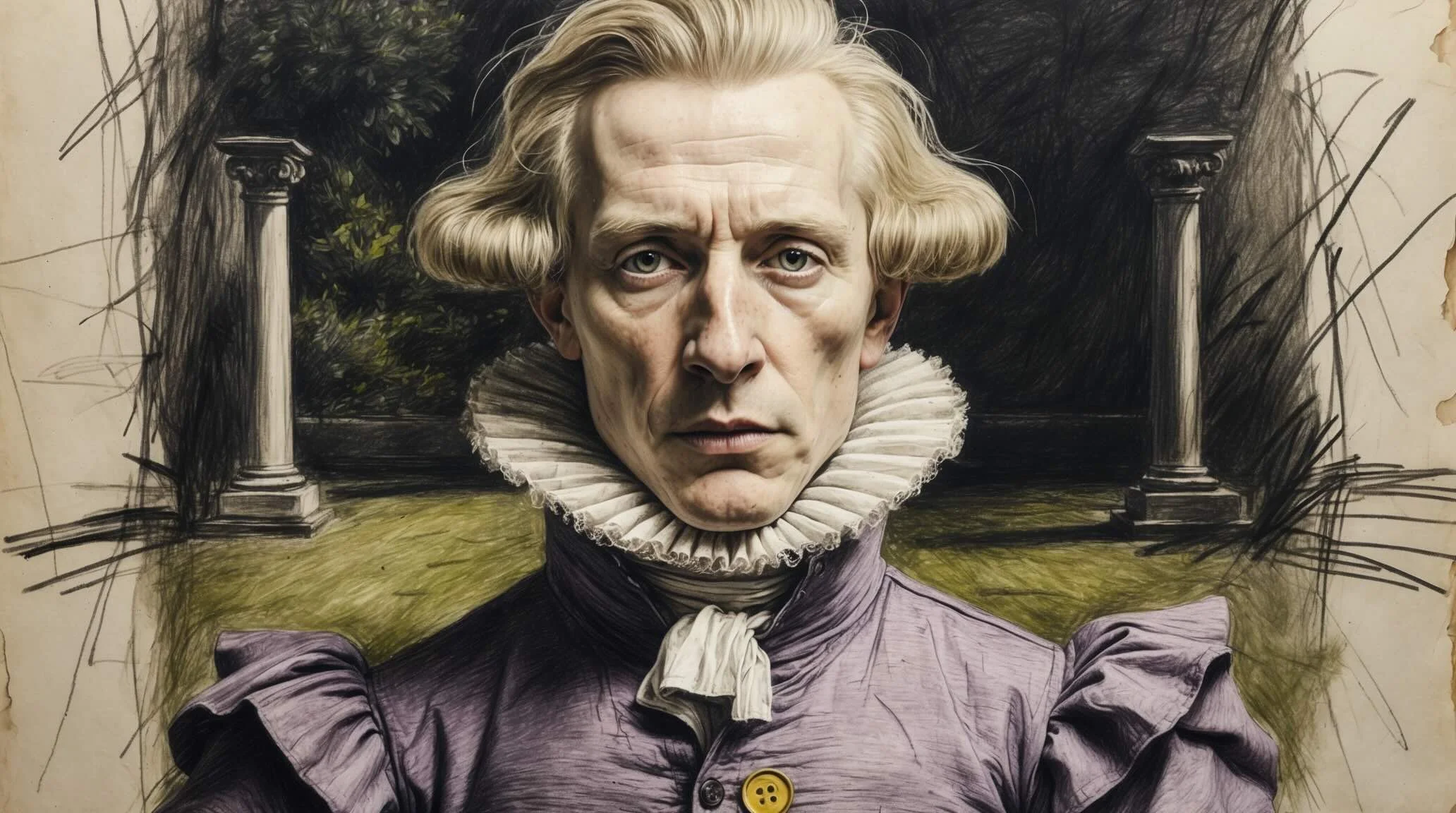
Character Profile – At a Glance
- Role: A foolish knight from Sir Toby’s circle, brought to Olivia’s house as a hopelessly unsuitable suitor. With three thousand ducats a year, he is the play’s most-mocked gull, the dupe Sir Toby exploits for money and sport throughout.
- Key Traits: Vain, cowardly, slow-witted, and easily flattered, with misplaced confidence in his own dancing and fencing. He is capable, once, of one of the play’s most genuinely poignant lines, and unable to see, until the final scene, that he has been a comic prop for two acts.
- The Core Conflict: A wealthy fool brought to court a countess far above his station, fleeced by the friend who flatters him, and lacking every social grace the position requires. He keeps staying, month after month, because Sir Toby tells him to.
- Key Actions: Arrives at Olivia’s house as a suitor in A1S3 and fails to "accost" Maria. He carouses with Sir Toby and Feste in A2S3 and produces "I was adored once too", hides in the box-tree in A2S5, and writes the absurd challenge to Cesario in A3S4. He strikes Sebastian in A4S1, is beaten, and returns bloodied in A5S1.
- Famous Quote:
"I was adored once too."
(Act 2, Scene 3) - The Outcome: He returns in A5S1 with a broken head, only to find Sir Toby, the man he calls to for help, dismissing him as a "knave" and a "gull". He receives no marriage and no resolution, and exits the play having been used, beaten, and discarded by the man he thought his friend.
The Knight Who Cannot "Accost"
Sir Andrew’s first scene is the play’s first sustained comic set-piece, and it gives the audience essentially the whole character within ninety seconds. Sir Toby introduces him to Maria; Sir Toby instructs him to "accost" her – meaning to approach her in conversation – and Sir Andrew, who does not know the word, takes it as her name.
Original
SIR TOBY: Accost, Sir Andrew, accost.
SIR ANDREW: What's that?
SIR TOBY: My niece's chambermaid.
SIR ANDREW: Good Mistress Accost, I desire better acquaintance.
MARIA: My name is Mary, sir.
SIR ANDREW: Good Mistress Mary Accost, –
(Act 1, Scene 3)
Shakespeare Retold (Modern Verse)
SIR TOBY: Go chat her up, Sir Andrew! Chat her up!
SIR ANDREW: Who is she?
SIR TOBY: My niece’s chambermaid.
SIR ANDREW: Good Mistress Chatterup, I’d like to get to know you better.
MARIA: My name is Mary, sir.
SIR ANDREW: Good Mistress Mary Chatterup…
The exchange is one of Shakespeare’s most economical comic openers. Sir Andrew’s misunderstanding of "accost" is the play’s first demonstration of two things at once: that he is genuinely slow-witted, and that Sir Toby is enjoying the slowness rather than correcting it. The pattern will run through the play. Sir Toby flatters Sir Andrew’s dancing, fencing, learning, and prospects with Olivia; Sir Andrew accepts each flattery and produces, in response, a piece of self-revelation that confirms how unfounded the flattery is. Within fifty further lines of his first appearance, Sir Andrew has reflected on his own wits with one of Shakespeare’s most affectionate pieces of comic self-knowledge, blaming his dullness on a fondness for beef. He is, in short, a man set up to be flattered and fleeced, and the play keeps the fall comic rather than pathetic by holding Sir Toby’s protective enjoyment of him always in view.
"I Was Adored Once Too"
The A2S3 carousing scene is the play’s longest sustained portrait of Sir Andrew’s social register, and it contains his most-quoted single line. The men have been drinking through the night; Sir Toby has been celebrating Maria’s wit and her affection for him; and Sir Andrew, listening, produces – without preparation and without anyone asking – five quiet words.
Original
SIR TOBY: She's a beagle, true-bred, and one that adores me: what o' that?
SIR ANDREW: I was adored once too.
(Act 2, Scene 3)
Shakespeare Retold (Modern Verse)
SIR TOBY: A thoroughbred, she is, and she adores me. How could it be?
SIR ANDREW: I was adored once, too.
The line is one of Shakespeare’s most extraordinary acts of comic compression. It arrives in the middle of a drunken scene with no preparation; it is delivered into a conversation that has not invited it; it is ignored entirely by Sir Toby, who moves straight on to talk of money. And it opens, for five words, a window onto a life Sir Andrew has been living before the play began and will continue living after it ends – a life in which he, too, has had moments of being loved, and in which the memory of those moments has survived under the surface of the gull he has been made into. The line has been one of the play’s most-discussed pieces of writing precisely because of how much it adds and how casually it is dropped. It is the single strongest piece of evidence that Sir Andrew is more than a comic prop: the man is foolish, but he is not nothing, and what looked like a stage gull has, for a moment, become a human being with a remembered past. The play returns immediately to the drinking and the gulling. But the five words remain, and they make the cruelty of the play’s later treatment of Sir Andrew weigh more than the comic structure quite knows what to do with.
The Challenge and the Coward
A3S4 contains Sir Andrew’s most extended piece of comic incompetence. Sir Toby has persuaded him that "Cesario" – Viola in disguise – is a rival for Olivia’s affections, and Sir Andrew has, at Sir Toby’s instigation, written a challenge to a duel.
Original
SIR ANDREW: Here's the challenge, read it: warrant there's vinegar and pepper in't.
FABIAN: Is't so saucy?
SIR ANDREW: Ay, is't, I warrant him: do but read.
SIR TOBY: Give me.
SIR TOBY [Reads]: 'Youth, whatsoever thou art, thou art but a scurvy fellow.'
FABIAN: Good, and valiant.
SIR TOBY [Reads]: 'Wonder not, nor admire not in thy mind, why I do call thee so, for I will show thee no reason for't.'
(Act 3, Scene 4)
Shakespeare Retold (Modern Verse)
SIR ANDREW: Read this, my letter challenging the youth. It’s spiced with vinegar and pepper.
FABIAN: Is it aggressive and insulting too?
SIR ANDREW: Oh yes it is, I tell you. Have a read.
SIR TOBY: Give it to me.
SIR TOBY [Reads]: ‘Young man, to me you're nothing but a scumbag.’
FABIAN: Good, and courageous.
SIR TOBY [Reads]: ‘Don’t bother contemplating in your mind why I would call you this; I won’t reveal it.’
The challenge is the play’s most concentrated piece of comic writing within the play, and it succeeds at exactly the wrong scale. Sir Andrew has produced a document so badly constructed that Sir Toby immediately decides not to deliver it as written – because, as he tells Fabian a few lines later, "this letter, being so excellently ignorant, will breed no terror in the youth: he will find it comes from a clodpole." The solution is comic perfection: Sir Toby will deliver the challenge "by word of mouth" instead, and will tell both parties – Sir Andrew and "Cesario" – that the other is a deadly swordsman, in the hope that both will refuse to fight and the comic spectacle will be of two terrified figures circling each other. The plan works exactly as designed. Viola, terrified, almost reveals her disguise; Sir Andrew, terrified, almost flees. The duel is prevented only by Antonio’s intervention – which, by accident, swaps Antonio for "Cesario" in the officers’ arrest and removes the swordsman Sir Andrew was supposed to fight. Sir Andrew, who has spent the scene shaking with fear, will later – having seen "Cesario" leave with the officers – convince himself that he had, in fact, frightened the youth into retreat. The self-deception is the character in full.
The Broken Head
By A4S1 Sir Andrew is, for the second time in the play, pursuing the duel he was earlier prevented from having. He sees the figure he believes is "Cesario" – actually Sebastian – and strikes him. Sebastian, the trained twin, hits him back. By A5S1 Sir Andrew is on stage with a broken head and the discovery that the friend who put him there is not coming to help.
Original
He has broke my head across and has given Sir Toby a bloody coxcomb too: for the love of God, your help! I had rather than forty pound I were at home. … ’Od’s lifelings, here he is! You broke my head for nothing; and that that I did, I was set on to do’t by Sir Toby.
(Act 5, Scene 1)
Shakespeare Retold (Modern Verse)
He cracked my head, and left Sir Toby with a bloody head as well. For love of God, we need your help! I’d give forty pounds to be home. … Good God, he’s over there! You smashed my head for nothing; what I did do, I was told to by Sir Toby.
Sir Andrew’s last sustained appearance is the play’s most exposed image of what the gulling has cost him. He has been used by Sir Toby for two acts as the financial supply, the social comedy, and the available body for the duel; he is now bleeding from the head, asking the play’s authorities for help, and naming Sir Toby as the man who put him in the line of fire. The response Sir Toby offers is unforgiving. When Sir Andrew offers to help bandage him, Sir Toby calls him an "ass-head and a coxcomb and a knave, a thin-faced knave, a gull." The friendship the play has been depicting for four acts now reveals itself, in a single line, as never having existed on the terms Sir Andrew thought it did. He exits the stage having lost the duel, the patronage, the marriage prospect, and the friend. The play, generous as it is, does not give him a closing line. The audience’s only available response is a kind of helpless affection – sympathy without rescue, the comic acknowledgement that this is a foolish man who has been treated more poorly than the comedy quite knows how to absolve.
"Nothing can fall much lower than this last character in intellect or morals: yet how are his weaknesses nursed and dandled by Sir Toby into something ’high fantastical’."
— William Hazlitt, Characters of Shakespeare’s Plays, 1817
Key Quotes
Quote 1
Methinks sometimes I have no more wit than a Christian or an ordinary man has: but I am a great eater of beef and I believe that does harm to my wit.
(Act 1, Scene 3)
Shakespeare Retold (Modern Verse)
I sometimes think I am no smarter than a simple Christian. But, also, I eat beef, and that dulls one’s wit.
Quote Analysis: Sir Andrew’s most-quoted single piece of self-reflection, and one of Shakespeare’s most affectionate portraits of comic self-knowledge. The man knows he is not clever; he has even formed a theory about why – beef is, he has heard, bad for the wits. The theory is exactly the kind that someone with no wit would form, and the line earns its comic warmth from how seriously Sir Andrew offers it. Sir Toby’s reply – "No question" – is the line’s perfect counterpart: Sir Toby agrees instantly, because Sir Andrew is right about himself, and because confirming the diagnosis costs Sir Toby nothing.
’Odours’, ’pregnant’ and ’vouchsafed:’
I’ll get ’em all three all ready.
(Act 3, Scene 1)
Shakespeare Retold (Modern Verse)
’Odours’, ’willing’, and ’shielded’.
I’ll make a note of them and use them later.
Quote Analysis: Sir Andrew overhears "Cesario" greet Olivia with an elaborate courtly flourish and resolves, on the spot, to memorise the impressive-sounding words for his own later use. The comedy is in the gap between ambition and equipment: he can hear that the vocabulary is fine, but has no idea what any of it means or how to deploy it. The line is Sir Andrew’s social climbing in miniature – the wish to seem courtly without the faintest capacity to be it – and it is exactly the impulse Sir Toby keeps feeding to keep him at the house.
Let him let the matter slip, and I’ll give him my horse, grey Capilet.
(Act 3, Scene 4)
Shakespeare Retold (Modern Verse)
Ask him to let the matter slip, and I’ll give him my horse, grey Capilet.
Quote Analysis: Sir Andrew’s response the moment the duel he demanded turns real. Told that "Cesario" is a ferocious swordsman, he abandons the fight at once and offers to bribe his way out of it with his horse. The cowardice is total and instant, and it exposes how hollow the earlier bravado was: the man who wrote a challenge "spiced with vinegar and pepper" will surrender his own horse rather than draw a sword. It is also the clearest sign that Sir Toby has engineered the whole confrontation for sport, knowing exactly how little fight Sir Andrew has in him.
I knew ’twas I; for many do call me fool.
(Act 2, Scene 5)
Shakespeare Retold (Modern Verse)
I knew he meant me! Many call me foolish.
Quote Analysis: Hidden in the box-tree, Sir Andrew hears a reference to a fool and cheerfully assumes it must be about him – and he is not wrong. The line is comic self-knowledge of a particularly disarming kind: he accepts the label "fool" without resentment, almost with pride, because so many people use it that he has come to take it as simple fact. The moment sits close to the "I was adored once too" register. Sir Andrew sees himself more clearly than the people mocking him assume, and the clarity makes the mockery land a little uneasily.
Key Takeaways
- The Gull and the Patron: Sir Andrew is the play’s most-mocked figure, the wealthy dupe Sir Toby keeps close for his money. The cruelty of the gulling is softened, for a while, by how much fun Sir Toby seems to be having with him.
- The Self-Knowing Fool: "I am a great eater of beef and I believe that does harm to my wit" is the play’s most affectionate piece of comic self-reflection. Sir Andrew knows he is foolish, and has even formed a theory about why.
- The Five Words That Save Him: "I was adored once too" is one of the most-quoted lines in Shakespearean comedy, and the principal reason readers see Sir Andrew as more than a comic prop.
- The Broken Head and the Discarded Friend: The A5S1 return with a bloody head, and Sir Toby’s dismissal of him as "an ass-head and a coxcomb and a knave", is the comedy’s most exposed image of what the gulling has cost the gull.
Study Questions and Analysis
Is Sir Andrew Aguecheek a sympathetic character?
The question has been one of the most-discussed in performance and criticism since Charles Lamb’s 1822 essay On Some of the Old Actors made the case for him explicitly. The line on which the case rests is "I was adored once too" – five words that open a window onto a life Sir Andrew has been living before the play began and that contained, at some point, the experience of being loved. The line is delivered into a drunken scene with no preparation, no follow-up, and no acknowledgement from anyone on stage; Sir Toby simply moves on. But the line cannot be unsaid, and modern criticism has read it as evidence that Shakespeare wanted the audience to hold the gulling at a slight distance – to laugh at Sir Andrew without quite laughing him off. William Hazlitt’s 1817 Characters of Shakespeare’s Plays captures the balance. He calls Sir Andrew a figure who could fall no "lower in intellect or morals", and yet he also confesses that "we patronize Sir Andrew" – the diminutive verb acknowledges both the affection and the condescension at once. Productions over the past century have increasingly chosen to play the character with full sympathy, especially in the A5S1 broken-head scene where Sir Toby’s dismissal exposes the fact that the friendship was never reciprocal. The most useful answer is probably that Sir Andrew is genuinely foolish, genuinely vain, genuinely exploited, and – in the play’s quiet view – genuinely human. The comedy permits the laughter; the play permits, alongside it, the recognition that this is a man.
Why does Sir Andrew stay at Olivia’s house when she will not see him?
The question is one of the play’s smallest pieces of structural irony. Sir Andrew has been brought to Olivia’s house by Sir Toby as a suitor, with the implicit promise that he will marry her and gain access to her household and fortune. Olivia has not seen him; she has, in fact, "abjured the company of men" for seven years in mourning for her brother; she is described as having sworn that "she’ll not match above her degree, neither in estate, years, nor wit" – every category in which Sir Andrew is, by his own admission, inadequate. The honest reading of his situation arrives in A1S3 when he says he will ride home tomorrow. Sir Toby’s response is a single word – "Pourquoi, my dear knight?" – a piece of French that Sir Andrew, characteristically, does not understand. Sir Toby’s flattery follows: Sir Andrew is good at dancing, fencing, "the back-trick simply as strong as any man in Illyria"; the niece will, given time, come around; the man has prospects he is too modest to recognise. Sir Andrew, who has heard this conversation before and will hear it again, allows himself to be persuaded to stay. The pattern is structural, and Maria names it openly in the same scene:
He’s a very fool and a prodigal.
(Act 1, Scene 3)
Shakespeare Retold (Modern Verse)
He’s foolish with his money, over-lavish.
Sir Toby keeps Sir Andrew on the premises because Sir Andrew’s three thousand ducats a year is the household’s principal source of unaudited drinking money, and the play makes clear that this is the only reason. Sir Andrew stays because he cannot read the situation, and because Sir Toby has every reason to make sure he never does.
What is the significance of "I was adored once too"?
The line is one of Shakespeare’s most-quoted single moments in any of the comedies, and its power is entirely structural. Sir Toby has been describing Maria’s devotion to him ("one that adores me"); Sir Andrew, who has been listening without contributing, produces – without preparation, without invitation, and without follow-up – the five words "I was adored once too." Sir Toby ignores them entirely and turns straight to the practical business of money:
Let’s to bed, knight. Thou hadst need send for more money.
(Act 2, Scene 3)
Shakespeare Retold (Modern Verse)
It’s time for bed now, knight. You need to get some money sent.
The five words live on a tonal frequency the rest of the scene does not occupy. Several things are happening at once. First, Sir Andrew is claiming, in his own quiet way, a parity of romantic experience with Sir Toby – a parity the audience knows is unlikely on present evidence, but that Sir Andrew himself is recalling as memory. Second, the past tense is exact and devastating. The adoration, whatever it was, is over. Sir Andrew is not currently adored; he is, in fact, in the middle of being mocked by the people he thinks are his friends. Third, the line is psychologically self-contained. Sir Andrew does not explain it, does not elaborate, does not ask for response. He has said what he needed to say to himself, and the scene moves on. Lamb’s essay was the first sustained reading of the line as evidence that Sir Andrew is more than a comic prop, and the case has been made every century since. The line earns its weight from how completely the play allows the rest of the action to keep moving past it.
How does Sir Andrew compare to other Shakespearean fools?
The comparison is structurally illuminating. The "professional fool" tradition – Feste in this play, Touchstone in As You Like It, the Fool in King Lear – produces figures whose foolishness is a position of wisdom: they speak truth from the licensed safety of comic costume. Sir Andrew is not in that tradition. He is what early modern critics called a "natural fool" – a figure of genuine slow-wittedness rather than performed simplicity. The comparison to Shakespeare’s other natural fools is closer. Slender in The Merry Wives of Windsor is the obvious analogue: a thin, wealthy, slow-witted young man who has been brought to court a woman beyond his social range, who is exploited by older men around him, and who lacks the basic equipment to recognise his exploitation. Falstaff’s relationship with Shallow in Henry IV, Part 2 operates on similar lines, with the older man fleecing the foolish landowner under cover of friendship. What distinguishes Sir Andrew from these predecessors is the depth of feeling Shakespeare gives him in single isolated lines – the "I was adored once too" of A2S3 has no analogue in the writing of Slender or Shallow, and it is on the strength of these moments that critics have read Sir Andrew as the most psychologically complete of Shakespeare’s natural fools. The line between mockery and sympathy is, in his case, thinner than the comic structure quite knows what to do with.
Why is Sir Andrew’s challenge to Cesario so badly written?
The challenge is one of Shakespeare’s most pointed pieces of comic writing within the play, and the badness is exact. A formal Renaissance challenge to a duel had clear conventions: it identified the offence, it specified the satisfaction sought, it allowed the recipient a clear basis for response. Sir Andrew’s challenge does the opposite of every one of these. It accuses "Cesario" of being "a scurvy fellow" without saying why ("I will show thee no reason for’t"); it asserts that Cesario "liest in thy throat" but immediately adds "that is not the matter I challenge thee for"; and it closes with a sign-off that manages to insult and befriend the recipient in the same breath:
He may have mercy upon mine; but my hope is better, and so look to thyself. Thy friend, as thou usest him, and thy sworn enemy, Andrew Aguecheek.
(Act 3, Scene 4)
Shakespeare Retold (Modern Verse)
He may have mercy on me, but I feel I have the better chance, so pray yourself. Your friend, and if you choose, your enemy, Andrew Aguecheek.
The whole document is, as Sir Toby diagnoses, "so excellently ignorant" that it could not function as a challenge – the recipient would have no clear basis to take offence and no clear understanding of what was being asked. The badness serves the comedy in two ways. First, it confirms Sir Andrew’s intellectual incapacity at the moment in the play where competence might have allowed him to assert himself. Second, it allows Sir Toby to substitute his own oral challenge, which becomes the engine of the comic duel that follows. The badly-written letter is, in this reading, the comic gift: Sir Toby could not have engineered the duel scene on the strength of a competent challenge, and Sir Andrew has supplied – without intending to – the document that makes the entire gulling possible.
What does Sir Toby’s treatment of Sir Andrew reveal about both characters?
The relationship is the play’s most sustained portrait of cynical patronage, and the A5S1 broken-head scene is its most exposed moment. Through Acts 1 to 4, Sir Toby has been performing friendship: flattering Sir Andrew’s dancing, fencing, learning, and prospects with Olivia, keeping him at the house, sharing his drink, drawing him into the gulling of Malvolio, and – finally – using him as the available body for the duel with "Cesario." The friendship has costs and benefits on both sides: Sir Andrew gets the company and the apparent prospect of marriage; Sir Toby gets the three thousand ducats a year. What A5S1 demonstrates is that the costs have not been equal. Sir Andrew has been losing money; Sir Toby has been spending it. Sir Andrew has been believing the friendship; Sir Toby has been performing it. The reveal comes in the broken-head scene, when Sir Andrew – having been beaten by Sebastian – calls to Sir Toby for help:
Will you help? An ass-head and a coxcomb and a knave, a thin-faced knave, a gull!
(Act 5, Scene 1)
Shakespeare Retold (Modern Verse)
How will you help? You’re just a clot, a fool, a simple-minded idiot.
The line is one of the play’s most exposed pieces of unkindness, and it is delivered while Sir Toby himself is also bleeding from the same encounter. The friendship Sir Andrew thought he had is, the line makes clear, a friendship that existed only on Sir Toby’s terms. Hazlitt’s image of Sir Andrew "nursed and dandled by Sir Toby into something high fantastical" captures the long arc: Sir Toby has, for two acts, made Sir Andrew’s foolishness pleasurable. The A5S1 line is the comedy’s quiet acknowledgement that the pleasure was Sir Toby’s, and Sir Andrew was paying for it.
Why does Sir Andrew receive no resolution at the end of the play?
The play’s marriage-resolution structure has slots for the figures who pair off, and Sir Andrew does not pair off. Viola is given to Orsino, Olivia to Sebastian, Maria to Sir Toby (offstage). Sir Andrew, who came to Illyria as a suitor and stayed as a gull, leaves it without the marriage he was promised and without the friendship he was given. The structural decision is interesting. Some productions resolve this by giving Sir Andrew a small wordless moment at the end – a touch, a look, an acknowledgement – that gestures at his loss; others have him exit the stage during A5S1 and not return; others let him stand mute on the margins through the closing speeches. The play itself does not require any particular handling. What it does require is that Sir Andrew be visibly excluded from the comedy’s redistribution of fortune. Hazlitt’s "we patronize Sir Andrew" is the play’s quietest acknowledgement of his fate: the audience is invited to feel for him, but not to expect the comedy to fix what has happened to him. The exclusion is part of the play’s structural cost. Malvolio is the most-discussed unresolved figure in the play; Sir Andrew is the other one. Both leave the stage having been used by the household; both leave without a marriage; both have been treated more poorly than the comedy quite knows how to absolve. Sir Andrew differs from Malvolio in one respect: he does not promise revenge. He simply, with a broken head and no friend, goes home.