Sebastian
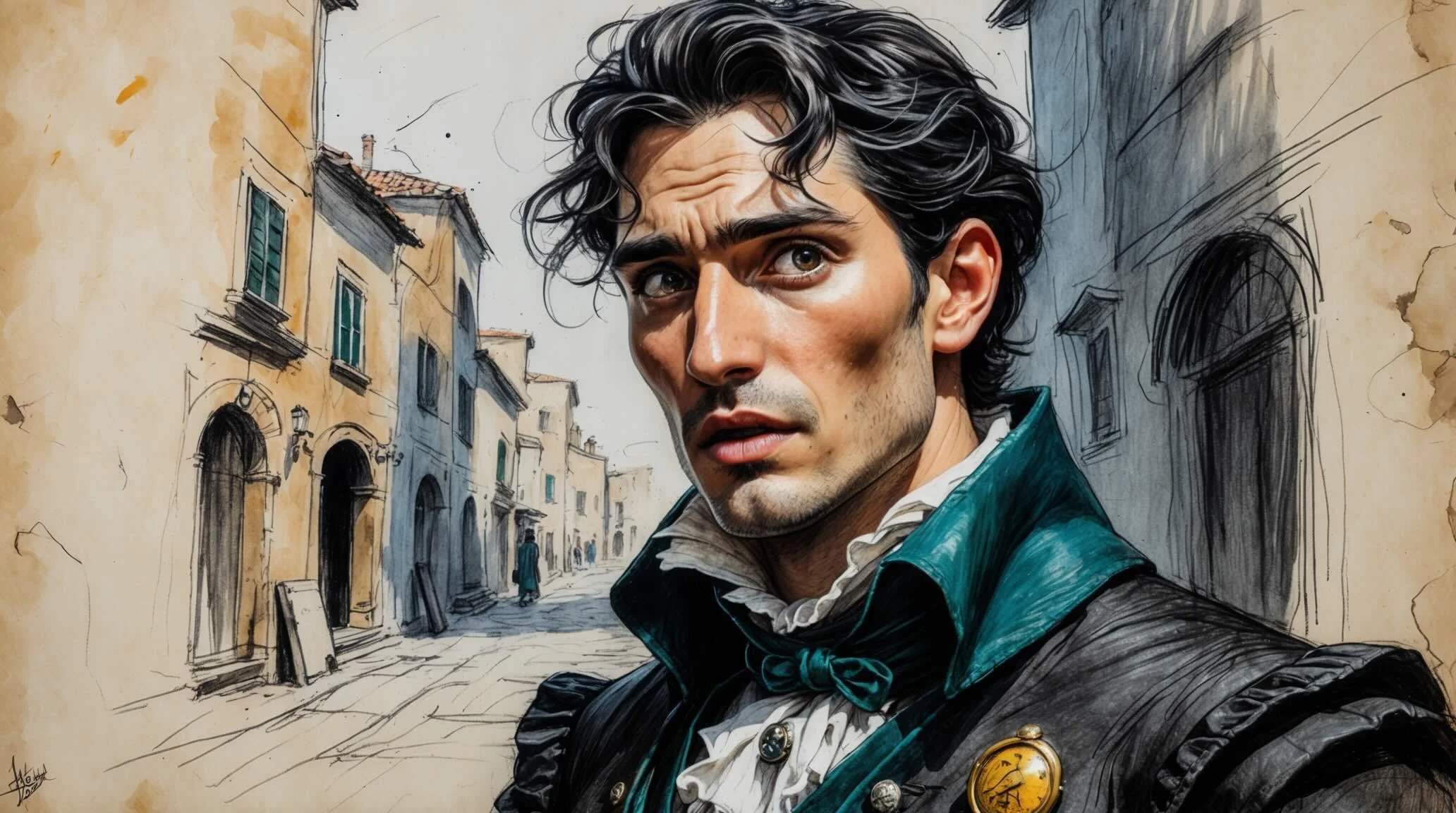
Character Profile – At a Glance
- Role: Viola’s twin brother, presumed drowned in the opening shipwreck and rescued by Antonio. His late arrival in Illyria is the thing that turns the comedy’s tangled disguise plot into the marriages that resolve it.
- Key Traits: Courteous, courageous, and willing to fight back when attacked, with a gift for the philosophical bewilderment that produces some of the play’s loveliest lines. Despite only a few short scenes, he is structurally the most consequential figure in the comedy.
- The Core Conflict: A young man arriving in a foreign city after a shipwreck, grieving a sister he believes drowned. He is addressed by people who think they know him, attacked by strangers with a grievance against a stranger with his face, and proposed to by a countess he has never met. He agrees to all of it.
- Key Actions: Parts from Antonio in A2S1, telling the story of his lost sister, and arrives in Illyria with him in A3S3. In A4S1 he is mistaken for Cesario, attacked by Sir Andrew, and fights back, then is led indoors by Olivia, who proposes. He weighs whether he is mad or dreaming in A4S3, marries her at the chapel, and reunites with Antonio and Viola in A5S1.
- Famous Quote:
"What relish is in this? How runs the stream?
Or I am mad, or else this is a dream:
Let fancy still my sense in Lethe steep;
If it be thus to dream, still let me sleep!"
(Act 4, Scene 1) - The Outcome: He marries Olivia offstage between A4S3 and A5S1, reunites with Antonio, and recognises Viola as his living sister in A5S1. He closes the play paired with Olivia in the comedy’s central marriage and, by his very arrival, makes every other marriage possible.
The Brother Lost at Sea
Sebastian’s first scene is the sea-coast scene of A2S1, parted from Antonio on the beach where Antonio has nursed him back to life. The conversation is a small marvel of grief and courtesy.
Original
You must know of me then, Antonio, my name is Sebastian, which I called Roderigo. My father was that Sebastian of Messaline, whom I know you have heard of. He left behind him myself and a sister, both born in an hour: if the heavens had been pleased, would we had so ended! But you, sir, altered that; for some hour before you took me from the breach of the sea was my sister drowned.
(Act 2, Scene 1)
Shakespeare Retold (Modern Verse)
You must have heard of me: I am Sebastian, nickname Roderigo; and my father was Sebastian of Messaline, who you’ve heard of. Now, when he died, he left me and my sister, both born an hour apart. How now I wish we’d died so close! But you, sir, stopped that, because, within an hour from saving me out of the breaking waves, my sister drowned.
The speech is the play’s first complete portrait of Sebastian, and its precision is striking. He has been travelling under a false name (Roderigo); he reveals the true name to Antonio only because Antonio’s "excellent a touch of modesty" has earned the disclosure. He grieves for his sister – the wish "would we had so ended" is one of the play’s most affecting lines about Viola before the comedy reveals she is alive. And he is, even in grief, courteous: he offers Antonio the apology of having to listen to lamentations ("I am bound to the Count Orsino’s court: farewell"). Sebastian’s manners across the play follow the pattern this scene establishes. He is grateful to Antonio without being effusive, polite to Feste until politeness fails, willing to fight when attacked, willing to accept astonishing good fortune when it arrives. The character is calibrated for the comedy’s needs: Sebastian can do the things Viola as Cesario cannot – fight back, accept Olivia’s proposal, marry her – and he can do them in a register that does not undercut the comic resolution. The stage-time is small; the structural function is total.
The Stranger Attacked in the Street
A4S1 is Sebastian’s first scene in Illyria proper, and it is one of Shakespeare’s most economical pieces of comic dramaturgy. Feste approaches him as Cesario; Sir Andrew, still pursuing the duel Viola escaped, strikes him; Sir Toby intervenes; the entire conversation is conducted on the basis of mistaken identity, and Sebastian – alone in a foreign city, unarmed for the social grammar – fights back.
Original
Why, there’s for thee, and there, and there.
Are all the people mad?
…
I will be free from thee. What wouldst thou now?
If thou darest tempt me further, draw thy sword.
(Act 4, Scene 1)
Shakespeare Retold (Modern Verse)
And here’s one back for you, and two and three.
Is everybody crazy here?
…
I’ll free myself from you. What will you do now?
If you dare to fight me, then whip out your sword.
The contrast with Viola is one of the play’s most-discussed comic effects. Viola, in the same circumstances three scenes earlier, has been terrified by Sir Andrew’s challenge – she is a young woman with no fencing training, hiding behind Cesario’s costume. Sebastian, faced with the same Sir Andrew, simply hits him back. The comedy delights in the asymmetry. Sir Toby, who has been managing Sir Andrew’s gulling for two acts, has finally pulled the wrong twin into the brawl, and Sebastian’s competence is the comedy’s quiet revenge on Sir Toby’s bullying. The line "Are all the people mad?" is Sebastian’s first articulation of the bewilderment that will run through the rest of his Illyrian experience. He has arrived in a city where strangers know him, attack him, and address him by names not his own; the question he asks is the only sane response. Olivia’s entrance moments later makes the bewilderment more total. She apologises for Sir Toby’s behaviour, calls him by Cesario’s name, and invites him indoors – and Sebastian, who has just spent ninety seconds defending himself against an attack and another sixty being lectured by a fool, accepts the invitation without quite knowing what he is accepting.
"If It Be Thus to Dream, Still Let Me Sleep"
The closing lines of A4S1 and the soliloquy of A4S3 are Sebastian’s most psychologically rich moments. He is being shown into Olivia’s house by a beautiful countess who calls him "Cesario" and pleads with him to be ruled by her, and he has – within the previous few minutes – been attacked in the street by men he has never met. The speech is the comedy’s most concentrated portrait of bewilderment shading into delighted acceptance.
Original
What relish is in this? How runs the stream?
Or I am mad, or else this is a dream:
Let fancy still my sense in Lethe steep;
If it be thus to dream, still let me sleep!
(Act 4, Scene 1)
Shakespeare Retold (Modern Verse)
What’s causing this? All’s not as it may seem.
I’m either mad, or else this is a dream.
If it’s a fairytale, it’s one to keep;
If it’s a dream, I want to stay asleep!
The four-line speech is the play’s most concentrated image of the kind of acceptance comedy permits. Sebastian has not asked for any of this – the wealthy countess, the proposal of marriage, the apparent inheritance of a household he has never seen – and the speech makes clear that he does not understand it. The two-clause structure ("Or I am mad, or else this is a dream") gives him the only two intelligible options, and the closing rhyme ("steep" with "sleep") yokes both options to the same conclusion: do not wake up. The A4S3 soliloquy that follows extends this. Sebastian, alone now in Olivia’s garden waiting for her, runs through the evidence: he holds a pearl she gave him; he can feel and see it; the lady manages her own household with "smooth, discreet and stable bearing", so she cannot be mad; he himself is reasoning clearly, so he cannot be mad; and yet what is happening is, by every measure he has, impossible. The speech ends not with resolution but with the lady’s entrance – and Sebastian, faced once more with the choice between scepticism and acceptance, accepts. He follows the priest into the chapel. By A5S1 he and Olivia will be married, and the marriage will turn out, retrospectively, to have been the comedy’s structural necessity all along.
The Twin Restored
A5S1 is the play’s recognition scene, and Sebastian’s role in it is structurally enormous and verbally restrained. He enters apologising to Olivia for having injured Sir Toby; he sees Antonio and greets him with the play’s warmest male-to-male reunion; and then he sees, standing across the stage, his sister.
Original
A spirit I am indeed;
But am in that dimension grossly clad
Which from the womb I did participate.
Were you a woman, as the rest goes even,
I should my tears let fall upon your cheek,
And say ’Thrice-welcome, drowned Viola!’
(Act 5, Scene 1)
Shakespeare Retold (Modern Verse)
My soul’s a spirit,
But I am wrapped within this larger body
That I’ve had since the day that I was born.
And if you were a woman, all things equal,
I’d let my sobbing tears run down your face
And say three times, ’oh welcome, drowned Viola’.
The recognition is one of Shakespeare’s most carefully delayed scenes. Sebastian and Viola have been on stage together for nearly forty lines before the play allows them to identify each other, and the recognition itself proceeds by small evidentiary steps: the father’s name (Sebastian of Messaline), the mole on his brow, the date of his death. The procedural restraint is the scene’s whole emotional power. Sebastian and Viola, who have each spent the play believing the other dead, do not collapse into immediate embrace; they verify, each on the other’s evidence, that what they are seeing is real. The "thrice-welcome" greeting – held back until Sebastian is sure – is the play’s most affectionate moment between siblings. The scene also resolves the comedy’s geometry: Sebastian has, by the time of the recognition, already married Olivia at the chapel, and the marriage is now socially intelligible because Olivia has been pursuing Cesario for the wrong reason. Orsino, watching this, will turn to Viola and propose. Antonio, watching this, will fall silent. The arrival Sebastian makes in A4S1 was not, as it appeared at the time, a piece of luck; it was the comedy’s structural requirement, and A5S1 is the demonstration that the requirement has been met.
"…the strongest and most direct expression of homoerotic feeling in Shakespeare’s plays."
— Bruce Smith, Homosexual Desire in Shakespeare’s England, 1991
Key Quotes
Quote 1
Fare ye well at once: my bosom is full of kindness...
(Act 2, Scene 1)
Shakespeare Retold (Modern Verse)
Goodbye. My heart is full of gratitude...
Quote Analysis: Sebastian’s farewell to Antonio on the beach, so full of feeling that he warns he is about to weep – "so near the manners of my mother" that his eyes will give him away. The line establishes the tenderness that runs under the whole character: Sebastian is courageous and decisive when he needs to be, but his first sustained note in the play is gratitude and grief, openly felt. It is also the warmest thing he says to Antonio in the play, and the audience hears it before it has any idea how much the relationship will come to matter.
I prithee, foolish Greek, depart from me: there’s money for thee; if you tarry longer, I shall give worse payment.
(Act 4, Scene 1)
Shakespeare Retold (Modern Verse)
Come on, kebab-head, please be on your way. Here’s money. If you wait here longer, I’ll give you something worse in compensation.
Quote Analysis: Sebastian’s reply to Feste, who has been pestering him as "Cesario." Where Viola trades elaborate wit with Feste in A3S1, Sebastian simply pays him to go away and threatens worse if he stays. The bluntness is the whole point: Sebastian has no idea who Feste is, no patience for the riddling, and no investment in the disguise game the rest of Illyria is playing. The line is an early sign of the decisiveness that will let him fight Sir Andrew and accept Olivia within the same scene.
I had a sister,
Whom the blind waves and surges have devoured.
(Act 5, Scene 1)
Shakespeare Retold (Modern Verse)
I had a sister who was lost at sea.
Quote Analysis: Sebastian’s grief stated aloud in the recognition scene, moments before he realises the "Cesario" standing opposite is that very sister, alive. The past tense is the line’s whole weight: he is mourning Viola as drowned at the exact moment the play is about to give her back. It mirrors Viola’s own earlier belief that Sebastian was lost, and the symmetry is what makes the reunion that follows so carefully earned – two people each grieving the other, each about to discover the grief was unfounded.
This is the air; that is the glorious sun;
This pearl she gave me, I do feel’t and see’t;
And though ’tis wonder that enwraps me thus,
Yet ’tis not madness.
(Act 4, Scene 3)
Shakespeare Retold (Modern Verse)
This is the air and that’s the lovely sun.
I see and feel this pearl she gave to me.
Although I am amazed at what has happened,
I am not mad.
Quote Analysis: The opening of Sebastian’s A4S3 soliloquy – alone in Olivia’s garden, taking inventory of his senses. The speech is the play’s most carefully constructed piece of empirical reasoning under impossible conditions: the air is real, the sun is real, the pearl Olivia gave him can be felt and seen. Sebastian’s conclusion – "yet ’tis not madness" – is the philosophical statement of the comedy’s whole position. The world Illyria has presented him with is wonderful, in the literal sense, and wonder is not the same thing as madness. The four lines are also one of the play’s most affirming responses to comic possibility: the disguise plot has produced a world where extraordinary good fortune is reaching the right person, and Sebastian is the figure willing to accept it.
Key Takeaways
- The Structural Restorer: Sebastian’s late arrival in Illyria is the comedy’s geometric necessity. Without him, neither Olivia’s marriage nor Viola’s can be resolved.
- The Brother Mistaken for the Sister: His A4S1 scenes with Feste, Sir Andrew, Sir Toby, and Olivia are one of Shakespeare’s most economical demonstrations of how mistaken identity produces a city where every greeting is wrong.
- The Acceptor of Wonder: "If it be thus to dream, still let me sleep" is the comedy’s most direct articulation of the kind of acceptance comic resolution requires.
- The Recognition with Viola: The carefully delayed A5S1 reunion, proceeding by evidentiary steps from the father’s name to the mole to the date, is the play’s most affectionate moment of sibling recognition.
Study Questions and Analysis
What is Sebastian’s structural function in the play?
Sebastian is, in plot terms, the figure whose late arrival makes the comedy’s marriages possible. Viola as Cesario cannot marry Orsino while she remains in disguise; Olivia cannot marry the Cesario she has been pursuing because Cesario is a woman. The geometry can only resolve when a man arrives who is, externally, identical to Cesario but available for the marriage Olivia is seeking. Sebastian is that man. He performs the structural function the comedy needs by simply being present and being willing – willing to fight Sir Andrew, willing to follow Olivia indoors, willing to marry her at the chapel. The economy of the role is striking. Sebastian has only 31 speeches in the play, fewer than any other named figure with a major function, and he is offstage for most of the action – he does not appear at all in Act 1, has only the two short scenes (A2S1 and A3S3) with Antonio in Acts 2 and 3, and only emerges into the central action in A4S1. The brevity is deliberate. Sebastian is calibrated to the comedy’s needs: small enough not to compete with his sister for psychological complexity, complete enough to make the resolutions credible. Critics have sometimes found him under-developed by comparison with Viola – the standard reading is that he exists chiefly to take on the role Viola has been filling in disguise. The reading is partly accurate. What it misses is that the comedy needs this kind of figure, and the discipline of the writing is in not giving him more than the structural function requires.
How does Sebastian compare to Viola?
The twins are physically identical in the play’s terms, and dramatically opposite in nearly every other respect. Antonio’s recognition speech in A5S1 makes the likeness explicit:
An apple, cleft in two, is not more twin
Than these two creatures. Which is Sebastian?
(Act 5, Scene 1)
Shakespeare Retold (Modern Verse)
An apple split in half is not more similar
Than these two people. Which one is Sebastian?
Viola is the play’s most psychologically complex female role, given soliloquies, courtship scenes, and the play’s quiet centre of feeling; Sebastian is the play’s structural restorer, given small but consequential scenes and very little interiority. Viola is cautious where Sebastian is decisive. Faced with Sir Andrew’s duel challenge, Viola is terrified; Sebastian, faced with the same Sir Andrew three scenes later, simply hits him back. Viola spends the play withholding her love; Sebastian, faced with Olivia’s proposal, accepts it within the same scene. The comedy uses the contrast deliberately. Each twin can do something the other cannot: Viola can endure the disguise, Sebastian can complete the marriage. The play’s geometry needs both, and the recognition scene of A5S1 is the moment the comedy acknowledges that what looked like one figure has, all along, been two. The asymmetry of stage time is, in this reading, structural rather than evaluative. Viola gets the play’s heart; Sebastian gets the play’s hinge.
Why does Sebastian agree to marry Olivia so quickly?
The decision is one of the play’s most-discussed pieces of comic compression, and several explanations operate together. Mechanically, the comedy’s resolution requires the marriage; the plot machinery has been moving toward it since A4S1, and Sebastian’s acceptance is the comedy’s structural necessity. Psychologically, the A4S3 soliloquy gives Sebastian’s own reasoning: he has tested his senses, found them reliable; tested Olivia’s management of her household, found it sane; weighed his own reasoning, found it intact. Within the evidence available to him, the only conclusion is that something extraordinary is happening, and his own response to extraordinary good fortune is to accept it. The line "If it be thus to dream, still let me sleep" is the explicit articulation of this. Materially, the proposal is also recognisably attractive: Sebastian is a young foreign nobleman with no immediate prospects, recently shipwrecked, in mourning for his sister; Olivia is a wealthy and beautiful countess offering him a household and a name. The play does not pretend this consideration is absent. Some modern readings have read Sebastian’s acceptance as opportunistic – the man takes what is offered without troubling himself about the misidentification at its core. Others have read it as comic openness – the willingness to receive what fortune sends. The play allows both readings, and the marriage works in either. What the play refuses is the alternative: Sebastian could have hesitated, demanded explanations, withheld assent – and the comedy would have ended differently. Marriage requires acceptance, and Sebastian gives it.
What is the significance of Sebastian’s relationship with Antonio?
The relationship is one of the play’s most-discussed bonds, and its meaning depends partly on what frame one applies. From Antonio’s side, the love is direct, repeatedly named, and visibly unconditional – Bruce Smith’s foundational 1991 study calls it "the strongest and most direct expression of homoerotic feeling in Shakespeare’s plays." From Sebastian’s side, the picture is warmer than it is often given credit for. He greets Antonio in A5S1 with unguarded relief:
Antonio, O my dear Antonio!
How have the hours racked and tortured me,
Since I have lost thee!
(Act 5, Scene 1)
Shakespeare Retold (Modern Verse)
Antonio! Oh my dearest friend, Antonio!
It has been torturous for many hours
Since I lost track of you!
But Sebastian’s speeches about Antonio are brief; his speeches about Olivia are sustained; and the play allows Olivia, not Antonio, to be the partner of his marriage. Critics have read this asymmetry in several ways. Joseph Pequigney’s 1992 essay argues that Sebastian and Antonio’s bond is mutual and that the marriage with Olivia does not preclude its continuation; other critics have read Sebastian as politely receiving Antonio’s love without quite returning it – on the standard view, Illyria’s comic world of marriages offers that attraction nowhere to be fulfilled. The play does not resolve the question. What it does, with care, is preserve the warmth of the recognition scene without making it the play’s central marriage. Sebastian’s last line about Antonio is a question – "Fear’st thou that, Antonio?" – and the play does not give him a final scene with Antonio in which to settle what they have been to each other.
How does Sebastian’s first scene with Antonio establish his character?
The A2S1 scene is one of Shakespeare’s most efficient pieces of character-establishment, and it gives the audience nearly everything it will need to know about Sebastian for the rest of the play. He is grieving – the wish "would we had so ended" makes clear that he loves Viola deeply and believes her drowned. He is courteous – he reveals his real name to Antonio only because Antonio has shown the kind of "modesty" that earns the disclosure. He is socially well-placed – his father was "Sebastian of Messaline, whom I know you have heard of", a phrasing that assumes his lineage is recognisable. He is also a young man adrift, travelling under a false name and following no fixed plan:
No, sooth, sir: my determinate voyage is mere extravagancy.
(Act 2, Scene 1)
Shakespeare Retold (Modern Verse)
Well, no, I can’t, for I’m just wandering without a place in mind.
The scene also establishes his relationship with Antonio: it is the relationship of a young man who has been rescued and cared for by an older man whose love he recognises and partly accepts, but whose presence he cannot quite welcome into Orsino’s territory. The whole portrait fits within a single scene, and the play uses that portrait economically. Sebastian’s later behaviour – fighting back when attacked, accepting Olivia’s proposal, recognising his sister carefully – all proceeds from the character A2S1 has established. The brevity of the scene matters. The play has limited time for Sebastian, and A2S1 makes sure he is fully drawn before he disappears for two acts.
What does "nature to her bias drew in that" mean?
The phrase is Orsino’s, not Sebastian’s – it comes in A5S1 when Orsino is making sense of Olivia’s marriage to Sebastian after she has spent the play pursuing Cesario:
So comes it, lady, you have been mistook:
But nature to her bias drew in that.
(Act 5, Scene 1)
Shakespeare Retold (Modern Verse)
And so, my lady, you have been mistaken:
But nature led you on to one like me.
The metaphor is from the game of bowls, in which the ball is shaped slightly off-centre to curve toward the target on its "bias". Orsino is saying that nature, faced with the unnatural situation of Olivia loving a woman in disguise, has curved on its bias toward the natural outcome of marrying her to a man – Sebastian – who happens to look exactly like Cesario. The phrase has been one of the play’s most-discussed pieces of language because of what it implies. It frames Olivia’s marriage to Sebastian as a kind of corrective: the love she felt for Cesario was misplaced, and nature has supplied a male body to receive it. Modern criticism has read the line in several ways. Some have read it as the play’s quiet endorsement of heterosexual marriage as the comic resolution’s only available form; some have read it as ironic, with the "bias" of nature acknowledged as a slightly dubious force; some have read it as a structural observation about how the comedy’s geometry actually works, with no normative weight. What the line does, in any reading, is name the structural function Sebastian performs. He is the figure nature has supplied to make the marriage Olivia wanted possible – and the play, in giving him the role, has also given him almost no interior life through which to question it.
Does Sebastian have his own arc or does he exist purely to enable others’ resolutions?
The honest answer is that he has both – a small arc of his own and a large structural function that the small arc serves. His own arc runs from grief to acceptance: Sebastian enters the play in A2S1 mourning his sister, drifting through Illyria with no plan beyond "mere extravagancy", travelling under a false name. By A4S3 he is in Olivia’s garden weighing the evidence of an extraordinary good fortune, and choosing to accept it. By A5S1 he has discovered his sister alive, married a countess, and reunited with Antonio. The arc is real: from loss to recovery, from drift to settled life, from grief to gratitude. What the arc does not do is dominate the play’s attention. The amount of stage-time Sebastian receives is small, and the soliloquies he is given are descriptive rather than developmental – he is taking inventory of his senses in A4S3, not progressing through a moral journey. The result is a character whose interior is real but lightly drawn. The play knows what it is doing. Viola has been carrying the comedy’s psychological weight for four acts, and Sebastian’s job is to arrive in time for the comedy to resolve. The discipline of the writing is in not giving him more than that requires. He is the comedy’s restorer, and the comedy treats him with the same combination of warmth and economy with which his function asks to be performed.