Revenge and Justice
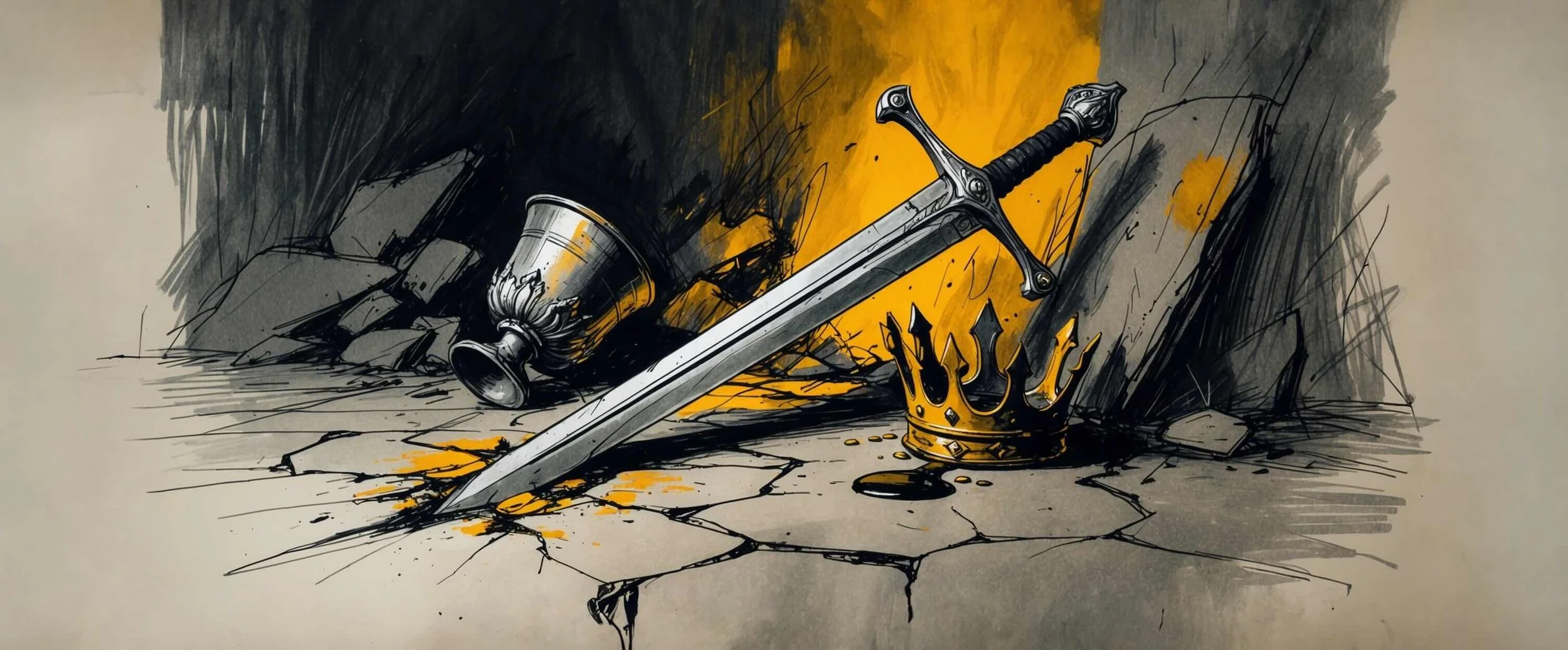
Theme Profile – At a Glance
- Focus: Revenge as the engine of the play, and justice as the standard against which revenge is measured – and found wanting.
- Key Characters: Prince Hamlet, Laertes, Fortinbras, The Ghost, King Claudius.
- The Core Tension: The Ghost demands blood. Christian doctrine forbids murder. Hamlet is trapped between two codes that cannot both be obeyed.
- Key Manifestations: The Ghost's command in Act 1; the prayer scene in Act 3; the contrast between Hamlet, Laertes and Fortinbras; the final poisoned duel; Hamlet's late acceptance of providence.
- Famous Quote:
"Revenge his foul and most unnatural murder."
(Act 1, Scene 5) - The Outcome: All three avengers achieve revenge. None of them achieves justice. The Danish royal house is destroyed, and the throne passes to a foreign prince.
The Ghost's Command and the Genre It Activates
The play opens with a ghost story, and the ghost story turns into a revenge tragedy the moment The Ghost speaks. By Shakespeare's day, the revenge-tragedy genre was well established – Thomas Kyd's The Spanish Tragedy, written around 1587, had set the conventions, and audiences arriving for a play called Hamlet in 1601 would have known what kind of evening to expect. A son discovers his father's murder. A father's spirit demands vengeance. The son spends the play arranging the kill.
Original
If thou didst ever thy dear father love—
... Revenge his foul and most unnatural murder.
(Act 1, Scene 5)
Shakespeare Retold (Modern Verse)
If ever you did truly love your father –
... Revenge his dreadful and unnatural murder.
The Ghost's command is exact, and it carries the full weight of the genre. The word "unnatural" matters: in the Elizabethan moral universe, a brother killing a brother is not just criminal but cosmic disorder. The Ghost asks Hamlet to restore the natural order through an act of personal violence.
But the play immediately complicates the command. Hamlet has been educated at Wittenberg – Martin Luther's university, the centre of Protestant Reformation thought. His framework is Christian, and his religion teaches that murder is a mortal sin and that vengeance belongs to God alone. The genre tells him to kill. His conscience tells him he cannot. The trap is set in A1S5, and the rest of the play is what happens inside it.
The Three Avengers
Shakespeare gives the play three young men whose fathers have been killed. Each is therefore expected, by the period's code of honour, to take revenge. Each represents a different way of doing it.
Fortinbras represents political revenge. His father was killed by Hamlet's father in single combat before the play begins. Fortinbras inherits the grudge, raises an army, redirects it (under pressure from his uncle) toward Poland, and arrives in Denmark at the end of the play to claim the throne by legal succession. His revenge is calculated, public, and conducted through institutions.
Laertes represents passionate revenge. His father Polonius has been killed by Hamlet behind the arras. His sister Ophelia has gone mad and drowned. When he returns from France in Act 4, his response is immediate, total, and willing to abandon every moral check.
Original
To hell, allegiance! vows, to the blackest devil!
Conscience and grace, to the profoundest pit!
I dare damnation.
(Act 4, Scene 5)
Shakespeare Retold (Modern Verse)
Allegiance, go to hell! I'll stand with devils!
Good manners and good will, dig in the dirt!
I don't care if I'm damned.
Hamlet sits between these two. He has the cause Fortinbras lacks – a secret, treacherous murder rather than an honourable battlefield death – and he has the moral weight Laertes refuses to carry. What he does not have is the operative will to act on either. The A4S4 soliloquy, delivered after he watches Fortinbras's army marching to fight for "an eggshell," is the moment Hamlet himself names the comparison.
Original
How stand I then,
That have a father killed, a mother stained,
Excitements of my reason and my blood,
And let all sleep?
(Act 4, Scene 4)
Shakespeare Retold (Modern Verse)
How can I stand here
After my father's killed, and mother tarnished,
My reasoning excited by my blood,
And then do nothing?
The verdict the play hands down is exact. Fortinbras gets the kingdom. Laertes and Hamlet kill each other. The avenger who can mobilise his grievance without exhausting himself thinking about it is the one who survives to collect the political reward.
The Corrosion of the Avenger
The play stages a quiet but devastating argument about what revenge costs the person pursuing it. To fight Claudius, Hamlet must adopt the methods Claudius uses – deception, manipulation, secret violence. The man who began the play horrified at his uncle's crime ends the play with five corpses to his name: Polonius, Rosencrantz, Guildenstern, Laertes, and Claudius himself. Ophelia's death sits at the edge of the count; the cruelty of the nunnery scene is part of what produces it.
Hamlet's clearest expression of how revenge corrupts the avenger comes in his Act 3 reflection on the body of Polonius, killed in error behind the arras.
Original
For 'tis the sport to have the engineer
Hoist with his own petard...
(Act 3, Scene 4)
Shakespeare Retold (Modern Verse)
It's fun to watch the one who makes the bombs
Blow himself up...
The line is delivered as a quip, but the quip is the evidence. Hamlet is now thinking in the same register as the man he is trying to destroy – the register of plots, traps, and engineered deaths. The avenger has begun to use the avenger's tools, and the tools are doing their work on the avenger as much as on the target.
Laertes pays the same price. Manipulated by Claudius into using a poisoned blade in the duel, Laertes loses the honour his revenge was supposed to defend. He dies acknowledging that the very weapon he chose has killed him too. Revenge, in this play, is a poison that kills the one who drinks it as surely as the intended victim.
The Substitution of Providence for Personal Justice
By Act 5, Hamlet has stopped trying to engineer perfect revenge. The transformation is not announced in soliloquy. It is delivered in a quiet exchange with Horatio, just before the fatal duel, in which Hamlet sets aside the obsessive control of outcomes that has defined the previous four acts.
Original
Not a whit, we defy augury: there's a special
providence in the fall of a sparrow. If it be now,
'tis not to come; if it be not to come, it will be
now; if it be not now, yet it will come: the
readiness is all.
(Act 5, Scene 2)
Shakespeare Retold (Modern Verse)
No chance, I ignore omens. It's predestined
just like a sparrow's death. If it is now,
it won't be later; if not later, now;
if not now, it will happen later on.
The preparation's key.
The framework has changed. Personal justice – the careful staging of "The Mousetrap," the agonised refusal at the prayer scene, the demand for perfect spiritual conditions – has been replaced by a Calvinist-Protestant acceptance that the timing belongs to God. Hamlet no longer needs to engineer the moment. He needs only to be ready when it comes.
The killing of Claudius in A5S2 confirms the shift. Hamlet does not produce a premeditated execution. He acts in the seconds after discovering that Gertrude has been poisoned, that Laertes has named Claudius as the architect of the plot, and that he himself is already dying. The revenge happens, but it happens as the consequence of a moment Hamlet did not arrange. The justice the play permits is not the justice Hamlet had been demanding. It is what arrives when Hamlet stops demanding.
"Shakespeare's audience would have viewed the Ghost's command to revenge not as a holy duty, but as a demonic temptation to commit a mortal sin. The tragedy is that Hamlet ultimately succumbs to this primitive bloodlust."
— Eleanor Prosser, Hamlet and Revenge, 1967
Key Quotes on Revenge and Justice
Quote 1
Revenge his foul and most unnatural murder.
(Act 1, Scene 5)
Shakespeare Retold (Modern Verse)
Revenge his dreadful and unnatural murder.
Quote Analysis: The Ghost's command is the inciting line of the entire play, and it carries the genre with it. "Foul" names the moral character of the crime; "unnatural" names its cosmic weight. By framing the murder as a violation of nature itself, the Ghost makes revenge sound like a restoration of order rather than an act of further violence. The whole play is what happens when Hamlet tries to test that framing against his own conscience.
Now might I do it pat, now he is praying;
And now I'll do't. And so he goes to heaven;
And so am I revenged. That would be scanned.
(Act 3, Scene 3)
Shakespeare Retold (Modern Verse)
I could just do it now, while he is praying;
I will. But that just sends him up to heaven;
What good is that? I should think this through better.
Quote Analysis: The prayer-scene soliloquy is the play's clearest evidence of how far Hamlet's idea of "justice" has travelled from anything a moral framework would recognise. Simple revenge is not enough. He wants to engineer Claudius's eternal damnation, to time the kill for a moment of unrepented sin. The over-intellectualising of the act is what allows Claudius to survive the scene and plot Hamlet's own death. Justice, in Hamlet's hands, has become a piece of theological accounting.
O, from this time forth,
My thoughts be bloody, or be nothing worth!
(Act 4, Scene 4)
Shakespeare Retold (Modern Verse)
From this time on, my thoughts
Will be of blood, or else they're nothing worth.
Quote Analysis: The closing couplet of the A4S4 soliloquy is Hamlet's most direct attempt to commit himself to the revenge code. The vow is delivered at the moment he has watched Fortinbras's army march off to fight for "an eggshell," and the shame of the comparison drives him to swear allegiance to bloody thinking. The vow does not hold. Within an act, he has been shipped to England, escaped, and returned a different man – one ready to accept providence instead.
Here, thou incestuous, murderous, damned Dane,
Drink off this potion. Is thy union here?
Follow my mother.
(Act 5, Scene 2)
Shakespeare Retold (Modern Verse)
Here, you incestuous, murderous, God-damned Dane:
Drink from this poison! Is the pearl in here?
Follow my mother.
Quote Analysis: The revenge is finally enacted. The crucial detail is that Hamlet does not deliver the kill from the position of justice. He delivers it as a dying man, in the seconds after watching Gertrude die from the same poison and hearing Laertes name Claudius as the architect. The "union" pun – pearl, marriage, joining – does the work the soliloquies could not do. Justice has not been carefully engineered. It has been allowed to happen.
Key Takeaways
- The Genre Is the Trap: The play uses the revenge-tragedy genre against itself. Hamlet inherits the genre's obligation and the period's Christian conscience at the same time, and the two cannot be held together.
- Three Roads, One Verdict: Fortinbras takes the political road and gets the kingdom. Laertes takes the passionate road and dies poisoned by his own weapon. Hamlet takes the philosophical road and dies achieving what he could not deliberately produce.
- Revenge Corrupts the Avenger: Every step Hamlet takes toward Claudius makes him more like Claudius. The five deaths on Hamlet's account are the cost the play insists on naming.
- Justice Arrives When the Avenger Stops Demanding It: Hamlet kills Claudius only after he has given up the careful staging of perfect revenge. The "readiness is all" speech is the play's quiet alternative to the bloody framework the Ghost imposed.
Study Questions and Analysis
Why does Hamlet delay his revenge?
This is the most-discussed question in English literary criticism. The play offers several answers and refuses to settle on one.
The delay is a hard fact. The Ghost orders revenge at the end of A1S5. Hamlet doesn't kill Claudius until A5S2. In the four acts between, he has chances to act and doesn't take them. Hamlet accuses himself most directly in A2S2, after watching the First Player weep over Hecuba. The actor can summon real tears for a made-up grief. Hamlet has real grief and a real order to act, and he has produced nothing.
O, what a rogue and peasant slave am I!
Is it not monstrous that this player here,
But in a fiction, in a dream of passion,
Could force his soul so to his own conceit...
(Act 2, Scene 2)
Shakespeare Retold (Modern Verse)
Oh, what a worthless wretched man I am!
Is it not awful that this actor here,
Pretending in his act of passion,
Could force his soul to follow what he imagined...
The critical tradition has offered several explanations.
Samuel Taylor Coleridge, in his 1818 lectures, blamed "an overbalance of the imaginative power." Hamlet thinks so much that there's no energy left for action. A. C. Bradley's 1904 Shakespearean Tragedy called it melancholy – what we might now call depression – and argued it was incompatible with decisive revenge.
Goethe, writing in 1796, saw a noble nature crushed by an impossible task. Hamlet is simply too fine for the work. Sigmund Freud in 1900, and Ernest Jones in 1910 and 1949, located the delay in the Oedipus complex. Claudius has done what Hamlet unconsciously wanted to do – kill the father, marry the mother – so Hamlet can't punish him without punishing himself.
T. S. Eliot, in his 1919 "Hamlet and His Problems," made the controversial case that the delay is the play's failure rather than Hamlet's. Hamlet's emotion exceeds anything the plot can justify.
Hamlet himself gives one direct reason in the A3S3 prayer scene. He passes up the chance to kill Claudius because Claudius is praying, and his theology says a man killed at prayer goes to heaven – which would be reward, not revenge.
The play commits to no single answer. The delay is psychological inhibition, theological scruple, intellectual over-engagement, and political caution all at once. None of these explanations cancels the others.
Is the Ghost's command a holy duty or a demonic temptation?
The play stages this question deliberately and does not resolve it. The audience has to hold both readings at once.
The Ghost describes torments that match the Catholic doctrine of Purgatory.
I am thy father's spirit,
Doomed for a certain term to walk the night,
And for the day confined to fast in fires,
Till the foul crimes done in my days of nature
Are burnt and purged away.
(Act 1, Scene 5)
Shakespeare Retold (Modern Verse)
I am your father's ghost,
Condemned to wander aimless every night,
Bound by the day to torment in the flames,
Until the sinful deeds of all my lifetime
Are burnt and purged away.
The setting is nominally Catholic Denmark, and the Ghost's claim to be Hamlet's father in a state of post-mortem suffering is, within that framework, plausible. If the Ghost is what it says it is, the command to revenge is a legitimate request from a wronged soul.
But Hamlet has been studying at Wittenberg – Martin Luther's university, the centre of the Protestant Reformation. The Protestant position was that real ghosts were impossible. Purgatory had been doctrinally abolished, so any apparent ghost must be a demon trying to tempt the faithful into damnable sin. Hamlet's hesitation in A2S2 is theological.
The spirit that I have seen
May be the devil: and the devil hath power
To assume a pleasing shape; yea, and perhaps
Out of my weakness and my melancholy,
... Abuses me to damn me.
(Act 2, Scene 2)
Shakespeare Retold (Modern Verse)
This spirit that I have seen
Might be the devil; and the devil has the power
To take a pleasing form; and possibly,
Out of my weakness and my melancholy,
... Tricks me, to damn my soul.
Eleanor Prosser's 1967 Hamlet and Revenge – quoted in the pull-quote above – argued that the play's first audiences would have read the Ghost as demonic. The Christian framework Hamlet's education would have given him treats any command to murder as a temptation regardless of its source. On Prosser's reading, Hamlet's tragedy is precisely that he gives in to the temptation, and the play's careful theological setting is designed to make this visible.
The counter-tradition – represented by critics like Roy Battenhouse and developed in different terms by Stephen Greenblatt's 2001 Hamlet in Purgatory – treats the Ghost as the genuine soul of the elder Hamlet. On Greenblatt's reading, the play is the dramatic working-out of what happens when a Protestant son receives a Catholic apparition. The Ghost is real. The framework for responding to it has been abolished.
The deeper argument the play permits is that both readings have textual support. The Ghost knows things only the elder Hamlet could know. But the Ghost also requires Hamlet to commit a mortal sin to obey it. Both registers operate at once. The audience is asked to feel the trap rather than to escape it.
How does Laertes function as a foil to Hamlet?
Laertes is the play's most direct comparison. Both men lose their fathers to violence. Both are bound by the period's honour code to take revenge. Their responses sit at opposite ends of the spectrum.
Hamlet, on hearing of his father's murder, asks questions, doubts the messenger, stages a play to test the truth, agonises through soliloquies, and passes up his clearest opportunity for theological reasons. Laertes, on hearing of his father's death, raises an armed mob, storms the palace, and threatens immediate violent revolution. He is willing, as he tells Claudius in A4S7, to "cut his throat i' th' church."
To cut his throat i' the church.
(Act 4, Scene 7)
Shakespeare Retold (Modern Verse)
To cut his throat inside the church.
The contrast extends past the immediate response. Hamlet's revenge ambition is structurally compromised by the same intellect that produces his most celebrated soliloquies. Laertes's revenge ambition is structurally compromised by his refusal to think at all – which is exactly what makes him available to Claudius's manipulation. The poisoned blade Laertes agrees to use in the duel is the consequence of his framework. A character willing to "dare damnation" has no operative check against the dishonourable means Claudius proposes.
The play's verdict on the two foils is delivered in the same scene. Both die from the same poisoned blade in A5S2. Hamlet dies having achieved revenge through providence rather than design. Laertes dies having destroyed his own honour in the service of a revenge that no longer belongs to him.
A. C. Bradley in 1904 argued that the Laertes-Hamlet pairing is the play's clearest piece of evidence that the revenge framework itself is the problem. Two men with the same task, working at opposite extremes of method, both die – and only the third avenger, Fortinbras, survives by operating outside the personal-revenge framework entirely.
The A5S2 reconciliation between Hamlet and Laertes is the play's quiet acknowledgement that both men have been manipulated by Claudius into killing each other, and that the personal-revenge framework has used them both up.
Exchange forgiveness with me, noble Hamlet:
Mine and my father's death come not upon thee,
Nor thine on me!
(Act 5, Scene 2)
Shakespeare Retold (Modern Verse)
Let us exchange forgiveness, noble Hamlet:
I will not blame you for my father's death,
Nor blame you for my own!
Why does Hamlet spare Claudius in the prayer scene?
The A3S3 prayer scene is one of the most theologically precise passages in Shakespeare. Hamlet's stated reasoning is exact within Catholic theology: a man killed in a state of grace goes to heaven, a man killed in a state of sin goes to hell. Proper revenge for Claudius's murder of the elder Hamlet – who was killed without confession and is therefore (in the play's framework) suffering in Purgatory – would be to catch Claudius in the same unprepared state.
Up, sword; and know thou a more horrid hent:
When he is drunk asleep, or in his rage,
Or in the incestuous pleasure of his bed...
Then trip him, that his heels may kick at heaven.
(Act 3, Scene 3)
Shakespeare Retold (Modern Verse)
Stop, sword! Let's wait until a worse occasion,
Perhaps when he is drunk or full of rage,
Or having sex in his incestuous bed...
I'll get him then, he'll kick and scream at heaven.
The reasoning is internally coherent. It is also one of the play's clearest pieces of evidence that Hamlet's idea of "justice" has become something a moral framework would struggle to recognise. Simple revenge is not enough. He wants to engineer eternal damnation, to time the kill for a moment of unrepented sin. The Ghost's command has produced a son who is now thinking in the same register as the murderer he is trying to punish.
The dramatic irony is one of Shakespeare's most carefully built arrangements. Hamlet mistakes Claudius's posture for genuine spiritual engagement. The audience knows that the prayer has, in fact, failed – Claudius's closing couplet names the failure directly.
My words fly up, my thoughts remain below:
Words without thoughts never to heaven go.
(Act 3, Scene 3)
Shakespeare Retold (Modern Verse)
My words ascend, my thoughts remain below:
Words with no thoughts will never get to heaven.
The soul Hamlet thinks is in a state of grace is no closer to salvation than it was before the prayer began. Hamlet's theological caution is operating on a false premise.
Some critics – Samuel Johnson most famously, in his 1765 edition – found Hamlet's reasoning at this moment morally repugnant. Johnson called it "too horrible to be read or to be uttered." The objection is that a Christian framework that permits this kind of theological accounting has become indistinguishable from the bloodlust it claims to transcend.
The deeper reading is that the scene is the play's most concentrated piece of evidence on what revenge does to the avenger. Hamlet entered the play horrified at his uncle's crime. By A3S3, he is calculating the precise theological geometry of Claudius's damnation. The corruption is gradual, but the prayer scene is the moment it becomes visible.
What role does providence play in the final act?
By Act 5, Hamlet has stopped trying to engineer perfect revenge. The shift is named most directly in the A5S2 conversation with Horatio, just before the duel.
There's a special
providence in the fall of a sparrow. If it be now,
'tis not to come; if it be not to come, it will be
now; if it be not now, yet it will come: the
readiness is all.
(Act 5, Scene 2)
Shakespeare Retold (Modern Verse)
It's all predestined,
just like a sparrow's death. If it is now,
it won't be later; if not later, now;
if not now, it will happen later on.
The preparation's key.
The framework has moved from Catholic-personal to Calvinist-Protestant. Hamlet no longer needs to time the kill. He needs to be ready when the moment arrives.
The killing of Claudius confirms the shift. Hamlet does not produce a premeditated execution. He acts in the seconds after Gertrude's death and Laertes's confession, with the information delivered to him by external events rather than engineered by his own plan. The "union" pun delivered as he forces Claudius to drink the poisoned cup – pearl, marriage, joining – fuses the personal and the providential. The revenge happens at the moment the universe makes it possible, not at the moment Hamlet has decided it should.
Stephen Greenblatt's 2001 Hamlet in Purgatory reads this shift as the play's central theological move. The Reformation had abolished the sacramental machinery – particularly Purgatory – that had previously allowed for in-between soul-states. The play sits on the fault-line where characters cannot quite tell which framework is judging them. By Act 5, Hamlet has arrived at a Calvinist position that lets him act without the elaborate Catholic accounting that had paralysed him earlier.
The counter-reading, developed by Eleanor Prosser and others, is more sceptical. The "readiness is all" speech is, on this reading, less a theological breakthrough than a piece of self-soothing rhetoric Hamlet uses to talk himself into the duel he should refuse. The providence Hamlet appeals to is the same framework that has just permitted him to send Rosencrantz and Guildenstern to their deaths in his place. The shift in vocabulary masks the same bloody outcome the Ghost originally demanded.
The play permits both readings. What it commits to is one fact. Hamlet's late acceptance of providence is the only framework in which the revenge actually happens. The careful engineering of Acts 2 and 3 produced nothing but Polonius's death behind the arras. The surrender of engineering in Act 5 produces the killing of Claudius. Whether this is moral progress or moral capitulation is the question the play declines to answer.
Does Hamlet actually achieve justice, or only revenge?
The play makes the distinction visible without resolving it. Revenge is the personal punishment of a wrongdoer. Justice is the restoration of moral and political order. Hamlet achieves the first. The play is more sceptical about the second.
By the end of A5S2, Claudius is dead. Hamlet has fulfilled the Ghost's command. The murderer of the elder Hamlet has been killed by the elder Hamlet's son, on the same poisoned blade used in the plot against him. At the level of personal retribution, the symmetry is exact.
But the cost is total. Gertrude is dead. Polonius is dead. Ophelia is dead. Laertes is dead. Rosencrantz and Guildenstern have been executed in England. The Danish royal house has been wiped out. The throne passes to Fortinbras, a foreign prince whose claim to it is based on inheritance from a war Hamlet's own father had fought decades earlier. Whatever the moral order of Denmark looked like before the Ghost appeared, it does not exist by the end of the play.
A. C. Bradley in 1904 read this as the structural cost of Shakespearean tragedy. The hero achieves what the genre demands, but only by destroying the world the achievement was supposed to restore. L. C. Knights developed this further in the 1930s, arguing that Hamlet is the clearest evidence in Shakespeare that revenge and justice are not the same thing and that the play's tragedy lies precisely in the gap between them.
The Christian framework Hamlet's education would have given him is more sceptical still. "Vengeance is mine, I will repay, saith the Lord" (Romans 12:19) places justice outside human capacity entirely. By this standard, revenge is never justice. It is the human substitute for a justice that only God can deliver, and the substitute always produces more disorder than it resolves.
The play's quiet position is that the question itself may be the wrong one. Hamlet's achievement is not justice. Hamlet's failure is not revenge. The framework that would let us sort the ending into "justice served" or "justice denied" has been dismantled by the play's own action. What is left is the silence Horatio commits to filling, and the long political memory of a kingdom that has lost its line.
The rest is silence.
(Act 5, Scene 2)
Shakespeare Retold (Modern Verse)
The rest is silence.
How does the play's view of revenge differ from earlier revenge tragedies?
The revenge-tragedy genre was well established by 1601. Thomas Kyd's The Spanish Tragedy, written around 1587, had set the conventions: a son discovers the murder of a father (or vice versa), a ghost demands vengeance, the protagonist spends the play arranging the kill, the final scene produces a bloodbath in which the avenger usually dies. The genre was popular, lucrative, and morally simple. Revenge was understood as legitimate, even satisfying, and the protagonists were not asked to think too hard about it.
Shakespeare's Hamlet takes the genre seriously and then subverts every one of its conventions.
The ghost still demands revenge, but the ghost is theologically ambiguous in a way Kyd's ghosts are not. The son still receives the command, but he spends the play questioning whether he should obey it. The villain is identified early, but the protagonist refuses to act on the identification until the universe forces his hand. The final scene still produces a bloodbath, but the avenger achieves his goal almost accidentally, in the seconds after a poisoning he did not arrange.
Most importantly, the protagonist's relationship to the genre is itself part of the play. Hamlet is aware that he is supposed to be a revenge hero. He measures himself against the standard the genre supplies, and finds himself wanting. The A2S2 self-accusation is the speech of a man comparing himself to the genre's expectations and falling short.
A dull and muddy-mettled rascal, peak,
Like John-a-dreams, unpregnant of my cause,
And can say nothing.
(Act 2, Scene 2)
Shakespeare Retold (Modern Verse)
A dull and lily-livered rascal, drained,
Lost in my dreams, with no clear sense of purpose,
I can say nothing.
T. S. Eliot's 1919 "Hamlet and His Problems" argued that this self-awareness is the play's structural problem. Hamlet's emotion exceeds anything the revenge plot can justify, and the play cannot find an "objective correlative" for what its protagonist feels. Eliot's reading was controversial and remains so, but it identified something real: Hamlet breaks the revenge tragedy because the protagonist is too large for the genre he has been placed in.
Harold Bloom's 1998 Shakespeare: The Invention of the Human developed this differently. Bloom's argument is that Hamlet's interiority – his soliloquies, his self-doubt, his philosophical reach – is what makes him the first fully modern character in Western literature. The revenge plot is what produces the soliloquies, but the soliloquies are bigger than the plot. By Act 5, the audience is more invested in Hamlet's mind than in Claudius's death, and the revenge becomes almost incidental to the play's actual subject.
The verdict the play hands down on its own genre is exact. Hamlet is a revenge tragedy that has worked out that revenge tragedy is morally inadequate. The genre still produces its bodies. The play uses the bodies to show what the genre cannot say.