

The Madness. The Murder. The Mystery.
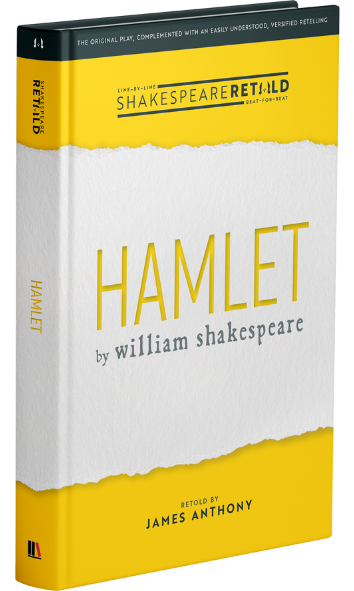
Shakespeare's masterpiece, retold in modern English verse.
Every soliloquy at full power, every line clear, every rhythm intact. A complete Hamlet study guide for students, teachers, and actors.
Hamlet Overview
Hamlet Deep Dive
Pick a scene, read for free – track progress via the Progress Bar. | Subscribe to go ad-free. | Buy the book.
-
ACT 1
-
ACT 1 SCENE 1
Guards see the ghost of the dead King Hamlet. They decide to tell Prince Hamlet.
-
ACT 1 SCENE 2
Claudius addresses the court; Hamlet mourns his father. Horatio tells Hamlet of the ghost.
-
ACT 1 SCENE 3
Laertes warns Ophelia about Hamlet. Polonius advises Laertes, then tells Ophelia to avoid Hamlet.
-
ACT 1 SCENE 4
Hamlet joins the watch. The ghost appears and signals Hamlet to follow it alone.
-
ACT 1 SCENE 5
The ghost reveals Claudius murdered King Hamlet. Hamlet swears revenge and makes Horatio and Marcellus promise secrecy.
-
-
ACT 2
-
ACT 3
-
ACT 3 SCENE 1
Claudius and Polonius spy on Hamlet and Ophelia. Hamlet delivers “To be or not to be.” Ophelia returns his gifts; Hamlet denies loving her. Claudius grows suspicious.
-
ACT 3 SCENE 2
Hamlet instructs the players and has them perform a scene mirroring his father’s murder. Claudius reacts guiltily and leaves. Hamlet sees this as proof of Claudius’s guilt.
-
ACT 3 SCENE 3
Claudius tries to pray, feeling guilt. Hamlet sees him alone and considers killing him, but decides not to, fearing Claudius’s soul might go to heaven.
-
ACT 3 SCENE 4
Hamlet confronts Gertrude in her chamber. He kills Polonius, hiding behind a curtain, mistaking him for Claudius. The ghost appears, reminding Hamlet of his mission. Gertrude is shaken.
-
-
ACT 4
-
ACT 4 SCENE 1
Gertrude tells Claudius that Hamlet has killed Polonius. Claudius decides to send Hamlet to England.
-
ACT 4 SCENE 2
Rosencrantz and Guildenstern try to find out where Hamlet has hidden Polonius’s body, but he evades them.
-
ACT 4 SCENE 3
Claudius questions Hamlet about Polonius’s body. Hamlet mocks him but eventually reveals its location. Claudius secretly orders Hamlet’s execution in England.
-
ACT 4 SCENE 4
Hamlet sees Fortinbras’s army and reflects on his inaction. Inspired by their bravery, he vows to pursue revenge more boldly.
-
ACT 4 SCENE 5
Ophelia, mad with grief, sings disjointed songs. Laertes returns, furious about his father’s death. Claudius calms him, promising answers and justice.
-
ACT 4 SCENE 6
Horatio receives a letter from Hamlet, revealing he escaped the ship to England after pirates attacked. Hamlet is returning to Denmark and asks Horatio to meet him.
-
ACT 4 SCENE 7
Claudius and Laertes plot Hamlet’s death. Claudius suggests a rigged fencing match and poisoned wine. Gertrude enters and reports that Ophelia has drowned.
-
-
ACT 5
-
ACT 5 SCENE 1
Gravediggers joke about death while digging Ophelia’s grave. Hamlet reflects on mortality, holding Yorick’s skull. Ophelia’s funeral arrives; Laertes leaps into her grave. Hamlet reveals himself and grapples with Laertes in grief and anger.
-
ACT 5 SCENE 2
Hamlet tells Horatio how he escaped death and replaced the letter with one condemning Rosencrantz and Guildenstern. He agrees to duel Laertes. During the match, Gertrude drinks poisoned wine. Laertes wounds Hamlet with a poisoned blade but is also wounded. Dying, he reveals Claudius’s plot. Hamlet kills Claudius, then dies. Fortinbras arrives to claim the throne.
-

Tackling Hamlet for The Royal Shakespeare Company is arguably the most daunting role for any actor. For me, learning the words was the easy part; interpreting the nuances of the language and breathing life into the performance was brutally tough.
The Shakespeare Retold series would have helped me immensely. For every line, I'd have had a lyrically identical modern-day translation that I precisely understood, helping reveal the emphasis and punch of each moment of my stage performance. Every actor would benefit from these compelling translations.
Played Hamlet for The Royal Shakespeare Company
Frequently asked questions about Hamlet
What is Hamlet about?
Hamlet is Shakespeare's longest tragedy, written around 1600. It follows Prince Hamlet of Denmark as he discovers that his uncle Claudius has murdered his father, married his mother, and seized the throne. The Ghost of Old Hamlet demands revenge, but Hamlet hesitates — paralysed by grief, religious doubt, and his philosophical nature — for almost the entire play. The story ends in catastrophe, with most of the principal characters dead.
When was Hamlet written?
Hamlet was written between 1599 and 1601, during what is often called Shakespeare's mature tragic period. It was first published in a short pirated quarto (Q1) in 1603, then in a longer authorised quarto (Q2) in 1604, and finally in the First Folio in 1623. The three texts differ substantially, and modern editions are typically conflated from Q2 and the Folio.
What genre is Hamlet?
Hamlet is a revenge tragedy — a popular Elizabethan genre derived from Senecan drama, in which a wronged hero pursues vengeance, usually with catastrophic consequences. Shakespeare both inhabits and questions the genre: where most revenge heroes act, Hamlet hesitates, and the play uses that hesitation to examine moral, philosophical, and theological questions about justice, action, and mortality.
Why is Hamlet considered Shakespeare's greatest play?
Hamlet's reputation rests on its psychological depth, philosophical reach, and linguistic richness. The title character is the most fully interiorised figure in early modern drama — a hero whose conflict is largely internal — and the play's soliloquies ("To be, or not to be", "O, what a rogue and peasant slave", "How all occasions do inform against me") meditate on suffering, mortality, and selfhood with a depth no earlier play had attempted. It has shaped the modern conception of dramatic character ever since.
What level is Hamlet studied at?
Hamlet is a set text on most major English-language curricula, including GCSE and A-Level (UK), AP English Literature (US), the IB Diploma, and undergraduate Shakespeare courses worldwide. Selected scenes and soliloquies are also frequently studied at Key Stage 3 and middle-school level. This study guide is written to support all of these levels, with modern English translation, scene-by-scene analysis, character profiles, theme guides, and key quotes.
What are the most famous lines in Hamlet?
Hamlet contains more famous lines than any other play in English. Among the most quoted: "To be, or not to be — that is the question", "Something is rotten in the state of Denmark", "The lady doth protest too much, methinks", "Frailty, thy name is woman", "Alas, poor Yorick — I knew him, Horatio", and "The rest is silence". Each is analysed in depth on the key quotes page.