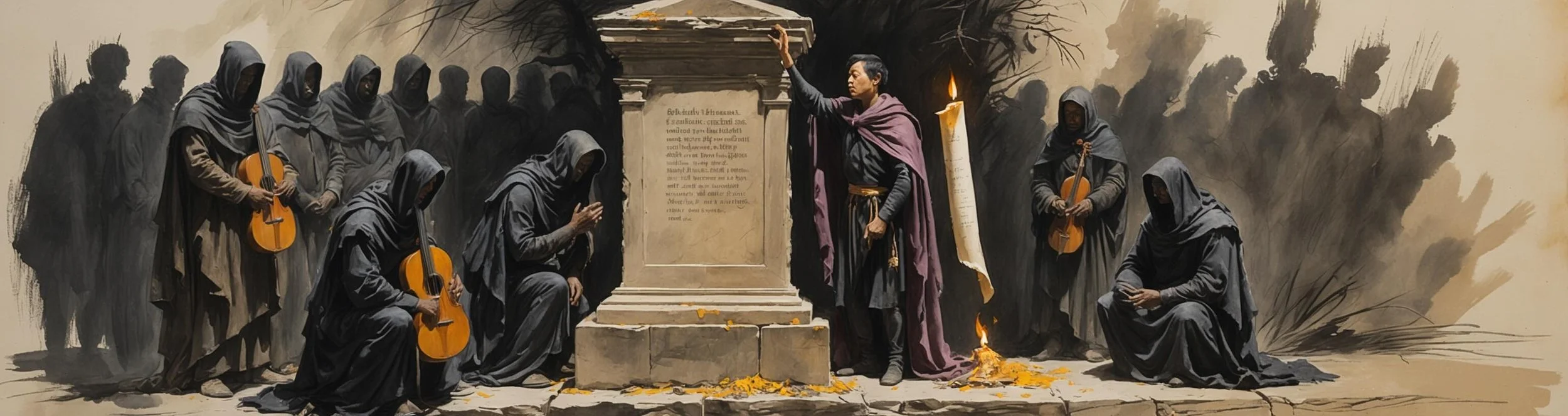
Scene Profile – At a Glance
- Location: A church, at Leonato’s family monument, in the hours before dawn.
- What Happens: Claudio reads an epitaph at Hero’s tomb and hangs it there, a hymn is sung to the goddess of the night, and as day breaks the prince and Claudio leave to change their clothes for the second wedding.
- Key Characters: Claudio, Don Pedro, a lord, musicians and attendants with tapers.
- Dramatic Function: The penance Leonato set in Act 5, Scene 1, performed: a short ritual scene that lets Claudio mourn, in public and in verse, the woman the audience knows is alive, and that clears the way for the wedding.
- Famous Quote:
"Done to death by slanderous tongues
Was the Hero that here lies..."
(Claudio, Act 5, Scene 3) - Why It Matters: It is the only scene in the play without a joke in it, and the only time Claudio grieves for Hero; whether thirty lines of ritual are enough to earn him his bride is the question the play leaves to its audience.
Scene Summary
At night, Claudio and Don Pedro come with torches to Leonato’s family monument, and Claudio asks a lord to confirm whose it is. He reads from a scroll the epitaph he has written: Hero was done to death by slanderous tongues, death has given her in reward a fame that never dies, and the life that died with shame lives in death with glorious fame. He hangs the scroll on the tomb to praise her when he can no longer speak, and calls for the solemn hymn. The musicians sing to the goddess of the night, asking pardon for those who killed her virgin knight, and calling on midnight and the graves to help them mourn.
Claudio bids Hero’s bones good night and promises to perform the rite every year. The prince tells the attendants to put out their torches: the wolves have preyed, and the dawn is dappling the east with grey. They thank the mourners and dismiss them, and the prince proposes that they change into other clothes and go to Leonato’s house. Claudio’s last words ask the god of marriage for better luck this time than the last.
Done to Death by Slanderous Tongues
The scene is a penance performed to the letter. Leonato ordered Claudio to hang an epitaph on the tomb and sing to Hero’s bones, and Claudio does exactly that, in rhymed tetrameter, with musicians, before witnesses, and then promises to do it every year.
Original
Done to death by slanderous tongues
Was the Hero that here lies:
Death, in guerdon of her wrongs,
Gives her fame which never dies.
So the life that died with shame
Lives in death with glorious fame.
Hang thou there upon the tomb,
Praising her when I am dumb.
(Claudio, Act 5, Scene 3)
Shakespeare Retold (Modern Verse)
A lady killed by slanderous tongues
Was Hero, who here lies:
Now death pays back all of those wrongs:
Through fame, she never dies.
So the life that died from shame
Lives in death with glorious fame.
I hang these words upon the tomb
To praise her more when I am dumb.
The epitaph is Claudio’s one piece of writing in the play, and it says less than it seems to. Hero was killed by slanderous tongues, it declares, without saying whose; death gives her fame; shame has become glory. The scroll mourns a wrong and does not name a wrongdoer, and the man who reads it aloud is the man whose tongue did the slandering, with the prince who confirmed it standing beside him. Nothing in the scene says so. The theme of honour and shame is at work in the form itself: honour is restored by public ritual, a name cleared by a name praised, and the ritual asks nothing of the penitent but attendance. The audience, which knows Hero is alive and the ceremony a stratagem, watches Claudio grieve sincerely for a death that has not happened, and the play lets both things be true. The hymn that follows is addressed to Diana, goddess of the night and of chastity, and asks her pardon for those that slew her virgin knight: the nearest the scene comes to a confession, and it is sung by hired musicians.
The Wolves Have Preyed
The prince ends the vigil with a dawn speech, and the play’s one wholly solemn scene turns on four lines into something else: the night of mourning is over, the clothes will be changed, and a wedding is waiting.
Original
Good morrow, masters; put your torches out:
The wolves have preyed; and look, the gentle day,
Before the wheels of Phoebus, round about
Dapples the drowsy east with spots of grey.
(Don Pedro, Act 5, Scene 3)
Shakespeare Retold (Modern Verse)
Good morning, masters; put your torches out:
The wolves have finished hunting; see, the day,
Before the sun’s begun to turn about,
Is splattering the eastern clouds in grey.
It is the most beautiful writing the prince is given, and it belongs to a man who has nothing to mourn and everything to arrange. The wolves have preyed; the gentle day dapples the east; the torches go out. The lines mark the point where the play’s tragic possibility, held open since the church, closes for good, and they mark it with weather rather than with feeling. Claudio’s closing couplet, hoping Hymen will speed with luckier issue this time, is the play’s own description of its structure: a failed wedding and a second one, with a night of ritual between. The theme of courtship and marriage is served here almost mechanically, and the brevity is the point. Thirty lines of penance stand between the slander and the second altar, and the play, like the prince, is in a hurry to change its weeds.
Language and Technique
- Rhymed tetrameter: The epitaph and the hymn are in short four-beat rhymed lines, the metre of inscriptions and songs rather than of speech. The sound tells the audience this is a ceremony, not a conversation, and the modern verse keeps the shape.
- Paradox: The life that died with shame lives in death with glorious fame: the epitaph turns on opposites, shame and fame, death and life, and the neatness is a way of closing a wound rather than examining it.
- The unnamed agent: Slanderous tongues did the killing; the scroll never says whose. The passive construction protects the man reading it, and the audience can hear what the words leave out.
- Dawn imagery: Phoebus’s wheels, the drowsy east, spots of grey: the prince’s dawn is painted rather than stated, and the shift from torchlight to daylight carries the scene’s whole change of mood.
- Classical allusion: Diana, goddess of the night and of chastity; Hymen, god of marriage; Phoebus the sun: three gods in thirty lines, each marking a stage, mourning, dawn and wedding.
Key Quotes from Act 5, Scene 3
Quote 1
So the life that died with shame
Lives in death with glorious fame.
(Claudio, Act 5, Scene 3)
Shakespeare Retold (Modern Verse)
So the life that died from shame
Lives in death with glorious fame.
Quote Analysis: The turn of the epitaph, and the only time anyone in the play says Hero’s shame has become glory. The couplet is neat enough to be an inscription and it is doing the work of a verdict: she was shamed, and the shame is reversed, by death. The modern verse leaves the second line as Shakespeare wrote it. Claudio hangs the words on the tomb so that they will praise her when he is dumb, and the audience, who know she is alive, hear a man committing his repentance to writing.
Pardon, goddess of the night,
Those that slew thy virgin knight;
For the which, with songs of woe,
Round about her tomb they go.
(Song, Act 5, Scene 3)
Shakespeare Retold (Modern Verse)
Pardon, goddess of the night,
Those who killed your virgin knight;
For we’re singing songs of woe
And dance around her tomb we go.
Quote Analysis: The hymn is sung to Diana, goddess of the moon and of virgins, and it asks her to pardon those that slew her virgin knight. It is the closest the scene comes to naming the guilt, and the guilt is sung by musicians rather than spoken by the guilty. The modern verse keeps the four-beat lines and the rhyme. The mourners circle the tomb with songs of woe, which is what the stage direction describes and what the play, at this point, is doing: going round the wrong rather than through it.
And Hymen now with luckier issue speed's
Than this for whom we rendered up this woe.
(Claudio, Act 5, Scene 3)
Shakespeare Retold (Modern Verse)
Let’s hope that Hymen, god of marriage, shows
More luck this time, preventing further woe.
Quote Analysis: Claudio’s last words before the wedding: may the god of marriage have better luck this time than with the woman they have just mourned. It is a prayer and it is also a summary of the plot, since the play is built on a failed wedding and a second attempt. The modern verse keeps Hymen. The line gives no hint that Claudio thinks the first failure was his, and the play does not pause to make him think it.
Key Takeaways
- Penance to the letter: Claudio hangs the epitaph, sings the hymn and promises a yearly rite, exactly as Leonato ordered; the scene is obedience performed as grief.
- The wrong without a wrongdoer: The epitaph blames slanderous tongues and names nobody; the hymn asks pardon for those that slew her and is sung by hired musicians.
- Mourning a living woman: The audience knows Hero is alive; the scene lets Claudio’s grief be sincere and the ceremony a stratagem at once.
- Dawn ends the tragedy: The prince’s four lines on the gentle day close the play’s tragic possibility and send everyone to change clothes for a wedding.
Study Questions and Analysis
What is the purpose of the tomb scene?
It performs the penance Leonato imposed in Act 5, Scene 1. When Borachio confessed and the prince and Claudio learned that Hero had, as they believed, died of their slander, Leonato told Claudio he could not give him back his daughter but could set him a task: to tell Messina she was innocent, to hang an epitaph on her tomb and sing it to her bones that night, and in the morning to marry Leonato’s niece. This scene is the middle item. It is also the play’s only wholly solemn scene, thirty lines without a joke, placed between Benedick and Beatrice sparring in the garden and the masked wedding, so that the audience passes through a night of mourning before the comedy resumes.
Now, unto thy bones good night!
Yearly will I do this rite.
(Claudio, Act 5, Scene 3)
Shakespeare Retold (Modern Verse)
I say to your bones now goodnight!
Each year I will perform this rite.
Whether the scene is enough to redeem Claudio is the question the play leaves open, and critics have answered it both ways. Algernon Charles Swinburne (1880) thought the marriage of Hero and Claudio “a doubtfully desirable consummation” that nonetheless “makes no flaw in the dramatic perfection” of a play that could not otherwise have been wound up; William Hazlitt (1817) saw Hero’s restoration as one of those “temporary consignments to the grave” Shakespeare was fond of, and took the device on its own terms. The scene itself gives Claudio sincere grief and no self-reproach: the epitaph blames tongues and the hymn asks pardon for those that slew her, but nobody says I. The theme of honour and shame is satisfied by the ritual, which is what rituals are for, and the audience is left to decide whether honour was the thing that needed satisfying.
Who is the goddess of the night in the hymn, and why is Hero called a virgin knight?
Diana, the Roman goddess of the moon, the hunt and chastity, who in the church scene Claudio had invoked as the image of what Hero seemed to be, Dian in her orb, before he called her more intemperate than Venus. The hymn asks Diana’s pardon for those that slew her virgin knight: Hero is counted among the goddess’s followers, a chaste servant killed by slander, and the song is an act of restitution to the goddess whose protection was wrongly denied her. Knight is used of a woman because it means a devoted follower, and because the rhyme wants it.
Midnight, assist our moan;
Help us to sigh and groan,
Heavily, heavily...
(Song, Act 5, Scene 3)
Shakespeare Retold (Modern Verse)
Midnight, please help our grief;
Our sighs and moans, give some relief,
With sadness, heavy sadness.
The hymn is one of two songs in the play, and it answers the other. Balthasar’s Sigh no more in Act 2, Scene 3 told the ladies that men were deceivers ever and to let them go; this one, sung by men over a woman they deceived to death, asks the graves to yawn and the night to help them groan. George Bernard Shaw (1898), who thought the play survived on the music of its words rather than their wit, had this kind of writing in mind: the hymn is pure sound and mood, and nothing in it argues. The theme of gender and patriarchy runs quietly underneath. The goddess of chastity is asked to pardon the men; the woman is a virgin knight on a scroll; and the only female voice in the scene is Diana’s, who does not reply.
Why does Don Pedro say “the wolves have preyed”?
It is a way of saying the night is over. Wolves hunt in the dark; by the time they have fed, dawn is near, and the prince’s speech moves from the predators to the gentle day dappling the east with grey before the chariot of the sun comes round. The image is more sinister than the moment needs, and that is its interest: something has been killed in the night, and the men standing with torches at a tomb are the ones who did it, though the play does not ask them to notice. The prince’s next thought is practical, to put out the torches, dismiss the attendants and change clothes for the wedding.
The speech is the prince’s finest verse and it says nothing personal at all. Don Pedro arranged both marriages, confirmed the slander with his own eyes, and will be told at the end of the play to get himself a wife because he looks sad; here he describes a sunrise. August Wilhelm Schlegel (1808) thought the church scene would have been “too tragical had not Shakspeare carefully softened it in order to prepare for a fortunate catastrophe”, and the tomb scene is part of the softening: a night of grief compressed to thirty lines and ended by weather. The theme of deception and noting gives the scene its irony, since the grief is for a death that was staged, and the man who stages dawn so beautifully is the one who was most completely deceived.