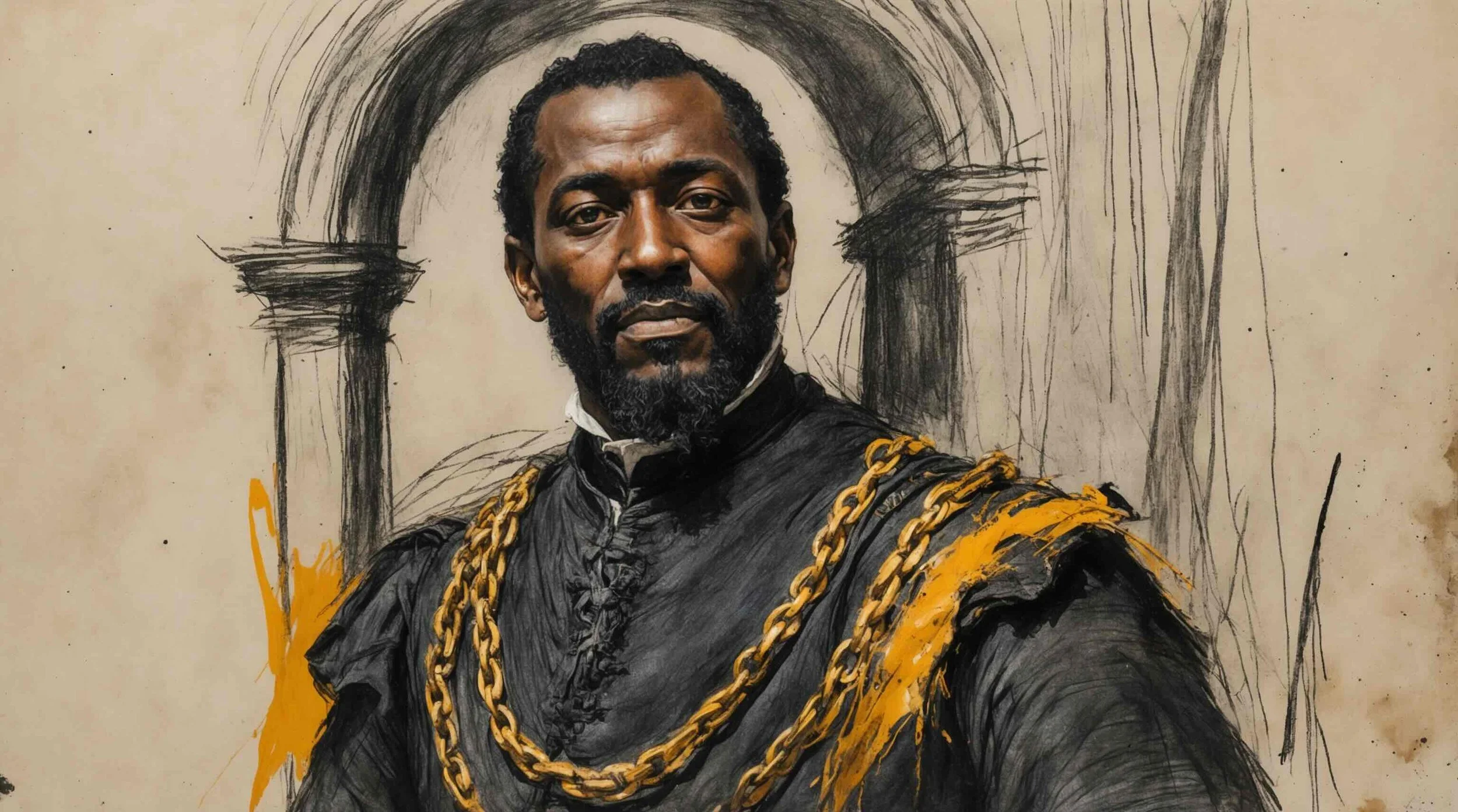
Character Profile – At a Glance
- Role: Prince of Aragon, the highest-ranking man in Messina and the play’s matchmaker. He woos Hero for Claudio, plots to pair Beatrice with Benedick, and joins Claudio in shaming Hero. Half-brother to the villain, Don John.
- Key Traits: Gracious, generous, playful and used to being obeyed. Loves arranging other people’s lives. Trusts his own eyes completely.
- The Core Conflict: Don Pedro believes his judgement is sound because his rank says so. When his brother shows him a woman at a window, the prince’s honour is engaged, and he condemns Hero with the same confidence he used to woo her.
- Key Actions: Woos Hero in disguise and wins her for Claudio (A2S1). Proposes, perhaps in jest, to Beatrice (A2S1). Devises the plot to make Benedick and Beatrice love each other (A2S1, A2S3). Watches the window and in church declares Hero "no maiden" (A3S2, A4S1). Learns the truth, repents, and ends the play without a partner (A5S1, A5S4).
- Famous Quote:
"I will in the interim undertake one of Hercules' labours; which is, to bring Signior Benedick and the Lady Beatrice into a mountain of affection the one with the other."
(Act 2, Scene 1) - The Outcome: Everyone else pairs off; Benedick tells him to get a wife. He has arranged two marriages and has none.
The Prince Who Woos for Others
Don Pedro arrives in Messina as a victor, greets Leonato with a graceful joke about trouble and cost, and within a hundred lines has taken charge of Claudio’s love life. Claudio wants Hero. The prince has a plan.
Original
I know we shall have revelling to-night:
I will assume thy part in some disguise
And tell fair Hero I am Claudio,
And in her bosom I'll unclasp my heart
And take her hearing prisoner with the force
And strong encounter of my amorous tale:
Then after to her father will I break;
And the conclusion is, she shall be thine.
(Act 1, Scene 1)
Shakespeare Retold (Modern Verse)
I know there is a party on tonight:
I’ll dress up in disguise to look like you
And then tell Hero that I’m Claudio,
And tell her all the contents of ‘my’ heart,
Seducing her with all my amorous powers
And tales of love that I will share while flirting.
Then after that, I’ll go and see her father;
And when that’s done, then Hero will be yours.
He will put on a mask, pretend to be Claudio, woo Hero himself, and then settle it with her father. Claudio does not object and the prince does not ask him to. It is a generous offer and a strange one, and the strangeness is the point: the prince likes to be the one who makes things happen, and he enjoys a disguise. By the end of the ball he has done exactly what he said, and he hands Hero over with a flourish: "name the day of marriage, and God give thee joy!"
The plan also causes the play’s first crisis, since Don John uses it to persuade Claudio that the prince has stolen Hero for himself. Don Pedro never learns how close his kindness came to ruining his friend. The theme of courtship and marriage in Messina is a thing done on behalf of others, and the prince is its most willing agent.
The Only Love-Gods
With Hero and Claudio settled and a week to fill before the wedding, Don Pedro proposes a second project: to make Beatrice and Benedick fall in love. He calls it one of Hercules’ labours, and he is pleased with himself.
Original
If we can do this, Cupid is no longer an archer: his glory shall be ours, for we are the only love-gods.
(Act 2, Scene 1)
Shakespeare Retold (Modern Verse)
If we can do this, then Cupid won’t need to shoot his arrow anymore, for we will thus become the only gods of love.
"We are the only love-gods" is a joke, and it is also what he believes. He will manage Benedick himself, with Claudio and Leonato as his cast; Hero and her women will manage Beatrice. The orchard scene that follows is his best performance in the play, grave and sorrowful and completely false, and it works. The theme of deception and noting in this comedy has a benevolent face, and it is the prince’s.
It is worth noticing what he says about Benedick to justify the trick: that he is "of a noble strain, of approved valour and confirmed honesty". The prince deceives the people he likes, for their own good, because he is sure he knows what their good is. The same certainty will be turned on Hero.
Will You Have Me, Lady?
In the middle of the betrothal scene the prince asks Beatrice to marry him. Nobody on stage, and nobody in the audience, is sure whether he means it.
Original
Will you have me, lady?
(Act 2, Scene 1)
Shakespeare Retold (Modern Verse)
Will you take me as your husband, lady?
She says he is too costly to wear every day, and apologises for being all mirth and no matter; he tells her that silence would offend him more, and that she was born in a merry hour. It is over in a moment and it is never mentioned again. But when she has gone the prince says she would make an excellent wife for Benedick, and Leonato supplies the warning.
Original
O Lord, my lord, if they were but a week married, they would talk themselves mad.
(Leonato, Act 2, Scene 1)
Shakespeare Retold (Modern Verse)
Oh Lord, my lord, if they were married for just a week, they’d talk each other into madness.
Whether the proposal was a gallantry, a test or a real offer that Beatrice was kind enough to treat as a joke, the prince recovers by doing what he always does: he arranges a marriage for someone else. The theme of love and romance in this play never quite reaches Don Pedro himself, and the proposal is the nearest it comes.
I Stand Dishonoured
The prince’s judgement fails in the same scene as Claudio’s, and with less excuse. Don John tells them Hero is disloyal; the prince says "I will not think it"; and then he goes to the window, sees what he is shown, and promises to join Claudio in disgracing her. In the church he does not merely stand by. He testifies.
Original
Why, then are you no maiden. Leonato,
I am sorry you must hear: upon mine honour,
Myself, my brother and this grieved count
Did see her, hear her, at that hour last night
Talk with a ruffian at her chamber-window
Who hath indeed, most like a liberal villain,
Confessed the vile encounters they have had
A thousand times in secret.
(Act 4, Scene 1)
Shakespeare Retold (Modern Verse)
Well, then you are no virgin. Leonato,
I’m sorry you must hear this: by my word,
Myself, my brother, and this grieving count
All saw and heard her at that time last night
Talk with a thug outside her bedroom window,
And, like a filthy villain, he indeed
Confessed to sordid dalliances they’d had
A thousand times in secret.
"Upon mine honour" is the phrase that matters. The prince has staked his word on what he saw, and once a prince’s word is given, in this world, it cannot be taken back without cost. His own account of his grievance is telling: "I stand dishonoured, that have gone about / To link my dear friend to a common stale." Hero is a stale, a decoy; the injured party is Don Pedro. He leaves with Claudio and his brother while she lies on the floor.
He is not cruel. He is sorry for Leonato and says so. But he never once asks Hero a question, and the man who spent two acts staging deceptions for other people’s good is undone by one staged for his harm. The theme of honour and shame in this play belongs to the men, and the prince’s is the most expensive.
Get Thee a Wife
When Borachio confesses, the prince’s first words are to Claudio: "Runs not this speech like iron through your blood?" His second are about his brother. His apology to Leonato is brief and conditional.
Original
By my soul, nor I:
And yet, to satisfy this good old man,
I would bend under any heavy weight
That he'll enjoin me to.
(Act 5, Scene 1)
Shakespeare Retold (Modern Verse)
As did I:
But to appease this old man Leonato,
I’ll gladly suffer any punishment
That he’ll inflict on me.
He will bend under any weight Leonato chooses, but he, like Claudio, did not sin "but in mistaking". Leonato asks him for nothing. The penance falls on Claudio, and the prince attends the tomb as a mourner rather than a penitent. In the last scene he is the one who notices Benedick’s "February face", and the one Benedick turns on at the end.
Original
Prince, thou art sad; get thee a wife, get thee a wife: there is no staff more reverend than one tipped with horn.
(Benedick, Act 5, Scene 4)
Shakespeare Retold (Modern Verse)
Prince, you are sad; get yourself a wife, go get a wife. There’s no staff more venerable than a cuckold’s horn.
Get thee a wife. The prince who made two matches is the one man left without one, and the play notices. Then the messenger announces that Don John has been caught, and Benedick tells him to think of that tomorrow. The theme of status and class in this play has put the prince above everyone, and the last scene leaves him there, alone.
"I take their love as the creation of Don Pedro, who would ‘fain have it a match,’ he says, to enliven the time between Claudio’s betrothal and nuptials by accomplishing a difficult thing."
— Gail Kern Paster, A Modern Perspective: Much Ado About Nothing, Folger Shakespeare Library
Key Quotes
Quote 1
What need the bridge much broader than the flood?
The fairest grant is the necessity.
(Act 1, Scene 1)
Shakespeare Retold (Modern Verse)
Why build a bridge that’s wider than the river?
The finest gift is what is needed most.
Quote Analysis: Don Pedro to Claudio, who has apologised for confessing his love too suddenly. The couplet is the prince’s philosophy in two lines: do not make more of a thing than it needs; give what is wanted. It is graceful and it is a little brisk. Claudio wanted to tell a longer story; the prince cuts him short and gets on with the arrangements. He is a man who prefers solutions to feelings, and the play will test what happens when the feelings are not his own.
I would she had bestowed this dotage on me: I would have daffed all other respects and made her half myself.
(Act 2, Scene 3)
Shakespeare Retold (Modern Verse)
I wish she had fallen in love with me: I would have pushed everyone else aside and taken her to be my better half.
Quote Analysis: Don Pedro in the orchard, within Benedick’s hearing, playing his part in the trick. He says he wishes Beatrice loved him, and that he would have set aside every other consideration to make her "half myself". It is bait for Benedick and the line is delivered as such. But it is the second time in the play the prince has said something of the kind about Beatrice, and audiences have often wondered how much of it was acting.
I stand dishonoured, that have gone about
To link my dear friend to a common stale.
(Act 4, Scene 1)
Shakespeare Retold (Modern Verse)
I’ve been dishonoured, since I tried to get
My friend to marry with a common whore.
Quote Analysis: The prince’s first words in the church when Leonato asks why he is silent. He is dishonoured. The grievance is his: he arranged the match, vouched for the bride, and has been made a fool of. Hero, in this sentence, is a "common stale", a word for a prostitute used as a lure. There is no pity for her and no hint that they might be wrong. The prince’s honour, once engaged, has no room for either.
Runs not this speech like iron through your blood?
(Act 5, Scene 1)
Shakespeare Retold (Modern Verse)
Well, don’t these words just make your blood run cold?
Quote Analysis: Don Pedro to Claudio, the instant Borachio has finished confessing. It is a good line and a revealing one. He does not ask what they have done. He asks Claudio how the speech feels, as if the harm were something that has happened to them. His next question is whether his brother set it up, and his next speech is about Don John’s treachery. The prince is quick to feel and quick to assign blame, and the two are not quite the same as remorse.
Key Takeaways
- The Arranger: Don Pedro woos for Claudio and matchmakes for Benedick because he likes to be the one who makes things happen; his kindness and his control are the same impulse.
- The Love-God: The orchard plot is his finest performance and his deepest belief: that he knows what is good for people better than they do.
- Upon Mine Honour: He condemns Hero in church on the evidence of his own eyes, and once his word is given he cannot take it back without cost.
- Alone at the Dance: He ends the play the only unmarried man on stage, told by Benedick to get a wife; the matchmaker is the one the play leaves out.
Study Questions and Analysis
Why does Don Pedro woo Hero for Claudio instead of letting him do it himself?
Because he can, and because it pleases him. The arrangement is proposed by the prince, not asked for by Claudio, and when it is done he presents the result as a gift.
Here, Claudio, I have wooed in thy name, and fair Hero is won: I have broke with her father, and his good will obtained: name the day of marriage, and God give thee joy!
(Act 2, Scene 1)
Shakespeare Retold (Modern Verse)
Here, Claudio, I have chatted up Hero for you, and fair Hero is yours; I have spoken with her father, and with his agreement, you can now name the day of your marriage, and may God bring you happiness!
He has wooed, won, spoken to the father and obtained his goodwill; all Claudio has to do is name the day. It is exactly how a great lord might arrange the marriage of a favourite, and nobody in Messina finds it odd except Don John, who finds it useful.
Jean E. Howard, in her 1987 essay on theatricality and rank in the play, read the proxy wooing as the first of the prince’s authorised performances: Don Pedro has the rank to stage deceptions and have them count as kindness, where the same tricks from his brother are villainy, and the play ends by returning control of its theatre to the "better sort". Who may deceive, in Messina, is a question of status. Harry Berger Jr. (1982) saw the scene as evidence of how love works in "the Men’s Club of Messina", as a transaction between men in which the woman is informed of the result; Hero’s own consent is given in a whisper we do not hear. Gail Kern Paster, in her "Modern Perspective" essay for the Folger edition, puts the cost on Hero’s side: she "accepts the marriage proposal of a man in a mask and then learns to transfer her consent from the wearer of that mask, Don Pedro, to his young favorite". The more relaxed view treats the device as a stock romance motif that Shakespeare takes from his sources and uses mainly to set Don John’s first lie in motion. The best reading may be that all of these are true. The prince is generous, the generosity is a form of power, and the power is what the villain exploits. The theme of status and class in this play is not a matter of rich and poor; it is a matter of who gets to act and who gets acted upon, and the prince is always the actor.
Why does Don Pedro want Beatrice and Benedick to marry?
He gives three reasons, and they are all about the pleasure of the thing. It will pass the time before the wedding; it is a labour fit for Hercules; and Benedick deserves it.
And Benedick is not the unhopefullest husband that I know. Thus far can I praise him; he is of a noble strain, of approved valour and confirmed honesty.
(Act 2, Scene 1)
Shakespeare Retold (Modern Verse)
And Benedick is not the most unlikely husband that I know. I know this much that I can credit him for: he is a nobleman, of proven courage and confirmed honesty.
"Not the unhopefullest" is faint praise with real affection under it. The prince likes Benedick, thinks Beatrice is "an excellent sweet lady", and believes that two people who are plainly made for each other should be made to see it. He is, as he says, playing Cupid, and he does not doubt his aim.
August Wilhelm Schlegel (1808) saw the design at once: the gulling of the two lovers mirrors the gulling of Claudio, and "the drollery, however, lies in the very symmetry of the deception." Samuel Taylor Coleridge (1818) explained why one trick fits both victims: "the same stratagem being used in regard to Benedick and Beatrice, — the vanity in each being alike." A. P. Rossiter (1961) placed the prince’s plot at the centre of the play’s argument: it is a deception that produces truth, staged by a man who, in the very next act, will be destroyed by a deception that produces a lie. Bertrand Evans (1960) observed that the audience is in on the prince’s plot and watches Don John’s from a distance, so that we share the prince’s pleasure in the first and are made to feel his error in the second. There is also a less flattering motive that productions sometimes play: the prince has just been turned down by Beatrice, lightly, and his immediate response is to give her to somebody else. Whether that is pique or grace depends on the actor. What is certain is that he enjoys it. His account of the plan ends with "we are the only love-gods", and a man who says that is not only being kind. The theme of deception and noting in this play asks who has the right to arrange other people’s feelings, and the prince never considers that the answer might be nobody.
Is Don Pedro in love with Beatrice?
The play will not say, and it has been careful not to. The proposal is brief, light and surrounded by jokes, and Beatrice’s refusal is kind enough to let it pass as one. But look at the line that provokes it.
I would rather have one of your father's getting. Hath your grace ne'er a brother like you? Your father got excellent husbands, if a maid could come by them.
(Beatrice, Act 2, Scene 1)
Shakespeare Retold (Modern Verse)
I would rather have a husband your father produced. Don’t you have a brother like yourself? Your father made excellent husbands, if only a lady could catch one.
Beatrice has just said that everyone is going to the world but her. The prince offers to get her a husband; she says she would rather have one of his father’s making, a brother like him; and he asks whether she will have him. It can be read as her inviting the question and him answering it, or as two quick people trading compliments. The second time he speaks of her, in the orchard, he says he would have "daffed all other respects" to have her, and that is a performance for Benedick, or mostly.
Critics have read the moment both ways. Gail Kern Paster takes the prince’s matchmaking as a pastime, a way "to enliven the time between Claudio’s betrothal and nuptials by accomplishing a difficult thing", and on that view the proposal is a courtly flourish that a modern audience is too ready to take seriously. Others have pointed out that the prince is the only major character the play leaves single, and that whether or not he loved Beatrice, Shakespeare chose to end on his exclusion; a Don Pedro who may have wanted her gives the final scene its quiet melancholy. Anna Jameson (1832) noticed something about Beatrice that bears on it: with Benedick "the power is throughout on her side", and a prince is the one suitor with whom that could never be true. Productions have gone both ways. Some let him smile the refusal off; some leave him visibly alone as the dancing starts. The theme of love and romance in this play is a thing the prince gives to others and never quite receives, and the proposal is the one moment he seems to ask for it.
Why does Don Pedro believe Don John so readily?
He does not, at first. His immediate response to the accusation is "I will not think it". What changes his mind is not an argument but a sight, and before he has seen it he has already promised what he will do.
And, as I wooed for thee to obtain her, I will join with thee to disgrace her.
(Act 3, Scene 2)
Shakespeare Retold (Modern Verse)
And as I was the one who wooed her for you, I will join you in bringing disgrace on her.
The logic is a prince’s. He made the match, so if the match is bad his honour is involved, and the remedy for injured honour is public disgrace. He is agreeing to a punishment before the trial, and the window scene, which we never see, merely confirms what he has committed himself to.
Carol Cook (1986) read the prince’s readiness as the natural consequence of the men’s world the play depicts: every joke about cuckoldry in the first two acts has prepared him to believe that a woman will betray a man, and when the evidence arrives it fits the story he already knows. Gail Kern Paster puts the point as a statistic the play itself seems aware of: "Many more wives are falsely accused than are, in fact, guilty." The Folger editors Mowat and Werstine name the prince’s particular weakness as "Don Pedro’s touchy sense of his own honor". Barbara Everett (1994) saw the failure as the group’s rather than the man’s; the prince and Claudio believe together, decide together and walk out together, and neither can doubt without breaking ranks. There is also a practical point: Shakespeare keeps the window scene offstage precisely so that we cannot judge how convincing it was, and must take the prince’s certainty on trust, as Hero must. It is also his brother who is lying to him, and a brother he has only just forgiven for a rebellion. A more suspicious man might have wondered. Don Pedro, who trusts himself, trusts his eyes and assumes his brother’s malice has been spent. The theme of deception and noting in this play punishes the confident, and nobody in Messina is more confident than the prince.
What is the relationship between Don Pedro and Don John?
Half-brothers, recently at war with each other, and recently reconciled. The play tells us this in its first scene, when Leonato welcomes Don John as "being reconciled to the prince your brother", and it tells us almost nothing else. When the truth comes out, the prince’s verdict is short.
He is composed and framed of treachery:
And fled he is upon this villany.
(Act 5, Scene 1)
Shakespeare Retold (Modern Verse)
That man has treachery within his bones,
And he has run away to flee his crime.
Composed and framed: made of it, built from it. The prince does not ask why. He does not wonder whether forgiving a rebel and then keeping him on a leash, muzzled and clogged in Don John’s own words, might have had something to do with it. He names the treachery and moves on.
Samuel Taylor Coleridge (1818) noticed how little Shakespeare gives the villain: "Don John is the main-spring of the plot of this play; but he is merely shown and then withdrawn." The brothers’ history is a rebellion and a pardon and no more, and the vagueness looks purposeful: Don John is to be a cause without a case. Gail Kern Paster sees the brothers as a designed pair: "Shakespeare assigns the function of destroyer with evident symmetry to Don Pedro’s brother, Don John the Bastard", so that the man who makes the matches and the man who breaks them share a father. Harry Berger Jr. (1982) read the two as two faces of the same power: the legitimate prince arranges people’s lives for their good, the bastard brother arranges them for their harm, and both treat the people as material. The pardon tells us something about the prince too, who is generous to his brother in exactly the way he is generous to everyone, by deciding what is good for them and expecting gratitude. The play supports the parallel in its structure, giving each brother a staged deception in the second and third acts, with the prince’s producing a marriage and Don John’s destroying one. The prince never draws the comparison himself. His last word on his brother is to leave the punishment to Benedick, and to think about it tomorrow. The theme of deception and noting in this play is a family business, and the honest brother is the one who does not know it.
Does Don Pedro take responsibility for what happened to Hero?
Partly. Before the truth is known, his position is firm and princely.
My heart is sorry for your daughter's death:
But, on my honour, she was charged with nothing
But what was true and very full of proof.
(Act 5, Scene 1)
Shakespeare Retold (Modern Verse)
I’m truly sorry for your daughter’s death;
But I will promise you that all her charges
Were true, and there was proof to back this up.
He is sorry she is dead; he is certain she was guilty; and he will not hear Leonato out. When Borachio confesses, he says that he, like Claudio, sinned only in mistaking, and offers to bend under any weight Leonato lays on him. Leonato lays none. The penance, the epitaph and the second marriage are all Claudio’s. The prince attends.
Carol Cook (1986) pointed out that nobody in the play ever apologises to Hero, and that the prince’s contrition, such as it is, is addressed entirely to her father, because in Messina the injury was done to him. Harry Berger Jr. (1982) put the double standard in a sentence: in this world "women are responsible for their sins but men are not". The gentler view notes that the prince is the first to feel the force of Borachio’s confession, that "iron through your blood" is a real reaction, and that a prince who offers penance to a subject is going further than his rank requires. The Folger editors Mowat and Werstine call his fault "Don Pedro’s touchy sense of his own honor", which is the right size: a failing, not a crime. The play leaves his guilt unresolved, since a comedy that stopped to punish him could not end in a dance. It is a fair point about the form and a hard one about the man. Don Pedro condemned Hero "upon mine honour", and his honour is never asked to pay. The theme of honour and shame in this play costs women everything and men very little, and the prince is the clearest case: he was wrong in public, says so in private, and is forgiven without being asked.
Why does Don Pedro end the play alone?
Shakespeare made the choice, and he made it visible. In the last scene Claudio has Hero, Benedick has Beatrice, and the prince has a question.
How dost thou, Benedick, the married man?
(Act 5, Scene 4)
Shakespeare Retold (Modern Verse)
How are you, Benedick, the married man?
It is the old joke from the first act, now true, and Benedick answers it at length before turning it back: "Prince, thou art sad; get thee a wife, get thee a wife." The messenger arrives with news of Don John’s capture; Benedick tells the prince to think of that tomorrow; and the play ends with pipers. We do not hear Don Pedro again.
Gail Kern Paster notes that it is Benedick, not the prince, who insists on the dance, "the stately, regulated movements of a communal dance in which the couples move not singly, but together, and no man is yet wearing horns", and the prince is the one man on stage with no partner for it. Barbara Everett (1994) saw the ending as part of the play’s honesty about its own society: the marriages are made, the slander is undone, and the person with most power is the one with least to show for it. Productions have found very different princes in the same lines, from a benign uncle content to watch to a lonely man who proposed to Beatrice and meant it; the comedy’s dance does not include everyone, and the man who arranged the dancing is left watching it. Whether he is sad because of Beatrice, because of his brother, or because a prince cannot be anyone’s equal, the text does not say. It says he is sad, and that the cure, in Benedick’s opinion, is a wife. The theme of courtship and marriage in this play has been the prince’s hobby for five acts. The ending suggests, gently, that a hobby is what it was.