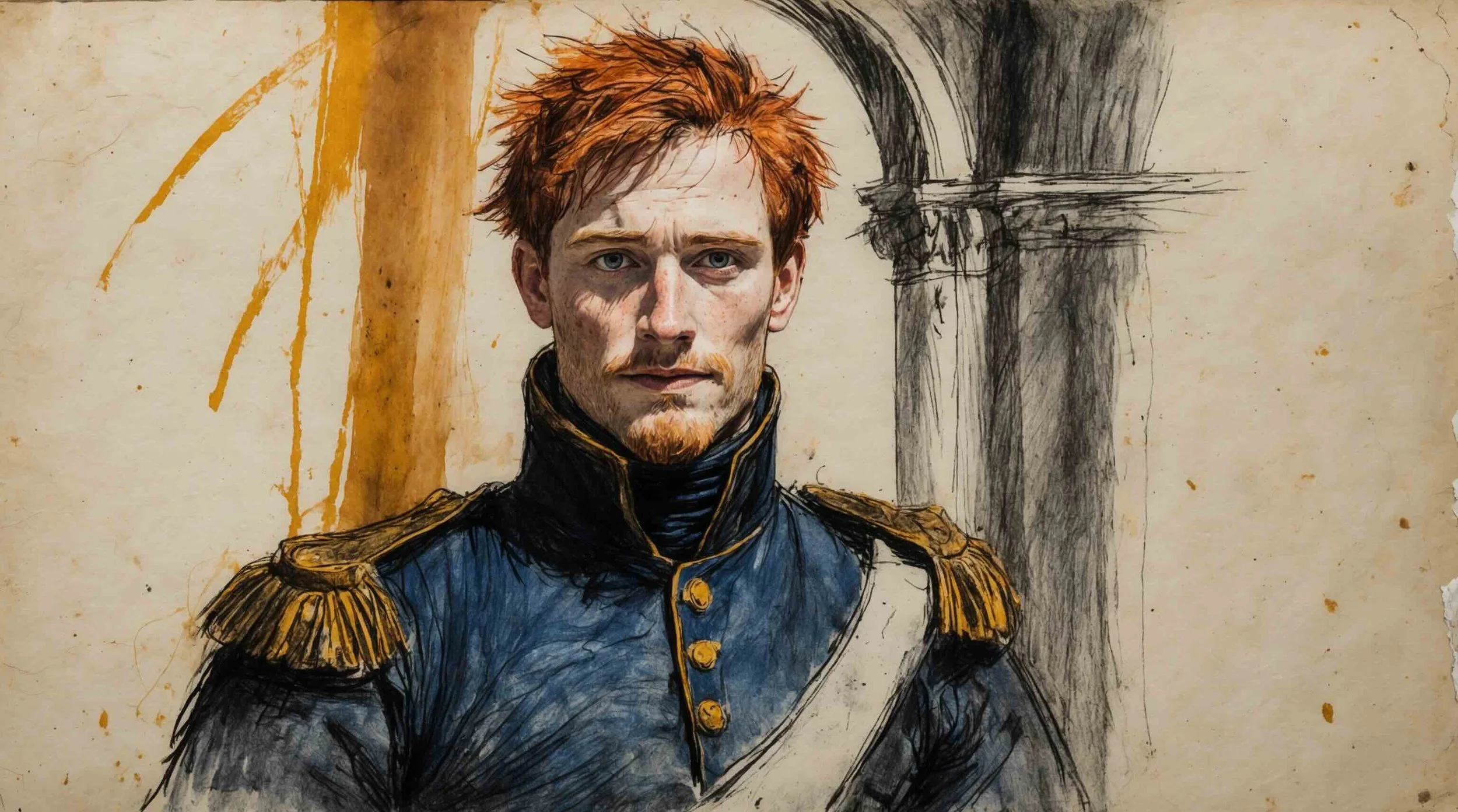
Character Profile – At a Glance
- Role: A lord of Padua and a soldier in Don Pedro’s company. A sworn bachelor, a "professed tyrant" to women, and Beatrice’s opponent in the merry war of wit.
- Key Traits: Witty, vain, warm-hearted and brave. Talks constantly, mostly about himself. Keeps his word when it costs him.
- The Core Conflict: Benedick has made bachelorhood his public identity, so falling in love means eating every word he ever said. When Beatrice asks him to kill Claudio, love and friendship pull in opposite directions.
- Key Actions: Mocks Claudio’s love and swears to die a bachelor (A1S1). Is tricked in the orchard and decides "the world must be peopled" (A2S3). Shaves his beard and blames toothache (A3S2). Stays in the church, declares his love and challenges Claudio (A4S1, A5S1). Marries Beatrice and tells the prince to get a wife (A5S4).
- Famous Quote:
"When I said I would die a bachelor, I did not think I should live till I were married."
(Act 2, Scene 3) - The Outcome: Married to Beatrice, unrepentant and dancing. "Man is a giddy thing, and this is my conclusion."
A Professed Tyrant to Their Sex
Benedick arrives talking and does not stop. His first exchange with Beatrice is a draw, which he does not admit; his second, with Claudio, sets out his position on women. Claudio is in love with Hero. Benedick has looked at her and seen nothing worth the trouble, and when Claudio talks of marrying he treats it as a kind of death. Pressed by the prince, he gives his creed.
Original
That a woman conceived me, I thank her; that she brought me up, I likewise give her most humble thanks: but that I will have a recheat winded in my forehead, or hang my bugle in an invisible baldrick, all women shall pardon me. Because I will not do them the wrong to mistrust any, I will do myself the right to trust none; and the fine is, for the which I may go the finer, I will live a bachelor.
(Act 1, Scene 1)
Shakespeare Retold (Modern Verse)
I am grateful that I was born of a woman; and that a woman brought me up, I am likewise grateful and give her my humble thanks. But if they think I’ll let horns that call hunting dogs be set on my forehead, or that I’ll hang up my own bugle, all women must forgive me. Because I won’t be so rude as to distrust one of them, I’ll do myself the favour of not trusting any of them; and that’s fine by me, for I can buy myself fine clothes and live my life as a bachelor.
The "recheat" and the "bugle" are the cuckold’s horns, and the speech is built on the fear of them. Benedick will not trust any woman because he cannot be sure of any, and he dresses the fear up as a principle, with a pun on fine and finer. Don Pedro tells him he will see him pale with love before he dies. Benedick offers to be hung up as a sign: "Here you may see Benedick the married man."
It is a performance, and a good one, and the play lets us enjoy it. It also notices that a man who talks this much about not marrying is a man thinking about marriage. The theme of wit and communication is built on Benedick: his jokes are armour, and the play spends two acts finding the gap.
The Prince's Fool
At the ball Beatrice, masked, tells a masked Benedick that Benedick is "the prince’s jester", a dull fool whose only gift is slander. She knows exactly who she is talking to. He may or may not know she knows. Either way it lands, and when the prince asks how it went Benedick cannot stop talking about it.
Original
She speaks poniards, and every word stabs: if her breath were as terrible as her terminations, there were no living near her; she would infect to the north star.
(Act 2, Scene 1)
Shakespeare Retold (Modern Verse)
She speaks in daggers, and every word feels like a stab: if her breath smelled as bad as her name-calling, then nothing could live near her; she would stink out the world to the stars and back.
Poniards are daggers, and the image is of a man standing "like a man at a mark, with a whole army shooting at me". It is the first time in the play Benedick has lost an exchange, and he has lost it to an opponent he could not answer because he was pretending to be someone else. He would not marry her, he says, if she came with everything Adam had before the Fall; she would have made Hercules turn the spit.
The speech protests too much, and Don Pedro hears it. The plan to trick the two of them into love is hatched a few minutes later, and the prince’s stated reason is that Benedick is "of a noble strain, of approved valour and confirmed honesty". Benedick is being punished for being a good man who talks too much.
The World Must Be Peopled
The gulling scene is Benedick’s. He hides in the arbour to mock Claudio for being in love, and overhears the prince, Claudio and Leonato discussing how Beatrice is dying for him. He believes it because Leonato says it: "knavery cannot, sure, hide himself in such reverence." Left alone, he talks himself round in a single speech.
Original
Shall quips and sentences and these paper bullets of the brain awe a man from the career of his humour? No, the world must be peopled.
(Act 2, Scene 3)
Shakespeare Retold (Modern Verse)
Will these sarcastic comments and witty excerpts from books prevent a man from following what he really desires? No; for the world must be populated.
"Paper bullets of the brain" is his own description of his own wit, and he is right: the jokes were never going to stop him. He runs through the objections, answers each one, and ends on the grandest excuse a man has ever found for changing his mind. Then Beatrice arrives to call him in to dinner, rudely, and he reads love into every word. The theme of deception and noting in the orchard works because Benedick wants to be deceived; the conspirators only supply the permission.
The next time we see him he has shaved off his beard, washed his face, started wearing scent and developed toothache. His friends enjoy themselves at length. He says nothing in his own defence, which for Benedick is a confession.
By This Hand, I Love Thee
When the wedding collapses and the prince and Claudio walk out, Benedick stays. It is the most important thing he does in the play, and he does it without a word of explanation. He is Claudio’s friend and the prince’s man, and he stands with Leonato, the friar and the weeping Beatrice. When the others leave, he and Beatrice are alone for the first time.
Original
I do love nothing in the world so well as you: is not that strange?
(Act 4, Scene 1)
Shakespeare Retold (Modern Verse)
There is nothing I love more in the world than you: isn’t that strange?
No jokes. Benedick, who has never said a plain thing in his life, says the plainest thing he can, and adds that it is strange, because it is. Beatrice answers in his old manner, confessing nothing and denying nothing, and then gives way. He asks her to bid him do anything. She says "Kill Claudio". He laughs, she turns to go, and he stops laughing.
Original
You are a villain; I jest not: I will make it good how you dare, with what you dare, and when you dare. Do me right, or I will protest your cowardice. You have killed a sweet lady, and her death shall fall heavy on you. Let me hear from you.
(Act 5, Scene 1)
Shakespeare Retold (Modern Verse)
You are a villain; and I’m not joking. I will prove it in any way you dare, with whatever weapon you dare use, at whatever time you dare. Accept this challenge, or I’ll call you a coward. You have killed a sweet lady, and you will pay the price for her death. Tell me your answer.
The challenge is delivered quietly, in Claudio’s ear, while Claudio and the prince are still joking about Benedick’s wit. Claudio does not believe it at first. Neither does the prince. "He is in earnest," they say when he has gone, and the play’s two cleverest men have for once been slow to understand something. The theme of honour and shame belongs to Claudio and the prince for most of the play. In this scene Benedick takes it off them.
Man Is a Giddy Thing
Benedick ends the play married and unembarrassed. Claudio and the prince are ready with the old jokes about the savage bull and the married man, and he has an answer prepared.
Original
In brief, since I do purpose to marry, I will think nothing to any purpose that the world can say against it; and therefore never flout at me for what I have said against it; for man is a giddy thing, and this is my conclusion.
(Act 5, Scene 4)
Shakespeare Retold (Modern Verse)
In short, since I do intend to marry, I will not hear anything from anyone who has a bad word to say about it; and so don’t ever ridicule me for what I’ve said against getting married, for a man can be a fickle thing, and that’s the end of it.
He does not say he was wrong. He says he has changed, and that men change, and that this is all there is to say about it. It is the same man who swore he would die a bachelor, applying the same confidence to the opposite position, and the play plainly thinks this is a better use of it. He forgives Claudio, calls for a dance before the wedding, and tells the prince to get himself a wife. The theme of courtship and marriage in this play ends with its loudest critic leading the dancing.
"Benedick is a professed and staunch enemy to marriage, and gives very plausible reasons for the faith that is in him."
— William Hazlitt, Characters of Shakespear’s Plays, 1817
Key Quotes
Quote 1
I would my horse had the speed of your tongue, and so good a continuer.
(Act 1, Scene 1)
Shakespeare Retold (Modern Verse)
I wish my horse was as quick as your tongue, and also had your stamina.
Quote Analysis: Benedick to Beatrice, ending their first bout. The horse joke is a good one and he loses anyway, because she gets the last word: "You always end with a jade’s trick: I know you of old." A jade is a worn-out horse, and the trick is to quit. Beatrice has turned his image against him in one line, and the pattern of the merry war is set. Benedick is funnier at length; Beatrice is deadlier in short.
I do much wonder that one man, seeing how much another man is a fool when he dedicates his behaviours to love, will, after he hath laughed at such shallow follies in others, become the argument of his own scorn by falling in love: and such a man is Claudio.
(Act 2, Scene 3)
Shakespeare Retold (Modern Verse)
It amazes me that a man – after seeing how another man makes a fool of himself when he falls in love – will, after he has laughed at this shallowness in others, then become the person he once laughed at because he’s fallen in love. And in this case, that man is Claudio.
Quote Analysis: Benedick alone in the orchard, moments before he is tricked. He is describing Claudio, who used to care about armour and now lies awake designing a new doublet, and he is describing himself ten minutes in advance. The speech is a trap Shakespeare sets for the speaker: every charge Benedick lays against lovers will be laid against him by the end of the act, and he knows it, which is why the speech ends by wondering whether he could ever be "so converted". He can.
Love me! Why, it must be requited. I hear how I am censured: they say I will bear myself proudly, if I perceive the love come from her; they say too that she will rather die than give any sign of affection. I did never think to marry: I must not seem proud: happy are they that hear their detractions and can put them to mending.
(Act 2, Scene 3)
Shakespeare Retold (Modern Verse)
She loves me? Well, I must return it. I heard how they criticised me: they say I will be cocky if I find out that she loves me; they also say that she would rather die than show any affection to me. I never thought I’d get married: but I mustn’t be over-proud, for people are happy that can hear criticism of themselves and then put it right.
Quote Analysis: Benedick, coming out of hiding. "It must be requited" is the whole conversion in four words, and the speed of it is the joke. What follows is more interesting: he has overheard that he is proud, and decides to mend. "Happy are they that hear their detractions and can put them to mending" is the sentence of a decent man, and it is the same lesson Beatrice draws from her own gulling an act later. The trick works on both of them the same way, by telling them something true about themselves.
In a false quarrel there is no true valour.
(Act 5, Scene 1)
Shakespeare Retold (Modern Verse)
There’s no bravery in an unfair fight.
Quote Analysis: Benedick to the prince and Claudio, who have just been laughing about nearly fighting two old men. It is the first thing he says to them after the church, and it is a rebuke they do not recognise. For four acts Benedick has been the one who makes the jokes. Here he refuses to, and his friends keep trying to draw him for their amusement, not noticing that the man has changed. The line is also a judgement on Claudio’s quarrel with Hero, which was false, and on his own challenge, which he believes is not.
Key Takeaways
- The Sworn Bachelor: Benedick's creed against marriage is built on the fear of cuckoldry, and the play treats it as a performance that protests too much.
- Talked into Love: He is gulled in the orchard because he wants to be; 'the world must be peopled' is the excuse of a man who has already decided.
- The Man Who Stayed: Staying in the church when the prince and Claudio walk out is the turning point of his character, done without a word of explanation.
- Kill Claudio: He laughs, then listens, then challenges his closest friend on Beatrice's word; the joker keeps his promise.
Study Questions and Analysis
Why is Benedick so against marriage?
He tells us, repeatedly, and the answer is always the same: horns. When Claudio first confesses he wants Hero for a wife, Benedick’s response is not about Hero at all.
Is't come to this? In faith, hath not the world one man but he will wear his cap with suspicion? Shall I never see a bachelor of three-score again?
(Act 1, Scene 1)
Shakespeare Retold (Modern Verse)
Has it come to this? In truth, is there no one left in the world who won’t end up wearing his cap to hide the cuckold’s horns? Will I never see a sixty-year-old bachelor again?
To wear one’s cap "with suspicion" is to wear it over the cuckold’s horns, and the joke that a married man is a man whose wife will betray him runs through everything Benedick says in the first two acts. The recheat winded in his forehead, the bugle in the invisible baldrick, the savage bull bearing the yoke: it is all the same fear, dressed in different clothes.
Samuel Johnson noticed the pattern in 1765, with a note on the recheat: "Shakespeare had no mercy upon the poor cuckold, his horn is an inexhaustible subject of merriment." Gail Kern Paster, in her "Modern Perspective" essay for the Folger edition, makes it the key to the character: "Cuckoldry jokes are in the air in Messina", and for a man like Benedick the stakes are not only sexual. "For soldiers like Benedick and Othello, marriage threatens loss of a valued form of masculine singleness, a loss of control." Carol Cook, in her 1986 essay for PMLA, read the joke as the central ritual of a world in which "to read others in this play is an act of aggression; to be read is to be emasculated": the men bond by joking about women’s infidelity, and the joke lets them disown the fear it expresses. Harry Berger Jr., in Shakespeare Quarterly (1982), called that world "the Men’s Club of Messina", and Benedick’s bachelor pose is sustained for its members and collapses the moment they tell him it should. The text supports all of this. Benedick’s last word on the subject in Act 1 is a fantasy of being painted and hung up as a sign for his friends to laugh at, and his first word on the subject after the gulling is that he may have "some odd quirks and remnants of wit broken on me". He is afraid of mockery, not of women, and the theme of gender and patriarchy in this play has a good deal to say about men who confuse the two.
What kind of woman does Benedick say he wants?
One who does not exist, which is the point. Alone in the orchard, he lists his requirements.
Rich she shall be, that's certain; wise, or I'll none; virtuous, or I'll never cheapen her; fair, or I'll never look on her; mild, or come not near me; noble, or not I for an angel; of good discourse, an excellent musician, and her hair shall be of what colour it please God.
(Act 2, Scene 3)
Shakespeare Retold (Modern Verse)
She’ll be rich, for sure; clever, or I’m not interested; decent, or I’ll never bid for her; beautiful, or I won’t look at her; mild mannered, or don’t come near me; noble, or I won’t have her even if she’s an angel; well spoken; an excellent musician; but her hair can be whatever colour God chooses.
Rich, wise, virtuous, fair, mild, noble, well-spoken, musical, and her hair can be whatever colour God likes. The last item is the giveaway: the list is a joke, and Benedick knows it is a joke, because a man who wanted a wife would not draw up a specification. The one quality he insists on that Beatrice conspicuously lacks is "mild".
Critics have enjoyed the speech. William Hazlitt (1817) thought the whole pose beautifully sustained: "His character as a woman-hater is admirably supported, and his conversion to matrimony is no less happily effected by the pretended story of Beatrice’s love for him." The catalogue is a stock comic form, the bachelor’s impossible ideal, and Shakespeare gives it to Benedick so that the woman he gets can fail every test but the ones that matter. Alexander Leggatt, in Shakespeare’s Comedy of Love (1974), described the play’s method as finding "the idea of human reality at the heart of convention", and the speech is a case in point: Benedick talks in lists, formulas and set pieces, and the gulling breaks the formulas down into something closer to feeling. It is worth noticing what Benedick says next: "Ha! The prince and Monsieur Love!" He mocks Claudio for having become "orthography", a man whose words are "a very fantastical banquet". Within a hundred lines Benedick is reading double meanings into "Against my will I am sent to bid you come in to dinner." The theme of love and romance in this play is often about the language lovers use, and Benedick’s is the most spectacular change.
Does Benedick really believe the trick, or does he want to?
Both, and the speech in which he convinces himself shows the two working together.
This can be no trick: the conference was sadly borne. They have the truth of this from Hero. They seem to pity the lady: it seems her affections have their full bent.
(Act 2, Scene 3)
Shakespeare Retold (Modern Verse)
This can’t be a trick: they told the story in all seriousness. They’ve heard the truth of this from Hero. They seem sorry for the lady: it seems her love is stretched to breaking point.
His evidence is that the conversation was "sadly borne", that the information came from Hero, and that the speakers pity Beatrice. It is thin, and he has just listened to Claudio saying "Bait the hook well; this fish will bite" under his breath. Benedick is a clever man who wants to believe something, and the play shows how little a clever man needs.
Samuel Taylor Coleridge, lecturing in 1818, explained why one trick serves for both lovers: "the same stratagem being used in regard to Benedick and Beatrice, — the vanity in each being alike." Benedick is caught through his pride, and the conspirators know it, which is why they spend so long on how proud he will be. A. P. Rossiter (1961) saw the orchard as the comic twin of Don John’s plot: in both, a staged scene is overheard, in both the watcher believes his eyes, and the difference is only in the intention of the stagers. Bertrand Evans (1960) noted that the audience knows the truth in both cases, so that we watch Benedick’s reasoning with a superior smile that the church scene will take away from us. Gail Kern Paster, in the Folger "Modern Perspective", declines to believe that the love was there all along and takes it instead "as the creation of Don Pedro"; what the trick does is give Benedick a reason to do what the prince wants, and the speed of his surrender, "it must be requited", is the proof of how little reason he needed. There is also the question of why the prince picks on him at all. Don Pedro says it is because Benedick is of "a noble strain, of approved valour and confirmed honesty", which is to say that the trick is a compliment. The conspirators are not making a fool of Benedick. They are making a husband of him, and he half knows it. The theme of deception and noting in this play is not simply that deception is bad; it is that people see what they are ready to see, and Benedick was ready.
Why does Benedick challenge Claudio?
Because Beatrice asked him to, and because, having asked her whether she believed in her soul that Claudio had wronged Hero, he believed her. The challenge itself is quiet. The speech that follows it, to the prince and Claudio together, is not.
I must discontinue your company: your brother the bastard is fled from Messina: you have among you killed a sweet and innocent lady. For my Lord Lackbeard there, he and I shall meet: and, till then, peace be with him.
(Act 5, Scene 1)
Shakespeare Retold (Modern Verse)
but I’m leaving you now. Your brother, that bastard John, has fled from Messina; between you all you have killed a sweet and innocent lady. As for Lord No-Beard over there, he and I will meet to fight; but until then, peace be with him.
"You have among you killed a sweet and innocent lady" is the first time anyone has said it to their faces, and Benedick says it as he resigns from the prince’s service. "Lord Lackbeard" is a boy’s insult, and Claudio is a boy; the man who used to swap jokes with him has just told him so.
Anna Jameson (1832) thought the challenge the proof of everything attractive in him: "Any woman might love such a cavalier as Benedick, and be proud of his affection; his valor, his wit, and his gayety sit so gracefully upon him!" Bertrand Evans (1960) read the scene structurally, as the point where Claudio’s callousness throws into relief the "humane and noble sympathy" of the love between Benedick and Beatrice. Shakespeare gives Benedick no soliloquy to explain the choice; we see the change in what he does, and he is the only one of the soldiers who chooses a person over the group. It is worth remembering what he is giving up. The prince has been his patron and his audience; Claudio has been his closest friend; the company of men is where Benedick has lived. He leaves it on the word of a woman he was insulting a week ago. Whether the challenge would ever have been fought is a question the play avoids, since Borachio confesses in the same scene. What matters is that it was made. The theme of honour and shame in this play is mostly about men destroying a woman to protect their own reputation. Benedick is the one man who risks his reputation to protect a woman’s.
Is Benedick really witty, or just talkative?
Beatrice says the second, and she says it to his face, under cover of a mask.
Why, he is the prince's jester: a very dull fool; only his gift is in devising impossible slanders: none but libertines delight in him; and the commendation is not in his wit, but in his villany; for he both pleases men and angers them, and then they laugh at him and beat him. I am sure he is in the fleet: I would he had boarded me.
(Beatrice, Act 2, Scene 1)
Shakespeare Retold (Modern Verse)
Well, he is the prince’s jester: an idiotic fool; his only talent is making up outrageous smears; only debauched twerps find him funny; and they don’t like his intelligence, just his inherent nastiness; for he entertains some men and makes others angry, and then they laugh at him and beat him up. I am sure he is in this room: I wish he’d come and try it on with me.
A "very dull fool" whose gift is for "impossible slanders", enjoyed only by libertines, laughed at and then beaten: it is a savage portrait, and Benedick cannot answer it without unmasking. Her last line, that she wishes he had "boarded" her, is a challenge he does not take up. For the rest of the scene he complains to anyone who will listen.
The question of how witty the pair actually are has been argued for a long time. George Bernard Shaw, reviewing a production in 1898, was brutal: "The main pretension in ‘Much Ado’ is that Benedick and Beatrice are exquisitely witty and amusing persons. They are, of course, nothing of the sort." Benedick, he decided, "is not a wit, but a blackguard", and the part survives only because "nothing but the music of the words — above all, not their meaning — can save the part." William Hazlitt, in Characters of Shakespear’s Plays (1817), took the opposite view: Benedick and Beatrice "are both essences in their kind". Anna Jameson (1832) split the difference, conceding that their exchanges "contain more mirth than matter". The historical record is on Hazlitt’s side as far as popularity goes. Leonard Digges, in verses printed in 1640, reported that "let but Beatrice / And Benedicke be seene, loe in a trice / The Cockpit Galleries, Boxes, all are full", and Charles I wrote "Bennedik & Betrice" against the play’s title in his copy of the Second Folio. W. H. Auden, lecturing in 1946, called them "the characters of Shakespeare we’d most like to sit next to at dinner". What the play itself says is more subtle. Benedick’s wit is real but it is also a habit, and the gulling scene shows him using it on himself: "paper bullets of the brain" is his own verdict. The theme of wit and communication in this play asks what talk is for, and Benedick’s answer changes from winning to telling the truth.
Why can’t Benedick write a love poem?
Because he is not that kind of lover, and the play likes him better for it. Alone in Leonato’s garden, waiting for Beatrice, he tries.
Marry, I cannot show it in rhyme; I have tried: I can find out no rhyme to 'lady' but 'baby,' an innocent rhyme; for 'scorn,' 'horn,' a hard rhyme; for, 'school,' 'fool,' a babbling rhyme; very ominous endings: no, I was not born under a rhyming planet, nor I cannot woo in festival terms.
(Act 5, Scene 2)
Shakespeare Retold (Modern Verse)
Indeed, I cannot express it in a rhyming poem; I’ve tried. I can find nothing to rhyme with ‘lady’ except for ‘baby’, which is an immature rhyme; for ‘scorn’, ‘horn’, which is inappropriate; for ‘school’, ‘fool’, which is a childish rhyme; these are all ominous endings for a poem. No, I was not born a rhyming poet, nor can I woo a lady with flowery language.
Lady and baby; scorn and horn; school and fool. Every rhyme he finds turns into a joke against himself, and he concludes that he was "not born under a rhyming planet". Leander, Troilus and "a whole bookful of these quondam carpet-mongers" were never so turned over as he is, and none of them, he notices, would help him write a sonnet.
Alexander Leggatt (1974) made the point that Benedick and Beatrice are the one pair of lovers in Shakespeare’s comedies who refuse the conventional language of love, and that their refusal is what makes them convincing: Claudio talks like a sonnet and gets everything wrong, and Benedick cannot manage a rhyme and gets it right. Frank Kermode, in Shakespeare’s Language (2000), observed that this is a play "in which great energy has gone into prose", and Benedick’s failure in verse is part of the design. August Wilhelm Schlegel (1808) had warned that "the lovers of jesting must fix a point beyond which they are not to indulge in their humour, if they would not be mistaken for buffoons by trade", and the garden scene is where Benedick finds the point. There is an irony the play enjoys: both of them do in the end write poems, "a halting sonnet of his own pure brain" and another in Beatrice’s hand, and these are produced in the last scene as evidence against them. The poems are never read aloud. We are told they exist, and that they are bad, and that they prove the case. Benedick’s conversation with Beatrice in this scene is the better love poem: "Thou and I are too wise to woo peaceably", and "Serve God, love me and mend." The theme of love and romance in this play distrusts the eloquent lover, and gives its happiest marriage to a man who cannot find a rhyme for lady.
How has Benedick changed by the end of the play?
Less than he thinks and more than his friends admit. His last long speech is an answer to the men who are about to mock him, and it is delivered with all the old confidence.
I'll tell thee what, prince; a college of wit-crackers cannot flout me out of my humour.
(Act 5, Scene 4)
Shakespeare Retold (Modern Verse)
I tell you what, prince; a whole gaggle of wisecrackers couldn’t spoil my happiness.
"A college of wit-crackers" is what he used to belong to. He has resigned, and he is not ashamed. The speech ends with "man is a giddy thing", which is both a confession and a boast, and with an order to strike up the pipers.
Barbara Everett, in a 1994 essay, called Much Ado the "unsociable comedy", a play about a society whose jokes and rituals nearly destroy an innocent woman, and Benedick’s withdrawal from the men’s company is, on that reading, the moral centre: he leaves the group to stand with the wronged. The Folger editors Barbara Mowat and Paul Werstine put the obstacle the other way about: Benedick and Beatrice "are kept apart not by a vicious outsider but by their pride in their own brilliance and by their mutual antagonism and distrust", and what has changed by the last scene is the pride. Gail Kern Paster notices that it is Benedick who calls for the dance before the wedding, and suggests why: "Perhaps this is why Benedick insists on ending the play not with a wedding but with the stately, regulated movements of a communal dance in which the couples move not singly, but together, and no man is yet wearing horns." His conversion is the only one in the play we watch happen on stage, step by step, and it is persuasive because it is so reluctant. He has not become a different man. He still talks too much, still praises himself, still gets the last word. But the last word is now "get thee a wife", said to a prince who has none, and the man who swore to die a bachelor is the one telling everybody else to marry. The theme of courtship and marriage in this play has one unambiguous success, and it is the couple who fought it hardest.