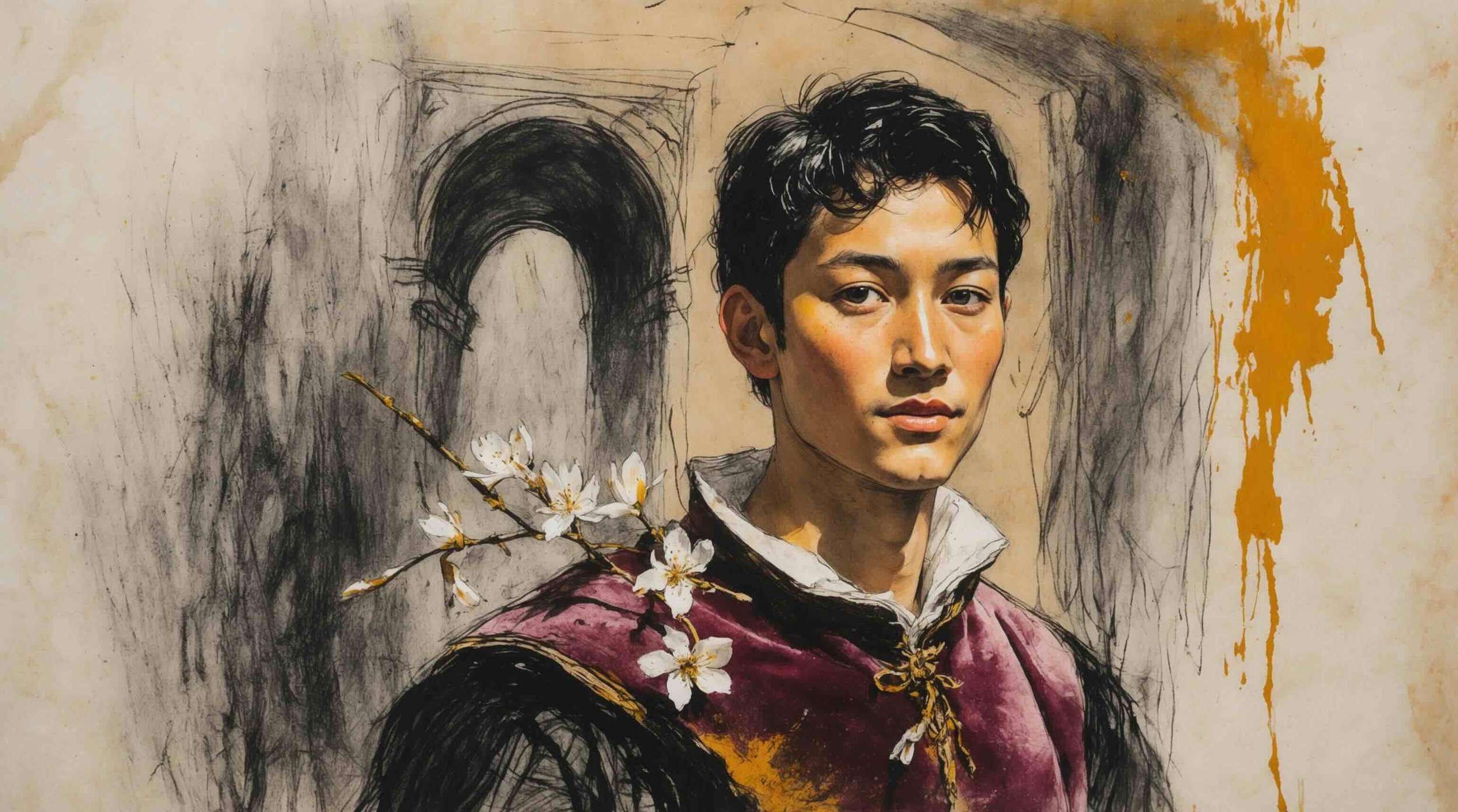
Character Profile – At a Glance
- Role: A young count of Florence and Don Pedro’s favourite, home from the war with a reputation for courage. The play’s conventional lover: he falls for Hero on sight, and destroys her at the altar.
- Key Traits: Brave in battle, inexperienced in everything else. Quick to believe the worst, slow to ask a question. Cares most about how things look.
- The Core Conflict: Claudio loves Hero but trusts his eyes and the prince more than he trusts her. Shown a woman at her window, he chooses public revenge over private doubt.
- Key Actions: Falls for Hero and lets the prince woo her for him (A1S1). Believes Don John that the prince has stolen her (A2S1). Watches the window scene and vows to shame her (A3S2). Rejects Hero at the altar as a "rotten orange" (A4S1). Jokes with the prince while she lies "dead", then repents, mourns at her tomb and marries her masked "cousin" (A5S1, A5S3, A5S4).
- Famous Quote:
"Give not this rotten orange to your friend;
She's but the sign and semblance of her honour."
(Act 4, Scene 1) - The Outcome: Forgiven and married to the Hero he thought he had killed. Whether he deserves her is the question the play leaves with the audience.
A Soldier's Eye
Claudio comes home a hero. The messenger says he fought like a lion in the figure of a lamb, and Leonato’s household has heard of him before he arrives. What he wants, now the war is over, is Hero. He asks Benedick whether she is not a modest young lady, gets mocked for his trouble, and tells the prince how it happened.
Original
When you went onward on this ended action,
I looked upon her with a soldier's eye,
That liked, but had a rougher task in hand
Than to drive liking to the name of love:
But now I am returned and that war-thoughts
Have left their places vacant, in their rooms
Come thronging soft and delicate desires,
All prompting me how fair young Hero is,
Saying, I liked her ere I went to wars.
(Act 1, Scene 1)
Shakespeare Retold (Modern Verse)
When we departed for the war, now over,
I looked at Hero with a soldier’s eye;
I liked her, but we had a tougher task
Than trying to change my liking into love.
But now I have returned, and thoughts of war
Have left space in my mind, and in their place
I now have yearning thoughts of mild desire
About how beautiful young Hero is,
Reminding me, before the war, I liked her.
The speech is honest about the order of things. He liked her before the war; the war left no room; now the "war-thoughts" have moved out and "soft and delicate desires" have moved in. It is the language of a young man who has just discovered he has feelings and is pleased with the discovery. It is also, listen closely, a speech about himself. Hero is "fair" and "young" and that is all we learn.
Two details in the same scene matter later. Claudio asks whether Leonato has a son, and is told Hero is his only heir. And when the prince offers to woo her on his behalf, in disguise, Claudio accepts without a word of objection. The theme of courtship and marriage in Messina is a business conducted between men, and Claudio is comfortable with that from the start.
Beauty Is a Witch
The first time Claudio is deceived, it takes one sentence. At the ball, Don John, pretending to mistake him for Benedick, tells him the prince is wooing Hero for himself. Borachio adds that he heard the prince swear to marry her that night. Claudio, alone, believes it at once.
Original
Thus answer I in the name of Benedick,
But hear these ill news with the ears of Claudio.
'Tis certain so; the prince wooes for himself.
(Act 2, Scene 1)
Shakespeare Retold (Modern Verse)
I gave my answer in Benedick’s name,
But heard the awful news as Claudio.
I’m sure the prince woos Hero for himself.
He does not go and ask. He does not wait an hour for the prince to return. He accepts the word of a man he barely knows against the word of a friend who has just done him a kindness, and he draws the general lesson: friendship is constant in everything but love, and every lover should "trust no agent". It is an extraordinary thing to conclude on no evidence, and it is a rehearsal. The theme of deception and noting in this play has an easy victim, and the villains have found him by Act 2.
Within minutes the prince hands him Hero, and Claudio is so happy he cannot speak: "Silence is the perfectest herald of joy." Beatrice has to tell Hero to stop his mouth with a kiss. The speed of the turn, from despair to joy with nothing learned in between, is the pattern of his whole part.
There Will I Shame Her
The second deception is better staged. Don John tells the prince and Claudio that Hero is disloyal and offers to show them. Claudio’s response is the most revealing line he speaks, because he says it before he has seen anything.
Original
If I see any thing to-night why I should not marry her to-morrow in the congregation, where I should wed, there will I shame her.
(Act 3, Scene 2)
Shakespeare Retold (Modern Verse)
If I see anything tonight that shows why I shouldn’t marry her tomorrow in the church where we are due to be wed, then I will humiliate her there.
He has already decided what he will do if the charge is true: not break the engagement quietly, not confront her, but humiliate her in church in front of the congregation. The punishment is chosen before the crime is proved, and the prince, who should know better, promises to join him. The theme of honour and shame is the engine here. Claudio’s honour has been touched, or might have been, and the remedy for touched honour in Messina is a public show.
We never see the window scene. Shakespeare keeps it offstage and lets Borachio describe it afterwards: Margaret at the window, called Hero, saying good night a thousand times. Claudio saw a woman in the dark at a distance and heard a name. He went away "enraged".
The Rotten Orange
The church scene is Claudio’s, and it is hard to watch. He plays along with the ceremony until the friar asks whether he has come to marry the lady, answers "No", and then, having had his joke, gives Hero back to her father as damaged goods.
Original
Behold how like a maid she blushes here!
O, what authority and show of truth
Can cunning sin cover itself withal!
Comes not that blood as modest evidence
To witness simple virtue? Would you not swear,
All you that see her, that she were a maid,
By these exterior shows? But she is none:
She knows the heat of a luxurious bed;
Her blush is guiltiness, not modesty.
(Act 4, Scene 1)
Shakespeare Retold (Modern Verse)
Look how she’s blushing like a virgin now!
Oh, with what confidence and show of truth
Can cunning sin disguise itself so well!
Doesn’t the fact she’s blushing now suggest
That she is pure and simple? Won’t you swear,
All you that see her, that she is a virgin,
By how she now appears? But she is not:
She knows the lust of sleeping with a man;
Her blush shows guiltiness, not modesty.
The cruelty is in the method. He makes the congregation look at her blush and then tells them what it means. He asks her, by her father’s authority, to answer "truly to your name", and when she says she talked with no man, the prince confirms that she is "no maiden". Hero faints. Claudio, who has called her "most foul, most fair" and sworn off beauty for ever, leaves with the prince and Don John. He does not look back.
What is missing is any sign that he loved her. The speeches are about his eyes, his honour and his future; Hero appears in them as an orange, a sign, a Dian and a Venus. Beatrice sees it instantly, and her verdict, "Count Comfect; a sweet gallant, surely!", is the play’s. The theme of gender and patriarchy in this play has its sharpest edge in a man who can destroy a woman without once having listened to her.
Sinned I Not But in Mistaking
Told that Hero is dead, Claudio jokes. Told by Leonato that he has killed her, he reaches for his sword. Told by Benedick that he is a villain, he treats the challenge as a dinner invitation. Only when Borachio confesses does he stop, and his first words are about himself.
Original
Impose me to what penance your invention
Can lay upon my sin: yet sinned I not
But in mistaking.
(Act 5, Scene 1)
Shakespeare Retold (Modern Verse)
Inflict on me whatever punishment
You think appropriate, but I did not sin,
But simply made an error.
"Yet sinned I not but in mistaking" has been held against him for four hundred years, and fairly. He accepts any penance Leonato can devise, and Leonato devises two: sing at Hero’s tomb, and marry her unseen cousin in the morning. Claudio agrees to both without hesitation, and the second is the stranger, since it means marrying a woman he has never met on the strength of her being an heir.
Original
Done to death by slanderous tongues
Was the Hero that here lies:
Death, in guerdon of her wrongs,
Gives her fame which never dies.
So the life that died with shame
Lives in death with glorious fame.
(Act 5, Scene 3)
Shakespeare Retold (Modern Verse)
A lady killed by slanderous tongues
Was Hero, who here lies:
Now death pays back all of those wrongs:
Through fame, she never dies.
So the life that died from shame
Lives in death with glorious fame.
The epitaph is formal and brief, and the song that follows asks the goddess of the night to pardon "those that slew thy virgin knight". It is the only time Claudio calls himself a killer. Whether it is enough is a question the play hands to each audience, and the answer has changed with the centuries. The theme of love and romance in this play saves its happy ending for the couple who earned it. Claudio’s is given to him, by a friar’s trick and a father’s mercy.
"The ultimate marriage of Hero and Claudio, on which I have already remarked as in itself a doubtfully desirable consummation, makes no flaw in the dramatic perfection of a piece which could not otherwise have been wound up at all."
— A. C. Swinburne, A Study of Shakespeare, 1880
Key Quotes
Quote 1
In mine eye she is the sweetest lady that ever I looked on.
(Act 1, Scene 1)
Shakespeare Retold (Modern Verse)
To me, she is the sweetest lady that I have ever set eyes upon.
Quote Analysis: Claudio to Benedick, who has just given his honest opinion of Hero: too low, too brown, too little. Claudio’s reply is the whole of his case for her, and notice where it begins: "in mine eye". He loves what he sees. The play will later make him see something else, at a distance, in the dark, and he will believe that too. Benedick’s answer, that he can see without spectacles and sees no such matter, is a joke that turns out to be the play’s theme.
Friendship is constant in all other things
Save in the office and affairs of love:
Therefore, all hearts in love use their own tongues;
Let every eye negotiate for itself
And trust no agent; for beauty is a witch
Against whose charms faith melteth into blood.
(Act 2, Scene 1)
Shakespeare Retold (Modern Verse)
Friendships endure through every walk of life
Except for when romantic love’s involved.
So, lovers have to all speak for themselves;
They have to do the chatting up alone,
And not rely on others; beauty’s spell
Makes bonds of friendship break through pangs of passion.
Quote Analysis: Claudio alone, having believed Don John’s lie about the prince. Six lines of general wisdom drawn from a single false report. Love dissolves friendship; every lover should speak for himself; beauty is a witch who melts faith into desire. It is the voice of a boy who has read about betrayal and recognises it on sight. The irony the play builds is that Claudio’s friend is loyal and Claudio is not: the person who abandons a bond on the word of a stranger is the speaker.
O Hero, what a Hero hadst thou been,
If half thy outward graces had been placed
About thy thoughts and counsels of thy heart!
But fare thee well, most foul, most fair! Farewell,
Thou pure impiety and impious purity!
For thee I'll lock up all the gates of love,
And on my eyelids shall conjecture hang,
To turn all beauty into thoughts of harm,
And never shall it more be gracious.
(Act 4, Scene 1)
Shakespeare Retold (Modern Verse)
You could have been the Hero of the myth
If only half your beauty had been summoned
To grace the thoughts and counsels of your heart!
But now I say goodbye, you evil beauty!
You perfect heathen, perfectly imperfect!
For you, I’ll block out all of love’s temptations,
And I’ll suspect the things my own eyes see,
Assuming gorgeous people want to hurt me,
And they’ll never appeal to me again.
Quote Analysis: Claudio’s farewell to Hero in the church. "Most foul, most fair", "pure impiety and impious purity": the paired opposites are the rhetoric of a man enjoying his own eloquence at the moment he should be least sure of himself. The last lines are a vow to distrust all beauty for ever, which is to say a vow to go on doing exactly what he has just done. There is grief in the speech, but the grief is for himself. Hero, lying at his feet, is already "thou" in the past tense.
Sweet Hero! Now thy image doth appear
In the rare semblance that I loved it first.
(Act 5, Scene 1)
Shakespeare Retold (Modern Verse)
Sweet Hero! Now I see your face before me
Exactly as it was when I first loved you.
Quote Analysis: Claudio, the moment Borachio has confessed. Hero’s "image" returns to him in the "semblance" he first loved, and the two words give him away. He loved an image. He rejected a semblance. He has recovered the image, and the woman herself, who he still believes is dead, hardly enters into it. The friar predicted exactly this in Act 4: that Hero dead would be lovelier to Claudio than Hero alive. He was right, and the play does not seem sure it is a compliment.
Key Takeaways
- Love at First Sight: Claudio loves what he sees in Hero and asks first whether she is an heir; the romance is sincere and conventional at once.
- Twice Deceived: He believes Don John's lie at the ball in one sentence and the window trick in one night; he never asks Hero a single question.
- Public Shame: His choice to reject Hero in church rather than in private is the play's cruellest act, and he chooses it before he has seen any proof.
- Sinned But in Mistaking: His repentance is real but self-centred, and the play lets the audience decide whether the tomb and the second wedding are enough.
Study Questions and Analysis
Does Claudio love Hero, or her inheritance?
The text raises the question in the first scene and never quite answers it. Having told the prince about his "soft and delicate desires", Claudio asks a practical question.
CLAUDIO: Hath Leonato any son, my lord?
DON PEDRO: No child but Hero; she's his only heir.
(Act 1, Scene 1)
Shakespeare Retold (Modern Verse)
CLAUDIO: Does Leonato have a son, my lord?
DON PEDRO: His only child is Hero, his sole heir.
He asks it before he has spoken a word to Hero, and the prince answers it as a matter of course. It does not make him a fortune-hunter. In this world a young nobleman would be expected to ask, and his feelings for Hero are plainly real as far as they go. But it tells us what kind of lover he is: one for whom love and a good match are the same thing, and who sees nothing odd in checking.
Critics have divided on the weight of the line. William Hazlitt (1817) heard nothing mercenary in the scene at all, and called Claudio’s confession "as pleasing an image of the entrance of love into a youthful bosom as can well be imagined". Gail Kern Paster, in her "Modern Perspective" essay for the Folger edition, reads the same speech the other way: "The play takes pains to construct Claudio as inexperienced and to emphasize the superficiality of a love which arises, he says, at a moment of postcombat mental vacancy". Harry Berger Jr. (1982) read the question about the heir alongside the other evidence, the prince wooing by proxy, the marriage arranged between men, the dowry handed over with the bride, and concluded that Claudio’s love is the product of what he called "the Men’s Club of Messina", a system in which women are exchanged, and that the play means us to notice. Most editors steer between the two: Claudio is neither a romantic nor a mercenary but a young man doing what young men of his rank do, and the play’s criticism is of the system as much as of him. What the scene establishes beyond argument is that Claudio does nothing himself. He asks Benedick’s opinion, asks the prince’s help, asks about the inheritance, and lets another man do the wooing. The theme of status and class in Messina makes a wife a transaction between gentlemen, and Claudio is a very correct gentleman.
Why does Claudio believe Don John so easily at the ball?
Because he is young, because he is insecure, and because Don John tells him exactly what he is afraid of.
Signior, you are very near my brother in his love: he is enamoured on Hero; I pray you, dissuade him from her: she is no equal for his birth: you may do the part of an honest man in it.
(Don John, Act 2, Scene 1)
Shakespeare Retold (Modern Verse)
Signior, you are a very dear friend of my brother, Don Pedro: he is in love with Hero; I ask that you persuade him to leave her alone, because her social status is far below him; you would be an honest man for doing so.
The lie is beautifully made. Don John pretends to think he is talking to Benedick, so that the information seems accidental; he gives the prince a motive, love; and he gives Claudio a flattering reason to intervene, honesty. Borachio adds a detail. Claudio needs nothing more.
Bertrand Evans, in Shakespeare’s Comedies (1960), called the play’s method "discrepant awareness": the audience holds an advantage over the characters "during fourteen of the play’s seventeen scenes", and here we know the truth before Claudio hears the lie, since we have watched the prince make his offer. Shakespeare uses the gap to show us how Claudio’s mind works before the stakes are high. The Folger editors Barbara Mowat and Paul Werstine list the play’s causes of disaster in order, and Claudio’s comes first: "Claudio’s own weak jealousy, Don Pedro’s touchy sense of his own honor, and Leonato’s too credulous paternal fury." Ellen Terry, who played Beatrice at the Lyceum, remembered that Johnston Forbes-Robertson’s Claudio "through the subtle indication of consuming and insanely suspicious jealousy made Claudio’s offensive conduct explicable at least", which is about as much as an actor can do. The most telling evidence is Claudio’s own soliloquy. He does not say he will ask the prince. He says that friendship is always betrayed in love, that beauty is a witch, and that he mistrusted nothing. He is not weighing a report; he is confirming a fear he already had, that the prince, a greater man, would naturally take what Claudio wanted. The theme of deception and noting in this play depends on willing victims, and Claudio is the most willing of all, because his confidence in himself is so thin that any story in which he loses sounds true.
Why does Claudio shame Hero in public rather than confronting her?
Because in his world a wrong to a man’s honour must be answered in public, and because he has decided to do it before he has seen a thing. In the church his language gives the reasoning away.
Out on thee! Seeming! I will write against it:
You seem to me as Dian in her orb,
As chaste as is the bud ere it be blown;
But you are more intemperate in your blood
Than Venus, or those pampered animals
That rage in savage sensuality.
(Act 4, Scene 1)
Shakespeare Retold (Modern Verse)
Give me a break! You’ve ‘seemed the same’! You’re wrong:
You ‘seem’ goddess of chastity, Diana,
As innocent as flower buds unbloomed;
But you’re more hot and randy than the goddess
Of love, that’s Venus, or those pampered beasts
That copulate in wild sexual acts.
He has been deceived by appearances, he thinks, and so he attacks appearance itself: Hero "seems" like Dian and is really Venus. The speech is about what he saw and what it looked like. It is never once about what Hero might say, and when she does speak, to ask whether he is well, he does not answer.
Carol Cook, in her 1986 essay in PMLA, read the scene as the play’s clearest demonstration of its masculine code: "Masculine privilege is contingent on the legibility of women, whose ambiguous ‘seeming’ gravely threatens the men of Messina and provokes them to use various defensive strategies against it, from the exchange of tendentious jokes to the symbolic sacrifice of Hero." Claudio’s shaming of Hero is, in this reading, a performance for the other men. Jean E. Howard (1987) made a similar point about theatre: Don John’s window scene was a play staged for Claudio, and Claudio answers it with a play of his own, in a church, with a congregation for an audience. August Wilhelm Schlegel (1808) admired the scene as "a grand piece of theatrical effect in the true and justifiable sense", and noticed how carefully it is managed: "The impression would have been too tragical had not Shakspeare carefully softened it in order to prepare for a fortunate catastrophe." Samuel Johnson (1765) was less impressed by Claudio’s rhetoric, and noted of "O Hero, what a Hero hadst thou been" that "I am afraid here is intended a poor conceit upon the word Hero." Productions have tried everything to make the scene bearable: Claudio in tears, Claudio egged on by the prince, Claudio barely out of his teens. None of it changes what he says. The theme of honour and shame in this play is a code that protects men by sacrificing women, and the church scene is the code in action.
How can Claudio joke with the prince while he thinks Hero is dead?
It is the hardest scene in the part, and Shakespeare wrote it deliberately. Leonato and his brother have just challenged the two young men; the old men leave, Benedick arrives, and Claudio is in high spirits.
We had like to have had our two noses snapped off with two old men without teeth.
(Act 5, Scene 1)
Shakespeare Retold (Modern Verse)
We almost had our two noses snapped off by two old men without teeth.
He goes on to tease Benedick for his pale looks, beg him for a joke, and, when the challenge comes, turn it into a feast of "a calf’s head and a capon". He still believes Hero was unfaithful and that her death was her own doing. But he also believes she is dead, and he has not a word to say about it.
Barbara Everett (1994) saw the scene as the key to what she called the "unsociable comedy": Claudio and the prince are not wicked, they are members of a group, and the group’s way of dealing with anything painful is to make a joke of it; the callousness is social, not personal. John Barton’s 1976 production for the RSC, set in British India, made the point visually, and Michael Billington in the Guardian called the setting "an ideal background for the play about the practical jokes of a bored officer class". Harry Berger Jr. (1982) was less forgiving, and read the scene as showing that Claudio never cared for Hero at all, only for his standing in "the Men’s Club of Messina". Directors tend to play the gaiety as brittle, the behaviour of young men who have done something they cannot afford to think about. The text allows it, since Claudio’s mood collapses the instant Borachio speaks: "I have drunk poison whiles he uttered it." But it is worth noticing that his poison is the discovery that he was wrong, not the memory of what he did. The theme of wit and communication in this play is mostly a pleasure. In this scene it is the sound of men not thinking.
Is Claudio’s repentance sincere?
Sincere, yes. Sufficient is another matter. At the tomb he reads an epitaph he has written, listens to a hymn, and makes a promise.
Now, unto thy bones good night!
Yearly will I do this rite.
(Act 5, Scene 3)
Shakespeare Retold (Modern Verse)
I say to your bones now goodnight!
Each year I will perform this rite.
The scene is short and solemn and unlike anything else in the play, and it is the one place where Claudio is allowed dignity. He does what Leonato asked. He calls Hero a "virgin knight" and himself, through the song, one of those who slew her. In the morning he will marry a stranger because her father wishes it.
William Hazlitt (1817) saw the device as a favourite of the playwright’s: Hero’s restoration "is brought about by one of those temporary consignments to the grave of which Shakespeare seems to have been fond", and he quoted the friar’s speech as Shakespeare’s own explanation of why it works. Northrop Frye, in A Natural Perspective (1965), placed the tomb scene in a pattern that runs through the late plays: the heroine who seems to die and returns, and the man who must mourn her before he can have her back; the ritual, in this reading, matters more than the sincerity, because it is the ritual that lets the comedy end. A. C. Swinburne (1880) accepted the ending as a necessity of form and no more, calling the marriage "a doubtfully desirable consummation" that nonetheless "makes no flaw in the dramatic perfection" of the play. Modern audiences tend to put the question more bluntly: whether Claudio has learned anything, and whether Hero should want him back. His own words at the end are "I am your husband, if you like of me", which is the first time he has asked her anything. It is not much, and the play does not pretend it is. The theme of love and romance in this comedy is more interested in the lovers who fought their way to it, and Claudio’s forgiveness is a gift of the plot rather than something he earns on stage.
Why does Claudio agree to marry a woman he has never seen?
Because Leonato asks it as penance, and because, for Claudio, a wife has always been something arranged by older men. His one line on the subject in the last scene is not reassuring.
I'll hold my mind, were she an Ethiope.
(Act 5, Scene 4)
Shakespeare Retold (Modern Verse)
I wouldn’t change my mind if she had dark skin.
He will keep his word even if the bride is black, which in the language of the time means ugly. The line is meant as a declaration of constancy. It also tells us that he is marrying a name and an inheritance, "almost the copy of my child that’s dead", and that her face is a detail he will put up with.
Carol Cook (1986) saw the second wedding as the play’s quiet confirmation of everything the first exposed: "Hero remains dead in her resurrection, as she is reappropriated to the mode of perception that killed her." She is handed over again, masked and silent, by one man to another, and Claudio accepts her sight unseen because what he is receiving is Leonato’s heir, not a person. Gail Kern Paster reads the masks the same way: "the final entrance of the bridal party, with not just the reborn Hero but all the women wearing masks, suggests that the old cultural categories that produce suspicion and slander remain largely untouched". Jean E. Howard (1987) saw the masking as one more theatrical trick arranged by the men who hold power in Messina, the "better sort" to whom the play returns control of its deceptions, and noted that this time the trick is benign only because its authors are. The defence of the scene is that in a romantic comedy the second betrothal is a rite of forgiveness, and that audiences of the time would have taken Claudio’s obedience as the sign of a chastened man. Both readings are available in the theatre, and productions choose. What the scene does not do is let Claudio choose Hero. She is given to him twice, once by the prince and once by her uncle, and the only difference the second time is that he says thank you. The theme of courtship and marriage in Messina is the exchange of daughters between men, and Claudio is its most obedient customer.
Is Claudio a villain or a victim?
The play makes him both, and then forgives him, and readers have never quite agreed that it should. Hero’s own words when she unmasks are the gentlest possible judgement.
And when I lived, I was your other wife:
And when you loved, you were my other husband.
(Hero, Act 5, Scene 4)
Shakespeare Retold (Modern Verse)
And when I lived, I was your other wife:
And when you loved, you were my other husband.
"When you loved" is the sting. She is saying that the Claudio who shamed her did not love her, and that the man in front of her is, she hopes, a different one. It is as close as the play comes to asking him to account for himself, and he answers with a single astonished line: "Another Hero!"
A. C. Swinburne, in A Study of Shakespeare (1880), said plainly that the marriage is "a doubtfully desirable consummation" and that the play’s perfection as a piece of design depends on our accepting it anyway. The Folger editors Mowat and Werstine name the fault exactly, "Claudio’s own weak jealousy", and set it beside the prince’s touchy honour and Leonato’s credulous fury as the three failings that let Don John’s malice work. Gail Kern Paster argues that the play constructs him "as inexperienced" on purpose, so that his cruelty reads as a failure of knowledge rather than of nature. Against all this stands the older view that an Elizabethan audience would have judged him by the evidence he had and the code he lived by, and found him rash rather than wicked. The villain is Don John, who never speaks to Hero either, and the victim is Hero, who is not allowed to answer. Claudio is the instrument, and the play’s honesty is that it shows how willingly an instrument can be used. Productions that make him very young make the forgiveness easier and the warning weaker. The theme of honour and shame in this play is carried by a man who is neither good nor bad enough to be interesting on his own, which is why it is so frightening.