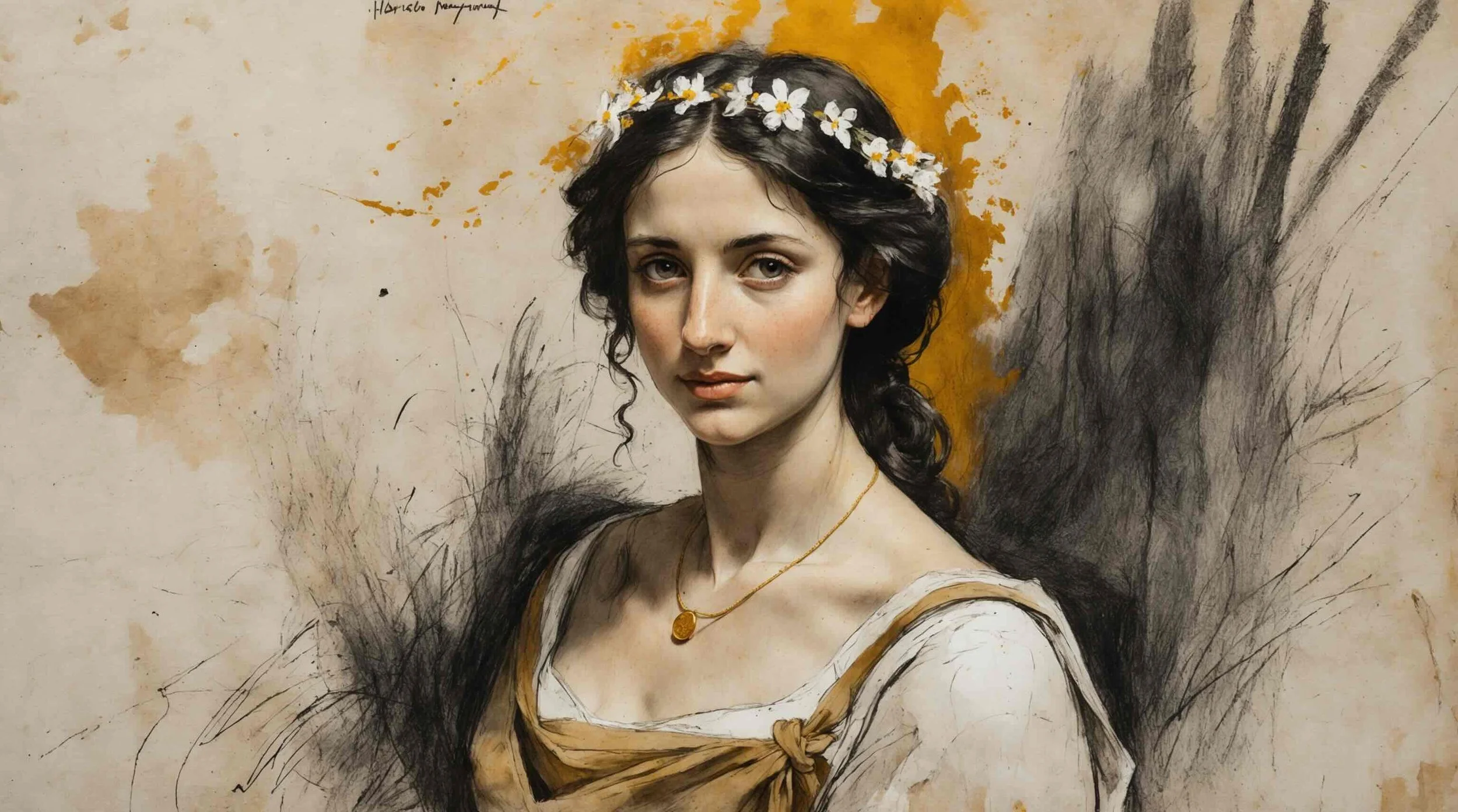
Character Profile – At a Glance
- Role: Leonato’s only daughter and heir, and Beatrice’s cousin. Courted by proxy, won in a night, slandered at the altar, "killed" by the report and brought back to life in a mask.
- Key Traits: Modest, dutiful, gentle and quiet. Sharper in private than in public: she has a wit of her own, and uses it when the men are not listening.
- The Core Conflict: Hero’s reputation is her whole value in Messina, and a stranger at a window can destroy it in a night. When it is destroyed, she has nothing to defend herself with but a denial, a faint and a false death.
- Key Actions: Says one line in the first scene (A1S1). Spars with the masked prince, and is betrothed to Claudio without a word we hear (A2S1). Stages the gulling of Beatrice (A3S1). Is rejected at the altar, swears her innocence and swoons (A4S1). Returns as her own masked cousin and unmasks (A5S4).
- Famous Quote:
"One Hero died defiled, but I do live,
And surely as I live, I am a maid."
(Act 5, Scene 4) - The Outcome: Restored and married to Claudio. The play gives her back her name and her husband, and not one word of complaint.
The Silent Daughter
Hero is on stage for the whole of the first scene and speaks once. Beatrice asks after "Signior Mountanto" and nobody knows who she means; Hero does.
Original
My cousin means Signior Benedick of Padua.
(Act 1, Scene 1)
Shakespeare Retold (Modern Verse)
My cousin is referring to Signior Benedick of Padua.
It is a small line and it tells us two things: that Hero knows her cousin’s mind better than her cousin admits, and that she will not say more than she is asked. For the rest of the scene the men talk about her. Her father makes a joke about her mother; Don Pedro says she looks like her father; Benedick says she is too low and too brown; Claudio says she is a jewel and asks whether she is the heir. Hero stands there.
Before the ball Leonato tells her what to say if the prince proposes, and her uncle hopes she will "be ruled by your father". Beatrice supplies the commentary: it is Hero’s duty to curtsy and say "Father, as it please you", unless the man is ugly. Hero does not reply. The theme of gender and patriarchy in this play has a loud voice and a quiet one, and the quiet one is Hero’s.
Speak Low, If You Speak Love
At the ball the prince, masked, asks her to walk with him, and for the only time in the play Hero flirts.
Original
So you walk softly and look sweetly and say nothing,
I am yours for the walk; and especially when I walk away.
(Act 2, Scene 1)
Shakespeare Retold (Modern Verse)
So long as you dance gently, look attractive, and don’t speak,
I’ll dance with you, until I dance away.
She tells him his face had better be nicer than his mask; when he says the mask is Philemon’s roof with Jove inside, she tells him it should be thatched. It is quick and it is confident, and it is the Hero that Beatrice knows. Then the prince says "Speak low, if you speak love", draws her aside, and we hear no more. By the end of the scene she has been won, for Claudio, and handed over by her father with his fortune attached.
Her part in her own betrothal is a whisper. Beatrice has to tell Claudio to speak, and then tells Hero to stop his mouth with a kiss; what follows is Beatrice’s report that Hero is telling him "in his ear that he is in her heart". The theme of courtship and marriage in Messina is conducted between men, and the bride’s consent is given where the audience cannot hear it.
Some Cupid Kills with Arrows
The gulling of Beatrice is Hero’s scene, and she runs it. She sends Margaret to lure her cousin into the orchard, tells Ursula what to say, and then, with Beatrice hidden in the honeysuckle, delivers a portrait of her that nobody else in the play would dare.
Original
Why, you speak truth. I never yet saw man,
How wise, how noble, young, how rarely featured,
But she would spell him backward: if fair-faced,
She would swear the gentleman should be her sister;
If black, why, Nature, drawing of an antique,
Made a foul blot; if tall, a lance ill-headed;
If low, an agate very vilely cut;
If speaking, why, a vane blown with all winds;
If silent, why, a block moved with none.
(Act 3, Scene 1)
Shakespeare Retold (Modern Verse)
Yes, that’s the truth. I haven’t seen a man yet,
However wise, or noble, young, or gorgeous,
Whose strengths she hasn’t held against him; if pale,
She’d swear the man appeared to be her sister;
If swarthy, she’d say Mother Nature spilled
Some ink whilst drawing him; if tall, a blunt lance;
If short, a tiny gemstone, badly carved;
If chatty, then he’s like a weather vane;
If quiet, he’s a rock that never moves.
Spell him backward: whatever a man is, Beatrice will find the fault in it, fair or dark, tall or short, talkative or silent. The speech is affectionate and it is also accurate, and it comes from the person who has had to live with Beatrice’s wit longest. Hero in verse, among women, is articulate, funny and a little merciless. It is the one scene in which she is the cleverest person on stage.
She ends it with a couplet about Cupid’s traps, and the trap works. The theme of deception and noting in this play has two faces, and Hero is the author of the kind one: a lie that tells Beatrice the truth about herself. Within a day she will be the victim of the other kind, and the symmetry is not an accident.
Is My Lord Well?
On her wedding morning Hero’s heart is "exceeding heavy", and she does not know why. In the church Claudio hands her back to her father as a "rotten orange", and her first response is bewilderment: "Is my lord well, that he doth speak so wide?" Asked by her father to answer truly, she does.
Original
They know that do accuse me; I know none:
If I know more of any man alive
Than that which maiden modesty doth warrant,
Let all my sins lack mercy! O my father,
Prove you that any man with me conversed
At hours unmeet, or that I yesternight
Maintained the change of words with any creature,
Refuse me, hate me, torture me to death!
(Act 4, Scene 1)
Shakespeare Retold (Modern Verse)
Those men know who accuse me; I know no one.
If I’ve behaved with any man alive
In ways no modest virgin ever would,
Then punish all my sins! And oh, my father,
If you can prove that any man spoke with me
At inappropriate times, or I last night
Spoke any words to any living thing,
Reject me, hate me, torture me to death!
It is the longest speech she makes in the play, and it is a plain denial with an oath on it. Nobody listens. Claudio has already said that "Hero itself can blot out Hero’s virtue", and when she says she talked with no man at that hour, the prince takes the denial as proof. Her father wishes her dead. She faints, and the men who accused her walk out.
What the scene shows is how little her word is worth. Three men say they saw something; one woman says she did not do it; and the one woman is not believed by her own father. Only the friar, who has been "noting" her face, and Beatrice, who has shared her bed for a year, take her side. The theme of honour and shame in this play is a possession that others hold on a woman’s behalf, and Hero discovers in the church that she cannot hold it herself.
Die to Live
The friar’s plan is to announce that Hero is dead, so that slander turns to remorse and Claudio remembers what he has lost. His instruction to her is a paradox.
Original
Come, lady, die to live: this wedding-day
Perhaps is but prolonged: have patience and endure.
(Friar Francis, Act 4, Scene 1)
Shakespeare Retold (Modern Verse)
You have to die to live: your wedding day
Is maybe just postponed: wait patiently.
She obeys, as she has obeyed everything. We do not see her again until the last scene, when she enters masked as her own cousin and is given to Claudio a second time by her uncle. He swears to marry her unseen. Then she unmasks, and speaks the lines that end her part.
"One Hero died defiled, but I do live." The friar explains the trick; Benedick asks which one is Beatrice; and the play moves on to its dancing. Hero says nothing further. The theme of love and romance in this comedy gives its best lines to the couple who fought, and gives Hero a second wedding in place of an apology. Whether that is a happy ending depends on who is watching, and the play seems to know it.
"Hero is the principal figure in the piece, and leaves an indelible impression on the mind by her beauty, her tenderness, and the hard trial of her love."
— William Hazlitt, Characters of Shakespear’s Plays, 1817
Key Quotes
Quote 1
When I like your favour; for God defend the lute should be like the case!
(Act 2, Scene 1)
Shakespeare Retold (Modern Verse)
When I like your face; for God forbid your face looks like your mask!
Quote Analysis: Hero to the masked prince. He has asked when she will say she is his, and she says when she likes his face; and God forbid the lute should look like its case. It is a real joke, delivered with real nerve to a man she probably knows is the prince, and it is the only time in the play Hero teases a man. The lute and the case are also the play in small: an instrument hidden in a plain box, a woman inside a reputation, a face behind a visor.
If it proves so, then loving goes by haps:
Some Cupid kills with arrows, some with traps.
(Act 3, Scene 1)
Shakespeare Retold (Modern Verse)
If that is true, then love must be aware
That Cupid kills with arrows or a snare.
Quote Analysis: Hero’s couplet closing the gulling scene. Loving "goes by haps", by chance, and Cupid kills some lovers with arrows and some with traps. It is a light line and a true one. Beatrice was never going to be shot; she had to be caught. Hero is the one who set the trap, and she sounds pleased with it. Within a day she will be caught in a trap of her own, set by a man who also used a window and a name.
God give me joy to wear it! For my heart is exceeding heavy.
(Act 3, Scene 4)
Shakespeare Retold (Modern Verse)
May God make me happy when wearing it! For my heart is very heavy.
Quote Analysis: Hero on her wedding morning, choosing a dress with Margaret. Her heart is heavy and she cannot say why, and Margaret turns it into a bawdy joke about the weight of a husband. The line is the play’s only hint that Hero senses what is coming, and it passes in a moment. It also tells us something about her marriage: she is being dressed for it, teased about it and hurried to it, and nobody in the room asks whether she wants it.
O, God defend me! How am I beset!
What kind of catechising call you this?
(Act 4, Scene 1)
Shakespeare Retold (Modern Verse)
God help me! How come everyone’s against me?
What kind of hostile questioning is this?
Quote Analysis: Hero in the church, as Claudio demands that she answer "truly to your name". "Catechising" is the word for being drilled in religious questions and answers, and it is exactly right: she is being examined, in a church, by men who already know the answers they want. "How am I beset" is the cry of someone surrounded. Her father has just ordered her to answer, her bridegroom is prosecuting, and the prince is about to pronounce sentence.
Key Takeaways
- The Quiet One: Hero speaks once in the first scene while the men discuss her; her silence is the condition of her life in Messina, not a failure of character.
- A Wit of Her Own: With the masked prince and in the orchard she is quick, funny and sharp; the play lets us see what the men never do.
- Her Word Is Nothing: In the church three men's eyes outweigh her oath, and her own father wishes her dead; her honour is held by others.
- Die to Live: She obeys the friar, returns masked and is given to Claudio a second time; the comedy restores her name and asks nothing for her.
Study Questions and Analysis
Why does Hero say so little?
Because in Messina a young unmarried woman of rank is expected to say little, and Hero is good at what is expected of her. The play draws attention to it. At her own betrothal, when Claudio has finished his speech, it is Beatrice who has to prompt her.
Speak, cousin; or, if you cannot, stop his mouth with a kiss, and let not him speak neither.
(Beatrice, Act 2, Scene 1)
Shakespeare Retold (Modern Verse)
Say something, cousin Hero; or if you can’t, stop him talking by kissing him so he can’t talk as well.
Hero does not speak; she whispers in Claudio’s ear. We learn what she said from Beatrice. In the first scene she has one line, in the church she has perhaps a dozen, and in the last scene she has a handful. The character with the most to lose in the play is the one who says least about it.
Carol Cook, in her 1986 essay in PMLA, made Hero’s silence the centre of her reading. The men of Messina talk constantly, about women, about cuckoldry, about honour, and the talk constructs a world in which "masculine privilege is contingent on the legibility of women": a woman is a "sign and semblance", something to be read rather than heard, and Hero’s quietness is not a trait but a position. Gail Kern Paster, in her "Modern Perspective" essay for the Folger edition, describes the result without softening it: "The too-compliant Hero accepts the marriage proposal of a man in a mask and then learns to transfer her consent from the wearer of that mask, Don Pedro, to his young favorite." Harry Berger Jr. (1982) added that the women themselves police the silence: Beatrice teases Hero for her obedience but also teaches her the curtsy. The older view, William Hazlitt’s in 1817, was that Hero is the play’s true centre precisely because of her quietness; he called her "the principal figure in the piece" and admired the church scene, where "her appeals to her own conscious innocence and honour are made with the most affecting simplicity". Both views are correct, and the play means them to be. Hero is written as the good daughter, and the play then shows what happens to good daughters when the men around them decide they are bad. The theme of gender and patriarchy in this comedy is not an argument; it is a demonstration, and Hero is the evidence.
Is Hero really as meek as she seems?
No. She is quiet with men who have power over her, which is almost all of them, and quick with everyone else. The masked prince gets a taste of it.
DON PEDRO: My visor is Philemon's roof; within the house is Jove.
HERO: Why, then, your visor should be thatched.
(Act 2, Scene 1)
Shakespeare Retold (Modern Verse)
DON PEDRO: My mask is like peasant Philemon’s roof: it hides the god Jove.
HERO: Well then your mask should be thatched like his house.
Philemon was the poor old man who sheltered Jove in his cottage; the prince means that a god is hidden behind a humble mask. Hero’s answer, that the mask should then be thatched, turns his compliment to himself into a joke about his face. In the orchard she is sharper still, taking Beatrice apart for the pleasure of a hidden audience, and with Margaret on her wedding morning she is capable of calling her cousin a fool.
Anna Jameson, in Characteristics of Women (1832), was among the first to insist that Hero is not insipid: "Hero, added to her grace and softness, and all the interest which attaches to her as the sentimental heroine of the play, possesses an intellectual beauty of her own." Barbara Everett (1961) went further and argued that the women of the play have a world of their own, with its own talk and its own judgement, and that the men only ever see its surface. The text supports this. Hero’s best lines are all spoken to women or to a masked man, in scenes where the social rules are briefly suspended. In the church, where the rules are at full strength, she can manage only a question and a denial. Performers have often found the part richer than readers do, because an actress can show the wit being suppressed. The theme of wit and communication in this play is not only Beatrice and Benedick; it is also a woman who has learned when to use it and when to keep quiet.
Why doesn’t Hero defend herself more forcefully in the church?
She does defend herself, and it makes no difference. Asked who she talked with at her window, she tells the truth.
HERO: I talked with no man at that hour, my lord.
DON PEDRO: Why, then are you no maiden.
(Act 4, Scene 1)
Shakespeare Retold (Modern Verse)
HERO: I spoke to no one at that time, my lord.
DON PEDRO: Well, then you are no virgin.
The denial is taken as a confession. She has no witness, since Beatrice did not share her bed that night; she has no idea what she is accused of, since nobody has told her; and the men accusing her are a prince, a prince’s brother and her bridegroom. She asks God to defend her, swears an oath, and faints.
Jean E. Howard, in her 1987 essay on theatricality and gender in the play, pointed out that Hero has been cast in a scene she did not write: Don John staged the window, Claudio staged the church, and Hero’s only role in either is to be looked at. A forceful defence is not available to her, because the form of the occasion gives her no lines. Carol Cook (1986) added that even her denial is heard as a sign, "her blush is guiltiness, not modesty", so that whatever her body does will be read against her; in Cook’s words, "to read others in this play is an act of aggression". August Wilhelm Schlegel (1808) judged the scene as theatre and found it "a grand piece of theatrical effect in the true and justifiable sense", too tragic, he thought, had Shakespeare not "carefully softened it in order to prepare for a fortunate catastrophe"; the softening is the friar, and it arrives only after Hero has fallen. Directors have sometimes given Hero more fight, and the text allows a little: "Is my lord well, that he doth speak so wide?" can be played as anger. But the swoon is the truth of the scene. Northrop Frye (1965) saw it as the first step in the pattern of death and return that governs the second half of the play, and in that reading Hero’s collapse is not weakness but the beginning of the cure. The theme of honour and shame in this play is decided by men’s eyes, not women’s words, and the church shows exactly what a woman’s word is worth when the eyes have made up their mind.
Why does Leonato turn on his own daughter?
Because he believes the prince, and because Hero’s shame is his. His speech over her unconscious body is the most shocking thing a father says in the comedies.
Do not live, Hero; do not ope thine eyes:
For, did I think thou wouldst not quickly die,
Thought I thy spirits were stronger than thy shames,
Myself would, on the rearward of reproaches,
Strike at thy life.
(Leonato, Act 4, Scene 1)
Shakespeare Retold (Modern Verse)
Do not live, Hero; don’t open your eyes,
For, if I didn’t think that you’d die quickly
If I believed your soul outweighed your shame,
Then, after I had scolded you, I would
Stab you to death.
He wishes her dead; he says that if he thought she would live he would kill her himself; he wishes he had adopted a beggar’s child instead. The grief is real, and it is grief for himself. "Mine and mine I loved and mine I praised": the word that repeats is "mine", and what he has lost is a possession.
Carol Cook (1986) read the speech as the play’s plainest statement that a daughter’s chastity is her father’s property, so that her disgrace is experienced by him as theft and he responds as a man robbed. The Folger editors Mowat and Werstine call it "Leonato’s too credulous paternal fury", and list it with Claudio’s weak jealousy and the prince’s touchy honour as the failings that let the slander work. An Elizabethan father whose daughter was publicly proved unchaste faced a real loss of standing, and Leonato’s violence, though extreme, is the violence of a man whose whole position has collapsed in an afternoon. Samuel Johnson (1765) noticed how quickly it passes: of Leonato’s line that "the smallest twine may lead me", his comment is as good an account of the speech as any: "Men overpowered with distress, eagerly listen to the first offers of relief, close with every scheme, and believe every promise." It is panic rather than conviction, and the friar’s answer is the one the play endorses: he has been "noting" Hero’s face and believes her, and he persuades Leonato with an argument, not a feeling. Hero hears none of it. She wakes to find her death already arranged. The theme of gender and patriarchy in this play puts a woman’s fate in the hands of the men who love her, and shows that love is no protection.
What is the point of pretending Hero is dead?
The friar explains it, and his explanation is a small essay on human nature.
When he shall hear she died upon his words,
The idea of her life shall sweetly creep
Into his study of imagination,
And every lovely organ of her life
Shall come apparelled in more precious habit,
More moving-delicate and full of life,
Into the eye and prospect of his soul,
Than when she lived indeed...
(Friar Francis, Act 4, Scene 1)
Shakespeare Retold (Modern Verse)
When he has heard she died from what he said,
He will recall sweet memories of her
Whilst reminiscing fondly on her life,
And all the gorgeous features of her body
Shall reappear in far more precious dress,
More dainty and alive and animated,
Appearing in his mind to move his soul
More than when she was living.
What we have, we do not value; what we lose, we rack the value of. Claudio will remember Hero dead more tenderly than he ever regarded her alive, and the memory will make him sorry. The friar is right, as it turns out: when Borachio confesses, Claudio’s first thought is of Hero’s "image" returning "in the rare semblance that I loved it first".
William Hazlitt (1817) recognised the device as a habit: Hero’s restoration "is brought about by one of those temporary consignments to the grave of which Shakespeare seems to have been fond", and he quoted the friar’s speech as the playwright’s own theory of it. Northrop Frye (1965) placed the device in a family of Shakespearean heroines who die and return, Hero, Helena, Hermione, Thaisa, Imogen, and argued that the false death is comedy’s way of letting a society confess its guilt and begin again; the ritual works whether or not the individual man has learned anything. Gail Kern Paster notes the symmetry that governs the whole play, in which "the actions to make and to break nuptials employ the same kinds of theatrical means": Hero was destroyed by a staged scene, and she is restored by one. The sceptical view is about what the device does for Hero herself, who must hide, be mourned and be given away again while the men work out their feelings. The friar’s own fallback plan is worth remembering. If the trick fails, Hero is to be hidden "in some reclusive and religious life", out of all eyes, tongues, minds and injuries. For a slandered woman in Messina, the alternatives are a convent or a mask. The theme of deception and noting in this play is not all malicious, but even its kindest uses leave Hero with no say in her own story.
Is Hero’s ending a happy one?
The play says so, and gives her father the line that explains it.
She died, my lord, but whiles her slander lived.
(Leonato, Act 5, Scene 4)
Shakespeare Retold (Modern Verse)
She only died whilst slander was alive.
The Hero who was slandered is dead; the slander is dead; the Hero who stands here is clean. It is a neat formula and it allows the comedy to end. Hero’s own version is "One Hero died defiled, but I do live, / And surely as I live, I am a maid", which is both a declaration of innocence and a reminder that her innocence is still the only thing anyone wants to know about her.
Carol Cook (1986) read the ending as a restoration of the system rather than of the woman: "Hero remains dead in her resurrection, as she is reappropriated to the mode of perception that killed her." She is returned to Claudio by her uncle, masked and silent, exactly as she was first given to him by the prince, and nothing in Messina has changed except that the men now know they were wrong. Gail Kern Paster makes the same point about the masks: the bridal party’s entrance with "all the women wearing masks" suggests "that the old cultural categories that produce suspicion and slander remain largely untouched". Harry Berger Jr. (1982) noted that Claudio is never required to apologise to Hero, only to Leonato, in a world where "women are responsible for their sins but men are not". On the other side, A. C. Swinburne (1880) accepted the marriage as "a doubtfully desirable consummation" that the play could not have ended without, and the traditional defence is that the second wedding is a rite of reconciliation, with Hero’s forgiveness read as grace rather than weakness. Barbara Everett (1994) found the ending deliberately uneasy, a comedy that knows its own society is not to be trusted and marries its heroine into it anyway. What can be said is that Hero chooses. "And when you loved, you were my other husband" is a condition as well as a welcome, and productions that let her pause before unmasking find a great deal in the pause. The theme of courtship and marriage in this play ends with two weddings, one earned and one granted, and Hero’s is the one that asks the audience to decide whether it is enough.
How do Hero and Beatrice compare?
They are cousins, bedfellows and opposites, and the play sets them side by side from the first scene. Hero is the daughter with a father to obey; Beatrice is the orphan with no one to answer to. Hero is won by a man speaking for another man; Beatrice turns down a prince. But the contrast is not simply meek against bold, as the wedding morning shows.
My cousin's a fool, and thou art another: I'll wear none but this.
(Act 3, Scene 4)
Shakespeare Retold (Modern Verse)
My cousin is a fool, and you are one as well: I’ll wear only this one.
Hero choosing her collar, over Margaret’s objection and Beatrice’s expected one, is small and firm. Among women she gives orders, teases and makes decisions. It is only in front of men that she falls silent, and Beatrice, who is silent in front of no one, pays for it in a different way: she ends the play with her mouth stopped.
Anna Jameson (1832) drew the comparison the way the nineteenth century liked it: "The character of Hero is well contrasted with that of Beatrice, and their mutual attachment is very beautiful and natural." William Hazlitt (1817) went against what has since become the usual proportion and called Hero, not Beatrice, "the principal figure in the piece", on the grounds that "the serious part is still the most prominent here". Modern critics have been more interested in what the two women share. Carol Cook (1986) argued that Beatrice’s wit and Hero’s silence are two responses to the same situation, a world in which men hold all the authority, and that neither escapes it: Hero is slandered, Beatrice is silenced. Barbara Everett (1961) saw the women’s friendship as the play’s quiet moral centre, the one bond in Messina that is never broken by a lie. Beatrice never doubts Hero for a second, and asks a man to kill for her. Hero, for her part, spends her one scene of power making her cousin happy. The theme of love and romance in this play is usually discussed as a matter of couples. Its steadiest example is two women who stand by each other when every man in the play lets them down.