
Home → Plays → Romeo and Juliet → Plot Summary
Romeo and Juliet: Plot Summary
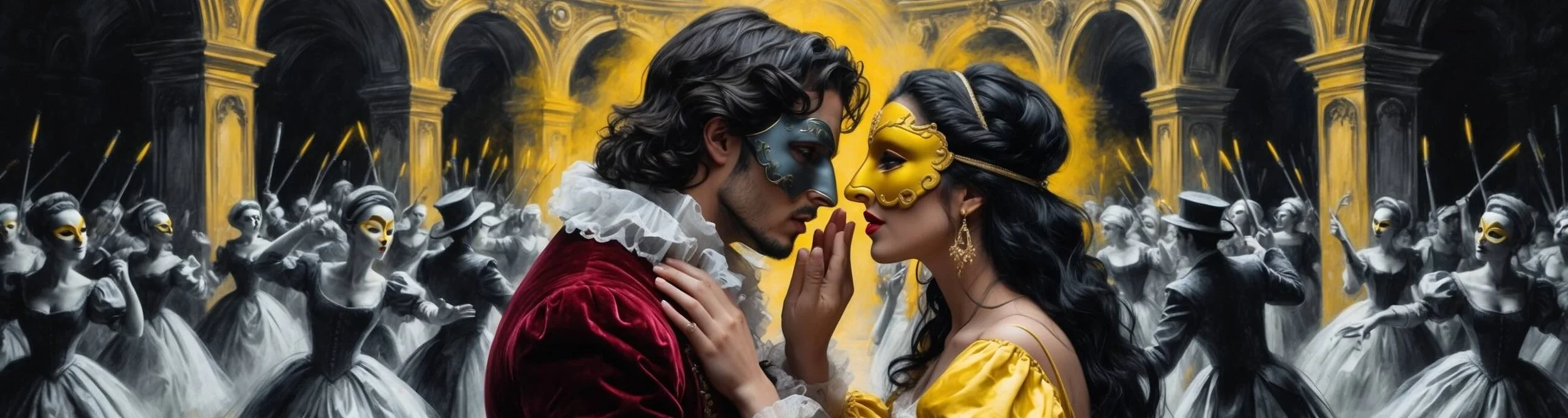
Plot Profile – At a Glance
- The Setting: Verona, in Renaissance Italy, with a brief move to nearby Mantua.
- The Protagonists: Romeo and Juliet.
- The Antagonist: The feud between the Montague and Capulet families, with hot-headed Tybalt as its sharpest blade.
- The Inciting Incident: Romeo and Juliet meet and fall in love at the Capulet feast, not knowing they are enemies by birth.
- The Core Conflict: The lovers' passion against the deadly feud that divides their families.
- The Climax: Romeo kills Tybalt and is banished, dooming the secret marriage.
- The Outcome: Both lovers take their own lives, and their deaths finally shame the families into peace.
- Genre: Tragedy.
In feud-torn Verona, Romeo, a Montague, and Juliet, a Capulet, fall in love at first sight and marry in secret the next day. But when Romeo kills Juliet's cousin Tybalt and is banished, their hope collapses. A desperate plan to reunite them goes wrong, and the two lovers die by their own hands – a tragedy that at last shames their families into peace. It is Shakespeare's most famous love story, framed from the very start as the tale of "a pair of star-crossed lovers".
Act 1: Ancient Grudge, New Love
A street brawl between the servants of the two houses shows how poisonous the old quarrel between Montague and Capulet has become, and the Prince warns that the next person to break the peace will pay with his life. Romeo, a lovesick Montague, is moping over a girl named Rosaline when his friends persuade him to slip into a Capulet feast in disguise. There he sees Juliet, the daughter of the house, and the two fall instantly in love – only afterwards learning that they belong to enemy families. Juliet's father, meanwhile, has begun promising her to a young nobleman called Paris.
Act 2: Secret Vows
That night Romeo lingers in the Capulets' orchard and overhears Juliet confess her love, wondering aloud "O Romeo, Romeo! Wherefore art thou Romeo?" – why must the boy she loves be a Montague? She reasons that a name means nothing, asking "What's in a name?", and the two exchange vows of marriage. With the help of Friar Laurence, who hopes the match might heal the feud, they are secretly wed the very next day – though the Friar cautions that "These violent delights have violent ends".
Act 3: Blood and Banishment
The feud flares again in the heat of the day. Tybalt, Juliet's cousin, kills Romeo's friend Mercutio, who curses both sides with his dying breath: "A plague o' both your houses!" Enraged with grief, Romeo kills Tybalt and is banished from Verona on pain of death. What should have been the start of the lovers' life together becomes a disaster: Juliet is left mourning her cousin, married to his killer, and about to be torn from her new husband.
Act 4: A Desperate Plan
With Romeo gone, Juliet's father suddenly commands her to marry Paris within days. Trapped, she turns to Friar Laurence, who gives her a potion that will make her seem dead for two days, so that she can be laid in the family tomb and then escape to Romeo. She drinks it that night, and the next morning the Capulets find her cold and lifeless, and the planned wedding becomes a funeral.
Act 5: The Tomb
The Friar's letter explaining the plan never reaches Romeo. Hearing only that Juliet is dead, he buys poison and rushes to her tomb, where he drinks it and dies at her side. Juliet wakes moments later, finds him dead, and stabs herself. Faced with their dead children, the Montagues and Capulets are finally shamed into ending their feud – "A glooming peace this morning with it brings" – far too late to save the lovers they destroyed.
Key Takeaways
- Love and hate share a root: The feud and the romance grow from the same two families.
- They marry in haste: Romeo and Juliet wed within a day of first meeting.
- Act 3 is the turning point: Tybalt's death and Romeo's banishment doom the marriage.
- A plan goes fatally wrong: The Friar's sleeping-potion scheme collapses when his message fails to arrive.
- Their deaths end the feud: The families reconcile only over the bodies of their children.
Romeo and Juliet Plot Summary – Frequently Asked Questions
How does Romeo and Juliet end?
The play ends in the Capulet tomb with a chain of misunderstandings. Friar Laurence has given Juliet a potion to fake her death and has sent word to Romeo explaining the plan, but the letter never arrives. Believing Juliet truly dead, Romeo comes to the tomb, drinks poison, and dies beside her.
Juliet wakes only moments too late. Finding Romeo dead, she takes his dagger and kills herself. When the two families and the Prince arrive and learn the whole story, the Montagues and Capulets are so stricken with grief and shame that they finally end their feud, promising to raise golden statues of the lovers. The reconciliation the marriage could not achieve in life is bought by the lovers' deaths.
Why are Romeo and Juliet called "star-crossed lovers"?
The phrase comes from the Prologue, which calls them "a pair of star-crossed lovers" before the action even begins. "Star-crossed" means thwarted by the stars: in the Elizabethan view, the position of the heavens at a person's birth could shape their fate, so to be star-crossed is to be doomed by forces beyond your control.
The label matters because it tells the audience the ending in advance. We watch the lovers struggle knowing they cannot win, which turns every hopeful moment into dramatic irony. It also raises the question the whole play turns on: are Romeo and Juliet destroyed by fate, or by the very human choices – the feud, the haste, the bad luck with a letter – that they and those around them make?
How many acts and scenes does Romeo and Juliet have?
Romeo and Juliet is divided into five acts containing twenty-four scenes in total: five scenes in Act 1, six in Act 2, five in Act 3, five in Act 4, and three in Act 5. It also opens with a famous Prologue, a fourteen-line sonnet spoken by the Chorus, and a second chorus introduces Act 2.
The structure is unusually swift. The whole tragedy unfolds over roughly four days, which is part of why the play feels so headlong: the lovers meet, marry, are parted and die in less than a week, and the breathless pace mirrors the haste that helps destroy them.
Why is Romeo banished?
Romeo is banished for killing Tybalt. After the secret marriage, Tybalt comes looking for Romeo to punish him for gatecrashing the Capulet feast. Romeo, now secretly married to Tybalt's cousin Juliet, refuses to fight, but his friend Mercutio takes up the quarrel and is killed. Maddened by grief and guilt, Romeo turns on Tybalt and kills him.
Because the Prince had already declared that anyone who reignited the feud would die, Romeo expects a death sentence. Instead the Prince banishes him from Verona. To Romeo, banishment feels worse than death, because it cuts him off from Juliet, and it is this exile that forces the couple into the desperate plan that ends in tragedy.
Whose fault is the tragedy?
The play deliberately spreads the blame rather than pinning it on one person. The feud between the families is the deep cause, poisoning Verona long before the lovers meet. The older generation – Lord Capulet, who forces the marriage to Paris, and both sets of parents who keep the quarrel alive – bears much of the responsibility.
So do the lovers' own choices and a run of sheer bad luck. Romeo and Juliet marry within a day and act on impulse; Friar Laurence's well-meaning but risky plan depends on a single letter that never arrives; Mercutio's hot temper and Tybalt's pride turn a feast into a killing. Whether you finally emphasise fate, the feud, haste or chance is one of the play's central debates, and a good answer weighs several of these together rather than choosing just one.
What goes wrong with Friar Laurence's plan?
Friar Laurence's plan is to reunite the lovers by faking Juliet's death. He gives Juliet a potion that will make her appear dead for around forty-two hours; her family will lay her in the Capulet tomb, and Romeo – warned by letter – will be waiting to carry her away to Mantua when she wakes.
The scheme fails at its single weakest point: communication. The letter explaining everything is entrusted to another friar, who is delayed and cannot deliver it. Meanwhile Romeo's servant brings him the news that Juliet has died and been entombed. Acting on true information about a false death, Romeo reaches the tomb before the Friar can stop him, and the carefully timed plan becomes the direct cause of both lovers' deaths.