Romeo
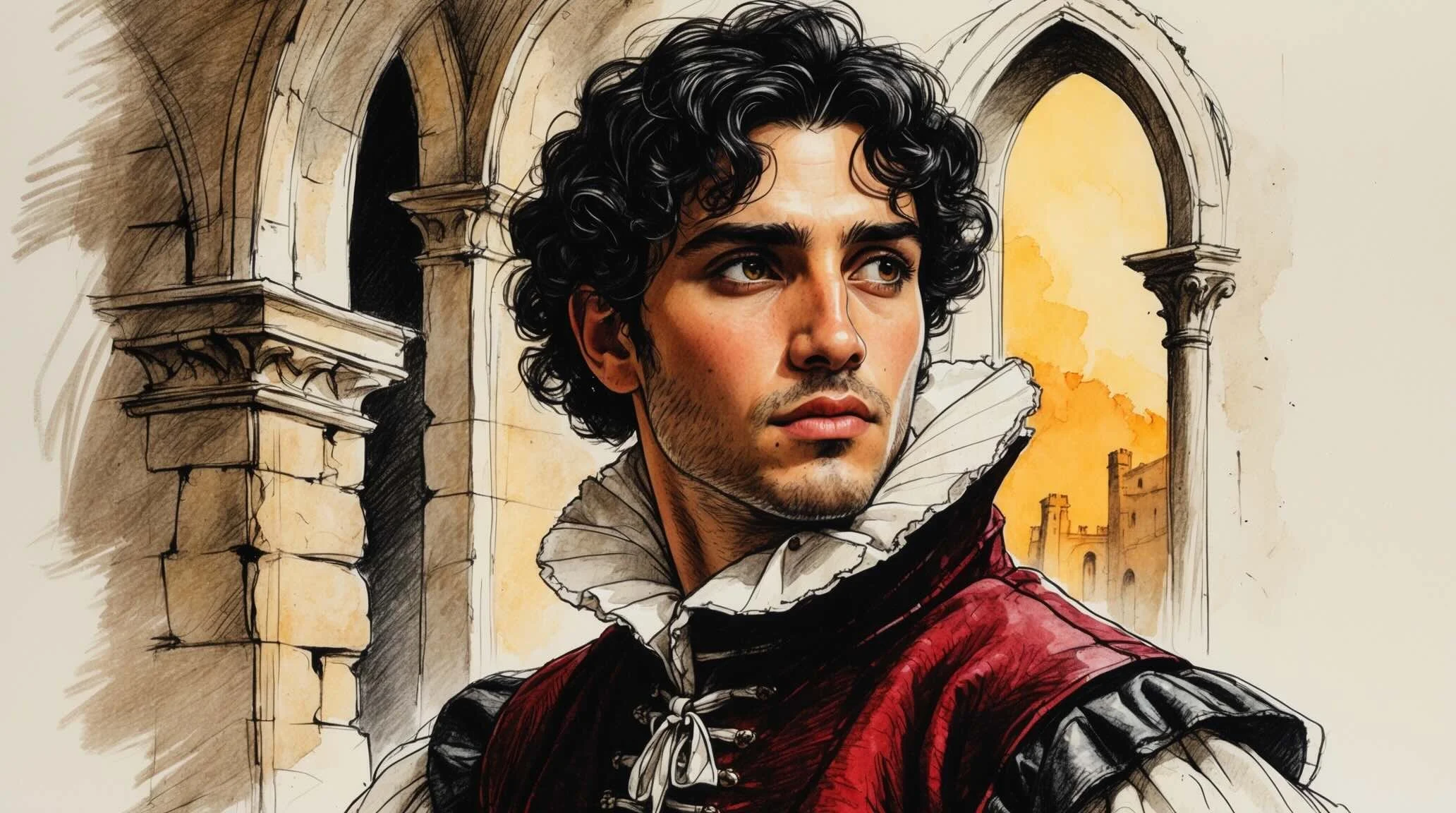
Character Profile – At a Glance
- Role: Only son of the Montague household, kinsman to Benvolio, friend to Mercutio, secret husband to Juliet, and the play’s titular hero.
- Key Traits: Passionate, lyrical, impulsive, romantic, brave, and increasingly capable of decisive action with catastrophic consequences.
- The Core Conflict: He is torn between the code of the Montague-Capulet feud and the love he has found with the daughter of his family’s enemy.
- Key Actions: Falls in love with Juliet at first sight; marries her in secret; refuses to fight Tybalt; kills Tybalt to avenge Mercutio; is banished to Mantua; returns on hearing of Juliet’s apparent death; kills Paris at the Capulet tomb; takes his own life beside her.
- Famous Quote:
"But, soft! What light through yonder window breaks?
It is the east, and Juliet is the sun."
(Act 2, Scene 2) - The Outcome: Returns to Verona on the false news of Juliet’s death, drinks poison beside her body, and dies moments before she wakes. His death is the catastrophe the Friar’s plan was meant to prevent.
The Lover Before the Lover
Romeo’s first appearance in the play is not the Romeo of legend. He is a melancholy, lovesick young man pining for a woman called Rosaline who has, the audience is repeatedly told, no interest in him. Friar Laurence, Mercutio, and Benvolio all mock him for it. The opening Romeo is a man performing the role of "a lover" rather than experiencing love – a difference Shakespeare goes out of his way to make legible.
Original
Why, then, O brawling love! O loving hate!
O any thing, of nothing first create!
O heavy lightness! Serious vanity!
Mis-shapen chaos of well-seeming forms!
(Act 1, Scene 1)
Shakespeare Retold (Modern Verse)
Why bother? Fighting love! Or loving hate!
From nothing these two forces activate!
Oh, woeful happiness and wretched pride!
What chaos caused by well-intentioned people!
This is the Petrarchan vocabulary of courtly love – oxymorons stacked on oxymorons, suffering performed as virtue. The audience is meant to recognise that Romeo, at this point, is in love with the idea of being in love. The transformation that follows in the next scene is so total partly because Shakespeare has set the bar so low: this poseur becomes, within hours, the husband whose love will define one of the most durable images in Western literature.
The Lyrical Reinvention
The moment Romeo sees Juliet at the Capulet ball, his language changes. The oxymorons disappear, the affectation falls away, and Romeo speaks in the cleanest, most direct lyric verse of his life. His first words about Juliet are not about himself.
Original
O, she doth teach the torches to burn bright!
It seems she hangs upon the cheek of night
Like a rich jewel in an Ethiope's ear;
Beauty too rich for use, for earth too dear!
(Act 1, Scene 5)
Shakespeare Retold (Modern Verse)
Oh, she does teach the torches to burn bright!
It’s though she’s hanging in the dark of night
Like gemstone earrings worn by someone black,
So richly fine, the earth can’t pay it back!
The shift in register is one of the play’s most important effects. The Romeo who sighed elaborately about Rosaline is no longer the same man. By the time he reaches the balcony, his language has matured into the speeches that two centuries of readers have learned by heart – "It is the east, and Juliet is the sun" – speeches that are no longer about performing love but about seeing it. The transformation is so swift and so complete that even Friar Laurence struggles to credit it, mocking Romeo for forgetting Rosaline so quickly. Romeo’s answer is decisive: this love, unlike the last one, is real because it is returned.
The Husband Who Will Not Fight
The Romeo of A3S1 is one of the most quietly remarkable figures in Shakespeare. He has been married for less than an hour. He encounters Tybalt – a man he has every reason, by the codes of his world, to fight – and refuses. He cannot explain why. To the audience, the reason is perfectly clear: he is now Tybalt’s cousin by marriage. To everyone on stage, his refusal looks like cowardice.
Original
Tybalt, the reason that I have to love thee
Doth much excuse the appertaining rage
To such a greeting: villain am I none;
Therefore farewell; I see thou know'st me not.
(Act 3, Scene 1)
Shakespeare Retold (Modern Verse)
Tybalt, the reasons that I have for loving you
Prevent me getting overwhelmed with anger
From how you’ve greeted me. I’m not a villain.
And so, goodbye; I see you do not know me.
The scene is a quiet masterpiece of dramatic irony. Romeo’s refusal to fight – the closest thing in the play to a moral act of love – is the very thing that gets Mercutio killed. Mercutio reads it as cowardice and intervenes; Tybalt’s blade reaches him under Romeo’s arm. From this moment, Romeo’s pacifism is no longer sustainable, and the man who refused to fight finds himself, within sixty lines, killing Tybalt in revenge. The trajectory of the rest of the play is set the moment Mercutio falls.
The Decisive Catastrophe
The Romeo of Act 5 is older than the Romeo of Act 1 by several lifetimes. Banishment, the wedding night with Juliet, the parting at dawn – all have transformed him from the lyrical lover into something harder, quicker, more decisive. When Balthasar arrives in Mantua with the news that Juliet is dead, Romeo’s reaction is not lament. It is action.
Original
Is it even so? Then I defy you, stars!
Thou know'st my lodging: get me ink and paper,
And hire post-horses; I will hence to-night.
(Act 5, Scene 1)
Shakespeare Retold (Modern Verse)
Can it be true? Then I defy you, fate!
You know where I live; bring me ink and paper,
And rent some horses, I will go tonight.
There is no soliloquy of grief here, no self-pity, no rhetorical lament. Romeo becomes, at this moment, the most decisive figure in the play. He buys poison from the apothecary in a single ruthless scene; he rides through the night to Verona; he kills Paris at the tomb with no real reluctance; and he drinks the poison beside Juliet’s body without hesitation. The lyrical young man of the balcony has become a man who acts. The tragedy is that the universe has given him the wrong information at the moment he has finally found the resolve to use it. The Friar, who designed the plan that would have saved him, is twenty minutes late.
"Shakespeare uses Mercutio's death to precipitate an essential change in Romeo; and it is this change, not anything extrinsic, that determines the main tragedy."
— Harley Granville-Barker, Prefaces to Shakespeare, 1930
Key Quotes by Romeo
Quote 1
But, soft! What light through yonder window breaks?
It is the east, and Juliet is the sun.
Arise, fair sun, and kill the envious moon,
Who is already sick and pale with grief,
That thou her maid art far more fair than she...
(Act 2, Scene 2)
Shakespeare Retold (Modern Verse)
But, hush! What light through yonder window breaks?
It is the east, and Juliet is the sun.
Shine brightly, lovely sun, usurp the moon,
Who’s sick and pale with jealousy and grief
That you, the moon’s goddess, is more enchanting...
Quote Analysis: The opening of the balcony scene, and one of the most quoted passages in English literature. The image is extravagant – Juliet as the sun rising in the east, eclipsing the moon – but for the first time in the play, Romeo’s hyperbole is doing something other than performing. He is alone, unaware Juliet can hear him, and the language is not aimed at an audience. The transformation from the affected lover of Act 1 is total. This is what Romeo’s voice sounds like when it is sincere.
O, I am fortune's fool!
(Act 3, Scene 1)
Shakespeare Retold (Modern Verse)
Oh, I am fortune’s fool!
Quote Analysis: Five words, and one of the most-quoted lines in the play. Romeo speaks them seconds after killing Tybalt, having seen Mercutio die, having abandoned the pacifism of his marriage hour, and having understood that everything he tried to build with Juliet is now compromised by the body at his feet. The line names the play’s central theme in a single phrase. By Act 5, when Romeo says "Then I defy you, stars!" he has stopped accepting fortune’s fool-status and decided to act against it – too late.
There is thy gold, worse poison to men's souls,
Doing more murders in this loathsome world,
Than these poor compounds that thou mayst not sell.
I sell thee poison; thou hast sold me none.
(Act 5, Scene 1)
Shakespeare Retold (Modern Verse)
There is your gold, a worse corrupter of men
That kills more people in this wretched world
Than these poor potions that you cannot sell.
I’ve sold you poison; you’ve not sold me none.
Quote Analysis: Romeo’s line to the apothecary in Mantua is one of the most cynical moments in the play, and one of the most adult. The lyrical young man has been replaced by someone capable of looking at gold and seeing it as the more lethal substance, capable of philosophical clarity in the moment of buying his own death. The change in register from Acts 1 and 2 is what the rest of the play insists on: Romeo, by Act 5, is decisive, hardened, and (within his own lights) clear-eyed.
From this world-wearied flesh. Eyes, look your last!
Arms, take your last embrace! And, lips, O you
The doors of breath, seal with a righteous kiss
A dateless bargain to engrossing death!...
Here's to my love! O true apothecary!
Thy drugs are quick. Thus with a kiss I die.
(Act 5, Scene 3)
Shakespeare Retold (Modern Verse)
From this despondent flesh. Eyes, take your last look!
Arms, take your last embrace! And, lips, you are
The doors of breath, seal with a righteous kiss
Commitment to an everlasting death!...
This is for you, my love! Oh, herbal drugs!
You work so fast. Thus, with a kiss I die.
Quote Analysis: Romeo’s death speech is the longest of the play’s farewells, and it is the speech of a man who believes, wrongly, that he is the last living party to a tragedy. He does not know Juliet is about to wake. Every line is a misreading, and the misreading is unbearable for the audience that watches. The kiss at the end is the kiss that has begun every important moment of his love for Juliet – at the ball, at the wedding, at dawn after the wedding night – and now ends it. He dies seconds before the woman beside him opens her eyes.
Key Takeaways
- Two Romeos: The opening lovesick poseur is replaced overnight by a direct, lyrical, sincere lover. The contrast is the point.
- The Refusal That Costs: His refusal to fight Tybalt is the play’s clearest moral act, and the catastrophe that follows is its direct consequence.
- The Decisive Catastrophe: By Act 5, Romeo can finally act with decision. The universe has given him the wrong information at the wrong moment.
- A Hero Defined by Love: Where the men around him define themselves by feud, faction, or honour, Romeo defines himself by love. The cost of that choice is the play.
Study Questions and Analysis
How does Romeo change over the course of the play?
The transformation is one of the most carefully tracked in Shakespeare.
Act 1 Romeo is a performer of love, sighing over Rosaline, speaking in oxymorons, mocked even by his closest friends. Act 2 Romeo is the lyrical lover who finds his real voice in the balcony scene. Act 3 Romeo is the husband who refuses to fight Tybalt, then kills him in revenge for Mercutio. Act 5 Romeo is the decisive man who buys poison, rides through the night, and kills Paris with no real reluctance.
The arc moves from affectation to sincerity to moral courage to ruthless action. By the time he reaches Juliet’s tomb, the lyrical boy of the balcony is barely visible.
On stage, the change is registered most explicitly by Friar Laurence, who reacts with comic dismay when Romeo announces his new love.
Holy Saint Francis, what a change is here!
Is Rosaline, whom thou didst love so dear,
So soon forsaken? Young men's love then lies
Not truly in their hearts, but in their eyes.
(Act 2, Scene 3)
Shakespeare Retold (Modern Verse)
Holy Saint Francis, what a change is here!
Is Rosaline, who you did love so dear,
So soon rejected? Young men’s love thus lies
Not truly in their hearts, but in their eyes.
The line is partly a joke and partly a warning. The Friar marks the speed of the transformation but does not, yet, see what it will produce.
Harley Granville-Barker’s 1930 Prefaces to Shakespeare reading, quoted on this page, has been the dominant interpretation for nearly a century: that Mercutio’s death in A3S1 is the moment that precipitates the change, and that everything Romeo becomes in the second half of the play is the consequence of the friend he watched die under his arm.
Is Romeo's love for Juliet real, given how quickly he forgot Rosaline?
Friar Laurence himself raises this exact question in A2S3, and Romeo’s answer is that this love is real because it is returned.
I pray thee, chide not; she whom I love now
Doth grace for grace and love for love allow;
The other did not so.
(Act 2, Scene 3)
Shakespeare Retold (Modern Verse)
Don’t mock me, please; the one I now adore
Is kind and loves me back, of that I’m sure;
The other one did not.
The play makes the case that Juliet’s reciprocity is what changes Romeo’s love from performance to substance. Rosaline gave him no answers, only a part to play. Juliet gives him a partner who matches him line for line.
Beyond that, the play tests the love through banishment, killing, separation, and finally death, and Romeo’s commitment never wavers. Whatever the speed of its origin, the love sustains four acts of catastrophic pressure, and when Romeo dies he believes he is dying for Juliet.
Many critics treat the Rosaline opening as Shakespeare’s deliberate way of showing how complete the reinvention is. By giving us the affected Petrarchan poseur of A1S1 first, the play makes the lyrical sincerity of A1S5 and A2S2 register as a transformation rather than as the character’s natural register. The opening Romeo is the control case against which the Juliet-Romeo is measured.
Why does Romeo refuse to fight Tybalt?
Because he is now married to Tybalt’s cousin and considers Tybalt family. The audience knows this. No one on stage does.
Romeo’s refusal is the closest thing in the play to a moral act of love, an attempt to live by the marriage rather than by the feud. Tragically, his refusal is what kills Mercutio. Mercutio reads it as cowardly capitulation, intervenes, and is fatally wounded under Romeo’s arm.
A plague o' both your houses! I am sped.
(Act 3, Scene 1)
Shakespeare Retold (Modern Verse)
God damn to both your families. I am done for.
Mercutio dies cursing not Romeo specifically but the entire structure of the feud that has produced his death. The "plague" he calls down on both houses falls, within five days, on every major figure in the play.
The scene is one of Shakespeare’s most painful ironies. Romeo’s pacifism, the most admirable thing he has done in the play, is what triggers the catastrophe. It is one of his most pointed pieces of writing on the relationship between moral action and tragic consequence: Romeo does the right thing, and his friend dies as a direct result.
From the moment Mercutio falls in A3S1, the play tips irreversibly into tragedy. The man who refused to fight finds himself, within sixty lines, killing Tybalt in revenge, and the "O, I am fortune’s fool!" cry that follows is his recognition that the moral act has produced its own catastrophic reversal.
How does Romeo's language change across the play?
The shift is one of Shakespeare’s most tracked stylistic experiments.
Act 1 Romeo speaks in Petrarchan oxymorons ("O brawling love! O loving hate!"), the conventional vocabulary of the courtly lover. Act 2 Romeo speaks in some of Shakespeare’s cleanest lyric verse ("It is the east, and Juliet is the sun"), direct, image-rich, sincere. Act 3 Romeo speaks in the broken, urgent verse of crisis.
Yet 'banished'? Hang up philosophy!
Unless philosophy can make a Juliet,
Displant a town, reverse a prince's doom,
It helps not, it prevails not: talk no more.
(Act 3, Scene 3)
Shakespeare Retold (Modern Verse)
But still I’m banished? Screw philosophy!
Unless philosophy can make a Juliet,
Transplant a town, reverse the prince’s verdict,
There’s no way it can help me, so stop talking.
The A3S3 Friar’s cell speech captures the new register precisely. The verse is shorter, the metaphors more direct, the syntax interrupted by exclamation. The polished Petrarchan poseur of A1S1 could not have spoken these lines. The catastrophe has stripped his language of its decoration.
Act 5 Romeo speaks in the hard, philosophical register of the apothecary scene and the elegiac register of the tomb soliloquy.
The trajectory tracks the character’s emotional development with unusual precision. Where another playwright might have used soliloquies to announce Romeo’s interior state, Shakespeare uses the verse itself, the shift in metaphor, syntax, and metrical handling, to make the change audible to the audience.
Critics from Granville-Barker onward, including Harold C. Goddard in his 1951 The Meaning of Shakespeare and Harold Bloom in his 1998 Shakespeare: The Invention of the Human, have argued that watching Romeo’s voice mature is itself one of the play’s central pleasures. The lyrical opening of A2S2 is famous. The harder, more decisive register of A5S1 is less so, but the contrast between them is one of the play’s most carefully engineered effects.
Does Romeo bear responsibility for the tragedy?
The play distributes responsibility carefully, but Romeo is undeniably one of the tragedy’s authors.
He kills Tybalt in revenge, getting himself banished. He buys poison on hearing only second-hand news. He kills Paris at the tomb without hesitation. He drinks the poison without checking whether Juliet’s body shows any sign of life, and her cheeks are flushed, the Friar’s potion working its way out, the moment he dies.
Each of these is a choice, and the play does not excuse any of them.
At the same time, the blame is shared: by the feud, by Friar Laurence, by Lord Capulet’s tyranny in forcing the Paris marriage, by the Mantua quarantine that delays the Friar’s letter. Romeo’s responsibility is part of a chain, not the whole of it.
The deeper question the play raises is whether responsibility, in a world organised by the feud, can be cleanly assigned at all. Romeo acts within constraints he did not choose. The constraints produce the actions. The actions produce the catastrophe. The play does not exonerate him, but it also does not allow the audience to read his choices as the sole or even primary cause of what follows.
How does Romeo function as a foil to Juliet?
The two are equally drawn but differently constructed.
Romeo speaks more conventionally. Juliet thinks more originally. Romeo acts impulsively. Juliet acts deliberately. Romeo’s grief over banishment in A3S3 is theatrical and self-pitying, and Friar Laurence mocks him for it ("art thou a man?"), where Juliet’s grief in A3S5 is silent, strategic, and ends with the planning of escape.
Romeo dies in elaborate elegiac rhetoric. Juliet dies in five words.
Yea, noise? Then I'll be brief. O happy dagger!
(Act 5, Scene 3)
Shakespeare Retold (Modern Verse)
What, noise? I must be quick. What luck! A dagger!
Where Romeo finds love in poetry, Juliet finds language for love in real time. The "What’s in a name?" speech is one of Shakespeare’s most philosophically original pieces of writing in the voice of a thirteen-year-old.
Many critics, Harold Bloom most prominently, argue that Juliet is the play’s true centre of gravity, and that Romeo, however lyrical, is in some sense a foil to her clarity. The reading is contested but persistent.
What is not contested is the symmetry the play establishes. The two lovers share the sonnet they speak together at first meeting (A1S5), share the alternating verse of the balcony scene (A2S2), share the parting at dawn (A3S5), and share the tomb (A5S3). Each scene gives them roughly equal voice, and the cumulative effect is one of Shakespeare’s most carefully balanced two-handers.
What is the significance of Romeo's death speech?
The speech is one of the longest farewells in Shakespeare and one of the most heartbreaking, because every line of it rests on a misreading.
Romeo does not know Juliet is alive. He believes he is the survivor of a love story. He is in fact arriving twenty minutes too early. The audience, seeing the colour returning to Juliet’s cheeks even as Romeo speaks, watches the universe punish him for being decisive:
Death, that hath sucked the honey of thy breath,
Hath had no power yet upon thy beauty:
Thou art not conquered; beauty's ensign yet
Is crimson in thy lips and in thy cheeks,
And death's pale flag is not advanced there.
(Act 5, Scene 3)
Shakespeare Retold (Modern Verse)
Death, that has stopped your lungs from sweetly breathing,
Has not yet had the time to dull your beauty.
You are not beaten; beauty still endures
In redness in your lips and in your cheeks,
And paleness from death has not arrived yet.
The irony is unbearable. Romeo, in the moment of greatest decisive action of his life, is registering the very evidence that should tell him to wait, the crimson in her lips, the colour in her cheeks, the absence of death’s "pale flag", and reading it as the special grace of beauty preserved by death rather than as the literal fact of life returning. He sees the truth and misinterprets it. The misinterpretation kills him.
The speech is also the last appearance of Romeo’s lyrical voice, the language of the balcony, returning at the moment of catastrophe. The kiss that ends the speech is the kiss that has begun every important moment of his love. He dies on it, and Juliet wakes seconds later.