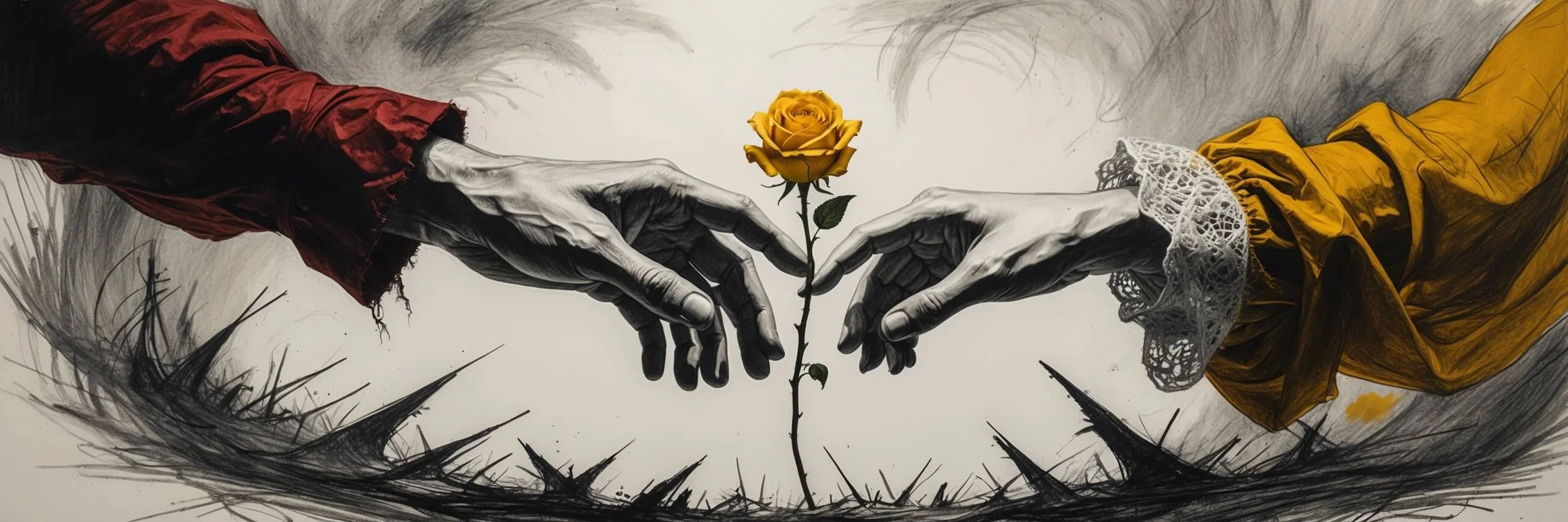
Theme Profile – At a Glance
- Focus: Love and violence as a single heightened force in Romeo and Juliet – the play opens with a brawl and ends in suicide, and the two are never far apart.
- Key Characters: Romeo, Juliet, Mercutio, Tybalt, Friar Laurence.
- The Core Tension: The same passion that draws the lovers together is the passion that feeds the feud. Love and hate share one language, one intensity, and one end.
- Key Manifestations: The opening street brawl; Romeo's oxymorons of love and hate; the lovers' shared sonnet; the Friar's warning; Mercutio's death and Tybalt's killing; the final suicides in the tomb.
- Famous Quote:
"These violent delights have violent ends..."
(Act 2, Scene 6) - The Outcome: The lovers die by their own hands, and only their deaths end the feud. Love does not defeat violence in this play – it joins it, and is consumed with it.
The Brawl That Opens the Play
Romeo and Juliet is remembered as the great love story, but it does not begin with love. It begins with a fight. Before either of the lovers has spoken a word, the servants of two households are biting their thumbs in the street, swords are drawn, and the Prince has to ride in to stop a riot. The Chorus tells the audience what is coming before the action even starts, and what it promises is not romance but blood.
Original
From ancient grudge break to new mutiny,
Where civil blood makes civil hands unclean.
(Act 1, Scene 1)
Shakespeare Retold (Modern Verse)
Where ancient hatred reignites a siege,
And civil conduct turns to civil rage.
The phrasing is deliberate. "Civil blood" and "civil hands" turn neighbours into combatants in a single line – the people who should keep the peace are the ones spilling each other's blood. This is the world the lovers are born into, and it is a world where strong feeling is expressed through violence as a matter of habit. Tybalt hates as easily as Romeo loves, and the play sets them side by side from the start.
What the opening establishes is that the feud is not a backdrop to the love story – it is the same heightened temperature the love story runs at. The young men of Verona are primed to feel everything at maximum intensity. When Romeo turns that intensity from fighting to loving, he has not changed register. He has only changed direction.
The Language of Oxymoron
The clearest evidence that love and violence are fused in this play is in its language. Long before he meets Juliet, Romeo is in love with Rosaline, and the way he describes that love is a tangle of contradictions. He cannot speak of love without speaking of its opposite in the same breath.
Original
Why, then, O brawling love! O loving hate!
O any thing, of nothing first create!
(Act 1, Scene 1)
Shakespeare Retold (Modern Verse)
Why bother? Fighting love! Or loving hate!
From nothing these two forces activate!
"Brawling love" and "loving hate" are not clever decoration. They are the theme of the whole play stated in two phrases. A brawl is the street violence the play opened with; love is what it claims to be about; and Romeo has welded them into a single idea. The oxymoron is the figure of speech that holds two opposites together without resolving them, and it is the figure Romeo and Juliet returns to again and again.
When Juliet learns that the man she has fallen for is the son of her family's enemy, she reaches for the same kind of language – love and hate named in the same line. The lovers do not merely live in a world divided between love and violence. They think in a grammar that refuses to keep the two apart.
The Friar's Warning
Friar Laurence is the one character who sees the danger clearly, and he names it. He agrees to marry the lovers in the hope that their union will end the feud, but he does not mistake the speed and heat of their love for safety. As Romeo arrives to be married, the Friar warns him that feeling this intense carries its own destruction inside it.
Original
These violent delights have violent ends
And in their triumph die, like fire and powder,...
(Act 2, Scene 6)
Shakespeare Retold (Modern Verse)
Infatuation often ends in pain,
And when it ends, like gunpowder and fire,...
The word "violent" appears twice in a single line, attached first to "delights" and then to "ends". The Friar is not warning against violence as something outside the love – he is warning that the love itself is violent, that its delight and its destruction are the same energy. The image of fire and gunpowder makes the point exact: the very thing that gives the spark its brilliance is the thing that blows it apart.
The Friar's counsel is moderation – "love moderately" – but moderation is the one thing this love cannot do. The lovers are not built for it, and neither is the world they are trying to survive in. The warning is accurate, and it is useless, because the heat that the Friar fears is the same heat that makes the love what it is.
Mercutio's Death and the Turn
For two acts the play lets love and violence run on parallel tracks. The feud simmers; the lovers court in secret. The moment the two tracks cross is the death of Mercutio, killed under Romeo's arm as Romeo tries to keep the peace. From that point the play stops being a comedy that might end in marriage and becomes a tragedy that must end in death. Romeo kills Tybalt in revenge, and immediately understands what he has done.
Original
O, I am fortune's fool!
(Act 3, Scene 1)
Shakespeare Retold (Modern Verse)
Oh, I am fortune's fool!
The line is the hinge of the play. Romeo, the lover, has just committed the act of the feud – he has spilled the "civil blood" the Chorus warned of. The man who refused to fight Tybalt because Tybalt is now his kinsman by marriage has killed him anyway, driven by the same heightened loyalty that made him love. His love for Juliet and his rage for Mercutio come from the same place, and within a single scene the one has produced the other.
This is the play's argument in miniature. Love did not save Romeo from violence; it delivered him to it. The marriage that was meant to end the feud is the very thing that ties Romeo to Mercutio and Tybalt, and so to the killing. From A3S1 onward, every act of love in the play carries an act of violence close behind it, until the two arrive together in the tomb.
"The movement of Romeo and Juliet is unlike that of any other Shakespearean tragedy. It becomes, rather than is, tragic."
— Susan Snyder, The Comic Matrix of Shakespeare's Tragedies, 1979
Key Quotes on Love and Violence
Quote 1
My only love sprung from my only hate!
(Act 1, Scene 5)
Shakespeare Retold (Modern Verse)
The man I love's the son of whom I hate!
Quote Analysis: Juliet says this the instant she learns Romeo's name, and it is the mirror of Romeo's "brawling love" speech from the first scene. Where he piled oxymoron on oxymoron, she states the contradiction plainly: her love has grown straight out of her hate, the two feelings sharing one root. The line tells us the lovers do not stand outside the feud, untouched by it. Their love is made of the same material as the family hatred – it springs from it, and it cannot finally be separated from it.
Come, gentle night, come, loving, black-browed night,
Give me my Romeo; and, when he shall die,
Take him and cut him out in little stars,...
(Act 3, Scene 2)
Shakespeare Retold (Modern Verse)
Come, gentle night-time; come here, lovely darkness,
And bring my Romeo; and when he's died,
Take him and cut him into little star shapes...
Quote Analysis: This is Juliet at her most rapturous, waiting for her wedding night – and even here, at the height of desire, her imagination reaches for death. She pictures Romeo dead and cut into stars, a love-image and a death-image fused into one. The passage shows how completely the two ideas have merged in the lovers' minds: she cannot dream of possessing Romeo without, in the same breath, imagining losing him. The tenderness is real, and so is the foreshadowing. By A3S2 the audience knows the stars are where this is heading.
Thy drugs are quick. Thus with a kiss I die.
(Act 5, Scene 3)
Shakespeare Retold (Modern Verse)
You work so fast. Thus, with a kiss I die.
Quote Analysis: Romeo's last line is the play's clearest fusion of love and violence in a single act. A kiss is the gesture of love; dying is the act of violence; and here they are the same motion. He drinks the poison and kisses Juliet in one continuous movement, so that the kiss and the death cannot be told apart. The line is the destination the whole play has been travelling toward since the opening brawl – the point at which loving and dying become a single thing, performed at once.
Yea, noise? Then I'll be brief. O happy dagger!
This is thy sheath;
there rust, and let me die.
(Act 5, Scene 3)
Shakespeare Retold (Modern Verse)
What, noise? I must be quick. What luck! A dagger!
My breast will be your sheath;
rust, as I die.
Quote Analysis: Juliet calls the dagger "happy" – a word of joy attached to the instrument of her death. The image is openly erotic: her body becomes the dagger's "sheath", and the violence of the stabbing is described in the language of the marriage bed she never reached. This is the final, most extreme version of the play's central fusion. There is no longer any gap at all between the act of love and the act of violence. To join Romeo, Juliet must kill herself, and she greets the blade as a lover. Love and violence end the play, as they began it, as one.
Key Takeaways
- The Play Is Framed by Violence: It opens with a street brawl and ends with two suicides. Love does not interrupt the violence – it runs through the same channels.
- Love and Hate Share a Language: Romeo's "brawling love" and Juliet's "only love sprung from my only hate" show the two feelings named in the same breath, again and again.
- The Passion Is the Danger: Friar Laurence warns that "violent delights have violent ends". The very intensity that makes the love beautiful is what makes it deadly.
- Mercutio's Death Is the Turn: The killing in A3S1 is the moment the love story tips into tragedy, and from then on every act of love is shadowed by an act of violence.
Study Questions and Analysis
How does the play link love and violence from the very beginning?
The link is built into the play's structure before a single line of love poetry is spoken. The opening scene is a brawl – servants trading insults, swords drawn, the Prince forced to intervene. The Chorus that precedes it has already told the audience that the story of "a pair of star-crossed lovers" is also the story of a feud, and that the two are inseparable.
The fearful passage of their death-marked love,
And the continuance of their parents' rage,...
(Act 1, Scene 1)
Shakespeare Retold (Modern Verse)
The risky path, on which both lovers died
And parents' anger never was retracted...
The phrase "death-marked love" yokes the two ideas together in the Chorus's own words: this love is marked for death from the outset. The lovers' passion and their parents' rage are named in consecutive lines, and the Chorus makes plain that nothing but the lovers' deaths will end the feud.
Caroline Spurgeon's 1935 Shakespeare's Imagery and What It Tells Us tracked how the play's dominant images of light – the sudden flash, the lightning, the spark – cast love as something brilliant and brief against a surrounding darkness. On Spurgeon's reading, the recurring light imagery is not decorative but structural: it tells us, at the level of the play's unconscious vocabulary, that this love will burn intensely and be extinguished fast. The brilliance and the brevity are the same fact, and the darkness the love flashes against is the world of the feud.
The opening, then, is not a prologue the love story leaves behind. It is the condition the love story has to live and die inside.
Why does Shakespeare use so many oxymorons in the play?
The oxymoron – a figure that yokes two opposites into a single phrase – is the play's signature device, and it is doing real thematic work rather than mere ornament. When Romeo describes his love for Rosaline as "brawling love" and "loving hate", he is not being witty for its own sake. He is using the only grammar that can hold love and violence together, because in this play they genuinely are held together.
The device recurs because the theme recurs. Juliet, learning Romeo's identity, frames her situation as a love sprung from hate. Romeo, dying, fuses a kiss with his death. The oxymoron is the sentence-level version of what the plot does at large scale: it sets two opposites in the same space and refuses to let either cancel the other.
M. M. Mahood's 1957 Shakespeare's Wordplay drew particular attention to the play's puns on love and death – the way a single word can carry both an erotic and a fatal meaning at once. On Mahood's reading, this wordplay is not decoration laid over the tragedy but a means of dramatising it: the language itself enacts the collision of love and death that the plot will go on to stage. When Juliet calls the dagger "happy" or imagines Romeo's "death", the double meanings are the theme working through the very texture of the verse.
The deeper point is that the oxymorons are not a phase Romeo grows out of. He speaks them about Rosaline in Act 1, but the whole play goes on speaking them – right up to the moment in the tomb when love and death are performed as a single action. The figure of speech turns out to be a prophecy of the form.
Is Mercutio's death the turning point of the play?
Most readings of the play treat A3S1 as the structural hinge, and the case for it is strong. Up to that point, the play behaves like a comedy – it has young lovers, a secret marriage, a bawdy Nurse, a witty friend, and a plot that could plausibly resolve in reconciliation. After Mercutio dies, none of those outcomes is available. The play commits to tragedy in the space of a single scene.
A plague o' both your houses! I am sped.
(Act 3, Scene 1)
Shakespeare Retold (Modern Verse)
God damn to both your families. I am done for.
Mercutio's dying curse – "a plague o' both your houses" – names the feud as the thing that has killed him, and the curse comes true. His death drives Romeo to kill Tybalt, which gets Romeo banished, which sets the whole machinery of the catastrophe in motion.
Susan Snyder's 1979 The Comic Matrix of Shakespeare's Tragedies gave this reading its most influential form, arguing that the play "becomes, rather than is, tragic". Snyder's point is that the tragedy is not present from the first scene in the way it is in, say, Macbeth; the early acts run on comic conventions, and the tragedy is something the play turns into when Mercutio dies. The audience watches one kind of play become another in real time.
A more sceptical reading, consistent with the Chorus's "death-marked love" and Spurgeon's light imagery, holds that the ending is foretold from the prologue and that Mercutio's death merely triggers a catastrophe that was always coming. The two positions are not finally incompatible: the play can be fated in its overall shape and still pivot, at the level of dramatic experience, on the single scene where its friend is killed. What is not in doubt is that A3S1 is where love stops being able to keep violence at bay.
Does the play suggest love can overcome violence, or that they are the same force?
The optimistic reading is that the lovers' deaths finally shame the families into peace – love wins, at terrible cost, by ending the feud at last. There is textual support for it: the Prince's closing speech presides over a reconciliation, and the play's own logic insists that nothing else could have stopped the violence.
But the harder reading, and the one the imagery supports, is that love does not defeat violence in this play because the two are never really opposed. They are the same heightened energy pointed in different directions. The lovers feel everything at maximum intensity, and so do the feuding young men; Romeo can switch from one to the other within a single scene. Love does not arrive from outside to rescue Verona from its violence. It is grown from the same soil.
Have lost a brace of kinsmen: all are punished.
(Act 5, Scene 3)
Shakespeare Retold (Modern Verse)
I've lost two of my cousins. We're all punished.
The Prince's verdict – "all are punished" – does not sound much like a victory for love. It is an accounting of the dead. The reconciliation is real, but it is bought with the bodies of the children, and the play makes the audience feel the cost rather than the triumph.
Caroline Spurgeon's 1935 reading of the light imagery supports the darker view. If love in this play is a brilliant flash against the dark – beautiful precisely because it is brief and consuming – then it was never the kind of thing that could outlast the violence. It burns too hot. The play's tragedy is not that violence happened to defeat a love that might have won, but that this love and this violence were, from the start, two names for the same fire.
How does the religious imagery of the lovers' first meeting fit the theme?
When Romeo and Juliet first speak, in A1S5, they do so in a shared sonnet built entirely on the imagery of pilgrims and saints. Romeo casts himself as a pilgrim and Juliet as a holy shrine; their hands touch as "palm to palm". It is the most tender, reverent exchange in the play – and it is worth attending to precisely because it is the one moment where love seems entirely separate from violence.
Good pilgrim, you do wrong your hand too much,
Which mannerly devotion shows in this;...
(Act 1, Scene 5)
Shakespeare Retold (Modern Verse)
Good pilgrim, do not blame your hands so much;
You show devotion holding me like this;...
The religious language raises the love above the brawling world of the feud – it is reverent, gentle, almost sacramental. But the scene is framed by violence on both sides. It happens at the Capulet feast, where Tybalt has just recognised Romeo and sworn revenge; and it ends, moments later, with Juliet's discovery that her "only love sprung from her only hate". The sonnet is an island of pure love in a sea of threat.
Harley Granville-Barker's 1930 Prefaces to Shakespeare drew attention to the lyrical design of the tragedy – the way Shakespeare builds set-pieces of formal beauty, like this shared sonnet, into a play that is moving inexorably toward catastrophe. On Granville-Barker's account, the lyrical passages are not relief from the tragedy but part of its architecture: the more exquisitely the love is rendered, the more violently its destruction registers. The reverent sonnet of A1S5 is calibrated to be undone, and the play undoes it within the same scene.
So the religious imagery does not stand apart from the theme. It marks the high point of the love precisely so that the audience feels the full distance of the fall – and even here, the violence of Tybalt's vow is pressing at the edges of the holy ground.
What is the significance of the play's death imagery in the love scenes?
One of the play's most unsettling features is how often the lovers reach for images of death at the very moments they are most in love. The pattern is consistent enough to be a deliberate design. Juliet, waiting for her wedding night, imagines Romeo dead and "cut out in little stars". Later, looking down at Romeo from her window as he leaves, she says he looks "as one dead in the bottom of a tomb". The love scenes are saturated with death.
This is not morbidity for its own sake. It is the play telling the audience, through the lovers' own imaginations, where the love is heading. The death imagery in the love scenes is the foreshadowing made intimate: the lovers themselves keep stumbling onto the truth that their love and their deaths are bound together.
M. M. Mahood's 1957 Shakespeare's Wordplay is illuminating here. Mahood traced the play's recurring puns in which a word of love also carries a sense of death, arguing that the wordplay performs the union of the two at the level of the line. When the lovers' language keeps producing these double meanings, it is enacting the theme rather than merely describing it. The death that surfaces in the love scenes is not an intrusion; it was always already inside the words.
The culmination is the tomb itself, where the death imagery of the love scenes becomes literal. Romeo dies with a kiss; Juliet greets the dagger as a lover and makes her body its "sheath". Everything the love scenes had imagined in metaphor, the final scene stages as fact. The lovers had been rehearsing their deaths, in the language of love, all along.
How should students write about love and violence as a single theme rather than two?
The most common weakness in exam answers on this play is to treat love and violence as opposites – love as the good thing the violence keeps interrupting. The stronger argument, and the one the text rewards, is that Shakespeare presents them as a single force. The best essays show the two fused rather than merely co-present.
The evidence for fusion is everywhere once you look for it. At the level of language, the oxymorons – "brawling love", "loving hate", a "happy dagger" – hold love and violence in one phrase. At the level of plot, Romeo moves from loving Juliet to killing Tybalt within a single scene, driven by the same intensity. At the level of imagery, the love scenes are full of death, and the death scene is full of love. A strong answer threads these levels together to show one argument: that the play's love and its violence are the same heat.
A useful structure is to track the fusion across the arc of the play – the oxymorons of Act 1, the Friar's warning in Act 2 that "these violent delights have violent ends", the turn at Mercutio's death in Act 3, and the literal fusion of the kiss and the dagger in Act 5. This shows the examiner a developing argument rather than a list of quotations.
Critically, the position is well supported. Susan Snyder's 1979 The Comic Matrix of Shakespeare's Tragedies gives you the play's movement from comedy into tragedy; Caroline Spurgeon's 1935 Shakespeare's Imagery and What It Tells Us gives you the light-against-dark imagery of a love that burns brief and bright; M. M. Mahood's 1957 Shakespeare's Wordplay gives you the love-and-death puns; and Harley Granville-Barker's 1930 Prefaces to Shakespeare gives you the lyrical design that makes the destruction land. Used precisely – named, dated, and applied to a specific line – any one of these lifts an answer from assertion to argument. The thesis to defend is simple and strong: in Romeo and Juliet, love and violence are not enemies. They are one thing.