Fate and Destiny
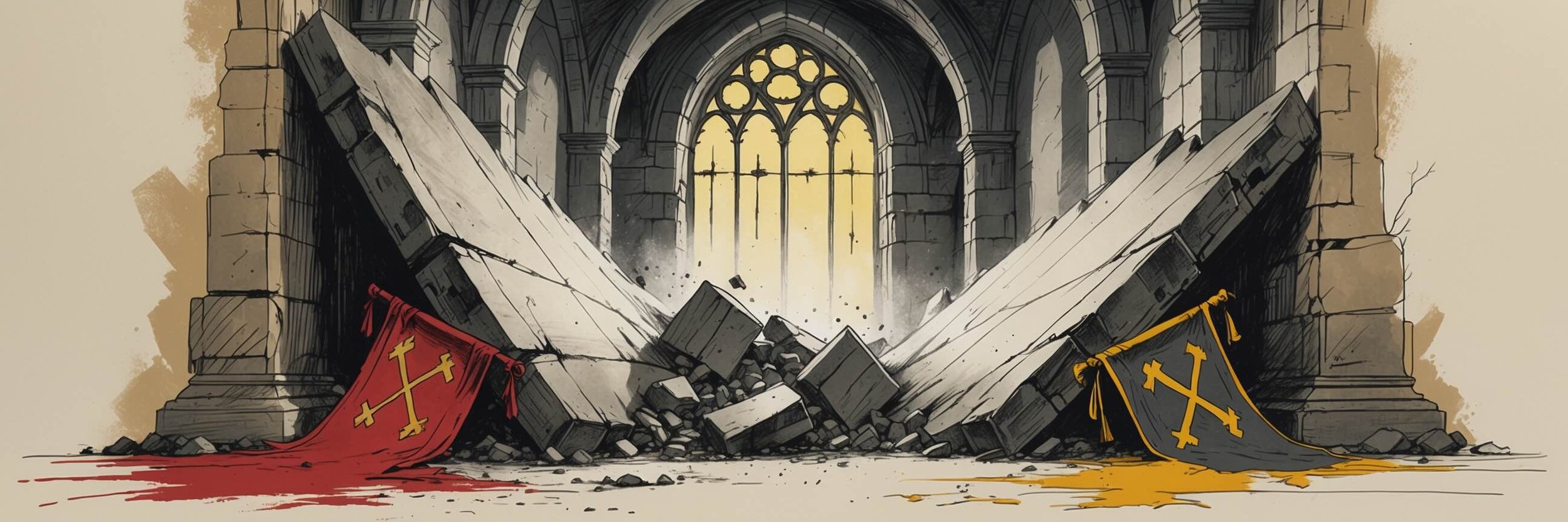
Theme Profile – At a Glance
- Focus: Fate as the play's stated cause of disaster, and the human machinery – the feud, the haste, the missed message – that actually drives it.
- Key Characters: Romeo, Juliet, Friar Laurence, the Nurse, Mercutio, Lord Capulet.
- The Core Tension: The Prologue says the stars are to blame. The plot shows a feud, a four-day rush and a quarantined letter doing the killing.
- Key Manifestations: The Prologue's "star-crossed" frame; Romeo's foreboding in Act 1, Scene 4; "fortune's fool" in Act 3, Scene 1; Juliet's "ill-divining soul" in Act 3, Scene 5; Romeo's defiance of the stars in Act 5.
- Famous Quote:
"A pair of star-crossed lovers take their life..."
(Prologue) - The Outcome: Two children die. The families call it fate and end the feud. The audience has watched every avoidable human choice that produced the tomb.
The Prologue Names the Stars
Before a single character speaks, the play tells the audience how it ends and who to blame. The Chorus delivers a sonnet that names the lovers "star-crossed" and promises their deaths. This is unusual. Most tragedies build suspense around whether the hero will survive. Romeo and Juliet removes that question in the first fourteen lines, and replaces it with a different one: if the stars have already decided, what are we watching for?
Original
From forth the fatal loins of these two foes
A pair of star-crossed lovers take their life;
(Prologue)
Shakespeare Retold (Modern Verse)
Two offspring of ill-fated enemies,
That, jinxed by love, both die by suicide,
The word "fatal" carries both its modern sense – deadly – and its older sense, to do with fate. The lovers come from "fatal loins": they are doomed by their birth into feuding houses before they have done anything at all. The Prologue invites us to read everything that follows as the working-out of a destiny written in the heavens.
But notice what the Chorus actually blames. The deaths will "bury their parents' strife." The thing the play asks the families to end is not the influence of the stars – which no one can change – but their feud, which they could end at any moment. From its first speech, the play offers a celestial explanation and quietly attaches it to a human cause.
Premonition and the Language of Fate
Shakespeare gives his young lovers a habit of foreboding. They keep sensing disaster before it arrives, and they keep blaming the heavens for it. Romeo does it first, on the way to the Capulet feast he has no reason to attend. He has a premonition that this night will set something terrible in motion.
Original
I fear, too early: for my mind misgives
Some consequence yet hanging in the stars...
(Act 1, Scene 4)
Shakespeare Retold (Modern Verse)
I fear, too early: something’s bothering me
About the fate that’s written in the stars...
The instinct is real, and the play rewards it: the feast is where Romeo meets Juliet, which is where the tragedy begins. But the language is the point. Romeo locates the danger "in the stars" – as a consequence hanging over him, outside his control. He does not say "I should not go to a party held by my family's enemies." He reaches for fate, when the human risk is sitting in front of him.
This is the play's method in miniature. The characters feel the pressure of events closing in, and they name that pressure "fate" because it is the largest word available to them. Juliet does the same thing at every parting. The vocabulary of destiny is how these teenagers make sense of a situation that is, in fact, being engineered by adults, accidents and their own haste.
Fortune's Fool: Fate as Vocabulary
The play's most quoted claim about fate is shouted in the street, in the worst moment of Romeo's life. He has just killed Tybalt in revenge for Mercutio's death, and he understands at once that he has destroyed his own future.
Original
O, I am fortune's fool!
(Act 3, Scene 1)
Shakespeare Retold (Modern Verse)
Oh, I am fortune’s fool!
Romeo casts himself as the plaything of fortune – a man events happen to, rather than a man who acts. It is a powerful image, and it is not quite true. Nobody forced him into the duel. He chose to answer Tybalt's challenge, chose to draw, chose to strike. The street fight that turns the love story into a tragedy is built entirely from human decisions, several of them his.
This is the gap the play keeps opening. The characters describe themselves as fortune's fools, as star-crossed, as doomed – and the audience watches them make the choices that doom them. "Fortune's fool" is how Romeo experiences the moment. It is not how the scene was caused. The catastrophe of A3S1 grows out of the feud, the heat, Mercutio's pride and Romeo's revenge, not out of the stars he later blames.
Defying the Stars and the Machinery of the Catastrophe
By Act 5 the language of fate has hardened into something Romeo wants to fight. Hearing the false news that Juliet is dead, he does not submit to the heavens – he turns on them. The defiance is magnificent, and it is the thing that kills him, because he rushes to Verona before the truth can catch up.
The final act is where the play shows its hand. Romeo dies because Friar Laurence's letter never reaches him – Friar John is held in quarantine, shut up in a house suspected of plague. Juliet wakes moments too late, with Romeo's body still warm. When the Friar arrives at the tomb, he reaches, as everyone in this play does, for the largest possible explanation.
Original
A greater power than we can contradict
Hath thwarted our intents. Come, come away.
(Act 5, Scene 3)
Shakespeare Retold (Modern Verse)
A greater power than that we could imagine
Has thwarted our intentions. Come away.
The Friar calls it "a greater power" – fate, providence, the will of heaven. But the audience knows exactly what thwarted his intents: an undelivered letter and a few minutes of bad timing. The "greater power" was a man with a plague warning on his door. The play lets the characters keep their cosmic vocabulary while showing us the entirely human machinery underneath. That is the deepest move the theme makes: fate is the story the survivors tell, and the mechanism is what the audience has watched the whole time.
"In the tragic vision death is, not an incident in life, not even the inevitable end of life, but the essential event that gives shape and form to life."
— Northrop Frye, Fools of Time, 1967
Key Quotes on Fate and Destiny
Quote 1
My only love sprung from my only hate!
(Act 1, Scene 5)
Shakespeare Retold (Modern Verse)
The man I love’s the son of whom I hate!
Quote Analysis: Juliet's reaction on learning Romeo's name reads like a verdict from the heavens – love and hate fused at birth, the one impossible match. But the impossibility is entirely man-made. What makes Romeo forbidden is not the stars; it is the feud his family has chosen to keep alive. Juliet names it as fate ("my only hate"), yet the obstacle is a quarrel the adults could end with a word. The line is the theme in a single breath: a human conflict experienced as destiny.
Quote 2
O God, I have an ill-divining soul!
Methinks I see thee, now thou art below,
As one dead in the bottom of a tomb:...
(Act 3, Scene 5)
Shakespeare Retold (Modern Verse)
Oh God, I have a hunch that evil’s coming!
I think I see you, now that you’re below me,
As though you’re dead and lying in a tomb:...
Quote Analysis: As Romeo climbs down from the balcony at dawn, Juliet has a vision of him dead "in the bottom of a tomb" – the exact place he will die. It is the play's clearest piece of foreshadowing, and it feels like prophecy. But a prophecy the audience has been told to expect since the Prologue is not really fate revealing itself; it is dramatic irony doing its work. Juliet senses the danger because the danger is real and closing in, not because the heavens have shown it to her. The "ill-divining soul" is fear that happens to be right.
Quote 3
Is it even so? Then I defy you, stars!
(Act 5, Scene 1)
Shakespeare Retold (Modern Verse)
Can it be true? Then I defy you, fate!
Quote Analysis: This is the turning point of Romeo's relationship with fate. Where Act 1 had him fearing the stars and Act 3 had him calling himself "fortune's fool," here he declares war on them. But his defiance is built on a false premise – Juliet is not dead – and acting on it is precisely what gets him killed. The tragedy is not that the stars defeat his rebellion. It is that he rushes to Verona on bad information before Friar Laurence's letter can reach him. He thinks he is fighting destiny; he is actually outrunning the truth.
Quote 4
Will I set up my everlasting rest,
And shake the yoke of inauspicious stars...
(Act 5, Scene 3)
Shakespeare Retold (Modern Verse)
Will be the place I die, and rest forever,
Removing all the pain of my misfortune...
Quote Analysis: In the tomb, Romeo frames his suicide as freedom – a way to "shake the yoke of inauspicious stars," to escape an unlucky destiny by ending his life. It is the play's last and bleakest version of the fate vocabulary. He believes the stars have crushed him, so he throws off their yoke the only way he thinks he can. The audience knows the "inauspicious stars" are an undelivered letter and a sleeping girl about to wake. Romeo dies blaming the heavens for a catastrophe that human hands, including his own, have built.
Key Takeaways
- The Prologue Sets the Frame: The play names the lovers "star-crossed" in its first sonnet, then spends five acts attaching that cosmic blame to a very human feud.
- Fate Is a Vocabulary, Not a Cause: The characters call themselves doomed, star-crossed and fortune's fools – while the audience watches them make the choices that doom them.
- The Mechanism Is Always Human: A feud, a four-day rush, a duel chosen in the heat, and a quarantined letter produce the deaths. No star lifts a hand.
- Both Readings Live in the Play: Shakespeare lets the characters keep their language of destiny while showing the machinery underneath. The theme is the gap between the two.
Study Questions and Analysis
Are Romeo and Juliet really doomed by fate, or by their own choices?
This is the central question of the theme, and the play deliberately keeps both answers in play at once.
The case for fate is loud and explicit. The Prologue calls the lovers "star-crossed" before the action begins. Romeo fears "some consequence yet hanging in the stars" in A1S4; he cries "O, I am fortune's fool!" in A3S1; Juliet has an "ill-divining soul" in A3S5; Romeo defies the stars in A5S1. The vocabulary of destiny saturates the play, and the lovers' premonitions keep coming true. On the surface, this is a tragedy of the heavens.
But the case for human cause is built into every scene where fate is invoked. The duel that ruins everything is a chain of choices: Mercutio picks the fight, Romeo intervenes, Tybalt kills Mercutio, Romeo takes revenge. The marriage is rushed because the lovers and the Friar choose haste. The fatal misunderstanding in the tomb depends on a letter that fails to arrive for an ordinary, plague-related reason.
Northrop Frye, in his 1967 Fools of Time: Studies in Shakespearean Tragedy, reads the play not as a drama of celestial design but as a "tragedy of passion" – a collision of legitimate human forces, love and family loyalty, that cannot both be satisfied. On Frye's account, the stars are the play's poetry, not its mechanism. Bertrand Evans, in his 1979 Shakespeare's Tragic Practice, sharpens this into a single idea: what looks like fate is "unawareness" dramatised – the tragedy is engineered out of the gap between what the audience knows and what the characters, at each fatal moment, do not.
The deeper reading is that the play needs both. If the deaths were pure accident, the ending would feel arbitrary; if they were pure destiny, the lovers' choices would not matter. Shakespeare holds the two together so that the audience feels the weight of fate and sees the human machinery at the same time. The answer the play commits to is not "fate" or "choice" but the tension between them.
Why does the Prologue tell the audience the ending in advance?
It is one of Shakespeare's boldest structural decisions. The opening Chorus is a sonnet that gives away the whole plot: two feuding houses, two doomed lovers, a double suicide, and a reconciliation bought with their deaths. Suspense about the outcome is destroyed in fourteen lines.
The effect is to change what the audience is watching for. We no longer ask "will they survive?" – we know they will not. Instead we watch how the disaster is assembled, moment by avoidable moment. Every near-miss becomes unbearable precisely because we have been told the destination. This is dramatic irony built into the architecture of the play.
It also installs the fate frame from the very first speech. By calling the lovers "star-crossed" before they appear, the Chorus tells us to read their deaths as written in the heavens. Susan Snyder, in her 1979 The Comic Matrix of Shakespeare's Tragedies, argues that the play begins in the world of romantic comedy – young lovers, a blocking feud, a clever friar, the machinery of a happy ending – and that the tragedy arrives when that comic machinery slips and cannot recover. The Prologue, on this reading, is the trapdoor: it tells us from the start that the comedy will not be allowed to work.
What the Prologue does not do is let fate off the hook of human cause. The Chorus blames the deaths on "their parents' strife" and asks that the deaths "bury" it. The largest claim in the speech – "star-crossed" – sits one line away from the most human one. The play tells you the stars did it and shows you the feud did it, in the same sonnet.
What does Romeo mean when he calls himself "fortune's fool"?
The cry comes in A3S1, seconds after Romeo has killed Tybalt. It is the play's most concentrated statement of the fate theme, and also its most revealing.
To call yourself "fortune's fool" is to say you are a plaything of fortune – that events are happening to you, beyond your control, as if Fortune's wheel had simply turned. It is a medieval and Renaissance commonplace: fortune is a fickle goddess who raises and ruins people at random.
But the scene that produces the line is built entirely from human choices. Mercutio provokes Tybalt; Romeo tries to keep the peace, which gets Mercutio killed under his arm; Romeo then chooses revenge and runs Tybalt through. None of this is the work of a goddess. It is temper, loyalty, honour-culture and a drawn sword. Romeo experiences the moment as fortune crushing him because that is how catastrophe feels from the inside – but the audience has watched him build it.
This gap is exactly what Bertrand Evans means by the tragedy of "unawareness." Romeo does not know, as he says the line, that he has just guaranteed his banishment, the collapse of the marriage plan, and ultimately the tomb. He reaches for "fortune" because he cannot see the machinery he is standing inside. Northrop Frye's reading aligns: the forces colliding here – love, family honour, male pride – are human and legitimate, and naming them "fortune" is the character's poetry, not the play's diagnosis. The line is true to Romeo's feeling and false to the scene's actual cause, and the play wants us to register both.
How do the lovers' premonitions work in the play?
Romeo and Juliet are unusually prone to foreboding, and their fears keep coming true. Romeo dreads "some consequence yet hanging in the stars" before the feast in A1S4. Juliet, watching Romeo leave at dawn in A3S5, has a vision of him dead "in the bottom of a tomb" – the precise manner and place of his death.
These violent delights have violent ends...
(Act 2, Scene 6)
Shakespeare Retold (Modern Verse)
Infatuation often ends in pain...
Friar Laurence adds his own warning as he prepares to marry them: "These violent delights have violent ends." The premonitions feel like prophecy, and on a fate reading they are – the heavens whispering to the doomed.
But there is a more sober way to read them. The Prologue has already told the audience how the play ends, so every premonition is dramatic irony, not supernatural revelation: the characters sense what we have been told to expect. And the fears are not mystical guesses – they are reasonable. A teenager sneaking into his enemies' house, a couple marrying in secret across a blood feud, two children rushing at a love their whole city forbids: disaster is the rational forecast, not a message from the stars. The Friar's warning is not prophecy at all; it is wisdom about haste, the play's other great theme. The premonitions come true because the danger is real, not because destiny has been consulted.
Is Friar Laurence's "greater power" really fate, or just bad luck?
When Friar Laurence reaches the tomb and finds both lovers dead, he explains the disaster with the largest word he has.
A greater power than we can contradict
Hath thwarted our intents. Come, come away.
(Act 5, Scene 3)
Shakespeare Retold (Modern Verse)
A greater power than that we could imagine
Has thwarted our intentions. Come away.
Taken at face value, the line confirms the fate reading: a "greater power" – heaven, providence, destiny – has overruled human plans. But the audience knows exactly what thwarted the Friar's intents, and it is not the heavens. His letter to Romeo never arrived because Friar John, sent to deliver it, was shut up in a quarantined house under suspicion of plague and could not get out of Verona. The "greater power" was a contagion scare and a locked door.
This is the sharpest example of Bertrand Evans's "unawareness" thesis. The Friar genuinely does not know about the quarantine when he says the line; he can only reach for providence to explain an outcome whose mechanism is hidden from him. The audience, who has seen Friar John's scene, knows the real cause. Susan Snyder reads the quarantined letter as the point where the play's comic machinery – clever plots, helpful friars, last-minute rescues – fails catastrophically: in a comedy the message arrives, and in this tragedy a piece of bad luck stops it. Whether you call that fate or accident is, in the end, the play's deliberate ambiguity. The Friar calls it a "greater power." The plague notice on a door is what actually did it.
Does the play ultimately blame the stars or the feud?
The ending answers this more clearly than the Prologue does. When the bodies are discovered, no one is punished by the heavens. Two human authorities deliver the verdict: the Prince and the grieving fathers.
The Prince's closing judgement does not mention the stars at all. He blames the feud – "all are punished" – and indicts himself for tolerating it. Capulet and Montague then end their quarrel and agree to raise golden statues of the dead children. The reconciliation the Prologue promised arrives, and it is a human settlement of a human conflict. The stars are never billed.
This is the play's quiet correction of its own opening frame. The Chorus called the lovers "star-crossed"; the final scene shows that what crossed them was a feud their parents chose to maintain. Northrop Frye's reading – that this is a tragedy of passion, of legitimate forces colliding, rather than a tragedy of cosmic design – is borne out by the ending, where the cause named on stage is always the strife, never the sky.
That said, the play does not simply discard the fate language as a mistake. The "star-crossed" frame gives the deaths their grandeur and their sense of inevitability; the feud explanation gives them their moral and political weight. The lasting power of the ending comes from holding both: the lovers feel like victims of destiny and are clearly victims of their families' hatred. The play blames the feud where it counts – in its verdict – while letting the stars colour how the loss feels.
How does Shakespeare use the imagery of stars and light to develop the theme?
The play is saturated with images of stars, light and the heavens, and they do double duty – they belong to the love story and to the fate theme at the same time.
Caroline Spurgeon, in her landmark 1935 Shakespeare's Imagery and What It Tells Us, identified light as the dominant image-pattern of Romeo and Juliet: the lovers are repeatedly imagined as sources of light – sun, stars, lightning, the brightness that flashes and is gone. Juliet is the sun; Romeo imagines her eyes outshining the stars; their love is "like the lightning, which doth cease to be / Ere one can say 'It lightens.'" Spurgeon's point is that this brilliance is always fleeting, always set against the surrounding dark. The imagery makes the love feel dazzling and doomed in the same breath.
The fate theme rides on the same images. "Star-crossed" makes the stars the agents of the lovers' ruin; Romeo's foreboding hangs "in the stars"; in the tomb he tries to "shake the yoke of inauspicious stars." The very thing that makes the lovers radiant – their association with starlight – is also the thing the play names as their doom. Light and destiny are fused.
The deeper effect is that the imagery lets Shakespeare assert fate without arguing for it. He does not need a literal prophecy or a visible god; the constant talk of stars and ill-fated light keeps the sense of cosmic doom alive in the texture of the language, even as the plot quietly attributes every disaster to human causes. Bertrand Evans's "unawareness" and Susan Snyder's slipped comedy explain the mechanism; Spurgeon's light-imagery explains why, despite that mechanism, the play still feels like a tragedy written in the stars. The poetry says fate; the plot says feud; and the two never quite let go of each other.