Mercutio
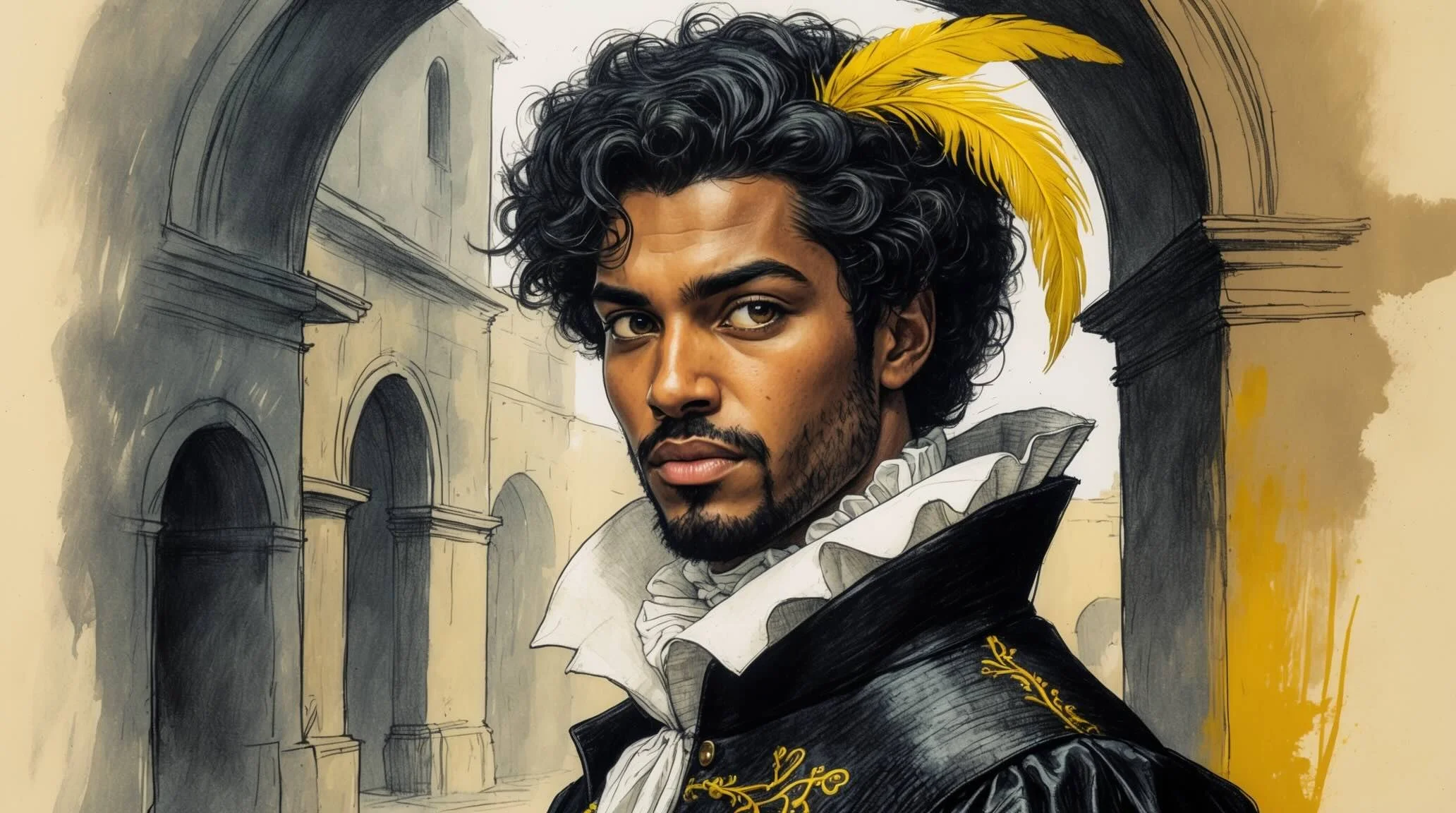
Character Profile – At a Glance
- Role: Kinsman to the Prince of Verona, friend of Romeo and Benvolio, and one of the play’s most brilliant comic voices.
- Key Traits: Witty, mercurial, bawdy, fearless, sceptical of love, and dangerously combative.
- The Core Conflict: Verbal genius and emotional volatility make him the play’s most charismatic figure. His impatience with Romeo’s love-sickness leads him into a fight he cannot afford.
- Key Actions: Mocks Romeo’s lovesickness; delivers the Queen Mab speech; gatecrashes the Capulet ball; teases the Nurse; confronts Tybalt when Romeo refuses; is killed under Romeo’s arm.
- Famous Quote:
"A plague o' both your houses! They have made worms' meat of me..."
(Act 3, Scene 1) - The Outcome: Killed by Tybalt in a brawl Romeo tries, and fails, to prevent. His death is the structural pivot of the play, transforming the comedy of the early acts into the tragedy of the later ones.
The Mercurial Wit
Mercutio is named for Mercury, the messenger god of speed, wit, eloquence, and quicksilver change, and the name is the character. His mind moves faster than anyone else’s on stage. He puns, fences with words, leaps from image to image, and never lets a phrase pass without unpacking it. Where Romeo speaks of love in dreamy abstractions, Mercutio drags every conceit back to earth, usually with a sexual joke.
Original
If love be rough with you, be rough with love;
Prick love for pricking, and you beat love down.
(Act 1, Scene 4)
Shakespeare Retold (Modern Verse)
If love is tough on you, get tough on love;
If love pricks you, then use your prick to beat it.
This is Mercutio’s mode in miniature: take the romantic posture seriously for one beat, then puncture it with a bawdy reversal. He is the play’s most determined enemy of sentimentality. Where his friends talk in sighs about the women they love, Mercutio turns love into a contest of wit, then into innuendo, then into impatience. His refusal to take Romeo’s romantic suffering at face value is part comic relief and part diagnosis: someone in this play needed to refuse the rhetoric, and Mercutio is the one Shakespeare assigned the job to.
Queen Mab and the Architecture of Dreams
The Queen Mab speech in A1S4 is Mercutio’s defining set-piece and one of the most famous monologues in Shakespeare. It begins as a brief joke (Romeo says he had a dream, Mercutio says dreamers lie) and spirals into an elaborate, brilliant, increasingly disturbing fantasy about the fairies’ midwife, who rides over sleepers’ bodies giving them dreams that match their desires.
Original
O, then, I see Queen Mab hath been with you.
She is the fairies' midwife, and she comes
In shape no bigger than an agate-stone
On the fore-finger of an alderman,
Drawn with a team of little atomies
Athwart men's noses as they lie asleep...
(Act 1, Scene 4)
Shakespeare Retold (Modern Verse)
Oh, then I see Queen Mab’s paid you a visit.
She is the fairies’ midwife, and she is,
In size, no bigger than a quart-cut gemstone
Worn on the finger of a counciler,
Drawn in a wagon pulled by tiny creatures
Across men’s noses as they lie asleep...
The speech is an extraordinary feat of imaginative momentum (Mercutio invents the wagon, the spider’s-leg spokes, the grasshopper-wing canopy, the cricket’s-bone whip) but as it builds, the comedy turns sour. Lovers dream of love, lawyers of fees, soldiers of cutting throats. By the end, Mercutio is talking about the hag who "presses" young women in their sleep, and Romeo has to interrupt him to bring him back. The speech reveals something the rest of the play only hints at: Mercutio’s wit is also a defence against something darker, and when his imagination is allowed to run free, the place it goes to is troubling.
The Friend Who Cannot Bear Sentiment
Mercutio’s relationship with Romeo is one of the play’s most tender and most volatile bonds. He genuinely loves his friend: that much is clear from his concern in A2S1 when he scours the orchard calling for him, and from the energy with which he resumes their banter when Romeo reappears. But he cannot bear Romeo’s romantic suffering, and his way of expressing love is to ridicule it.
Original
Why, is not this better now than groaning for love? Now art thou sociable, now art thou Romeo; now art thou what thou art, by art as well as by nature...
(Act 2, Scene 4)
Shakespeare Retold (Modern Verse)
Well, isn’t this more fun than groaning out of love? You’ve opened up again, back to being Romeo, back to your old self, by how you look as well as how you act...
What Mercutio does not know, what makes the moment poignant, is that the version of Romeo he is celebrating, the witty banter-trading Romeo of their old camaraderie, is already gone. Romeo is married. The friendship Mercutio is rejoicing in is, by the time of this scene, an illusion. It is one of the cruellest dramatic ironies in the play: the moment Mercutio thinks he has his friend back is the moment he has lost him for good.
The Death That Changes Everything
Mercutio’s death is the structural hinge of the entire play. Before it, the tone is that of a romantic comedy: masked balls, balcony scenes, a marriage played for charm. After it, the tone is unrelievedly tragic. And Mercutio knows what he is doing. His curse on the Capulets and Montagues, repeated three times as he dies, is the moment the play’s fatal trajectory is named aloud.
Original
A plague o' both your houses!
They have made worms' meat of me: I have it,
And soundly too: your houses!
(Act 3, Scene 1)
Shakespeare Retold (Modern Verse)
God damn to both your families!
They’ve turned me into worm food. Now, I’ve had it,
I have completely had it: get me inside!
The curse is the dying Mercutio’s clearest moment of moral clarity: he sees, as he is bleeding out, that he has been killed by a feud he had no real stake in. The Prince’s kinsman, a friend to a Montague killed by a Capulet, becomes the first major casualty of a quarrel that was never his. From this moment on, every death in the play can be traced back to the wound under Romeo’s arm. Mercutio dies still making puns ("ask for me to-morrow, and you shall find me a grave man"), and the joke lands the harder for being true.
"Shakespeare, having carried the part of Mercutio as far as he could, till his genius was exhausted, had killed him in the third Act, to get him out of the way. What shallow nonsense!"
— Samuel Taylor Coleridge, Lectures on Shakespeare, c.1813
Key Quotes by Mercutio
Quote 1
True, I talk of dreams,
Which are the children of an idle brain,
Begot of nothing but vain fantasy,
Which is as thin of substance as the air
And more inconstant than the wind...
(Act 1, Scene 4)
Shakespeare Retold (Modern Verse)
Yes, I talk of dreams,
And they are born out of a lazy mind,
Devoid of value, stoking up the ego
Which is devoid of substance, like thin air,
And fickler than the wind...
Quote Analysis: Mercutio’s coda to the Queen Mab speech is a sharp self-puncturing. Having spent fifty lines elaborating the most vivid fantasy in Shakespeare, he dismisses the whole thing as nonsense. The move is characteristic: he cannot let any sustained imaginative flight stand without undermining it. The lines also frame his attitude to Romeo’s romantic dreams: to Mercutio, all dreams are "thin of substance," including the dream of love.
More than prince of cats, I can tell you. O, he is the courageous captain of compliments. He fights as you sing prick-song, keeps time, distance, and proportion...
(Act 2, Scene 4)
Shakespeare Retold (Modern Verse)
He’s more than Tybalt from the folk tale, that’s for sure. He is the master at standing on ceremony. He fights like he is reading sheet music, keeping time, distance and rhythm...
Quote Analysis: Mercutio’s mockery of Tybalt as a textbook fencer (all rules, no instinct) is funny, but it foreshadows his own death. Mercutio dies because Tybalt’s by-the-book technique catches him in a moment when he himself has stopped paying attention to rules. His contempt for Tybalt’s formalism is partly what gets him killed; he never quite believes Tybalt is a real threat.
No, 'tis not so deep as a well, nor so wide as a church-door; but 'tis enough,'twill serve: ask for me to-morrow, and you shall find me a grave man.
(Act 3, Scene 1)
Shakespeare Retold (Modern Verse)
No, it’s not as deep as a well, nor as wide as a church door; but it’s enough to do the trick: Ask for me tomorrow, and you’ll find me in my grave.
Quote Analysis: One of Shakespeare’s greatest dying lines: a pun delivered by a man who knows he is dying. "A grave man" plays on its two meanings (serious / in a grave) and captures Mercutio’s whole character in five words. Even at the end, he refuses sentimentality. The joke is also a small, dignified act of courage: he is determined to die as he lived, with a quip on his lips.
Why the devil came you between us? I was hurt under your arm.
(Act 3, Scene 1)
Shakespeare Retold (Modern Verse)
Why on earth did you push to get between us? I was stabbed when you grabbed me.
Quote Analysis: Mercutio’s accusation against Romeo is one of the play’s most painful moments. Romeo intervened between the duellists with the best of intentions, trying to keep the peace, and his intervention is exactly what got Mercutio killed. The line establishes the bitter truth that Romeo will spend the rest of the play trying to outrun: that his love for Juliet, which made him refuse to fight Tybalt, has cost his best friend his life.
Key Takeaways
- Wit Against Sentiment: Mercutio is the play’s most committed enemy of romantic posturing, puncturing every conceit with a pun, an innuendo, or a deflation.
- Queen Mab Reveals More Than He Knows: His most famous speech begins as a joke and ends in a darker imagination. The wit is partly a defence against something he does not name.
- A Friendship Built on Banter: His love for Romeo is real but expressed through ridicule. The cruellest irony is that Mercutio dies celebrating a friendship Romeo has already left behind.
- The Pivot of the Tragedy: His death transforms the play’s tone irrevocably. Comedy becomes catastrophe, and every later death traces back to the wound under Romeo’s arm.
Study Questions and Analysis
What is the function of the Queen Mab speech?
The A1S4 speech is many things at once: a comic deflation of Romeo’s premonitions, a virtuoso display of Mercutio’s wit, and a glimpse into a darker imagination than the rest of the play has prepared us for.
It begins as a quick joke (dreams are nonsense) and develops into an elaborate fantasy that veers, by the end, into images of nightmares, wounds, and sexual violation. Romeo has to interrupt him.
The speech is important because it shows that Mercutio’s brilliance is not just decorative: it has weight, depth, and a darkness he himself seems unable to fully control.
Shakespeare gives the play’s most committed enemy of sentimentality the play’s most extended imaginative flight. The Queen Mab speech is, by line count, the longest single speech Mercutio delivers, and the contrast between the speaker’s anti-romantic posture and the speech’s elaborate fantasy is the play’s most direct piece of evidence that the anti-romantic posture is itself a performance. The man who insists dreams are "thin of substance" can, when his mind is allowed to run free, generate substance on a scale no other character in the play approaches.
The deeper argument is that the speech’s darkening trajectory, from courtiers’ kisses to lawyers’ fees to soldiers’ throat-cuttings to the hag who "presses" young women in their sleep, exposes what the comic surface is built over. The closing image is the speech’s most disturbing.
This is the hag, when maids lie on their backs,
That presses them and learns them first to bear,
Making them women of good carriage...
(Act 1, Scene 4)
Shakespeare Retold (Modern Verse)
It’s her, when virgin’s lay upon their backs,
That teaches them of sex and bearing children,
Preparing them as lovers and as mothers.
Mercutio’s wit, on this reading, is the brilliant performance that prevents him from acknowledging the darker imagination underneath it, and the function of the speech is to show the audience what the character’s daily self-presentation has been concealing.
Samuel Taylor Coleridge’s c.1813 Lectures on Shakespeare, quoted on this page, operates on exactly this ground. The Queen Mab speech is, on Coleridge’s reading, the play’s clearest evidence that Mercutio’s genius is far from "exhausted" by A3S1, and that the early death of such a character represents not narrative convenience but the sacrifice the tragedy requires.
Why is Mercutio's death the turning point of the play?
Up to A3S1, Romeo and Juliet has the rhythm of a romantic comedy: banter, balcony scenes, a wedding played for charm. Mercutio’s death changes everything.
Within minutes, Romeo kills Tybalt, is banished, and the marriage that should have ended the feud becomes the engine of catastrophe. Shakespeare uses Mercutio’s death to mark the moment when the play tips irrevocably into tragedy.
Every subsequent death (Tybalt, Paris, Romeo, Juliet, Lady Montague) flows from the wound under Romeo’s arm.
Mercutio is also the first character to name the play’s tragic logic aloud, in his curse "A plague o' both your houses." The curse is, in the play’s economy, performative: once spoken by a dying man, it operates as the formal designation of what the rest of the play will fulfil. Every subsequent catastrophe registers as the curse working its way through both households, and the arrangement is one of Shakespeare’s most pointed pieces of writing on the relationship between speech and consequence.
Harley Granville-Barker’s 1930 Prefaces to Shakespeare reading captures the function of the death exactly. Mercutio’s killing is "the moment that precipitates the essential change in Romeo," and the change in Romeo is "what determines the main tragedy." The death is not merely a sad incident in the play’s catalogue of losses but the dramatic mechanism by which Romeo himself is converted from the lyrical lover of A2S2 into the decisive killer of A3S1 and the ruthless figure of Act 5.
The further argument is one Samuel Taylor Coleridge developed in his Lectures on Shakespeare. The killing-off of so brilliant a character so early in the play has, on Coleridge’s reading, been catastrophically misread by earlier critics as evidence of Shakespeare’s authorial exhaustion. The truth, Coleridge insisted, is the opposite: Mercutio is killed because the tragedy requires the sacrifice of the play’s most life-affirming voice, and the decision is one of Shakespeare’s deepest pieces of dramatic engineering rather than a piece of authorial convenience.
How does Mercutio function as a foil to Romeo?
Mercutio is everything Romeo is not.
Where Romeo idealises love, Mercutio reduces it to physical comedy. Where Romeo speaks in sonnets, Mercutio speaks in puns. Where Romeo is willing to lay down his sword for love, Mercutio sees that refusal as cowardice.
The two friends represent opposing temperaments (Romeo all sentiment, Mercutio all scepticism) and the play stages their incompatibility through the Tybalt confrontation. Romeo’s romantic transformation is what costs Mercutio his life. The friendship is, in retrospect, already incompatible with the man Romeo has become.
Shakespeare gives the two friends almost no on-stage time together after Romeo’s transformation. The A2S4 reunion scene operates on Mercutio’s mistaken assumption that Romeo has recovered his old self. In fact, Romeo has acquired a new self that Mercutio will never meet. By A3S1, Mercutio is dead, and the friendship the audience has watched in Act 1 and early Act 2 is the maximum the play allows it.
The deeper argument is that the foil works in both directions. Mercutio’s scepticism would, in another play, have been the corrective voice that pulled Romeo back from the catastrophic absolutism of his choices. Romeo’s sincerity would, in another play, have been the moral register that softened Mercutio’s defensive cynicism. Neither correction occurs. The two friends operate on incompatible registers, and the play’s tragic engineering depends on the fact that neither voice can, finally, be heard by the other.
The further argument is that the foil reveals what each character lacks. Romeo lacks Mercutio’s wit and his capacity for self-puncturing: without Mercutio in the late play, no one can deflate Romeo’s elaborate romantic rhetoric, and the rhetoric runs unchecked through to the A5S3 death speech. Mercutio lacks Romeo’s capacity for sincere commitment: his anti-romantic posture is, on the Queen Mab evidence, the defensive register of a man who cannot let any imaginative flight stand without undermining it.
Is Mercutio a Montague?
No, and this is dramatically crucial.
Mercutio is kinsman to the Prince, not to either feuding house. He fights for Romeo out of friendship, not blood loyalty, which is what gives his dying curse its weight: "A plague o' both your houses." He has died for a quarrel that was never his.
The Prince’s later grief confirms what Mercutio’s death has already established.
And I for winking at your discords too
Have lost a brace of kinsmen: all are punished.
(Act 5, Scene 3)
Shakespeare Retold (Modern Verse)
And as I turned a blind eye to your fighting,
I’ve lost two of my cousins. We’re all punished.
The feud has now killed members of the city’s ruling family, and the Capulet-Montague private war has consequences neither family can contain.
The arrangement is exact. By making Mercutio neither a Montague nor a Capulet, Shakespeare gives the play its first piece of evidence that the feud is not, in fact, a private matter between two families. Mercutio’s death establishes that the violence has spilled beyond the houses that produced it, and the Prince’s intervention in the next sequence is the consequence: the state has now acquired its own grievance, and Romeo’s banishment in A3S1 is the legal expression of the city’s broader interest in ending the feud.
The deeper argument is that Mercutio’s status as the Prince’s kinsman makes his curse politically as well as personally weighted. "A plague o' both your houses," spoken by a Capulet or a Montague, would operate as a piece of internal family bitterness. Spoken by a member of the ruling family, it operates as a formal civic indictment. The curse names what the Prince’s subsequent rulings will enforce, and the alignment between Mercutio’s dying words and the Prince’s official sentence is one of Shakespeare’s most pointed pieces of writing on the relationship between private violence and public order.
Why does Mercutio fight Tybalt when Romeo refuses?
Mercutio reads Romeo’s refusal as a humiliating capitulation, and he says so directly before drawing on Tybalt himself.
O calm, dishonourable, vile submission!
Alla stoccata carries it away.
(Act 3, Scene 1)
Shakespeare Retold (Modern Verse)
What a pathetic, weak capitulation!
The first to draw his sword will win the fight.
His own honour, in his view, demands that someone respond to Tybalt’s challenge, and Romeo will not.
Underneath the honour code, though, there is also Mercutio’s psychological refusal to let Romeo’s strange new pacifism stand unchallenged. Something is wrong with his friend, and Mercutio’s response is to act it out himself.
The tragedy is that he steps in for Romeo at the exact moment Romeo’s reasons for refusing have become the most important thing in his life: reasons Mercutio knows nothing about.
Shakespeare gives Mercutio no access to the information that would have changed his response. Romeo cannot explain his refusal without revealing the secret marriage. Mercutio therefore interprets the refusal within the only framework available to him: the honour code of male Verona, in which a challenge unrefused is a piece of cowardice that requires correction by a friend.
The deeper argument is that Mercutio’s intervention is not, on his own framework, an error. By the standards of the masculine-honour register he has operated within throughout the play, his response is exactly what friendship demands: the friend whose honour is compromised by refusing a challenge must be defended by a friend willing to take the challenge in his place. The framework is internally coherent. The catastrophe is that the framework cannot accommodate the new register Romeo has entered.
The further irony is that Mercutio’s contempt for Tybalt’s formalism, the A2S4 mockery of him as "the courageous captain of compliments" who fights by sheet music, is precisely what produces his death. Mercutio underestimates Tybalt because Tybalt’s technique offends his aesthetic. He engages the duel without the caution Tybalt’s competence actually warrants, and Tybalt’s textbook technique catches Mercutio at the moment Romeo’s intervention takes his attention off his guard. The death is, in this sense, the consequence of the contempt: the wit who could not believe Tybalt was a real threat is killed by the threat he refused to register.
What does Mercutio's bawdy humour reveal about his character?
Mercutio’s relentless sexualisation of every conversation, from Queen Mab to the medlar tree to his teasing of the Nurse, has often been read as misogyny, but it is more usefully read as Mercutio’s defence mechanism.
The medlar passage in A2S1 is the most concentrated example. Calling out to Romeo after he has slipped over the orchard wall, Mercutio takes a brief horticultural conceit and pushes it as far as it will go.
Romeo, that she were, O, that she were
An open et caetera, thou a poperin pear!
(Act 2, Scene 1)
Shakespeare Retold (Modern Verse)
Oh Romeo, if only that she was
That open fruit and you a phallic pear!
Sex is one of the few topics his wit cannot be defeated by, and he returns to it whenever a conversation threatens to become sincere. When Romeo speaks of love, Mercutio responds with anatomy. When the Nurse appears, Mercutio reduces her to bawdy songs.
The pattern is so consistent it suggests something the play does not name directly: that Mercutio’s hostility to romantic feeling may be the protective coating around a vulnerability he never admits to.
Shakespeare gives Mercutio no private moment in which the defensive register is dropped. Every speech Mercutio delivers in the play operates within the same anti-romantic, anti-sincere mode, and the consistency is itself the evidence. A character whose register never varies is a character whose register is doing protective work, and the work the wit is protecting against is the only register the wit refuses to enter.
The deeper reading is that the Queen Mab speech is the play’s clearest piece of evidence on what the wit is defending against. The fantasy of A1S4 darkens, by its closing lines, into images of nightmares and sexual violation. Romeo has to interrupt to bring Mercutio back from where his imagination has led him. The argument is that Mercutio’s wit operates as the container for an imagination that, when released, generates the darker images the comic surface has been concealing.
The further argument is that Mercutio’s bawdiness is also a piece of social positioning. The Prince’s kinsman, operating in a city organised by family loyalty, has aligned himself with a young Montague through friendship rather than blood: a position that depends on the maintenance of the masculine-honour register in which the friendship is articulated. The bawdy humour is, on this reading, the cement of that masculine register, and the wit that defends against sincerity is also the wit that secures the social arrangement Mercutio’s friendship with Romeo depends on.
The deeper indictment the play permits is that the defensive register is also what kills him. The wit who could not register sincerity could not register the change in Romeo, and the failure to register the change is the condition of the A3S1 intervention that produces his death.
What is the significance of his dying line "ask for me tomorrow, and you shall find me a grave man"?
It is one of Shakespeare’s greatest puns and one of his greatest dying lines.
The wordplay on "grave" (serious, and in a grave) captures Mercutio’s whole character in a single phrase: a man who refuses sentimentality even at the moment of his death.
The line also serves a structural function. By making his last act a joke, Mercutio insists that his death be witnessed in his own register, not ennobled or sanctified. He dies on his own terms, as fully himself as in any earlier scene. It is the most dignified end Shakespeare could have given him, precisely because it refuses dignity.
Shakespeare denies Mercutio any final piece of rhetorical seriousness. A dying speech that registered grief, fear, or moral self-reckoning would have converted Mercutio’s death into the kind of tragic farewell the play’s later catastrophes will receive. Instead, the pun preserves the comic register through to the final breath, and the argument is that the wit is not, finally, separable from the character: Mercutio cannot be ennobled by death because Mercutio cannot be ennobled at all, and the refusal of ennoblement is itself the completeness of the portrait.
The deeper argument is that the line operates as the play’s last piece of evidence on what is being lost. Every subsequent death in the play receives some piece of elaborate rhetorical apparatus: Romeo’s elegiac soliloquy in A5S3, Juliet’s brief but deliberate "happy dagger," even Paris’s dying request to be laid beside Juliet. Mercutio’s death receives a pun. The contrast names what the play’s other deaths cannot replicate: the voice that operated outside the play’s romantic-tragic register is the voice the rest of the play cannot recover, and the pun is the marker of the irreplaceability.
Samuel Taylor Coleridge’s reading, quoted on this page, operates on exactly this ground. Earlier critics had read Mercutio’s death as evidence that Shakespeare’s invention had been exhausted by the character and that the early death was a piece of authorial convenience. Coleridge’s response, "What shallow nonsense!", names the argument the dying pun itself articulates: Mercutio is killed at the height of his powers, the genius is intact at the moment of death, and the loss the play registers is the loss of the voice the dying pun was the last piece of evidence for.