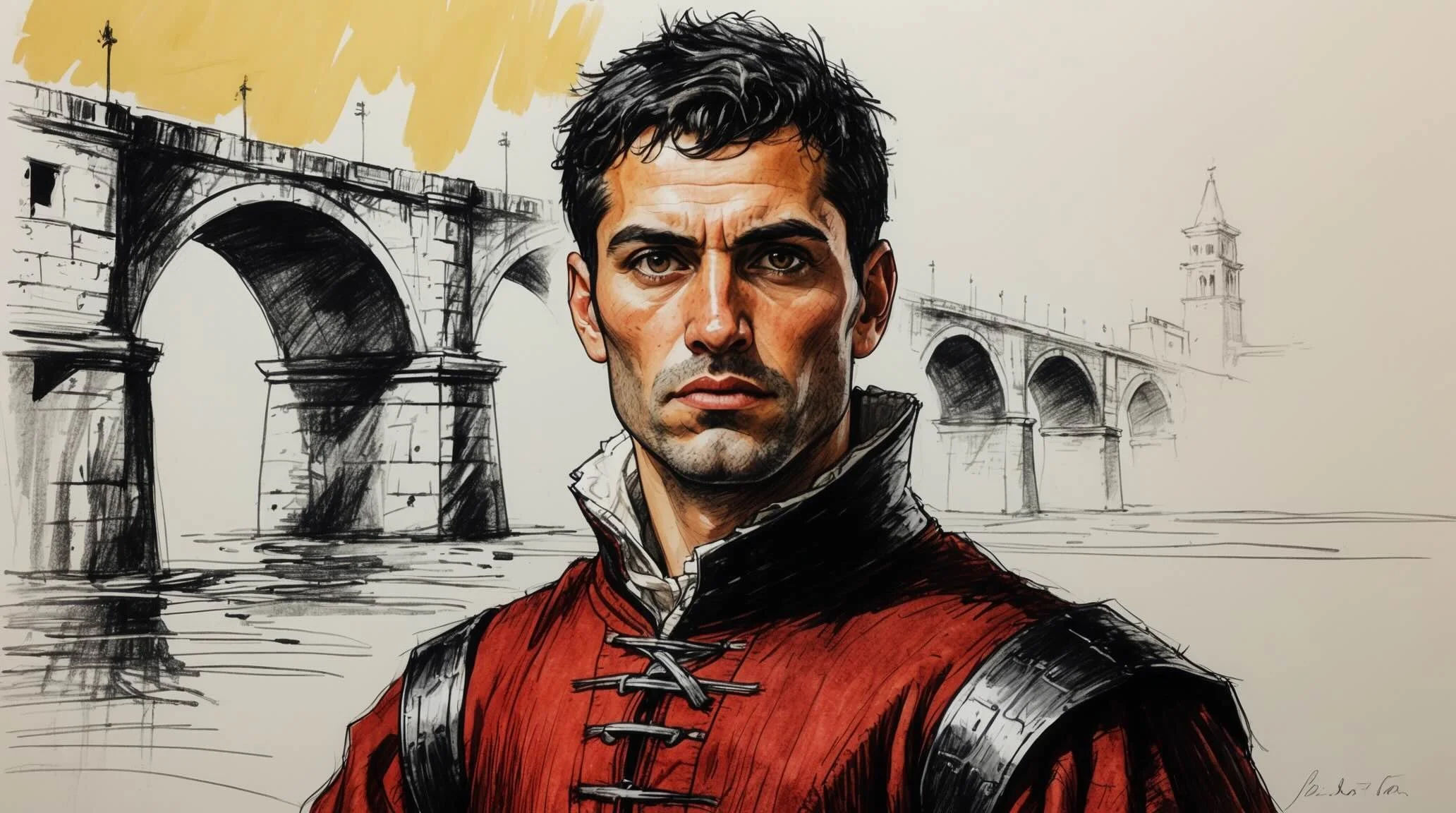
Character Profile – At a Glance
- Role: Nephew to Lord Montague, cousin and closest confidant to Romeo, friend to Mercutio.
- Key Traits: Peaceable, rational, loyal, observant, and diplomatic.
- The Core Conflict: Bound by family loyalty to the Montagues, yet temperamentally opposed to the violence that loyalty demands. He tries to keep the peace in a Verona that punishes restraint.
- Key Actions: Tries to break up the opening brawl; counsels Romeo to forget Rosaline and proposes crashing the Capulet ball; warns Mercutio to retire before Tybalt arrives; reports the deaths of Mercutio and Tybalt to the Prince.
- Famous Quote:
"I do but keep the peace: put up thy sword,
Or manage it to part these men with me."
(Act 1, Scene 1) - The Outcome: After his report to the Prince in Act 3, Benvolio vanishes from the play entirely. Many read the silent absence as the failure of reason in a city consumed by passion.
The Voice of Reason in a Violent City
Benvolio’s name, derived from the Italian bene volere ("to wish well"), is a transparent signal of his dramatic function. He is the rational counterweight to the tribal hatred that defines Verona, the antithesis of his Capulet opposite Tybalt, whose name connotes feline aggression. Where Tybalt sees the very word "peace" as an insult, Benvolio sees it as a moral imperative. The opening brawl establishes the contrast within its first thirty lines. Benvolio enters trying to separate the warring servants ("Part, fools!"), and when Tybalt arrives with sword already drawn, Benvolio turns to him and attempts to enlist him in the same project.
Original
I do but keep the peace: put up thy sword,
Or manage it to part these men with me.
(Act 1, Scene 1)
Shakespeare Retold (Modern Verse)
I’m trying to keep the peace. Put down your sword,
Or use it to break up these men with me.
The lines propose a moral grammar in which peace is the precondition for sword-drawing, and the weapon exists only to separate fighters rather than to join them. The position is sensible, civilised, and characteristic of the play’s named-for-good-will character. Tybalt’s response in the next breath ("What, drawn, and talk of peace! I hate the word…") establishes the play’s central dynamic: in Verona, the peacemaker is always outnumbered, and his moral grammar has no operative authority over the city’s violence.
The Sympathetic Cousin and Confidant
Long before Friar Laurence takes on the role of Romeo’s adviser, that role belongs to Benvolio. He is the first to notice Romeo’s lovesick withdrawal, the first to coax the cause from him, and the first to offer a remedy. His approach to love is unromantic and pragmatic: a passion is an infection, and the cure is exposure to alternatives. It is Benvolio who proposes the fateful plan of crashing the Capulet ball, unwittingly setting the entire tragedy in motion.
Original
Tut, man, one fire burns out another's burning,
One pain is lessened by another's anguish;
Turn giddy, and be holp by backward turning;
One desperate grief cures with another's languish:
Take thou some new infection to thy eye,
And the rank poison of the old will die.
(Act 1, Scene 2)
Shakespeare Retold (Modern Verse)
A fresh fire puts out one that burnt before,
A pain stops when a new pain has begun;
When giddy, spin the other way some more;
An awful grief is cured when new ones come.
Observe some women, then you might be tempted,
And all your lovesick pain might be exempted.
Benvolio’s counsel reveals him as essentially comic in disposition: the kind of friend who believes heartbreak yields to sense and time. The tragic irony, of course, is that his prescription works: Romeo does find a new beauty to displace Rosaline. But Benvolio cannot foresee that the cure will prove deadlier than the disease, because he understands neither the ferocity of Romeo’s nature nor the depth of the family feud his cousin is about to cross.
The Witness Whose Words Cannot Save
Benvolio’s final significant role is as a narrator of catastrophe. He warns Mercutio to retire from the public square as the day grows hot and the Capulets approach, perhaps the most prudent piece of advice in the play, and the most casually ignored. Moments later he is left to deliver an exhausted account of Mercutio’s killing and Romeo’s revenge, fighting to save Romeo’s life through the only weapon he has ever trusted: clear, honest speech.
Original
I pray thee, good Mercutio, let's retire:
The day is hot, the Capulets abroad,
And, if we meet, we shall not scape a brawl;
For now, these hot days, is the mad blood stirring.
(Act 3, Scene 1)
Shakespeare Retold (Modern Verse)
I tell you, good Mercutio, let’s go home:
It’s hot, and Capulets are everywhere,
And, if we meet, we won’t escape a fight;
In days as hot as this, it makes one’s blood boil.
After this scene, Benvolio disappears entirely. Shakespeare neither kills him nor explains his absence: he simply ceases to be present in a play that has moved beyond the reach of reason. Many critics read this silence as deliberate. Once the tragedy escalates from public brawl to private vendetta, the peacemaker has no further role to play. His exit marks the point at which Verona becomes ungovernable by sense.
Key Quotes by Benvolio
Quote 1
Part, fools!
Put up your swords; you know not what you do.
(Act 1, Scene 1)
Shakespeare Retold (Modern Verse)
Break this up, you idiots!
Put your swords away; you don’t know what you’re doing.
Quote Analysis: Benvolio’s first line in the play defines him instantly. The biblical resonance ("they know not what they do") elevates a street brawl into a moral parable about senseless violence, and frames Benvolio as the play’s voice of conscience: a voice that the action will repeatedly drown out.
Take thou some new infection to thy eye,
And the rank poison of the old will die.
(Act 1, Scene 2)
Shakespeare Retold (Modern Verse)
Observe some women, then you might be tempted,
And all your lovesick pain might be exempted.
Quote Analysis: Benvolio treats love as an illness curable by distraction: a pragmatic, unsentimental view that contrasts sharply with Romeo’s all-consuming passions. The advice succeeds in ways Benvolio could never have predicted. Romeo does indeed transfer his affections, but to Juliet, sealing the tragedy.
I pray thee, good Mercutio, let's retire:
The day is hot, the Capulets abroad,
And, if we meet, we shall not scape a brawl;
For now, these hot days, is the mad blood stirring.
(Act 3, Scene 1)
Shakespeare Retold (Modern Verse)
I tell you, good Mercutio, let’s go home:
It’s hot, and Capulets are everywhere,
And, if we meet, we won’t escape a fight;
In days as hot as this, it makes one’s blood boil.
Quote Analysis: Benvolio’s prophetic warning is the most unheeded prudence in the play. The image of "mad blood stirring" in the heat captures both the literal weather of Verona and the metaphorical climate of the feud: a city that boils into violence whenever rivals cross paths. His good sense arrives moments before catastrophe, and is brushed aside by Mercutio’s bravado.
Tybalt, here slain, whom Romeo's hand did slay;
Romeo that spoke him fair, bade him bethink
How nice the quarrel was, and urged withal
Your high displeasure...
(Act 3, Scene 1)
Shakespeare Retold (Modern Verse)
Tybalt, lying here dead, was killed by Romeo;
Romeo politely spoke, and urged he think
How trivial the quarrel was, and spoke of
How angry you would be.
Quote Analysis: Benvolio’s report to the Prince is his last meaningful contribution to the play: a measured, almost legal account that downplays Romeo’s culpability while remaining substantively truthful. It is the final demonstration of his faith in reasoned speech, and the moment after which he is no longer needed in a story that has slipped beyond reason’s reach.
Key Takeaways
- The Peacemaker by Name and Nature: Benvolio’s name means "good will" in Italian. He is the play’s rational moral compass, the one Montague who consistently chooses peace over honour.
- Foil to Tybalt: Where Tybalt embodies the feud’s pride, Benvolio embodies its only cure. He represents restraint, reason, and willingness to step between drawn swords.
- Unwitting Catalyst: His pragmatic counsel to Romeo and his suggestion to crash the Capulet ball set the entire tragedy in motion. Even good sense can produce catastrophic outcomes in a broken system.
- The Silent Exit: His unexplained disappearance after Act 3 is one of the play’s most quietly devastating choices. The voice of reason simply has nowhere to stand once the tragedy turns inward.
Study Questions and Analysis
What does Benvolio's name reveal about his role in the play?
His name comes from the Italian bene volere, meaning "to wish well" or "good will."
Shakespeare often uses names to signal function, and Benvolio’s is among the most direct: he is the character whose entire purpose is benevolence.
The name stands in deliberate opposition to Tybalt, whose name suggests feline aggression. Together, the two men frame the rational and irrational poles of Verona’s young male population.
Shakespeare places these two named-for-function characters in the play’s first scene in immediate succession. Benvolio enters in A1S1 trying to part the brawling servants. Tybalt enters within twenty lines and immediately escalates. The audience meets the named-as-peacemaker and the named-as-warmaker in their characteristic registers before any of the play’s principal lovers have appeared. The encounter sets the moral architecture within which the love story will operate.
The name-as-function convention runs through the play’s minor characters as a piece of dramatic shorthand. Mercutio is the mercurial figure named for Mercury. Tybalt is the cat-named warrior. Benvolio is the well-wisher. The convention lets the audience read the play’s moral geometry through its character roster before any individual character is given the chance to perform his function in extended action.
Benvolio’s name is, in the end, evidence of what the play’s moral architecture lacks. A city in which the named-for-good-will character is the most marginal Montague (peripheral to the love story, gone after A3S1, never given a soliloquy or extended scene) is a city whose moral architecture has reduced good will to a piece of structural decoration. The name names what Verona is missing.
How does Benvolio function as a foil to Tybalt?
Benvolio and Tybalt meet in the opening brawl as perfect inversions.
Benvolio draws his sword to part the fighters. Tybalt draws his to join them. Benvolio appeals to reason. Tybalt’s response is total.
What, drawn, and talk of peace! I hate the word,
As I hate hell, all Montagues, and thee:
Have at thee, coward!
(Act 1, Scene 1)
Shakespeare Retold (Modern Verse)
What, with a sword, talk peace! I hate the word,
As I hate hell, all Montagues, and you:
I’ll fight you, coward!
The contrast sets up the play’s central tension. Verona’s young men are evenly split between those who would heal the feud and those who would feed it. The latter consistently win.
The A1S1 brawl is the play’s first piece of evidence on the moral geometry of Verona’s young men. The binary opposition between the two named-for-function figures lands before the principal lovers appear and before the central plot has begun. The rest of the play will be read against the framework the brawl establishes.
The foil works on more than the surface. Benvolio’s restraint and Tybalt’s aggression are not just individual temperaments but two different relationships to the feud’s logic. Benvolio still has access to a moral framework outside the feud, the framework in which "peace" is a virtue and "violence" is a problem to be solved. Tybalt has internalised the feud so completely that the outside framework is no longer available to him. Peace, on Tybalt’s terms, is equivalent to hell.
The play does not, finally, vindicate Benvolio’s framework. The peacemaker survives the A3S1 catastrophe; the warmaker dies in it. But the survival is not a moral success. Benvolio’s framework has not prevented the catastrophe, has not even slowed it. The reasonable-restraint framework is inadequate when applied to a moral situation that has, by the play’s opening, already passed beyond what the framework was designed to address.
The binary the opening brawl establishes is, in the end, a false binary. The choice between Benvolio’s framework and Tybalt’s framework is not the choice that will determine the play’s outcome. The outcome is determined by the wider arrangement within which both characters operate, and the arrangement makes both their frameworks inadequate.
How does Benvolio's advice about Rosaline drive the plot?
Benvolio’s pragmatic prescription is that one infatuation is best cured by exposure to another.
By giving liberty unto thine eyes;
Examine other beauties.
(Act 1, Scene 2)
Shakespeare Retold (Modern Verse)
By giving freedom to your eyes to wander
And look at other beauties.
This leads directly to his suggestion that Romeo gatecrash the Capulet ball and compare Rosaline against other Veronese beauties.
The advice succeeds, but in a way Benvolio cannot foresee. Romeo’s eye is indeed turned, but to Juliet, daughter of his family’s enemy. The tragedy is set in motion not by malice but by sensible counsel applied to an unstable temperament.
Shakespeare gives the play’s principal plot-engine to its most well-intentioned minor character. The ball is the location at which the lovers will meet. The suggestion to crash it comes from Benvolio. The suggestion is offered as remedial counsel for what Benvolio reads as a piece of curable lovesickness. The well-wisher’s advice, offered in good faith, produces the situation the catastrophic plot requires.
On his own terms, the advice is exactly right. A young man whose attachment to an unresponsive woman has produced the melancholic withdrawal Romeo displays in A1S1 would, by any reasonable Renaissance medical or moral framework, benefit from the kind of redirective exposure Benvolio prescribes. The advice is not foolish or short-sighted. It is the application of the period’s standard remedial logic to a situation that logic was designed to address.
The irony operates inside this exactness. The advice produces the catastrophe not because it is wrong but because the situation to which it is applied is not, in the end, the situation the advice was designed to address. Romeo’s attachment to Rosaline is the kind of curable lovesickness Benvolio diagnoses. Romeo’s attachment to Juliet, when it emerges, is something different in register: the absolute commitment the play’s tragic structure requires. The advice succeeds in displacing the first attachment, but the displacement produces a new attachment whose register is comprehensively outside Benvolio’s framework.
The catastrophe is not the failure of Benvolio’s advice but its success. The advice was designed to produce a new object of attachment, and it produced one. The new object happened to be the daughter of the family the Montagues were feuding with. The feud’s logic infects every other operative framework in the city. None can be operated within Verona without producing the catastrophic outcome the feud’s broader logic was always preparing.
Why does Benvolio disappear from the play after Act 3?
Shakespeare offers no explanation, and the silence is itself meaningful.
Once Romeo is exiled and the tragedy moves from the public square into private chambers (the Capulet bedroom, the Friar’s cell, the tomb), there is no role left for a character whose function is to mediate public violence.
Many critics read his vanishing as symbolic. The voice of reason has no place in a story that has surrendered to fate and passion.
Shakespeare gives Benvolio’s exit no on-stage acknowledgement. The character who has appeared throughout the play’s first three acts (A1S1, A1S2, A1S4, A2S1, A2S4, A3S1) simply stops appearing. No other character refers to his absence or asks where he has gone. The exit is total. The silence is total. The absence of any in-play acknowledgement is itself the structural evidence of how completely the play has moved beyond the register within which Benvolio operated.
The exit marks the tragedy’s turn inward. The first three acts have been organised around public action (the street brawl, the masked ball, the public square confrontation, the Prince’s interventions) and Benvolio has functioned within that public register as the figure who tries to mediate, witness, and report. Acts 4 and 5 operate in a different register entirely: the private chamber, the closed cell, the sealed tomb. The public-mediation role has no functional space, and the character whose existence consisted in the role cannot continue.
Other characters die in the tragedy (Mercutio, Tybalt, Paris, Romeo, Juliet, Lady Montague) and their deaths are marked, mourned, and processed within the play’s dramatic economy. Benvolio’s disappearance is unmarked and unmourned. The play’s named-for-good-will character is given its quietest exit, and the quietness is itself the argument. The city in which Benvolio operated has, by A3S1, ceased to exist. The new city the catastrophe is producing has no place for him.
The figure who tries to operate within a moral framework the action has outgrown does not, by the play’s logic, get the dignity of an on-stage exit. He simply stops being available. The cessation is the play’s verdict on what his framework has become.
How reliable is Benvolio's report to the Prince?
Benvolio’s account is substantively accurate but selectively framed.
He emphasises Romeo’s attempts to keep the peace and Tybalt’s aggression, while glossing over the speed and lethality of Romeo’s revenge after Mercutio’s death.
Lady Capulet immediately accuses him of partiality, and she has a point: Benvolio is a Montague defending his cousin.
He is a kinsman to the Montague;
Affection makes him false; he speaks not true:
(Act 3, Scene 1)
Shakespeare Retold (Modern Verse)
He is a kinsman to the Montague;
Through loyalty, he lies; this isn’t true.
Yet the Prince accepts his testimony, perhaps because Benvolio’s reputation for honesty has been built across the play.
The A3S1 report is one of the play’s longest single speeches: nearly thirty lines of detailed narrative reconstruction. It operates in the legal-forensic register the Prince’s investigation requires. Benvolio is not fabricating. He is selecting. The events he describes occurred. The framing he gives them serves Romeo’s case rather than offering a comprehensive account.
The speech is the play’s clearest evidence of what Benvolio’s character finally consists in. The peacemaker who attempted to part the opening brawl, who counselled Romeo about Rosaline, who warned Mercutio about the hot day: this is the same character who, having watched Mercutio die and Romeo kill Tybalt, immediately builds the legal-rhetorical defence that will save Romeo from execution. Benvolio’s restraint has never been moral abstraction. It has been the operative register of a character whose primary loyalty is to his cousin.
Lady Capulet’s objection names the fact the speech itself cannot acknowledge. The speech is given by a partial witness who has a substantive personal interest in the outcome. The conventions of legal-forensic narrative permit selective emphasis without producing literal falsehood. The partial witness produces the partial account the conventions allow.
The Prince’s acceptance of the speech operates on grounds the play does not fully articulate. The Prince has presumably accumulated enough evidence of Benvolio’s general reliability to weight the speech accordingly. He has an institutional preference for the more lenient sentence Benvolio’s framing makes available. He has the need to produce a resolution the public order requires. The acceptance is therefore not the consequence of Benvolio’s straightforward truthfulness but the product of the institutional context.
Benvolio’s reliability is, in the end, a matter of structural function rather than personal character. His loyalty to peace was always partial, operative in the public register where peace was an institutional good, suspended in the moments where his cousin’s life was at stake. The A3S1 speech is the moment the partiality is finally exposed.
What does Benvolio's failure to prevent violence tell us about Verona?
Benvolio embodies everything an ordered society should reward: prudence, fairness, willingness to intervene, faith in reasoned speech.
That none of these qualities saves anyone (not Mercutio, not Tybalt, not Romeo, not Juliet) is a damning verdict on Verona itself.
The city is structured so that violence wins by default. The peacemaker can only ever delay catastrophe. He cannot prevent it.
Shakespeare gives Benvolio every opportunity the conventional dramatic framework would require for the peacemaker’s success, and allows him to fail at each one. He tries to part the brawl in A1S1; the brawl continues. He counsels Romeo to forget Rosaline in A1S2; the counsel succeeds but produces the worse attachment. He warns Mercutio to retire in A3S1; the warning is ignored and Mercutio dies. He reports the catastrophe to the Prince later in the same scene; the report produces banishment rather than execution but does not prevent what follows.
The failures are not the failures of Benvolio’s individual capacity. They are the failures of the city the capacity operates within. The advice is good. The timing is sound. The framework is the conventional framework the period’s moral economy endorses. The failures are not the advisor’s but the framework’s application to a city whose arrangement has, by the play’s opening, been organised around the feud’s logic rather than around the framework the peacemaker represents.
The play’s broader catalogue of failed peacemakers confirms the argument. Friar Laurence’s clerical framework fails. The Prince’s civic framework fails. Lord Capulet’s social framework at the ball fails to prevent Tybalt’s deferred response. Benvolio’s reasoned-restraint framework fails. By A5S3, the play has shown the failure of every available framework for managing the feud’s logic. Verona has, by the play’s opening, already become a city in which no framework can produce the intervention the catastrophe requires.
The city is, in this sense, the play’s principal antagonist. The individual characters operate within Verona’s broader arrangement. The arrangement produces the physics within which the catastrophe is inevitable. The catastrophe is therefore not the consequence of any individual character’s choices but the consequence of the city itself.
How do Benvolio's relationships with Romeo and Mercutio differ?
With Romeo, Benvolio is a patient older-brother figure: listening, counselling, drawing him out of his moods. His A1S1 account to Lord Montague of how he tried to approach the melancholy Romeo captures this register exactly.
Towards him I made, but he was ware of me
And stole into the covert of the wood:
I, measuring his affections by my own,...
(Act 1, Scene 1)
Shakespeare Retold (Modern Verse)
I walked towards him, but he spotted me
And darted off to hide within the trees.
I guessed that, based on how I felt myself,...
The lines show the relationship in miniature. Benvolio notices, approaches, and tries to read his cousin’s mood by feeling-projection. Romeo flees from the very attentiveness Benvolio is offering. The pattern recurs throughout the first three acts.
With Mercutio, he is the straight man to a brilliant performer. He is often outpaced by Mercutio’s wit but provides the grounded presence that allows Mercutio to spark.
The two relationships reveal Benvolio’s adaptability. He is whatever each friend needs him to be, sacrificing his own dramatic colour to serve as a stabilising presence in a volatile group.
Shakespeare gives Benvolio no scene of his own. There is no soliloquy, no extended speech in which the audience hears his interiority directly, no moment in which his preferences operate apart from the needs of the friend he is attending. Benvolio exists, on the play’s evidence, in relation to others. The relation is always one of service rather than expression. The character is the play’s clearest evidence of what unconditional friendship in Verona has been reduced to.
The two friendships operate in different registers because the two friends require different registers. Romeo’s lovesickness in A1S1 requires the counselling-and-drawing-out register. Mercutio’s mercurial wit in A2S4 requires the straight-man-and-grounding register. Benvolio adapts to both because adaptation is the operative principle of his existence. Some characters in the play’s social economy are constituted entirely by the relational functions they perform, and this constitution is the structural condition that produces the disappearance after A3S1.
The adaptability is, in the end, the play’s quietest piece of evidence on what Benvolio has cost himself. The character who is whatever each friend needs him to be has no available register for what he himself might need. The play offers no scene in which Benvolio expresses a preference, articulates a desire, or registers a personal stake in the outcomes the action is producing. The character who has organised his existence around the service of others has, by A3S1, no available register for the kind of personal continuation the play’s tragic register would require.
His adaptability is the condition both of his usefulness and of his eventual erasure. The friend who served Romeo and Mercutio so reliably is the friend the play cannot, in its catastrophic register, find a use for. The absence of personal-expressive register that made the service possible is the absence that makes the post-A3S1 disappearance possible. The character whose existence was organised around relation cannot, by the play’s logic, persist when the relations have been catastrophically disrupted.