
Friar Laurence
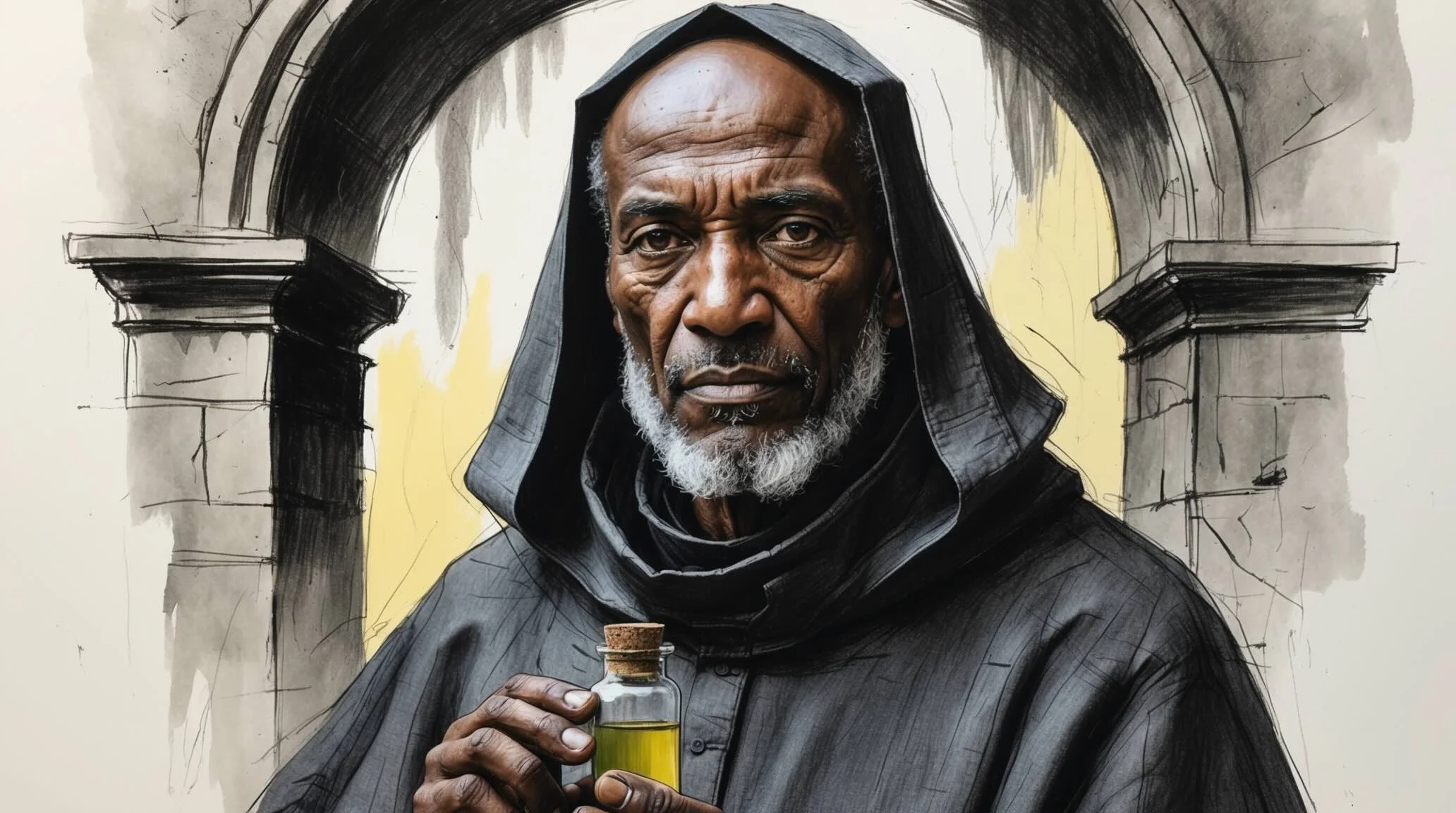
Character Profile – At a Glance
- Role: Franciscan friar in Verona, herbalist, confessor and trusted adviser to Romeo, and the priest who marries Romeo and Juliet in secret.
- Key Traits: Wise, well-meaning, philosophically inclined, pragmatically political, and increasingly out of his depth.
- The Core Conflict: A holy man who believes he can engineer peace through secret marriage and chemical deception; the plans unravel with catastrophic speed.
- Key Actions: Marries Romeo and Juliet in secret; shelters Romeo after Tybalt’s death; concocts the sleeping potion to fake Juliet’s death; fails to ensure his letter reaches Romeo in Mantua; flees the Capulet tomb at the moment Juliet wakes.
- Famous Quote:
"These violent delights have violent ends
And in their triumph die, like fire and powder,
Which as they kiss consume."
(Act 2, Scene 6) - The Outcome: Survives the catastrophe to deliver a full confession to the Prince and offer his own life if his judgement is found at fault.
The Herbalist Philosopher
Friar Laurence is introduced not in his cell or his pulpit, but in a garden at dawn, gathering herbs and meditating on the dual nature of natural things. The opening soliloquy of A2S3 is one of the most thematically loaded in the play: a sustained reflection on how the same plant can heal or kill depending on how it is used, a principle the Friar will spend the rest of the play applying with mixed success to human beings.
Original
Within the infant rind of this small flower
Poison hath residence and medicine power:
For this, being smelt, with that part cheers each part;
Being tasted, slays all senses with the heart.
Two such opposed kings encamp them still
In man as well as herbs, grace and rude will...
(Act 2, Scene 3)
Shakespeare Retold (Modern Verse)
Within the new-formed petals of this flower
Lives poison, yet it has medicinal power:
For if you smell it, that’s the cheerful part;
But if you taste it, it will stop your heart.
These two opposing forces both appear
In men as well as herbs, kind and severe...
The speech establishes the Friar’s worldview: nature contains both poison and remedy, men contain both grace and rude will, and the difference lies in measure and timing. This is the philosophical foundation of every decision he will make in the play. He believes he can manage the doses: that a secret marriage can be the medicine that cures the Verona feud, that a sleeping potion can be the trick that buys Juliet time. The play’s tragedy is, in part, the tragedy of a thoughtful man who has misjudged how violently his ingredients will react.
The Reluctant Conspirator Turned Architect
When Romeo arrives at the Friar’s cell at dawn, not yet sleep-deprived but already engaged to Juliet, the Friar’s response is bemused mockery, not approval. He notes that Romeo had been weeping over Rosaline a few hours earlier and observes drily that young men’s love lies more in their eyes than in their hearts. But within twenty lines, he agrees to perform the marriage, and his reasoning is political rather than romantic.
Original
But come, young waverer, come, go with me,
In one respect I’ll thy assistant be;
For this alliance may so happy prove,
To turn your households’ rancour to pure love.
(Act 2, Scene 3)
Shakespeare Retold (Modern Verse)
Come with me, wavering youth, without resistance,
For there’s a way I might be some assistance;
This union might have a happy ending
By leading to both houses’ hatred mending.
The justification is striking. The Friar agrees to the marriage not because he believes in the love, but because he believes in the reconciliation it might force. The phrase "in one respect" is significant: he can identify only one good reason, and that reason is civic, not religious. From this moment, the Friar becomes the play’s most active engineer: the man who marries the lovers in private hoping to publish the news once the political climate changes. His own warning against haste ("Wisely and slow; they stumble that run fast") is delivered as he hurries off to perform a secret wedding inside the same scene.
The Counsellor of Patience to Lovers Who Have None
The Friar’s philosophical mode reaches its sharpest expression as Romeo and Juliet meet to be married, when he warns the young lovers, to no apparent effect, that the violence of their delight contains the seed of its own destruction.
Original
These violent delights have violent ends
And in their triumph die, like fire and powder,
Which as they kiss consume: the sweetest honey
Is loathsome in his own deliciousness
And in the taste confounds the appetite:
Therefore love moderately; long love doth so;
Too swift arrives as tardy as too slow.
(Act 2, Scene 6)
Shakespeare Retold (Modern Verse)
Infatuation often ends in pain,
And when it ends, like gunpowder and fire,
That lust will self-combust. Delicious honey
Is nauseating due to being tasty,
And quickly eating too much makes you sick.
And so, take time with love, so love can last;
For love too slow is as bad as love too fast.
The speech is one of Shakespeare’s clearest statements of the play’s central warning about haste. Fire and gunpowder consume in the kissing; honey nauseates by its sweetness; love must be moderate to last. It is wise counsel, and it is delivered as he is about to marry two lovers who have known each other for less than a day. The Friar diagnoses the disease with perfect clarity and then proceeds to administer it. The dramatic irony is one of the most poignant in the play: he sees the danger, names it precisely, and acts as if naming it were enough to defuse it.
The Plan That Fails
When Juliet appears at the cell with a knife at her own throat, threatening suicide rather than marry Paris, the Friar improvises the plan that will prove the play’s undoing. The sleeping potion is bold, ingenious, and characteristic of his herbalist mind: a controlled, measured dose of apparent death. The plan requires only one external dependency: that Romeo, in Mantua, receives a letter explaining what has been done.
Original
Stay, then; I’ll go alone. Fear comes upon me:
O, much I fear some ill unlucky thing.
(Act 5, Scene 3)
Shakespeare Retold (Modern Verse)
Stay, then; I’ll go alone. I’m getting scared,
Fearing that something awful has occurred.
These lines, spoken as the Friar approaches the Capulet tomb at the climax, mark the moment his confidence collapses. Friar John has failed to deliver the letter, held in quarantine because of plague, and the Friar’s whole plan has unravelled in his absence. He arrives in time to find Paris and Romeo both dead and Juliet about to wake. What he does next is the moment the play’s verdict on him sharpens: he flees. Faced with the noise of the watchmen, he urges Juliet to come with him, and when she refuses, he leaves her alone in the tomb. The play does not soften this. The architect of the plan abandons his patient at the moment of crisis.
"Within the context of Shakespeare's plays… the Friar's plan is an aspect of his own vainglory, an opportunity for him to preside over, and perform, a naturalistic resurrection."
— Marjorie Garber, Shakespeare After All, 2004
Key Quotes by Friar Laurence
Quote 1
Wisely and slow; they stumble that run fast.
(Act 2, Scene 3)
Shakespeare Retold (Modern Verse)
Go wise and slow; for haste makes one unsteady.
Quote Analysis: The Friar’s parting line as he hurries Romeo to a secret wedding within hours of meeting Juliet is one of Shakespeare’s sharpest dramatic ironies. He has just diagnosed the danger of haste, and he is about to commit it. The line captures the Friar’s whole tragedy in eight words: a man whose wisdom is genuine, and whose actions consistently undermine it.
These violent delights have violent ends
And in their triumph die, like fire and powder,
Which as they kiss consume...
(Act 2, Scene 6)
Shakespeare Retold (Modern Verse)
Infatuation often ends in pain,
And when it ends, like gunpowder and fire,
That lust will self-combust...
Quote Analysis: Perhaps the Friar’s most quoted line, and one of the play’s most precise statements of its central warning. The image of fire and gunpowder kissing each other into destruction prefigures the ending exactly. What makes the line tragic is that the Friar speaks it on the wedding day: he knows the danger, names the danger, and proceeds.
Hold, daughter: I do spy a kind of hope,
Which craves as desperate an execution.
As that is desperate which we would prevent.
(Act 4, Scene 1)
Shakespeare Retold (Modern Verse)
Wait, daughter; for I see a ray of hope,
Requiring desperation to achieve it.
And now this circumstance I’d say is desperate.
Quote Analysis: The Friar’s introduction of the sleeping potion plan is candid about its risks: "desperate," repeated three times in three lines. He knows the plan is reckless. He commits to it anyway, persuaded by Juliet’s threat of suicide and by his own belief that he can engineer his way out of an impossible situation. The repetition of "desperate" is the play’s way of marking the moment the Friar steps beyond the limits of his wisdom and into improvisation.
I will be brief, for my short date of breath
Is not so long as is a tedious tale.
Romeo, there dead, was husband to that Juliet;
And she, there dead, that Romeo’s faithful wife:
I married them.
(Act 5, Scene 3)
Shakespeare Retold (Modern Verse)
I will be brief, for my time left alive
Is not as long as is a tedious tale.
Romeo, laying dead there, married Juliet;
And she, there dead, was Romeo’s faithful wife.
I married them.
Quote Analysis: The Friar’s confession to the Prince is one of the most candid moments in the play. He owns his role in the marriage, the potion plan, the failed letter, and offers his own life as the price if his judgement is found wanting. The opening "I will be brief" is followed by forty lines of careful narrative, but the impulse to take responsibility is genuine. Whatever else the Friar has been in the play, he is willing, at the end, to be answerable for what he has done.
Key Takeaways
- Wisdom Without Discipline: The Friar diagnoses the dangers of haste with perfect clarity, then commits to the very actions that embody them.
- The Politician in the Cell: The marriage is a political bet, not an act of faith. The Friar hopes the union will force the warring houses to reconcile.
- The Plan Beyond His Reach: The sleeping potion scheme depends on a single letter reaching Mantua. When the letter fails, the Friar has no second plan.
- The Confessor Who Flees: His abandonment of Juliet in the tomb is the play’s quietest indictment of him. He names his fear, leaves, and survives to deliver a confession the lovers cannot.
Study Questions and Analysis
Why does Friar Laurence agree to marry Romeo and Juliet?
His reasoning is political rather than romantic. He has just mocked Romeo for forgetting Rosaline so quickly and called him a "young waverer," yet he agrees to perform the marriage because he believes the union might "turn your households’ rancour to pure love."
The Friar sees an opportunity to engineer reconciliation between the Capulets and Montagues, and the marriage is the lever. His decision is not naive about the lovers’ impulsiveness. It is calculating about the social outcome.
The argument is exact. The Friar’s A2S3 monologue has just established the herbalist’s worldview: the same substance can be poison or remedy depending on dose and application. The marriage operates, in his mind, as a piece of social herbalism: love applied in the right dose, at the right moment, to a body politic that has been poisoned by feud.
The tragedy is that the calculation depends on a level of control over events the Friar does not actually possess. The deeper reading, which Marjorie Garber’s 2004 Shakespeare After All develops, is that the calculation is also a piece of clerical "vainglory": the Friar sees the opportunity to preside over a reconciliation that would be his own theological-political achievement, and the calculation is therefore not purely civic but partly self-aggrandising.
The play permits both readings. What it commits to is one fact: the Friar’s "in one respect" is the moment the marriage is decided, and the reason is reconciliation rather than love.
Is Friar Laurence responsible for the tragedy?
The play distributes responsibility carefully, but the Friar is undeniably one of the major engineers of the catastrophe.
He performs the secret marriage, designs the sleeping potion plan, fails to ensure his letter reaches Mantua, and abandons Juliet in the tomb at the critical moment. His own confession to the Prince in A5S3 admits all of this.
At the same time, the play does not single him out for special blame. Lord Capulet’s tyranny in A3S5, the feud itself, and the bad luck of Friar John’s quarantine are equally weighted causes. The Friar’s failure is best understood as one node in a chain of failures, not the sole cause of disaster.
The argument the play commits to is that responsibility, in a tragedy organised by the feud, cannot be cleanly assigned to a single agent. The Friar acts within constraints he did not choose: a city divided by a generations-old feud, a young man and woman who would have acted with or without him, a postal failure produced by an outbreak of plague. The constraints produce the actions; the actions produce the catastrophe.
The deeper reading, which Marjorie Garber develops, is that the Friar’s responsibility is sharpened by his self-awareness. He diagnoses haste, then commits it. He names the danger of "violent delights" on the wedding day. He flags the "desperate" register of the potion plan as he proposes it. The Friar is not a man acting in ignorance; he is a man who sees the risks clearly and proceeds anyway, and the moral weight of his choices is greater for that reason.
The Prince’s closing judgement, "We still have known thee for a holy man," accepts a more forgiving framing than the audience’s full knowledge of the play might support.
What does the opening herb soliloquy tell us about the Friar?
The A2S3 soliloquy is the philosophical foundation of his character.
He argues that nature contains both poison and remedy in the same plants, and that the same dual quality exists in human beings.
Two such opposed kings encamp them still
In man as well as herbs, grace and rude will...
(Act 2, Scene 3)
Shakespeare Retold (Modern Verse)
These two opposing forces both appear
In men as well as herbs, kind and severe...
This worldview shapes everything he does. He believes in measured doses, in timing, in the chemical management of opposing forces. The marriage is his attempt to use love as a remedy for the feud’s poison. The sleeping potion is his attempt to use death as a remedy for forced marriage. His confidence in chemistry, both literal and metaphorical, is the engine of his catastrophic interventions.
Shakespeare gives the Friar a private soliloquy before any of the play’s other characters meet him. The audience encounters him alone, in a garden at dawn, articulating a worldview that will govern every subsequent decision he makes. The framing matters: the Friar is not introduced as a clerical functionary or a comic priest but as a thinker, a man whose mind operates by analogy between the natural and the moral.
The deeper irony is that the herbalist’s confidence is precisely the source of the tragedy. A man who believes he can manage doses will, when faced with an impossible situation, reach for the potion bottle rather than the safer counsel. The A2S3 soliloquy is therefore not just an exposition of the Friar’s worldview but a piece of dramatic foreshadowing: the audience is being shown, in the play’s calmest register, the philosophical framework that will, in A4S1, produce the sleeping potion plan.
The Friar’s vainglory, on Marjorie Garber’s reading, lies precisely here: in the belief that the herbalist’s logic can be applied to human beings without the catastrophic miscalculations to which human beings, unlike herbs, are subject.
Why does the Friar’s letter to Romeo fail to arrive?
Friar John, who was meant to carry the letter to Mantua, is held in quarantine because the authorities suspect he has been exposed to the plague. Friar John explains the failure directly.
Suspecting that we both were in a house
Where the infectious pestilence did reign,
Sealed up the doors, and would not let us forth;
So that my speed to Mantua there was stayed.
(Act 5, Scene 2)
Shakespeare Retold (Modern Verse)
Suspected that we’d both been in a house
In which had had an outbreak of the plague,
So they sealed up the doors and locked us in;
And that prevented me going to Mantua.
The detail is dramatically vital. The entire tragedy hinges on a piece of bad luck the Friar could not have anticipated. The plague reference is also historically grounded: outbreaks were a constant feature of Shakespeare’s London, and quarantine was a real practice that the play’s first audience would have recognised from their own lives.
Some readings stress this as pure misfortune. Others note that the Friar’s plan was extraordinarily fragile to begin with, depending on a single messenger with no backup. Either way, the failure of the letter is the moment the Friar’s plan collapses.
The argument is one of Shakespeare’s most pointed pieces of writing on the relationship between plan and contingency. The Friar’s A4S1 scheme has the elegance of a piece of herbalism: measured dose, calculated timing, predicted outcome. What it does not have is the redundancy that any real-world plan requires. The single point of failure is the letter, the letter depends on a single courier, and the courier depends on the absence of a plague outbreak no one could have predicted.
The deeper reading is that the failure of the letter is not, in the play’s broader moral economy, simply bad luck. It is the consequence of the Friar’s worldview: the herbalist’s confidence in managed doses fails the moment it encounters a variable the herbalist could not have controlled. The plague, in this reading, is not the play’s interruption of the Friar’s plan but the play’s revelation that the plan was never robust enough to survive the world it was operating within.
What the play commits to is one fact: the plan fails, the lovers die, and the Friar’s confession in A5S3 names the plague-quarantine as the proximate cause without acknowledging the deeper fragility of the plan itself.
How does the Friar function as a substitute father to Romeo?
Romeo turns to the Friar at every important moment of the play: first to confess his love in A2S3, then to seek marriage, then to take refuge after killing Tybalt in A3S3, then to receive the paternal admonition the Friar delivers when Romeo, having heard of his banishment, threatens suicide on the floor of the cell.
Hold thy desperate hand:
Art thou a man? Thy form cries out thou art:
Thy tears are womanish; thy wild acts denote
The unreasonable fury of a beast...
(Act 3, Scene 3)
Shakespeare Retold (Modern Verse)
Put your sword down:
Are you a man? You look as though you are:
Your tears are womanlike; your wildness states
You have the fury of an angry beast...
Romeo’s biological father, by contrast, is a marginal presence whose worry about his son is voiced second-hand by Lady Montague in A1S1. The Friar fills the void, offering counsel, shelter, and a moral framework.
Like the Nurse with Juliet, he is a chosen parent rather than a blood one, and like the Nurse, he ultimately fails the child who has trusted him.
The symmetry between the Friar and the Nurse is one of the play’s most carefully constructed pieces of pairing. Both are non-parental adults who have, by the play’s opening, replaced the biological parents in the emotional lives of the two protagonists. Both perform critical functions: the Nurse arranges the secret wedding from Juliet’s side, the Friar performs it. Both, at the moment of crisis, fail their charges: the Nurse counsels bigamy in A3S5, the Friar abandons Juliet in A5S3.
The deeper argument is that the play’s biological parents, Lord and Lady Montague and Lord and Lady Capulet, are, by the standards of the play’s emotional economy, functionally absent. Romeo’s father appears briefly and is largely worried. Juliet’s father is a tyrant. The mothers are remote figures whose authority operates principally through their husbands.
The chosen parents fill the void, but the play tests them both, and both fail. The conclusion is that Verona’s emotional economy has no functional parental register at all, neither biological nor chosen, and the lovers are therefore operating, by the late play, in an isolation that has been engineered by the failures of every adult around them.
Why does the Friar abandon Juliet in the tomb?
The moment is brief and devastating. The Friar arrives at the tomb to find Paris and Romeo both dead, Juliet beginning to wake, and the watchmen’s voices approaching. He urges her to leave with him, naming his fear directly.
Stay not to question, for the watch is coming;
Come, go, good Juliet,
I dare no longer stay.
(Act 5, Scene 3)
Shakespeare Retold (Modern Verse)
Do not ask questions, for the guards are coming;
Come, go, good Juliet,
I daren’t stay longer.
When she refuses, he runs.
The reading most generous to him is that he panics. The reading most damning is that he chooses self-preservation over the patient he has put into this position. Either way, the contrast with the play’s Christ-imagery elsewhere is striking: the priest abandons his charge in the place of death and survives to confess. The play does not let him off this hook, and neither should the reader.
Shakespeare gives the Friar’s abandonment no soliloquy and no rhetorical justification. The lines are brief, the exit is immediate, and the audience watches the architect of the plan leave his patient alone in the tomb the architect himself has filled with bodies.
Marjorie Garber’s reading sharpens the indictment. If the Friar’s plan was, as she argues, "an aspect of his own vainglory, an opportunity for him to preside over, and perform, a naturalistic resurrection," then his flight from the tomb is the moment at which the vainglory collapses. The naturalistic resurrection has failed. The priest who was to preside over it cannot bear to witness its failure. He flees rather than face the consequences of his own design. The Friar’s confession in the next scene works, on this reading, as the verbal compensation for the physical abandonment: the man who could not stay with Juliet at the moment of crisis arrives at the Prince’s interrogation prepared to narrate himself into a more sympathetic position than his actions would otherwise support.
The play does not finally adjudicate between the generous and damning readings. What it commits to is one fact: the priest fled, the patient died, and the survivor wrote the first draft of the story.
Is the Friar’s confession at the end an act of integrity or self-justification?
It is both, and the play allows both readings.
The Friar gives a full and largely accurate account of his actions, names his role unflinchingly, and offers his own life if his judgement is found at fault.
And if aught in this
Miscarried by my fault, let my old life
Be sacrificed, some hour before his time,
Unto the rigour of severest law.
(Act 5, Scene 3)
Shakespeare Retold (Modern Verse)
And if there’s something
That happened by my fault, then let my old life
Be sacrificed, shortly before my time’s up
As is the jurisdiction of the law.
There is genuine moral seriousness here.
But the speech is also forty lines of self-narration delivered in a moment when the Capulets and Montagues are stunned into silence, and it shapes how the deaths will be remembered, with the Friar as a tragic helper rather than as the man who designed the failed plan.
The Prince’s response, "We still have known thee for a holy man," accepts the framing. The play allows the Friar to write the first draft of his own legacy.
Shakespeare gives no other character on stage the opportunity to challenge the Friar’s account. Balthasar speaks briefly to confirm his role as Romeo’s servant. The Page confirms Paris’s part. But neither offers an alternative reading of the Friar’s choices, and neither has the standing to do so. The Friar’s confession is therefore the only narrative available to the assembled parents and the Prince, and the absence of any contesting voice is itself part of the play’s argument.
Marjorie Garber’s reading complicates the generous interpretation further. If the Friar’s plan was, throughout, a piece of clerical self-aggrandisement disguised as pastoral care, then the confession is the final piece of the same project: the rhetorical performance through which the failed priest secures a place in the public memory as the tragedy’s well-meaning helper rather than as one of its principal engineers. The opening "I will be brief," followed by forty lines of careful narrative, is itself a piece of evidence: the Friar knows that brevity is the appropriate register, and chooses elaboration anyway.
The play’s quiet position is that the confession does both pieces of work simultaneously. The integrity is real: the Friar names his actions, accepts responsibility, and offers his life as forfeit. The self-justification is also real: the framing shapes the legacy in ways the audience, having watched the whole play, can see through and the on-stage audience cannot. The arrangement is one of Shakespeare’s most pointed pieces of writing on the relationship between truth-telling and self-presentation in the aftermath of catastrophe, and the play permits both readings without resolving them.
