

A shipwreck, an enchanted island, a magician who forgives … retold in modern English verse.
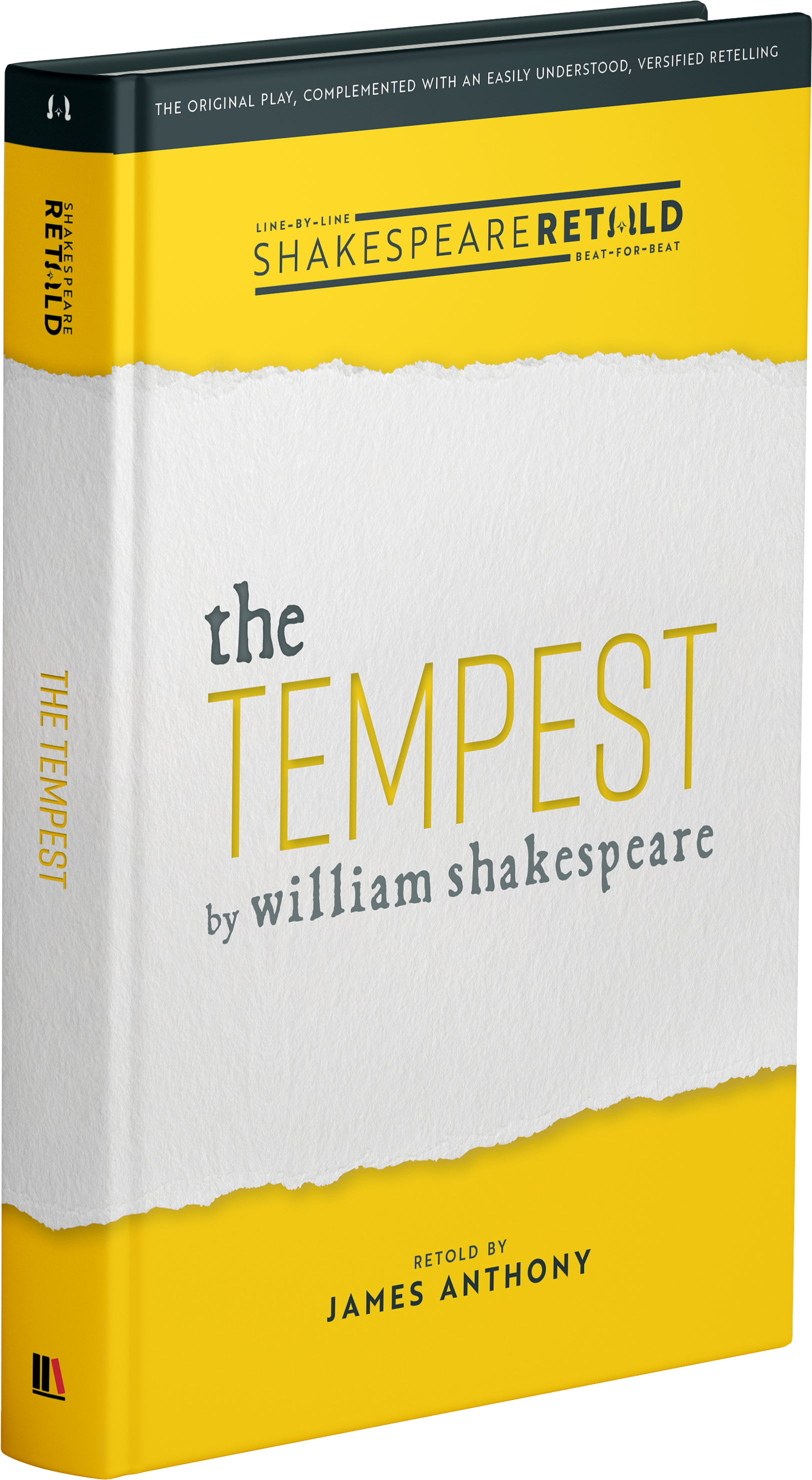
The complete study guide to The Tempest – every line translated; every rhythm kept; every scene, character and theme explored – free for students, teachers, actors, and theatregoers.
The Tempest Overview
The Tempest Deep Dive
-
ACT 1
-
The Tempest – Act 1 Scene 1
A ship splits in a storm
The Tempest Act 1, Scene 1 retold in modern English verse: the Boatswain defies the king as the ship goes down.
-
The Tempest – Act 1 Scene 2
Prospero tells his daughter the truth
The Tempest Act 1, Scene 2 retold in modern English verse: the story of Milan, Ariel, Caliban, and love at first sight.
-
-
ACT 2
-
The Tempest – Act 2 Scene 1
A commonwealth, and a plot to kill the king
The Tempest Act 2, Scene 1 retold in modern English verse: Gonzalo's commonwealth, and a plot to kill the king.
-
The Tempest – Act 2 Scene 2
A monster, a fool and a drunk under one cloak
The Tempest Act 2, Scene 2 retold in modern English verse: Trinculo finds a fish and Caliban finds a god.
-
-
ACT 3
-
The Tempest – Act 3 Scene 1
Miranda proposes to the log-man
The Tempest Act 3, Scene 1 retold in modern English verse: Ferdinand carries logs for love and Miranda proposes marriage.
-
The Tempest – Act 3 Scene 2
"Be not afeard; the isle is full of noises"
The Tempest Act 3, Scene 2 retold in modern English verse: Caliban plots murder and hears the island's music.
-
The Tempest – Act 3 Scene 3
A feast that vanishes, and three men of sin
The Tempest Act 3, Scene 3 retold in modern English verse: a banquet vanishes and the harpy names three men of sin.
-
-
ACT 4
-
ACT 5
-
The Tempest – Act 5 Scene 1
"Mine would, sir, were I human"
The Tempest Act 5, Scene 1 retold in modern English verse: Prospero forgives his enemies, drowns his book, and frees Ariel.
-
The Tempest – Epilogue
"Let your indulgence set me free"
The Tempest Epilogue retold in modern English verse: Prospero, without his magic, asks the audience to release him.
-
Frequently asked questions about The Tempest
What is The Tempest about?
The Tempest is the story of one afternoon on an island. Prospero, the rightful Duke of Milan, has lived there for twelve years with his daughter Miranda since his brother Antonio, backed by Alonso, King of Naples, seized his dukedom and set the pair adrift. Now his enemies are sailing past, and with his magic and the spirit Ariel he raises a storm that wrecks them on his shore. He separates the survivors: Alonso's son Ferdinand is led to Miranda and the two fall in love; Antonio tempts Alonso's brother Sebastian to murder the sleeping king; the jester Trinculo and the drunken butler Stephano join Caliban, son of the witch Sycorax and the island's only native, in a plot to kill Prospero; and a vanishing banquet and a harpy confront the three men of sin with their crime. Prompted by Ariel, Prospero chooses forgiveness over revenge, renounces his magic, reclaims Milan, blesses the marriage, frees Ariel and, in the Epilogue, asks the audience to release him too.
When was The Tempest written?
The Tempest was written in 1610–11 and is probably the last play Shakespeare wrote alone; afterwards he collaborated with John Fletcher on Henry VIII, The Two Noble Kinsmen and the lost Cardenio. The earliest record is a performance before King James at Whitehall on 1 November 1611, and it was played again at court in the winter of 1612–13 during the celebrations for the marriage of the king's daughter Elizabeth. Its shipwreck draws on the Bermuda pamphlets of 1610: William Strachey's letter describing the wreck of the Sea Venture on the way to Virginia in 1609, Sylvester Jourdain's Discovery of the Barmudas, and the Virginia Company's True Declaration. The play was first printed in the First Folio of 1623, where it stands first in the volume, with unusually detailed stage directions.
Is The Tempest a comedy, a tragedy or a romance?
The First Folio placed it first among the comedies, and it ends as a comedy should, with a wedding, a reconciliation and nobody dead. Since Edward Dowden's study of 1875 it has usually been grouped with Pericles, Cymbeline and The Winter's Tale as one of the late plays or romances: stories of shipwreck, separated families, lost children found and wrongs forgiven, in which magic and the sea do what the plot needs. Some critics prefer tragicomedy, the term John Fletcher used for plays that bring their characters near death without killing them. Whatever the label, The Tempest is unusual among Shakespeare's plays in observing the classical unities: one place, one action, and a plot that takes roughly the time it takes to perform.
Is Prospero Shakespeare?
Not on any evidence the play gives, but the idea is nearly two centuries old and every student meets it. Prospero is an artist who stages illusions for an audience, gives up his art in Act 5, and in the Epilogue stands without his magic asking for applause; the play is very likely the last Shakespeare wrote alone; and the speech about the great globe seems to name the theatre itself. Put together, these made Prospero's farewell to magic into Shakespeare's farewell to the stage, a reading first proposed in the 1830s and given its most influential form by G. Wilson Knight in The Crown of Life (1947). Against it: Shakespeare went on to write three more plays with Fletcher, nothing suggests he thought of The Tempest as a last work, and the retirement reading tells us nothing about Caliban, Ariel or the men of sin. Use it as a dated critical reading, not as a fact about the play.
What level is The Tempest studied at?
The Tempest is studied at GCSE and A-Level in the UK, AP English Literature in the US, the IB Diploma, and on undergraduate courses worldwide, where its postcolonial readings have made it one of the most taught of all Shakespeare's plays. Prospero's revels speech, Caliban's speech about the island's noises, Ariel's songs and the Epilogue are also standard audition and drama-school pieces. This study guide is written to support all of these levels, with modern English translation, scene-by-scene analysis, character profiles, theme guides, and key quotes.
What are the most famous lines in The Tempest?
The Tempest gives the language "Our revels now are ended", "We are such stuff / As dreams are made on", "O brave new world, / That has such people in't!", "Be not afeard; the isle is full of noises", "Full fathom five thy father lies", "Hell is empty / And all the devils are here", "what's past is prologue", "this thing of darkness I / Acknowledge mine" and, from Prospero's renunciation of magic, "I'll drown my book". Each is analysed in depth on the key quotes page.