
Home → Plays → The Tempest → Plot Summary
The Tempest: Plot Summary
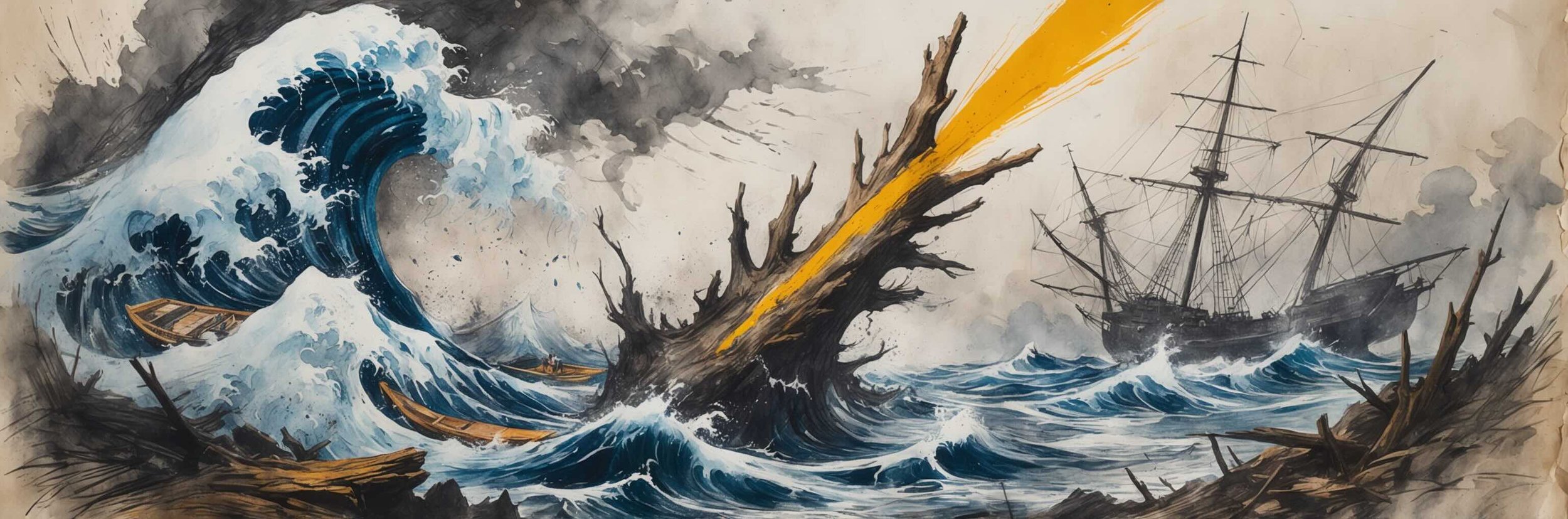
Plot Profile – At a Glance
- The Setting: A remote island somewhere between Tunis and Naples, and the ship wrecked on its shore; the whole action takes place in a single afternoon, twelve years after Prospero was cast adrift.
- The Protagonist: Prospero, the rightful Duke of Milan, who has spent his exile mastering magic and now has his enemies in his power.
- The Antagonist: Antonio, the brother who stole Prospero's dukedom with the help of Alonso, King of Naples; on the island, Caliban, who plots Prospero's murder, and Prospero's own appetite for revenge.
- The Inciting Incident: Prospero raises a storm that wrecks the king's ship, sailing home from a royal wedding in Tunis, and scatters his enemies across the island.
- The Core Conflict: Whether Prospero will use his power to punish the men who wronged him or to forgive them – played out against three smaller plots for power: Antonio's, Caliban's, and the drunken butler's.
- The Climax: Act 5, Scene 1, when Ariel says that if it were human it would pity the prisoners, and Prospero chooses "the rarer action", renounces his magic, and forgives.
- The Outcome: Prospero regains Milan, Ferdinand and Miranda are betrothed, Ariel is set free, Caliban is left seeking grace, and Prospero steps forward alone to ask the audience to release him.
- Genre: Printed first among the comedies in the First Folio of 1623; now usually called a romance or late play, and often read as Shakespeare's farewell to the stage.
Twelve years before the play begins, Prospero, Duke of Milan, lost his dukedom to his brother Antonio and was set adrift with his infant daughter Miranda in a rotten boat. They landed on an island already occupied by the spirit Ariel and the witch's son Caliban, and Prospero, with his books of magic, made himself master of both. Now his enemies are sailing past, and he raises the storm of the title to wreck them on his shore. Across a single afternoon he separates the survivors, makes the king's son fall in love with Miranda, drives the king mad with guilt, foils two murder plots, and stages a wedding masque – and then, with everyone at his mercy, decides to forgive them all. He breaks his staff, drowns his book, frees Ariel, and asks the audience to set him free.
Act 1: The Storm and the Story
A ship is breaking up in a storm. On deck the Boatswain shouts at the passengers to get below – the king of Naples among them – and asks what the roaring waves care "for the name of king". The mariners give up, the courtiers pray, and the cry goes up: "We split, we split, we split!" On the island, Miranda has watched the wreck and begs her father to calm the sea. Prospero tells her that nobody has been harmed, takes off his magic cloak, and tells her, for the first time, who they are: he was Duke of Milan, "Twelve year since", until his brother Antonio, to whom he had left the running of the state while he studied, made a deal with Alonso, King of Naples, and had them put to sea in "A rotten carcass of a boat". Old Gonzalo smuggled food, water and Prospero's books aboard. Now fortune has brought his enemies past the island, and he has one afternoon to act. Miranda sleeps, and Ariel reports: the ship's company are safe and scattered in groups, the king's son alone, and "Not a hair perished". Ariel asks for the freedom Prospero promised, and Prospero angrily retells how he found the spirit imprisoned by the witch Sycorax "Into a cloven pine" and set it free. Then Caliban, Sycorax's son, is summoned to fetch wood. He claims the island as his own – "This island's mine" – and Prospero answers that his kindness ended when Caliban tried to rape Miranda; Caliban's reply is that all he got from being taught language is that he knows "how to curse". Finally Ariel, invisible, sings Ferdinand, the king's son, up the beach with "Full fathom five". He and Miranda see each other and fall in love on the spot, exactly as Prospero intended; and Prospero, to make the prize worth winning, accuses Ferdinand of being a spy, charms his sword out of his hand, and makes him a prisoner.
Act 2: Two Plots
On another part of the island Gonzalo tries to comfort the king, who believes his son drowned, while Antonio and Sebastian, the king's brother, mock every word he says. Gonzalo imagines the perfect commonwealth he would build on the island, with no work, no law and no king, and they point out that he would still be king of it. Ariel plays music and everyone falls asleep except Antonio and Sebastian. Antonio goes to work on him: Ferdinand is drowned, the king's daughter is in Tunis and too far away to inherit, so Sebastian is one sword-stroke from the crown of Naples – "what's past is prologue". He did the same to his own brother, he says, and his conscience has never troubled him. Sebastian agrees. They draw their swords over the sleeping king and Gonzalo, and Ariel, sent by Prospero, sings in Gonzalo's ear and wakes him just in time; the two men claim they heard wild beasts. Elsewhere Caliban, carrying wood and cursing, hears thunder and someone coming and lies flat under his cloak. Trinculo, the king's jester, finds him, decides that "he smells like a fish", and crawls under the cloak too when the storm returns. Stephano, the king's butler, arrives drunk with a bottle he saved from the wreck, takes the four-legged thing under the cloak for a monster, and gives it wine. Caliban decides the man with the bottle is a god, swears to be his subject, and leads them off singing "Freedom, hey-day".
Act 3: Love, Murder and a Banquet
Ferdinand is carrying logs, Prospero's punishment, and finding the work light because Miranda watches him do it. She disobeys her father by telling Ferdinand her name, and then proposes to him outright: "I am your wife". He accepts. Prospero, watching unseen, is delighted. Across the island, Caliban has a proposal of his own for Stephano: kill Prospero while he sleeps, take his books first, and make Miranda queen. Ariel, invisible, keeps saying "Thou liest" in Trinculo's voice, until Stephano beats the jester; then it plays a tune on a pipe and drum, and Caliban tells the frightened drunkards not to be afraid, because "the isle is full of noises". Ariel leads them off after the music. The court party, meanwhile, is exhausted with searching for Ferdinand, and Antonio and Sebastian agree to try again that night. Then strange shapes bring in a banquet and invite them to eat. As they reach for it, thunder sounds, the table vanishes, and Ariel appears as a harpy to name Alonso, Antonio and Sebastian "three men of sin", accuse them of the crime against Prospero, and promise them lingering ruin unless they repent. Alonso, hearing his guilt in the thunder, goes off to drown himself beside his son; the other two draw their swords on the air; Gonzalo sends the younger men after them.
Act 4: The Masque
Prospero ends Ferdinand's trial and gives him Miranda, with a stern warning not to touch her before the wedding. To celebrate the betrothal he has Ariel and the spirits perform a masque: Iris, Ceres and Juno bless the couple, and nymphs and reapers dance. In the middle of it Prospero remembers Caliban's plot, stops the show, and, seeing Ferdinand's alarm, tells him that the actors were spirits and have melted into thin air, as everything will: "We are such stuff / As dreams are made on". Ariel reports that it has led the three conspirators, drunk and stinking, through briars and into a filthy pond, and Prospero, calling Caliban "A devil, a born devil" on whom nurture will never stick, sets the trap. Gaudy clothes are hung on a line outside his cell. Caliban urges his masters to get on with the murder, but Stephano and Trinculo cannot resist the finery, and while they are loading themselves with it, Prospero and Ariel set spirit hounds on all three and drive them off howling.
Act 5: Forgiveness and Farewell
Ariel tells Prospero that the king and his followers are held charmed in a grove, and that if Prospero could see them his heart would soften; Ariel's own would, "were I human". Prospero decides then and there that "the rarer action is / In virtue than in vengeance", and sends Ariel to bring them. Alone, he calls on the spirits he has commanded, lists what his magic has done, and renounces it, promising to break his staff and, "deeper than did ever plummet sound", to drown his book. The court party is led in and stands spellbound while Prospero, in his old robes as Duke of Milan, forgives Alonso, forgives Antonio while calling him what he is, and demands his dukedom back. Alonso, still mourning his son, resigns it – "Thy dukedom I resign" – and Prospero draws back a curtain to show Ferdinand and Miranda playing chess. Miranda, seeing a crowd of people for the first time, cries "O brave new world"; her father answers, "'Tis new to thee". The Boatswain arrives with news that the ship is whole and the crew awake, and Ariel drives in Caliban, Stephano and Trinculo in their stolen clothes. Prospero acknowledges Caliban as his – "this thing of darkness I / Acknowledge mine" – and Caliban promises to be wise hereafter and to seek for grace. Prospero invites the company into his cell to hear his story, promises calm seas for the voyage to Naples and the wedding, and says that in Milan "Every third thought shall be my grave". His last order to Ariel is to set it free. Then, in the Epilogue, he comes forward alone, his charms all overthrown, and asks the audience for the applause that will "set me free".
Key Takeaways
- The storm is a trick: Nobody drowns, the ship is unharmed, and Prospero says so in the second scene; the play's terror is staged by its hero.
- One afternoon, one island: The action runs in something like real time – three hours by the characters' own count – which makes this the most tightly plotted play Shakespeare wrote.
- Three plots for power run in parallel: Antonio tempts Sebastian to murder the king; Caliban tempts Stephano to murder Prospero; and Prospero, who already has the power, must decide what to do with it.
- The climax is a decision, not a fight: The turning point is Ariel's remark that it would pity the prisoners if it were human, and Prospero's choice of virtue over vengeance.
- The play ends by giving power away: Prospero drowns his book, frees Ariel, hands the future to Ferdinand and Miranda, and asks the audience to release him.
The Tempest Plot Summary – Frequently Asked Questions
How does The Tempest end?
With forgiveness rather than revenge. In Act 5, Scene 1, Prospero, who has every one of his enemies charmed and helpless, decides that the rarer action is in virtue than in vengeance, renounces his magic, and has Ariel bring the court party to his cell. He reveals himself to them as the Duke of Milan they cast adrift twelve years earlier, forgives Alonso, forgives Antonio and Sebastian while making clear he knows about the plot to murder the king, and takes back his dukedom. Then he draws a curtain to reveal Ferdinand, whom Alonso believed drowned, playing chess with Miranda.
The ship is found whole and its crew awake, Caliban and the drunkards are driven in and pardoned, and Prospero invites everyone into his cell to hear his story before they all sail to Naples for the wedding. Ariel is freed. In the Epilogue Prospero steps forward alone, without his magic, and asks the audience to release him from the island with their applause. Nobody dies in the play, and no marriage takes place on stage; the ending is a set of promises.
Who is Prospero and why is he on the island?
Prospero is the rightful Duke of Milan. Twelve years before the play, as he tells Miranda in Act 1, Scene 2, he handed the running of the state to his brother Antonio so that he could devote himself to study; his library, he says, was dukedom enough for him. Antonio used the power he was given to make himself duke in fact, then struck a deal with Alonso, King of Naples, to make it official in exchange for tribute. One night Prospero and his three-year-old daughter were seized, taken out to sea and set adrift in a rotten boat.
Gonzalo, the Neapolitan councillor charged with the job, secretly stocked the boat with food, water, clothes and the books Prospero valued above his dukedom. The boat drifted to the island, where Prospero freed the spirit Ariel from the tree in which the witch Sycorax had imprisoned it, and took charge of Sycorax's son Caliban. The books made him a magician; the magic made him master of the island; and when his enemies' ship sailed past on its way home from Tunis, the magic gave him his chance.
Does anyone die in The Tempest?
No. The play opens with a shipwreck that seems to drown everyone aboard, and for four acts the survivors believe the others dead: Alonso mourns Ferdinand, Ferdinand mourns Alonso, and the courtiers have given up the search. But Ariel tells Prospero in Act 1, Scene 2 that not a hair has perished, and in Act 5 the whole ship's company, the vessel itself and even the passengers' clothes turn out to be intact.
Two murders are planned and neither happens. Antonio and Sebastian draw their swords on the sleeping king and are stopped by Ariel, and the second attempt they plan never gets its chance; Caliban's plot to brain Prospero in his sleep never gets past the clothes-line. The only deaths in the play are in the past, reported: Sycorax, the witch who once ruled the island, died before Prospero arrived. It is the one Shakespeare play in which the shipwreck, the sword-fights and the assassination plots all end with everyone alive.
What is the masque in Act 4, and why does Prospero stop it?
The masque is the show Prospero puts on to celebrate Ferdinand and Miranda's betrothal: Ariel and the spirits play the goddesses Iris, Ceres and Juno, who bless the couple with a fruitful marriage, and nymphs and reapers dance. A masque was the fashionable court entertainment of the day, and this one is the play within the play.
Prospero breaks it off because he suddenly remembers Caliban's plot against his life, which is due that very hour. The spirits vanish, Ferdinand is alarmed, and Prospero calms him with the most famous speech in the play: the actors were spirits and have melted into air, and so, in time, will the towers, the palaces, the great globe itself. We are such stuff as dreams are made on. Then he admits that he is vexed and troubled, sends the young couple inside, and sets the trap for the conspirators.
What is Caliban's plot?
In Act 3, Scene 2, Caliban persuades Stephano, the drunken butler he has taken for a god, to murder Prospero in his afternoon sleep. The plan is detailed: seize his books first, because without them he is powerless and the spirits will not obey him; then batter his skull, or stab him, or cut his throat; then take Miranda, who will be Stephano's queen while Caliban's new master is king of the island. Trinculo is to be viceroy.
Ariel overhears every word and reports it, and the plot fails in Act 4 in the most humiliating way available. Ariel leads the three through thorns and into a stinking pond, then hangs gaudy clothes on a line by Prospero's cell; Stephano and Trinculo stop to loot them, Caliban begs them to get on with the murder, and Prospero sets spirit hounds on all three. In Act 5 they are driven in wearing the stolen finery, and Caliban, seeing his god for what he is, resolves to seek for grace.
Why does Prospero give up his magic?
Because the plot is finished. Prospero's magic has one purpose in the play, to bring his enemies within his reach and make them repent, and in Act 5, Scene 1 that purpose is complete. When Ariel says it would pity the prisoners if it were human, Prospero takes the point: a man should be moved more than a spirit, and since the men are penitent his purpose need not extend a frown further. The magic that was for vengeance has no further use once vengeance is renounced.
He then makes the renunciation formal in the speech that begins by calling on the elves of hills, brooks and groves, lists what his art has done, and ends with the promise to break his staff and drown his book. Two practical reasons sit beneath it: a duke returning to Milan cannot rule by sorcery, and Ariel, the instrument of every effect, has been promised freedom. The Epilogue makes the surrender complete, since Prospero tells the audience that his charms are overthrown and the only strength he has left is his own.
How many acts and scenes does The Tempest have?
Five acts and nine scenes, plus an Epilogue: two scenes in Act 1, two in Act 2, three in Act 3, one in Act 4 and one in Act 5. It is one of Shakespeare's shortest plays, and the only one apart from The Comedy of Errors to keep the classical unity of time: the action runs in about three hours, the characters say so more than once, and Prospero checks the clock with Ariel as he goes.
The scenes are very unequal. Act 1, Scene 2, in which Prospero tells Miranda their history and then deals with Ariel, Caliban and Ferdinand in turn, is by far the longest and does the work of a whole act of exposition; the storm scene that precedes it is over in a few minutes. The Shakespeare Retold translation follows the play scene by scene, with the Epilogue given its own page, and the links below open each act at its first scene.
Read the Modern Translation
Read Act 1 Read Act 2 Read Act 3 Read Act 4 Read Act 5 Read the Epilogue