
Home → Plays → The Tempest → Context
The Tempest: Context & Background
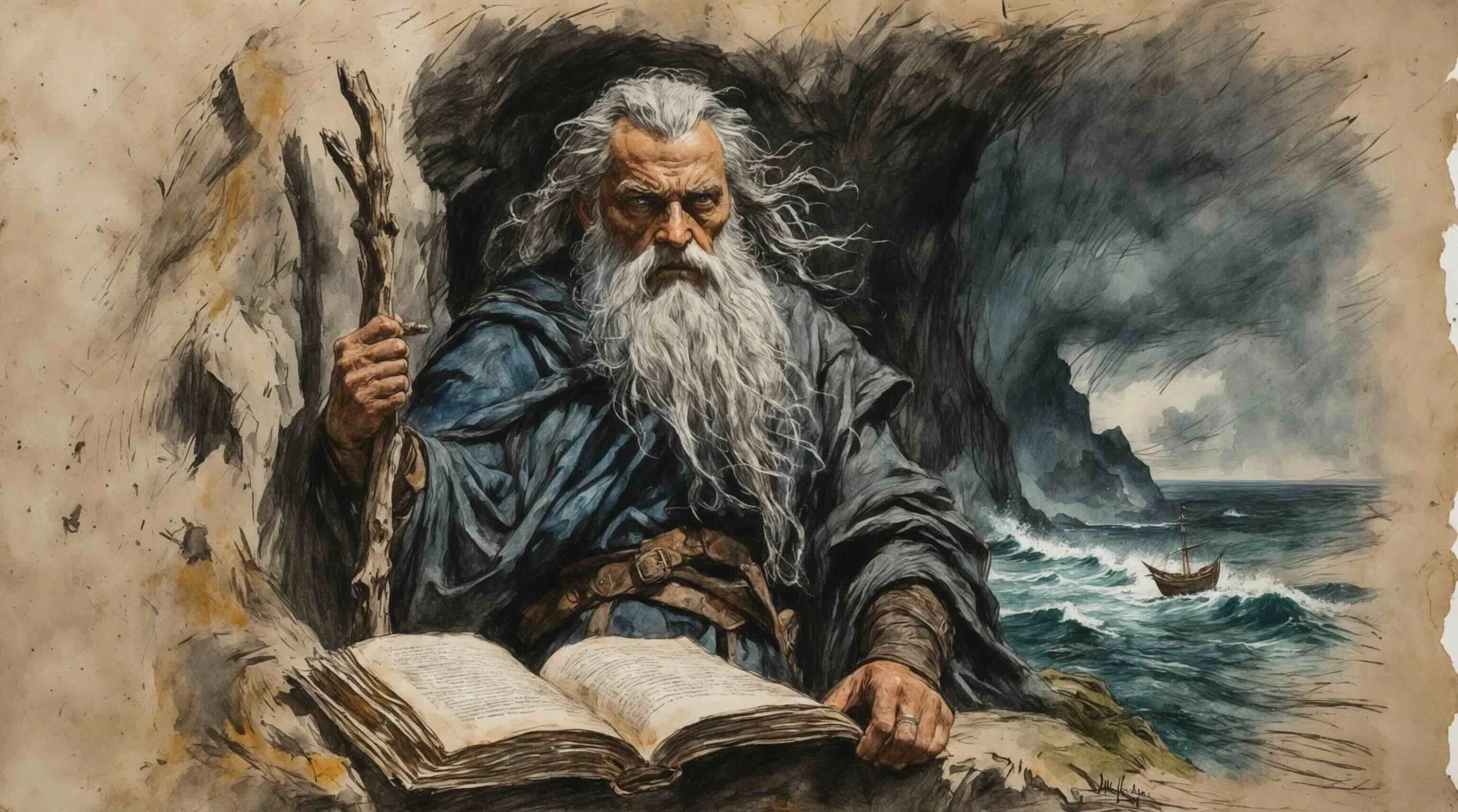
Context Profile – At a Glance
- Date Written: 1610–1611 – the first recorded performance was at Whitehall before King James on 1 November 1611; probably the last play Shakespeare wrote alone, and the first printed in the First Folio of 1623.
- Genre: Listed among the comedies in the Folio; now usually called a romance or late play, alongside Pericles, Cymbeline and The Winter's Tale.
- Primary Source: None for the plot – unusually for Shakespeare, the story is his own. The materials came from the 1610 pamphlets about the wreck of the Sea Venture on Bermuda, Montaigne's essay "Of the Cannibals" in John Florio's 1603 translation, and Ovid's Metamorphoses in Arthur Golding's 1567 version.
- The Bermuda Wreck: In July 1609 the flagship of a Virginia Company fleet was driven onto Bermuda by a hurricane; everyone survived, and their accounts reached London the following year.
- Magic and King James: The king who watched the play in 1611 had written a treatise against witchcraft, Daemonologie (1597), and Prospero's "art" is drawn carefully on the right side of the line that divides the learned magician from the witch.
- The Court Masque and the Blackfriars: Written for the King's Men's new indoor theatre and shaped by the masques of the Jacobean court – music, spectacle, goddesses descending, and a show that vanishes on command.
The Bermuda Wreck: Where the Storm Came From
In June 1609 a fleet of nine ships left Plymouth for the new English colony at Jamestown in Virginia. In late July a hurricane scattered it, and the flagship, the Sea Venture, carrying the expedition's leaders Sir Thomas Gates and Sir George Somers, was driven onto the reefs of Bermuda – an island group sailors had avoided for a century as a haunt of devils and storms. Every soul aboard got ashore. The castaways lived on the island for the best part of a year, finding it fertile and mild, built two small ships from cedar and the wreck, and reached Jamestown in May 1610 to find the colony starving. The news reached London that autumn, and it reads like a miracle: a ship given up for lost, a crew delivered whole, an enchanted island that turned out to be paradise.
Shakespeare read the accounts. Silvester Jourdain's A Discovery of the Barmudas was printed in October 1610, and William Strachey's long letter, the True Reportory of the Wrack, dated 15 July 1610, circulated in manuscript years before it was printed in 1625. Strachey describes the storm, the light like a little star that played about the rigging (the St Elmo's fire that Ariel claims to have been), the mutinies among the castaways, and the astonishment of survivors who had prayed for death. The play's own island is in the Mediterranean, between Tunis and Naples, but Ariel fetches dew "From the still-vexed Bermoothes", and the shipwreck, the miraculous survival, the drunken conspiracies and the strange fertility of the place are all Bermuda's.
Exam tip: The island is a composite, not a location. Argue that Shakespeare sets a New World shipwreck in an Old World sea on purpose, so that the play can be about colonialism and empire and discovery without being tied to a particular colony – and then show how Caliban's story carries the Virginia material even though nobody in the play mentions America.
Montaigne, Ovid and Virgil: The Books Behind the Play
The play has no source story, but it is full of other people's books. The most important is Montaigne's essay "Of the Cannibals", which Shakespeare read in John Florio's English translation of 1603. Montaigne describes the native people of Brazil by everything they lack – no trade, no letters, no magistrates, no riches or poverty, no contracts, no occupations – and asks whether a Europe that tortures and burns living men has any right to call them savages. Gonzalo's commonwealth speech in Act 2, Scene 1 lifts Montaigne's list almost word for word, and Caliban's name is usually taken as a rearrangement of "cannibal". Shakespeare uses the essay both ways: Gonzalo's dream of natural innocence is heckled off the stage by Antonio and Sebastian, while Caliban, the play's actual native, is neither the innocent Montaigne imagined nor the monster the courtiers see.
Two classical poets stand behind the play's grandest moments. When Prospero calls on the "Ye elves of hills" in Act 5, he is speaking the words of the witch Medea in the seventh book of Ovid's Metamorphoses, in Arthur Golding's translation of 1567 – an unsettling borrowing, since it gives the play's white magician the voice of its most famous black one. Virgil's Aeneid supplies the rest: the courtiers' argument about "'Widow Dido" and Carthage, which the play sets a few miles from Tunis; Ferdinand's first words to Miranda, "Most sure, the goddess", which echo Aeneas meeting his mother Venus in disguise; and the harpy that fouls the banquet in Act 3, borrowed from the third book of the Aeneid. Even Caliban's god, "Setebos", comes from a book: the account of Magellan's voyage in Richard Eden's collection of 1555, where it is the name of a Patagonian deity.
Exam tip: Treat the borrowings as arguments, not decoration. Gonzalo's speech is a source being staged and then mocked; Prospero's invocation is a source that quietly undercuts him. An essay that shows Shakespeare putting Montaigne's optimism and Ovid's witchcraft into his characters' mouths, and then letting the play test them, is doing real contextual analysis of nature and nurture and magic and art.
Magic, King James and the Renaissance Magus
When the play was performed at court in 1611, the king in the audience was an authority on witchcraft. James had presided over witch trials in Scotland in the 1590s, published Daemonologie in 1597 to prove that witches were real and should die, and one of the first statutes of his English reign, in 1604, tightened the law against conjuration. That is the world in which Prospero practises magic for three hours on stage, and the play takes care with the distinction that kept him safe. Renaissance thought separated the learned magus, who studied the hidden workings of nature through books and commanded spirits by knowledge, from the witch, who bargained with the devil. Prospero belongs to the first kind and Sycorax to the second: he speaks of his "secret studies" and lays down his cloak with "Lie there, my art"; she is the "damned witch Sycorax" who worshipped a devil and imprisoned Ariel in a tree for refusing her commands.
The figure Prospero most resembles is a type the age knew well: the scholar-magician of the kind represented by John Dee, Queen Elizabeth's astrologer and mathematician, whose library was the largest in England and whose reputation for conjuring spirits ended in poverty and suspicion. The play's other great magician on the London stage, Marlowe's Faustus, sold his soul for his power and was carried off to hell; Prospero gives his up and goes home. But the renunciation is not simple. The speech in which he abjures his "rough magic" is Medea's, and "rough" admits what the play has been showing: that the art which raised the storm, tormented Caliban and drove Alonso to the edge of suicide is not so easily told apart from the witch's. A duke who intends to rule Milan under a king like James does well to drown the book before he sails.
Exam tip: Use the play's own vocabulary, and notice who uses it. Prospero calls his practice "art" and Sycorax's "sorceries terrible"; Caliban, looking at the same magic from below, says "by sorcery he got this isle"; and the one time Prospero applies a harsher word to his own practice, "rough magic", is the moment he gives it up. Tracing that vocabulary lets you argue that the renunciation is political and moral as well as theatrical, which strengthens any essay on magic and art or power and control.
The Court, the Masque and the Blackfriars Stage
The first performance anyone recorded was at Whitehall, before the king, on 1 November 1611, and the play was chosen again for the celebrations of Princess Elizabeth's marriage to the Elector Palatine in the winter of 1612–13. It suits a court. Its central entertainment, the wedding masque of Act 4, is a miniature of the form the Jacobean court had made its own since Ben Jonson and Inigo Jones began collaborating in 1605: goddesses descending, an allegory of harmony, a dance by nymphs and reapers, and a noble audience watching itself being flattered. Prospero stops the show mid-dance, and the speech that follows, on "the great globe itself" dissolving like a pageant, turns the masque's own vanishing into the play's most famous image of illusion and reality.
The play was also shaped by a building. From 1609 the King's Men played in winter at the Blackfriars, an indoor theatre lit by candles, with a smaller and richer audience than the Globe, music between the acts, and a taste for spectacle that could be controlled: a banquet that vanishes, a harpy that descends, spirits that appear and melt away. The Tempest calls for more music than almost any other play Shakespeare wrote, from Ariel's songs to the "Sounds and sweet airs" Caliban describes, and settings of two of the songs by Robert Johnson, the King's lutenist, survive. The play's unusual observance of the unities – one island, one afternoon – and its act divisions, which the Folio prints where most of Shakespeare's plays have none, both fit an indoor house where the candles had to be trimmed between acts.
Exam tip: Read the play as a piece of stagecraft. Prospero is a director as much as a duke: he casts Ariel, times the entrances, stages the banquet and the masque, and reviews the performance. Linking his control of the island's shows to the technical resources of the Blackfriars turns a point about illusion and reality into a point about the theatre the play was written for.
The New World and the Play's Afterlife
England's first lasting American colony was three years old when the play was written. The Virginia Company had been chartered in 1606 and Jamestown founded in 1607; the Sea Venture was carrying the colony's new leaders. The play never names Virginia, but the New World is everywhere in it: in Trinculo's calculation that in England people who will not give a coin to a beggar will pay "to see a dead Indian", a joke about the native people who really were brought to London and exhibited; in the water with berries and the language lessons that Caliban remembers from Prospero's first days; in the question, argued in the Virginia pamphlets and in Montaigne, of whether the people found across the ocean were natural innocents, natural slaves, or men.
For most of its history the play was not read that way. Dryden and Davenant's adaptation, The Enchanted Island (1667), which gave Miranda a sister and Caliban one too and added a man who had never seen a woman, held the stage for well over a century, and the nineteenth century admired the play as a fairy tale about a magician and his spirit. The colonial reading belongs to the twentieth century. Aimé Césaire's Une Tempête (1969) recast Caliban as a black slave and Ariel as a mulatto one; Roberto Fernández Retamar's essay "Calibán" (1971) claimed Caliban as the symbol of Latin America; and by the 1980s critics such as Paul Brown were reading the play as a document of colonialist discourse itself. Alongside this runs an older tradition, going back to the nineteenth century, that hears Prospero's farewell to his art as Shakespeare's own farewell to the theatre – a reading the play neither confirms nor forbids.
Exam tip: Date your readings. Saying that The Tempest is a colonial play is a 1960s and 1980s position, and saying that it is Shakespeare's farewell is a nineteenth-century one; an examiner rewards a student who knows which lens they are using and can say what each reveals and hides. The strongest essays on colonialism and empire or masters and servants treat the postcolonial reading as one context among several, tested against the text rather than imposed on it.
Key Takeaways
- A New World wreck in an Old World sea: The storm, the survival and the enchanted island come from the 1609 Bermuda wreck; the setting between Tunis and Naples keeps the play free of any single colony.
- No source story, many source books: Montaigne supplies Gonzalo's commonwealth, Ovid's Medea supplies Prospero's invocation, Virgil supplies Dido, the goddess and the harpy.
- Magic on the right side of the law: Under a king who wrote Daemonologie, Prospero is a learned magus and Sycorax a witch – and he still drowns the book before going home.
- Written for candlelight: The Blackfriars indoor stage and the court masque explain the music, the vanishing banquet, the goddesses and the play's tight unity of time and place.
- The readings have a history: Fairy tale, farewell, colonial parable – each belongs to a period, and the play has accommodated all three.
The Tempest Context – Frequently Asked Questions
When was The Tempest written, and was it Shakespeare's last play?
It was written in 1610 or 1611. The earliest source it uses, Strachey's letter about the Bermuda wreck, is dated July 1610, and the earliest performance on record was at Whitehall on 1 November 1611, so the writing falls between the two. It was performed again at court in the winter of 1612–13 among the entertainments for the wedding of the king's daughter, and it was printed for the first time in the First Folio of 1623, where it stands first of all the plays.
It is usually called Shakespeare's last play, and it is probably the last he wrote on his own. He went on to collaborate with John Fletcher on Henry VIII and The Two Noble Kinsmen, and on a lost play, Cardenio, so the idea that Prospero's farewell to magic is Shakespeare's farewell to the stage is a reading rather than a fact; it dates from the nineteenth century and has never gone away.
What were Shakespeare's sources for The Tempest?
There is no source for the story, which is rare in Shakespeare; only a handful of his plays, such as A Midsummer Night's Dream and Love's Labour's Lost, are similarly free of a narrative model. The raw material came from three directions. The Bermuda pamphlets of 1610, above all William Strachey's True Reportory and Silvester Jourdain's Discovery of the Barmudas, gave him the storm, the miraculous survival, the St Elmo's fire and the enchanted island. Montaigne's essay "Of the Cannibals", in Florio's translation of 1603, gave him Gonzalo's commonwealth and the question of the natural man.
Ovid's Metamorphoses, in Golding's translation, gave him Medea's invocation, which becomes Prospero's speech renouncing magic; Virgil's Aeneid gave him Dido, Carthage, the harpy and Ferdinand's greeting to Miranda as a goddess; and Richard Eden's 1555 account of Magellan's voyage gave him the name of Caliban's god, Setebos. Behind these lie the conventions of the court masque and of Italian improvised comedy, whose stock plots of a magician on an island with a daughter and a servant-monster the play resembles closely enough that some scholars think Shakespeare knew them.
Where is the island in The Tempest?
In the Mediterranean, by the play's own geography. The king's ship was sailing home to Naples from Tunis, where Alonso's daughter Claribel has just been married, and the wreck happens somewhere on that route; the courtiers' banter about Dido and Carthage places them near the North African coast. Nothing in the play says the island is in the New World.
But its materials are. Ariel has been to the "still-vexed Bermoothes", the storm and survival are Bermuda's, the natives exhibited in London are Virginia's, and Caliban's god is Patagonian. Critics have argued for two centuries about whether the island is Mediterranean or American, and the honest answer is that Shakespeare wanted both: an island that could carry the excitement of the Atlantic voyages without being a report on any particular colony.
Is The Tempest about colonialism?
It has been read that way since the 1960s, and the reading has strong support in the text. Caliban's account of his dispossession in Act 1, Scene 2 – welcome, exchange, language lessons, then enslavement – follows the pattern of the first English encounters in Virginia; Prospero's rule is enforced by torment; Trinculo and Stephano plan to exhibit or exploit the native they find; and the play was written within months of the first reports of the Jamestown colony's collapse into starvation and mutiny.
The reading has a history of its own. The Martinican poet Aimé Césaire rewrote the play as Une Tempête in 1969, with Caliban as a black slave who refuses the name Prospero gave him; Roberto Fernández Retamar claimed Caliban for Latin America in 1971; and from the 1980s critics such as Paul Brown and Francis Barker and Peter Hulme argued that the play does not merely reflect colonial practice but takes part in the discourse that justified it. Not everyone agrees. Meredith Anne Skura's 1989 essay questioned whether the New World material was as central as the revisionists claimed, and whether the play's older concerns – usurpation, forgiveness, a father giving up a daughter – were being pushed aside. The play accommodates the colonial reading without being exhausted by it.
What kind of magic does Prospero use?
Learned magic, of the sort Renaissance writers called natural or white magic: power over the elements and over spirits, gained by study rather than by a pact with the devil. Prospero calls it his "art" throughout, and its instruments are a book, a staff and a cloak, the equipment of the scholar-magician. His control over Ariel rests on a debt of gratitude and on knowledge, not on a bargain, and the play contrasts him pointedly with Sycorax, who worshipped the devil Setebos, dealt with the powers of darkness and could not undo her own spell.
The distinction mattered in 1611 because James I had written against witchcraft and the law punished conjuration, so a magician-hero had to be the acceptable kind. Frank Kermode's Arden edition of 1954 made the contrast between Prospero's art and Caliban's nature the organising idea of the play. But Shakespeare complicates his own scheme: Prospero's great renunciation borrows the words of Ovid's Medea, a witch, and he calls his own practice "rough magic" as he gives it up. The play seems to know that the line between the magus and the witch is easier to draw in a treatise than on an island.
Why is The Tempest called a romance?
Because it belongs, with Pericles, Cymbeline and The Winter's Tale, to the group of plays Shakespeare wrote at the end of his career that share a shape: a family broken by crime or misfortune, a long separation, a sea voyage or shipwreck, a lost child found, and a reconciliation that forgives what a tragedy would punish. The Folio called it a comedy, and it ends with a betrothal like one, but its mood is different; the crimes are real, the forgiveness costs something, and Antonio never says he is sorry.
The word "romance" was attached to these plays by nineteenth-century critics, and Coleridge, lecturing in 1818, had already called The Tempest "a specimen of the purely romantic drama", a birth of the imagination rather than of history. What sets it apart even from its companions is its discipline. Where The Winter's Tale spans sixteen years and two countries, The Tempest keeps to one island and one afternoon, so that the romance's usual long story of loss is told in the past tense by Prospero in the second scene, and the play itself is all recovery.