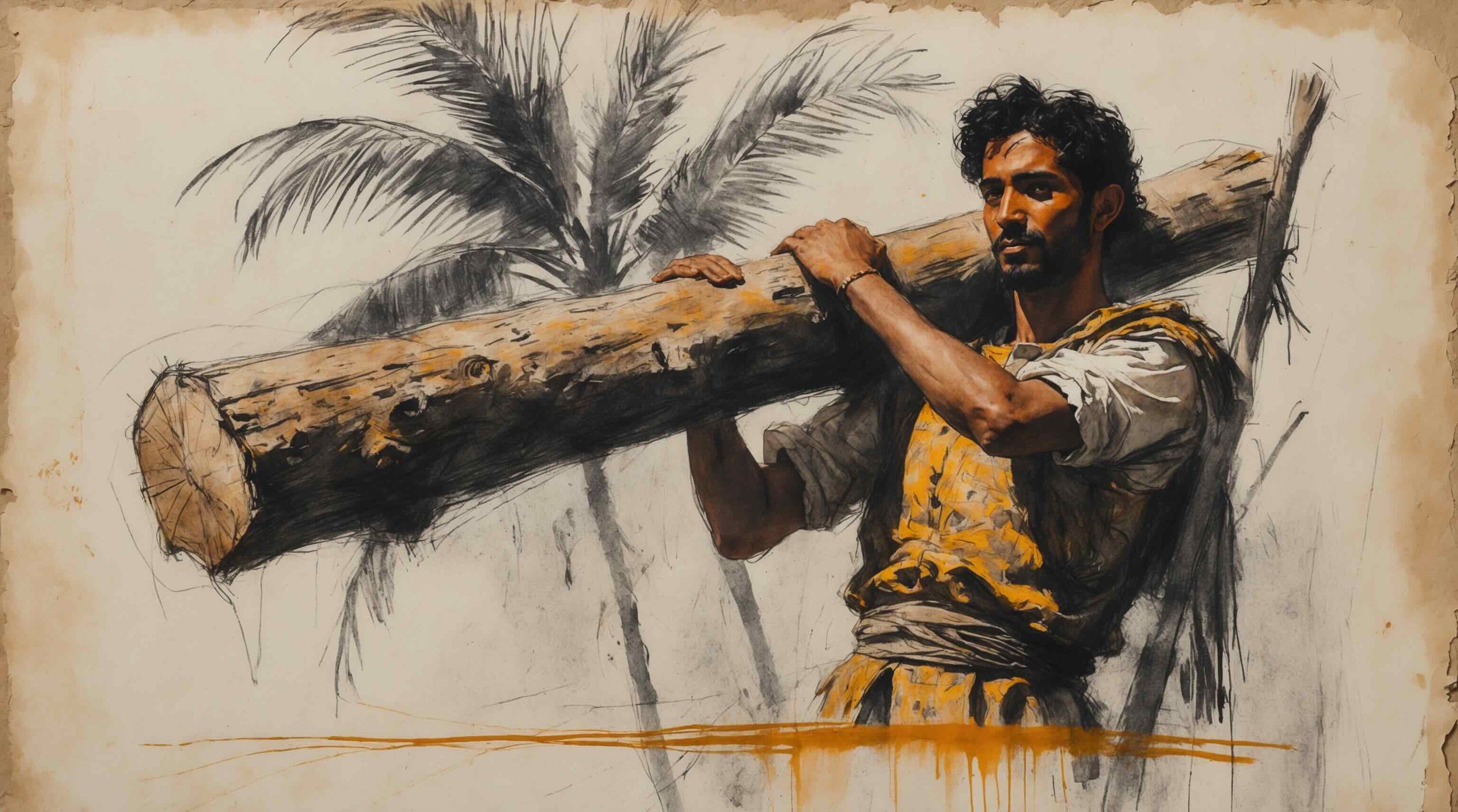
Character Profile – At a Glance
- Role: Prince of Naples, son of King Alonso. The first man to leap from the burning ship, he is led by Ariel’s music to Miranda, falls in love with her on sight, and is set to carrying logs by Prospero to prove it.
- Key Traits: Brave, courteous and sincere. A prince who takes his rank seriously and gives it up for love without a second thought. Willing to work, and to wait.
- The Core Conflict: Ferdinand believes his father is drowned and that he is now king. Prospero treats him as a spy and a slave. He has to earn Miranda by submitting to a man he could resist.
- Key Actions: Jumps from the ship crying that hell is empty and all the devils are here (reported, A1S2). Follows Ariel’s song and hears that his father lies full fathom five. Takes Miranda for a goddess, is charmed from drawing his sword, and accepts imprisonment for the sake of seeing her once a day. Carries logs, tells Miranda he loves her, and accepts her proposal (A3S1). Swears to Prospero that he will not touch her before the wedding, and watches the masque (A4S1). Is discovered playing chess with Miranda and restored to his father (A5S1).
- Famous Quote:
"Might I but through my prison once a day
Behold this maid: all corners else o' the earth
Let liberty make use of; space enough
Have I in such a prison."
(Act 1, Scene 2) - The Outcome: Betrothed to Miranda, reunited with Alonso, and heir to both Naples and Milan. He gets everything the play has to give, and does not have to break his back for it after all.
Hell Is Empty
Ferdinand is introduced before he appears, in Ariel’s report on the tempest. The spirit describes how he burned along the rigging and drove every soul but the sailors to jump, and he singles out the king’s son.
Original
the king's son, Ferdinand,
With hair up-staring, – then like reeds, not hair, –
Was the first man that leaped; cried, 'Hell is empty
And all the devils are here.'
(Ariel, Act 1, Scene 2)
Shakespeare Retold (Modern Verse)
The king’s son, Ferdinand,
His hair on end – like reeds, rather than hair, –
Was first to jump ship, shouting, ‘Hell is empty
And all the devils are here.’
It is a strange first impression: a prince with his hair on end, shouting that hell is empty as he jumps into the sea. The line has become one of the most quoted in the play, usually without its context. In context it is a young man’s panic, reported by the creature who caused it, and Prospero’s reply is delight: that’s my spirit. Ferdinand’s terror was the point of the exercise.
By the time we see him he has recovered. Ariel has landed him alone in an odd angle of the isle, and he is sitting on a bank with his arms folded, weeping for his father. The music finds him there. Everything that happens to Ferdinand for the rest of the play is arranged by Prospero, and he never finds out.
The Goddess on Whom These Airs Attend
Ferdinand follows the song to Miranda, and his first words to her are a prayer. He has just heard a spirit sing that his father is coral and pearl; a beautiful girl appearing to more music can only be the goddess the music serves.
Original
Most sure, the goddess
On whom these airs attend! Vouchsafe my prayer
May know if you remain upon this island;
And that you will some good instruction give
How I may bear me here: my prime request,
Which I do last pronounce, is, O you wonder!
If you be maid or no?
(Act 1, Scene 2)
Shakespeare Retold (Modern Verse)
This is the goddess
For whom the music plays! Answer my prayers,
So I know if you live upon this island;
And hopefully you’ll give some indication
Of how I must behave. My primary question,
Which I’ll ask last, is – Oh, you are a wonder! –
Are you a girl or not?
The speech is courtly and elaborate and ends in the plainest question a man can ask a woman. Miranda’s answer, that she is no wonder but certainly a maid, is plainer still, and the play lets the two registers meet. Ferdinand’s next surprise is that she speaks his language, and his next boast is that he is the best of those who speak it: with his father dead, he is King of Naples. Prospero, listening, decides he needs taking down.
What Ferdinand does not know is that the whole meeting has been staged. Prospero brought him here, put the goddess in front of him, and is now going to make him suffer for wanting her, so that the prize will not seem light. The theme of illusion and reality in this play is mostly about what Prospero’s victims cannot see, and Ferdinand is the happiest of them, because the illusion he is caught in is one he would have chosen.
The Patient Log-Man
Act 3 opens with a prince carrying wood. Prospero has set him to move some thousands of logs and pile them up, on pain of punishment, and Ferdinand, who could have refused, is doing it. His soliloquy explains why.
Original
The mistress which I serve quickens what's dead
And makes my labours pleasures...
(Act 3, Scene 1)
Shakespeare Retold (Modern Verse)
The lady that I do it for relieves
The pain and makes it pleasurable.
The speech is built on paradox: some sports are painful, some baseness is nobly undergone, and this mean task would be heavy and odious if it were not for the woman he does it for. It is the language of the sonnet tradition, in which the lover serves a mistress and calls the service joy. But Shakespeare has made the service literal. Ferdinand is not sighing in a garden. He is doing forced labour, and the mistress cries when she sees him at it.
The scene that follows is the play’s love scene, and it is unlike any other in Shakespeare because both parties are so direct. Miranda offers to carry the logs. Ferdinand refuses. She asks whether he loves her; he calls heaven and earth to witness that he does; she cries and proposes. The theme of masters and servants runs through the whole play, and here it is turned into courtship: Ferdinand calls himself her slave and means it as the highest thing he can say.
A Second Father
Ferdinand vanishes for most of Act 4 and 5 and returns for the ending, discovered by Prospero playing chess with Miranda in front of the astonished court. Alonso, who has spent three days mourning him, asks who the girl is. Ferdinand’s answer is the most grown-up thing he says.
Original
Sir, she is mortal;
But by immortal Providence she's mine:
I chose her when I could not ask my father
For his advice, nor thought I had one.
(Act 5, Scene 1)
Shakespeare Retold (Modern Verse)
She is human;
But by the grace of God, she is my wife:
I chose her when I could not ask my father
For his advice, and didn’t think I had one.
He chose her when he could not ask his father, because he thought he had no father. It is an apology and a justification at once: he did not defy Alonso, he simply acted as a king would, being to his own knowledge the king. And he adds that Prospero, whom he has heard of all his life and never seen, has given him a second life and is now, through Miranda, a second father.
The line completes the play’s political design. Naples and Milan, enemies at the start, are joined in the next generation; Alonso, who helped depose Prospero, now shares a child with him. Ferdinand is the instrument of the reconciliation without ever knowing there was a quarrel. The theme of revenge and forgiveness is settled by the old men in the last act, but it is the young man at the chessboard who makes the settlement stick.
"the princely Ferdinand, cast by fate upon the haven of his happiness in this idol of his love"
— William Hazlitt, Characters of Shakespear’s Plays, 1817
Key Quotes
Quote 1
Where should this music be? I' the air or the earth?
It sounds no more: and sure, it waits upon
Some god o' the island. Sitting on a bank,
Weeping again the king my father's wreck,
This music crept by me upon the waters,
Allaying both their fury and my passion
With its sweet air: thence I have followed it,
Or it hath drawn me rather.
(Act 1, Scene 2)
Shakespeare Retold (Modern Verse)
Where is that music from? The sky or earth?
It’s stopped: I’m sure it’s playing on the orders
Of some god on the island. On a sandbank
I wept about the king my father’s shipwreck,
And then this music came across the ocean,
And calmed the angry waves and calmed my sorrow
With its relaxing sound: I followed it,
Or rather, it seduced me.
Quote Analysis: Ferdinand’s first speech, and the audience’s first sight of the island through a stranger’s eyes. He does not know whether the music is in the air or the earth; he knows only that it found him weeping on a bank and calmed both the sea and his grief. The last line is the important one. He has followed the music, or rather it has drawn him, and the correction admits that he is not in charge. He never will be. Ariel’s song is the first of the leads by which Prospero brings him to Miranda, and Ferdinand, unlike Caliban, is happy to be led.
My spirits, as in a dream, are all bound up.
My father's loss, the weakness which I feel,
The wreck of all my friends, nor this man's threats,
To whom I am subdued, are but light to me...
(Act 1, Scene 2)
Shakespeare Retold (Modern Verse)
My powers, like in a dream, no longer work.
My father’s death, the weakness that I feel,
The death of all my friends, nor this man’s threats,
Who’s cast a spell on me, are nothing to me...
Quote Analysis: Prospero has charmed Ferdinand from moving, and this is Ferdinand’s account of what it feels like: his powers bound up as in a dream. Then he takes stock of his losses, his father, his friends, his freedom, and finds them light beside the one thing he has gained, which is the chance to see Miranda through his prison bars once a day. It is the speech of a man who has just been enchanted, and the enchantment is only partly Prospero’s. Ferdinand is in love, and love is doing to him what the magic does to everyone else: making him content with a cell.
O heaven, O earth, bear witness to this sound
And crown what I profess with kind event
If I speak true! If hollowly, invert
What best is boded me to mischief! I
Beyond all limit of what else i' the world
Do love, prize, honour you.
(Act 3, Scene 1)
Shakespeare Retold (Modern Verse)
Oh heaven and earth, hear what I’m going to say
And kindly make what I declare come true
If I am speaking truthfully! If not,
Make all my future benefits turn bad!
For, more than anything within the world,
I love and prize and honour you.
Quote Analysis: Miranda has asked whether he loves her, and this is the answer. It is an oath, not a description: heaven and earth are called to witness, and Ferdinand asks that his fortune be inverted to mischief if he speaks hollowly. The last two lines drop the rhetoric and say the thing plainly, beyond all limit, love, prize, honour. Prospero, watching, calls it a fair encounter of two most rare affections, which is his way of saying the plan has worked. Miranda cries. She is, she says, a fool to weep at what she is glad of.
Let me live here ever;
So rare a wondered father and a wife
Makes this place Paradise.
(Act 4, Scene 1)
Shakespeare Retold (Modern Verse)
Let me live here forever;
A father and wife so rare and lovely
Makes this place Paradise.
Quote Analysis: Ferdinand’s response to the wedding masque. Prospero has summoned Iris, Ceres and Juno to bless the marriage, and Ferdinand, who has never seen a spirit before this week, asks to stay on the island for ever. A father so rare and wondered, and a wife, make the place paradise. The line is an innocent one and the play does not let it stand. Within forty lines Prospero has remembered Caliban’s plot, the goddesses have vanished, and paradise has turned out to be, like everything else on the island, a show that ends when the magician stops.
Key Takeaways
- Led by Music: Ariel's song brings him to Miranda. Everything that happens to him is arranged by Prospero, and he never finds out.
- Love as Service: He carries logs to prove himself, and calls himself Miranda's slave as the highest thing he can say.
- The Chastity Vow: Prospero makes him swear not to touch Miranda before the wedding. Ferdinand swears, and the masque is his reward.
- The Reconciliation Made Flesh: His marriage joins Naples to Milan. The old men forgive each other; the young man at the chessboard makes it last.
Study Questions and Analysis
Why does Prospero make Ferdinand carry logs?
He tells us himself, in an aside, the moment he sees that the lovers have changed eyes:
They are both in either's powers; but this swift business
I must uneasy make, lest too light winning
Make the prize light.
(Prospero, Act 1, Scene 2)
Shakespeare Retold (Modern Verse)
They’re both enraptured; but their smitten swiftness
I must disrupt, or else this easy victory
Will undermine the prize.
Too easy a winning would make the prize seem cheap. So Prospero calls Ferdinand a spy and a traitor, charms his sword out of his hand, threatens him with manacles and seawater and a diet of withered roots, and sets him to moving logs. None of it is real. Ferdinand is never in danger, and the labour is a test he cannot fail as long as he keeps at it. The point is not to find out whether he is worthy but to make him feel that he has earned her.
There is a second reason, and it is about Prospero rather than the lovers. He has spent twelve years in absolute control of his daughter and the island, and the arrival of a young man who wants to marry her is the first thing that has happened outside his script. The log-carrying keeps Ferdinand under orders for one more act. Frank Kermode (1954) read the trial as part of the play’s scheme of discipline, the young prince learning the patience that art demands; Stephen Orgel’s Oxford edition (1987) saw the same episode as Prospero’s way of retaining authority over a match he cannot prevent. Both are right, and the play makes the second visible in the way Prospero watches. He is not testing Ferdinand. He is enjoying him.
Is Ferdinand a convincing lover?
Convincing is the right test, because he is certainly a conventional one. His speeches to Miranda come out of the sonnet tradition: she is the top of admiration, worth what is dearest in the world, created of every creature’s best. He has, he admits, said versions of this before:
Full many a lady
I have eyed with best regard and many a time
The harmony of their tongues hath into bondage
Brought my too diligent ear...
(Act 3, Scene 1)
Shakespeare Retold (Modern Verse)
Those ladies
I’ve seen and I’ve admired, and many times
Their softly spoken words have left me raptured
For I’m overattentive.
That admission is what makes him believable. Ferdinand is not a boy who has never loved; he is a young prince who has admired several women and found a defect in each, and who is now, for the first time, unable to find one. The comparison is a compliment and also a piece of honesty, and Miranda answers it with a greater honesty: she cannot compare him with anyone, because she has never seen another man.
William Hazlitt (1817) counted "the princely Ferdinand, cast by fate upon the haven of his happiness in this idol of his love" among the parts of the play that could not be spared, and the phrase catches what is good about him: the sense of a man arriving somewhere he was always going. The Restoration found him too simple. John Dryden’s preface to the 1670 adaptation with Davenant explains that they added a second young man, one "who had never seen a woman", to match Miranda’s innocence, as if Shakespeare’s prince were not naive enough to be interesting. He is not naive. He is sincere, which on stage is harder to play and easier to believe.
What is the point of Ferdinand’s chastity vow?
Prospero gives him Miranda in the first lines of Act 4 and immediately attaches a condition: if he breaks her virgin-knot before the ceremony, the heavens will send no blessing and the marriage bed will be strewn with weeds. Ferdinand’s answer is a vow:
As I hope
For quiet days, fair issue and long life,
With such love as 'tis now, the murkiest den,
The most opportune place, the strong'st suggestion,
Our worser genius can, shall never melt
Mine honour into lust...
(Act 4, Scene 1)
Shakespeare Retold (Modern Verse)
Since I hope
For quiet days, fine children and a long life,
That’s full of love like now, a dingy den,
A place where women flirt to try to tempt me,
Or any lure the devil tries, won’t change
My honour into lust...
A few lines later Prospero warns him again, and Ferdinand answers again that the cold virgin snow on his heart has cooled his liver. Two warnings and two vows in forty lines is a lot, and it tells us that the subject matters to Prospero more than it matters to the plot. The masque that follows is a masque of chastity: Venus and Cupid have been kept away, and Juno and Ceres bless a marriage in which nothing will happen until the rite is done.
Stephen Orgel’s "Prospero’s Wife" (1984) connected the anxiety to the play’s missing women. Prospero’s own wife is mentioned once, as a piece of virtue who said Miranda was his daughter, and the play is full of a father’s worry about legitimacy, inheritance and control of the female body. Ferdinand’s vow is the price of Miranda, and Prospero exacts it in public. Frank Kermode (1954) placed the vow inside the play’s opposition of nurture and nature: Caliban tried to take Miranda by force, and the prince who will not touch her is his civilised opposite. The theme of nature and nurture is being demonstrated through the two young men, and Ferdinand’s role is to be the one who can wait.
Why does Ferdinand think his father is dead?
Because Ariel told him so, in the most beautiful lie in the play. Landed alone, Ferdinand hears a song that says his father lies full fathom five, his bones coral, his eyes pearls. He believes it, and says so to Miranda and Prospero in the next scene, with a detail that has puzzled readers ever since:
Yes, faith, and all his lords; the Duke of Milan
And his brave son being twain.
(Act 1, Scene 2)
Shakespeare Retold (Modern Verse)
His lords all perished; plus the Duke of Milan
Along with his brave son.
The Duke of Milan and his brave son. Antonio, as far as the rest of the play knows, has no son; nobody mentions one again, and at the end there is no one for Antonio to leave Milan to. Editors have argued about the line for two centuries. It may be a survival from an earlier draft, a slip of the pen, or a deliberate loose end in a play that is otherwise unusually tidy. Whatever it is, it shows how thoroughly Ferdinand believes he is alone: king, heir and mourner all at once.
The belief is essential to the plot. Ferdinand can only offer Miranda the crown of Naples because he thinks he has it, and can only choose her without his father’s advice because he thinks he has no father. Alonso, meanwhile, is convinced his son is drowned, and his grief is the lever by which Prospero moves him to repentance. Father and son each mourn the other for three days on the same island, and the reunion in Act 5 is the play’s reward for both. E. M. W. Tillyard’s Shakespeare’s Last Plays (1938) saw this pattern of loss and recovery as the shape of all the late plays, and Ferdinand’s supposed death is the clearest example: a destruction that never happened, believed long enough to change everyone it touched.
What is the significance of the chess game?
It is the tableau Prospero chooses for the play’s great reveal. He has told Alonso that he too lost a child in the tempest, let the king wish both children alive and ruling in Naples, and then pulled back the entrance to his cell to show them exactly that: the heir of Naples and the heir of Milan at a game of kings. Ferdinand’s first words on seeing his father are about the sea:
Though the seas threaten, they are merciful;
I have cursed them without cause.
(Act 5, Scene 1)
Shakespeare Retold (Modern Verse)
Though seas are dangerous, they’re merciful;
I’ve sworn at them without a reason.
He has cursed the waves for drowning his father, and the waves have given the father back. The line is a small act of repentance, and it echoes the larger ones happening around it. Alonso has asked forgiveness of Prospero; Prospero has forgiven Antonio; and now the young man takes back his curse against the sea. The play’s treatment of revenge and forgiveness ends with everyone, even Ferdinand, having something to withdraw.
Chess in the seventeenth century was the game of princes, played for the crowns on the board, and the picture Prospero reveals is a political one before it is a romantic one. Stephen Orgel’s Oxford edition (1987) read the final act as the restoration of a dynastic order rather than a private reconciliation, and the chess game is its emblem: two heirs, two states, one board. What makes the scene human is Miranda’s accusation that Ferdinand is cheating, and her cheerful forgiveness of it. The old men have just finished a long negotiation over wrongs. The young ones are already past it.
How does Ferdinand compare with Caliban?
They are the two young men on the island, and the play sets them side by side without ever putting them in the same scene until the last. Both want Miranda. Both are made to carry wood for Prospero. Both call Prospero a tyrant, Caliban to his friends and Ferdinand in his soliloquy, where he says the father is composed of harshness. And Prospero himself invites the comparison, in the cruellest thing he says to his daughter:
To the most of men this is a Caliban
And they to him are angels.
(Prospero, Act 1, Scene 2)
Shakespeare Retold (Modern Verse)
To most men, he just looks like Caliban
And they seem angels next to him.
The difference between them is the play’s argument about nature and nurture. Caliban, on Prospero’s account, is a devil on whose nature nurture can never stick; Ferdinand is a prince whose nature was nurtured at a court. Caliban tried to take Miranda; Ferdinand swears not to touch her. Caliban plots murder for his freedom; Ferdinand accepts slavery for love. On the surface it is a demonstration that breeding tells.
Under the surface the play is less sure. Frank Kermode (1954) read the pairing as Shakespeare’s design: the natural man and the civil man, tested by the same tasks and the same girl. Paul Brown (1985) pointed out how convenient the design is for Prospero, who gets to be the judge of both. Lorie Jerrell Leininger’s "The Miranda Trap" (1980) noticed that Miranda is the prize in both cases and is consulted in neither. And Caliban, who never sees Ferdinand, is given the play’s best poetry, while Ferdinand, who is everything Caliban is not, is given competent verse and a happy ending. If the play believed that nurture was all, it would not have arranged the gifts that way.
Does Ferdinand change during the play?
Less than anyone else who matters, and that is part of his function. The play is about old men learning to forgive and servants waiting to be free; Ferdinand arrives good and stays good. But he does learn one thing, and he learns it in the log scene, when he tells Miranda what he is:
I am in my condition
A prince, Miranda; I do think, a king;
I would, not so!
(Act 3, Scene 1)
Shakespeare Retold (Modern Verse)
I am
A prince, Miranda; and, I think, a king –
I wish it wasn’t so!
A prince, and probably a king, and he wishes he were not. It is the first time in the play that anyone has wished for less rank rather than more. Antonio deposed a brother for a dukedom; Sebastian will kill one for a crown; Stephano wants to be king of the island. Ferdinand, who has just inherited Naples as far as he knows, would give it up to be a log-man with a wife. Whether that is a change or simply what he was always like, the play does not say, but it puts the wish in his mouth at the exact moment the others are plotting.
E. M. W. Tillyard (1938) saw the young lovers of the late plays as the vehicles of regeneration: they do not need to reform, because their role is to be what the older generation lost. Northrop Frye, in his introduction to the play (1959), read the comic structure the same way, with the marriage as the sign of a renewed society. On both accounts Ferdinand does not need to change. He needs to be worth the change everyone else makes, and the play gives him three days of hard labour and a chess game to prove it.