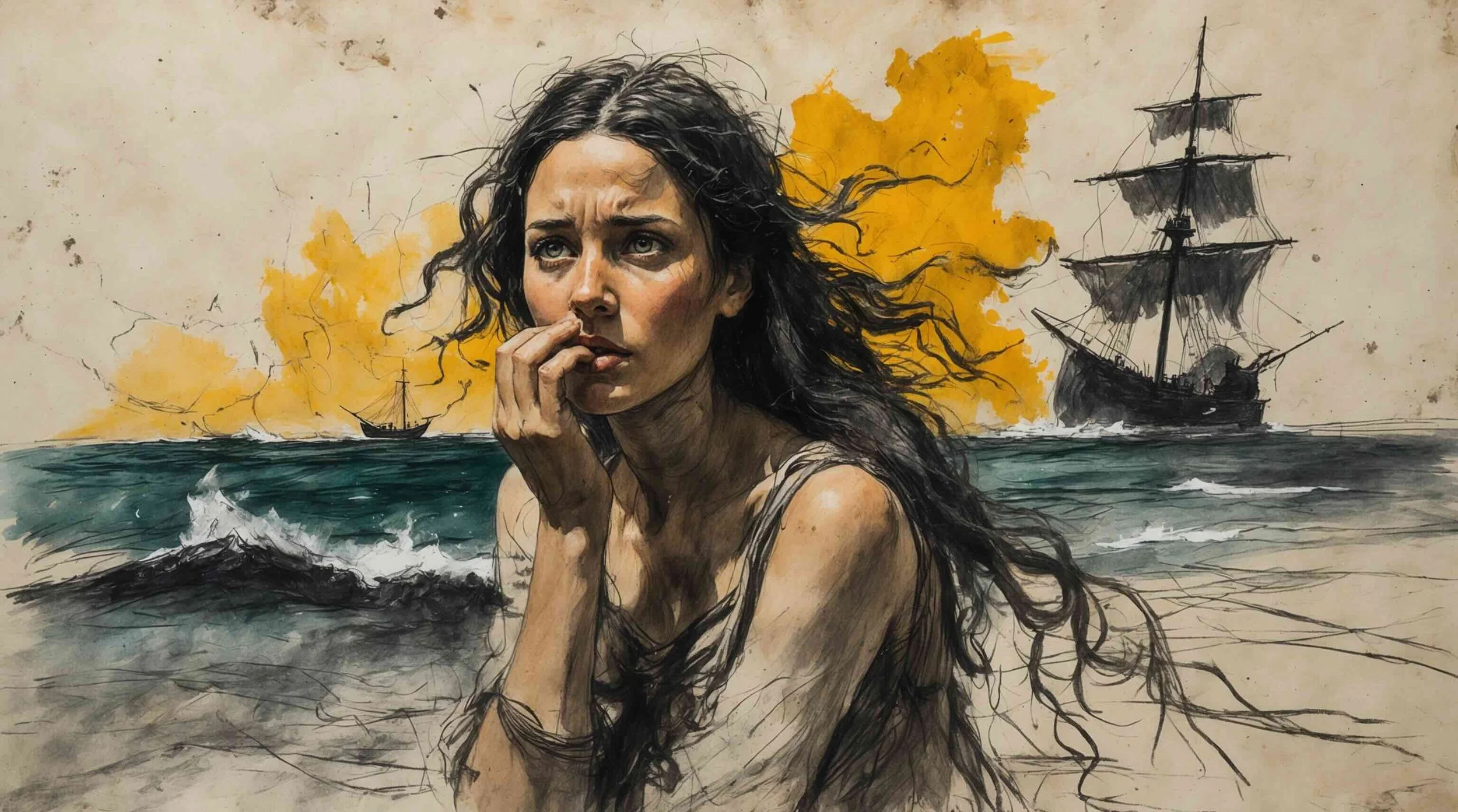
Character Profile – At a Glance
- Role: Prospero’s daughter, brought to the island at three and raised there alone. Now fifteen, she has seen only two men in her life, her father and Caliban, until the storm washes Ferdinand ashore.
- Key Traits: Compassionate, direct and quick-witted. Innocent of the world but not simple. She says what she feels, and the play rewards her for it.
- The Core Conflict: Miranda has been educated by her father and kept for him. Falling in love with Ferdinand is the first thing she has ever wanted for herself.
- Key Actions: Weeps for the sailors she thinks have drowned and begs her father to calm the storm (A1S2). Learns for the first time that she is a princess of Milan. Falls in love with Ferdinand on sight and pleads for him when Prospero threatens him. Offers to carry Ferdinand’s logs, tells him her name against orders, and proposes marriage (A3S1). Watches the masque. Beats Ferdinand at chess and greets the court of Naples as a brave new world (A5S1).
- Famous Quote:
"O brave new world,
That has such people in't!"
(Act 5, Scene 1) - The Outcome: Betrothed to Ferdinand and bound for Naples as its future queen. Her father corrects her wonder at the new world with three words: it is new to her.
The Girl Who Suffered With Them
Miranda’s first speech is a plea. She has watched a ship break up in the storm her father raised, and she asks him, if it was his doing, to stop it. What she describes is not the wreck but the sound of it, and what she feels is not fear but sympathy.
Original
O, I have suffered
With those that I saw suffer: a brave vessel,
Who had, no doubt, some noble creature in her,
Dashed all to pieces. O, the cry did knock
Against my very heart. Poor souls, they perished.
(Act 1, Scene 2)
Shakespeare Retold (Modern Verse)
Oh, I have suffered
With those I witnessed suffer on the ship,
Who had on board, no doubt, some noble person,
All smashed to bits. Oh, all their crying banged
Against my heart. Poor people, they all perished.
The word "suffered" is doing two jobs. She has suffered alongside the drowning men, and she has suffered their suffering, taken it into herself. It is a definition of compassion, and the play gives it to a girl who has never met a stranger. Prospero answers that no one was harmed, which is true; but the audience remembers that his daughter’s first instinct was to wish she had a god’s power so that she could have saved them. Her father has that power and used it to frighten them.
The scene that follows is the long story of their exile, and Miranda’s part in it is mostly to listen. But her interruptions matter. When Prospero asks whether the King of Naples’s conduct was that of a brother, she refuses to blame her grandmother for her uncle: good wombs, she says, have borne bad sons. It is a fifteen-year-old telling her father that families are not simple. He has no answer, and moves on.
Good Wombs Have Borne Bad Sons
Miranda is often played as a wide-eyed innocent, and the text gives some support to that. She has never seen a woman other than herself in a mirror. She thinks Ferdinand is a spirit. She does not know what a king is until she is told she is the daughter of a duke. But innocence in this play is not the same as stupidity, and Miranda’s replies to her father are consistently sharper than his questions.
Original
I should sin
To think but nobly of my grandmother:
Good wombs have borne bad sons.
(Act 1, Scene 2)
Shakespeare Retold (Modern Verse)
I would be wrong
To think other than warmly of my grandma:
Good wombs have borne bad sons.
This is a proverb, and Miranda uses it like a lawyer. Prospero has just invited her to conclude that his brother Antonio could not really be a brother at all. She declines. Bad sons come from good mothers; wickedness is not an argument against kinship. She is, without saying so, refusing to let her father write Antonio out of the family, and by the end of the play Prospero will have come round to her position, forgiving the brother he cannot bear to name.
The same quickness shows in the log scene, where she offers to do Ferdinand’s work for him and argues that she would find it easier because she wants to do it and he does not; and in the chess scene, where she accuses him of cheating and forgives him in the same breath. Miranda is inexperienced. She is not slow.
The Third Man She Ever Saw
When Ferdinand walks in, led by Ariel’s music, Miranda takes him for a spirit. Her father corrects her: it eats and sleeps and has senses like ours. Ferdinand, meanwhile, has taken her for a goddess. Within twenty lines they have, as Prospero says, changed eyes, and Prospero decides to make it difficult for them.
Original
Why speaks my father so ungently? This
Is the third man that e'er I saw, the first
That e'er I sighed for: pity move my father
To be inclined my way!
(Act 1, Scene 2)
Shakespeare Retold (Modern Verse)
Why is my father speaking rudely? This is
The third man I have ever seen, and first man
I’ve ever craved. I hope he sympathises
With how I feel!
The count is exact and touching. Two men in her life, and this is the first she has sighed for. Everything Miranda does for the rest of the scene follows from that sigh. She pleads for Ferdinand when Prospero calls him a traitor, offers herself as his guarantor, and clings to her father’s clothes until he threatens to hate her. When Prospero tells her that most men would make Ferdinand look like Caliban, she answers that her affections are then most humble; she has no ambition to see a better man.
It is easy to read this as a girl who does what her father has arranged for her to do, and in one sense she is. Prospero planned the meeting and is pleased with the result. But the play lets Miranda disobey him in every small way it can. Her love is arranged; her defiance is her own.
O Brave New World
Miranda’s last speech is the one everyone knows, and it is often quoted without the reply that follows it. Prospero has opened his cell to show the court of Naples his daughter playing chess with the son they thought was drowned. Miranda looks up and sees, for the first time, a crowd of people.
Original
O, wonder!
How many goodly creatures are there here!
How beauteous mankind is! O brave new world,
That has such people in't!
(Act 5, Scene 1)
Shakespeare Retold (Modern Verse)
Oh, wow!
How many gorgeous men are standing here!
How beautiful mankind is! Luscious world,
That has such men in it!
The people she is admiring include Antonio, who tried to have her drowned as a baby, and Sebastian, who tried to murder his own brother two days ago. Prospero’s answer, that it is new to her, is one of the driest lines in Shakespeare: three words that contain everything he knows and she does not. Aldous Huxley took the phrase for the title of his 1932 novel, and the irony has stuck to it ever since.
But the irony is not the whole point. Miranda is right about mankind in the only way she can be, which is that she has never seen it. Her wonder is the wonder of a person meeting the world without any of the reasons to be disappointed in it. Prospero, who has all of the reasons, has just chosen to forgive the men she is admiring. Between her innocence and his experience, the play finds its ending. The theme of illusion and reality runs through the whole of The Tempest, and here, at the last, Miranda is the one character who is not deceived. She simply does not yet know what she is looking at.
"Ariel has in everything the airy tint which gives the name; and it is worthy of remark that Miranda is never directly brought into comparison with Ariel, lest the natural and human of the one and the supernatural of the other should tend to neutralize each other."
— Samuel Taylor Coleridge, Notes on The Tempest, 1818
Key Quotes
Quote 1
There's nothing ill can dwell in such a temple:
If the ill spirit have so fair a house,
Good things will strive to dwell with't.
(Act 1, Scene 2)
Shakespeare Retold (Modern Verse)
Such evil cannot live in one so gorgeous:
For if the devil dwelt somewhere so lovely,
Good things would fight to live there.
Quote Analysis: Miranda’s answer when her father calls Ferdinand a traitor and a spy. The argument is that beauty is a house and evil could not bear to live in it: if a bad spirit had so fair a dwelling, good things would fight to move in. It is a piece of Renaissance reasoning that connected outer beauty with inner virtue, and the play knows it is not always true. Miranda applies the same logic to the court of Naples in Act 5, and is wrong about at least two of them. But about Ferdinand she is right, and the speech shows how she thinks: from what she sees, directly, to what she believes.
I do not know
One of my sex; no woman's face remember,
Save, from my glass, mine own...
(Act 3, Scene 1)
Shakespeare Retold (Modern Verse)
I don’t know
Another lady; I’ve not seen a woman,
Except me in the mirror...
Quote Analysis: The most extraordinary thing Miranda says, delivered without any sense that it is extraordinary. She has no memory of another woman’s face; the only one she knows is her own, in a mirror. It is a line about total isolation, and Shakespeare puts it in the middle of a love scene, where it becomes a line about total honesty. Miranda cannot compare Ferdinand to other men because she has none to compare him with, so she says so. The speech that follows, in which she swears by her modesty that she wants no companion in the world but him, is the more believable for it.
I am your wife, if you will marry me;
If not, I'll die your maid: to be your fellow
You may deny me; but I'll be your servant,
Whether you will or no.
(Act 3, Scene 1)
Shakespeare Retold (Modern Verse)
I’ll be your wife, if you will marry me;
If not, I’ll die a virgin. As your wife,
You’re free to turn me down; but I will serve you,
If you say yes or no.
Quote Analysis: Miranda proposes. She has just told herself to stop being bashful and speak plainly, and this is what plainness produces: a marriage offer in one line, a fallback in the second, and a promise in the third and fourth that she will serve him whether he agrees or not. Ferdinand, who has been playing the courtly lover with speeches about full souls and peerless perfection, is answered in language a child could follow. It is the moment the scene stops being about wooing and becomes about two people deciding something.
My affections
Are then most humble; I have no ambition
To see a goodlier man.
(Act 1, Scene 2)
Shakespeare Retold (Modern Verse)
My love is
Most humble then, for I have no desire
To see a finer man.
Quote Analysis: Prospero has just told his daughter that Ferdinand is a Caliban next to most men. This is her reply, and it is a small masterpiece of not arguing. She does not say he is wrong; she says that if he is right, her affections are humble ones, and she is content with that. There is a stubbornness under the meekness. Miranda has decided, and she has found a way to say so that her father cannot punish. It is the first sign of the woman who will, two acts later, propose marriage herself.
Key Takeaways
- Compassion First: Her first speech is grief for strangers she thinks have drowned. She wishes for a god's power to save them; her father has it, and uses it to frighten them.
- Not Simple: She has never seen another woman, but she out-argues her father on family, offers to carry the logs, and beats Ferdinand at chess.
- Arranged and Her Own: Prospero plans her meeting with Ferdinand. Her defiance of him afterwards, and her proposal of marriage, are her own.
- New to Thee: Her wonder at the brave new world is answered by her father in three words. She admires men who tried to murder each other, and she is not wrong to.
Study Questions and Analysis
Is Miranda a passive character?
She is often played that way, and the case is not hard to make. She is put to sleep when her father wants privacy, woken when he wants a witness, and matched with a husband she has been steered towards by magic. She speaks less than any other major character, and much of what she says is a reaction to what men say first.
The case against needs closer reading, and it starts in the log scene. Ferdinand is doing forced labour; Miranda arrives, tells him to rest, and then makes an offer that no other Shakespearean heroine makes to a lover:
If you'll sit down,
I'll bear your logs the while: pray, give me that;
I'll carry it to the pile.
(Act 3, Scene 1)
Shakespeare Retold (Modern Verse)
If you’ll sit down,
I’ll lift some of your logs: please, give me that;
I’ll carry it to the pile.
She means it. When he refuses, she argues that she would do the work more easily than he would, because she wants to and he does not. A few lines later she tells him her name, which her father has forbidden; and a few lines after that she proposes to him. All three are choices, and all three are disobedient. Prospero, watching unseen, is delighted, but that does not make the choices his.
Lorie Jerrell Leininger’s essay "The Miranda Trap" (1980) is the strongest statement of the passive reading: Miranda exists, on this account, to be the bait that catches Ferdinand and the innocent who justifies Caliban’s enslavement, and the play never lets her be anything else. Ania Loomba, in Gender, Race, Renaissance Drama (1989), took the point further, arguing that the accusation of attempted rape does double work, defining Caliban as a beast and Miranda as a possession in need of guarding. Stephen Orgel’s "Prospero’s Wife" (1984) noted that Miranda’s mother is mentioned once and never named, and read her daughter as a figure surrounded by the silence of the play’s missing women. Against all of that stands the log scene, and the chess scene, and the woman who says "I am your wife, if you will marry me". Miranda is confined. She is not passive within her confinement.
Why does Miranda fall in love with Ferdinand so quickly?
Because she has been arranged to, and because she would have anyway. Both answers are in the text. Prospero has planned the meeting: he tells Ariel that the lovers have changed eyes and promises to free him for it, which means the music that led Ferdinand to Miranda was magic in the service of a match. But the play is careful to show Miranda’s reaction before her father has said a word to her about it:
I might call him
A thing divine, for nothing natural
I ever saw so noble.
(Act 1, Scene 2)
Shakespeare Retold (Modern Verse)
I might say
He is divine, for I’ve seen nothing living
That looked so noble.
She has seen two men in her life, and one of them is Caliban. Ferdinand is a prince who has just survived a shipwreck and walked in to music. It would be stranger if she did not fall in love. What the speed does is expose the question the play keeps asking about her: whether a feeling that has been engineered can also be real. Miranda’s answer, in the log scene, is to make the feeling her own by acting on it against orders.
William Hazlitt, in Characters of Shakespear’s Plays (1817), described her as "Miranda ('worthy of that name') to whom all the power of his art points, and who seems the goddess of the isle", which catches the way the play frames her for Ferdinand before she has spoken. John Dryden’s preface to his 1670 adaptation with Davenant records that they added a counterpart to her, "a man who had never seen a woman", so that the two innocences could set each other off; the Restoration evidently found a girl who fell in love with the third man she ever saw less a problem than an opportunity. The speed is the point. Miranda has no defences against Ferdinand because she has never needed any, and the play treats that as a kind of grace rather than a weakness.
Does Miranda or Prospero speak the "Abhorred slave" speech?
In the 1623 Folio, the only early text of the play, the speech that begins "Abhorred slave" is given to Miranda. It is she who says she pitied Caliban, took pains to make him speak, and taught him each hour one thing or other; and it is she who calls his race vile and says he deserved his prison. For the Restoration and the eighteenth century that was unthinkable. Dryden and Davenant’s adaptation of 1667 moved the speech to Prospero, Theobald’s edition of 1733 did the same, and most editors followed for two hundred years.
Shakespeare Retold prints the speech as Prospero’s, in that tradition, and the reading pages on this site follow the book. It is worth knowing that the Folio disagrees, and why the difference matters. If the lines are Miranda’s, then the teacher who tried to civilise Caliban and failed is the girl he tried to rape, and the play’s harshest judgement on him comes from its gentlest character:
I pitied thee,
Took pains to make thee speak, taught thee each hour
One thing or other...
(Prospero, Act 1, Scene 2)
Shakespeare Retold (Modern Verse)
I pitied you,
Worked hard to help you speak, taught you for hours
On many topics.
Frank Kermode’s Arden edition (1954) restored the speech to Miranda, and modern editions have generally kept it there, on the grounds that the Folio is the only authority and that nothing in the speech is impossible for her. The objection that the language is too fierce for a gentle girl says more about eighteenth-century ideas of gentleness than about Miranda, who curses no one but has already, in this scene, called Caliban a villain she does not love to look on. Students writing about the scene should say which text they are using. Either way, the speech is the moment the island’s only two young people are set against each other, and the attempt to teach Caliban is remembered as a kindness that failed because of what he was, not because of how it was done.
What does "O brave new world" mean, and why is it ironic?
"Brave" in Shakespeare’s English means fine, splendid, admirable; it has nothing to do with courage. Miranda is saying that the world is wonderful because it contains such beautiful people. She has just seen, for the first time, more than three human beings in one place, and the people she is admiring are the King of Naples and his court.
The irony is that the audience knows who they are. Antonio deposed her father and put her in a leaking boat as a baby. Sebastian tried to murder his brother the day before. Alonso was party to the original plot. Miranda’s wonder is aimed at the least wonderful men in the play, and her father’s reply is a correction so gentle it is easy to miss: it is new to her. The world is not brave. It is only new.
Aldous Huxley borrowed the phrase for the title of Brave New World in 1932, and since then it has been almost impossible to hear it without irony. But Shakespeare’s irony is kinder than Huxley’s. Miranda is not a fool, and the men she admires have, most of them, just been forgiven. The line sits at the point where the play’s treatment of illusion and reality turns. Everyone else on the island has been deceived by Prospero’s magic; Miranda alone is deceived by nothing but inexperience, and inexperience, unlike enchantment, can be cured. Anne Barton, in her New Penguin introduction (1968), called The Tempest "an extraordinarily obliging work of art" that "will lend itself to almost any interpretation", and Miranda’s line is a good test of the claim. Read it as innocence, as irony, or as prophecy, and the play will let you.
How does Prospero control Miranda?
Completely, and with love, and the play does not treat those as opposites. He is the only teacher she has ever had; he has told her, in this very scene, that she has learned more from him than princesses with more time and worse tutors. He decides when she will learn her own history. And when he has told her enough, he decides when she will stop listening:
Thou art inclined to sleep; 'tis a good dulness,
And give it way: I know thou canst not choose.
(Prospero, Act 1, Scene 2)
Shakespeare Retold (Modern Verse)
You look like you are sleepy; that’s a good thing,
So let it be – I know you cannot fight it.
She sleeps because he makes her, and wakes when he tells her to. He then arranges for her to meet Ferdinand, stage-manages the meeting from a distance, and eavesdrops on the love scene that follows. Even the wedding masque is his gift, and it ends when he chooses. Miranda’s life on the island has been a series of things her father decided.
Stephen Orgel’s essay "Prospero’s Wife" (1984) argued that the play is organised around absent women, and that Prospero has, in effect, taken over both parents’ roles: he is Miranda’s father, mother and schoolmaster, and no one is left to speak for her. Ania Loomba (1989) read the arrangement politically, seeing in Prospero’s treatment of both Miranda and Caliban the same pattern of possession dressed as protection. The play, to its credit, lets Miranda answer. Her refusal to blame her grandmother for her uncle, her offer to carry the logs, her proposal of marriage and her cheerful accusation of cheating at chess are all small acts of independence performed inside a cage she cannot see. That she cannot see it is Prospero’s doing. That she keeps performing them is hers.
What does Miranda’s name mean?
It is Latin, and it means "she who must be admired", or simply "wonderful". Shakespeare seems to have coined it for the play; there is no earlier record of it as a name. The point is made inside the text, when Ferdinand hears it for the first time:
Admired Miranda!
Indeed the top of admiration! Worth
What's dearest to the world!
(Ferdinand, Act 3, Scene 1)
Shakespeare Retold (Modern Verse)
Miranda!
Surpassing admiration! You are worth
The greatest treasure in the world!
The name and the response to it are the same word, and Ferdinand says so. Miranda is the girl who must be admired, and Ferdinand is admiring her. Her own first word on seeing the court in Act 5 is "wonder", which is her name again, turned outward: the admired one admiring. Prospero’s answer to that speech, that the world is new to her, quietly reminds the audience that wonder is a feeling that belongs to the inexperienced.
William Hazlitt noticed the pun in 1817, calling her "Miranda ('worthy of that name')" and describing her as the figure "to whom all the power of his art points". The name fixes her role. She exists, in the play’s design, to be looked at with wonder, first by Ferdinand and then by the audience, and the question the play leaves open is whether that is a privilege or a limit. The names around her are worth noticing too. Prospero means "fortunate"; Caliban’s is usually taken as an anagram of "cannibal"; Ariel is the airy spirit. Shakespeare named the island’s inhabitants for what they are, and Miranda’s name tells us she is there to be wondered at.
What does the chess scene tell us about Miranda?
That she has grown up. It is her last scene, and Shakespeare gives her four lines in it before the famous speech, and they are the most adult lines she has. Prospero pulls back the entrance to his cell and shows the court of Naples the lovers at a board game:
MIRANDA: Sweet lord, you play me false.
FERDINAND: No, my dear'st love,
I would not for the world.
MIRANDA: Yes, for a score of kingdoms you should wrangle,
And I would call it, fair play.
(Act 5, Scene 1)
Shakespeare Retold (Modern Verse)
MIRANDA: Dear lord, you’re cheating me.
FERDINAND: I’m not, my love,
I would not for the world.
MIRANDA: You’d cheat to win the rule of twenty kingdoms
And I would say that’s fair.
She accuses Ferdinand of cheating; he denies it; she says he would cheat for twenty kingdoms and she would call it fair. This is teasing, and it is also a statement of terms. Miranda knows that the man she is marrying is a prince who will one day play for kingdoms, and she is telling him, lightly, that she will be on his side when he does. The girl who could not imagine any companion but him has become a woman who can imagine what he might do and forgive it in advance.
Chess in the period was a game of kings and dynasties, and the picture Prospero reveals is a political one: the heir of Naples and the heir of Milan at a board, with the crowns of both about to be joined. Stephen Orgel, in his Oxford edition (1987), read the whole final act as the restoration of a political order rather than a private reconciliation, and the chess tableau supports him. But the lines themselves are private. They are the only exchange in the play between Miranda and Ferdinand that Prospero did not arrange, and the only one in which she is plainly the cleverer of the two. It is a small scene. It is also the closest thing she gets to a future.