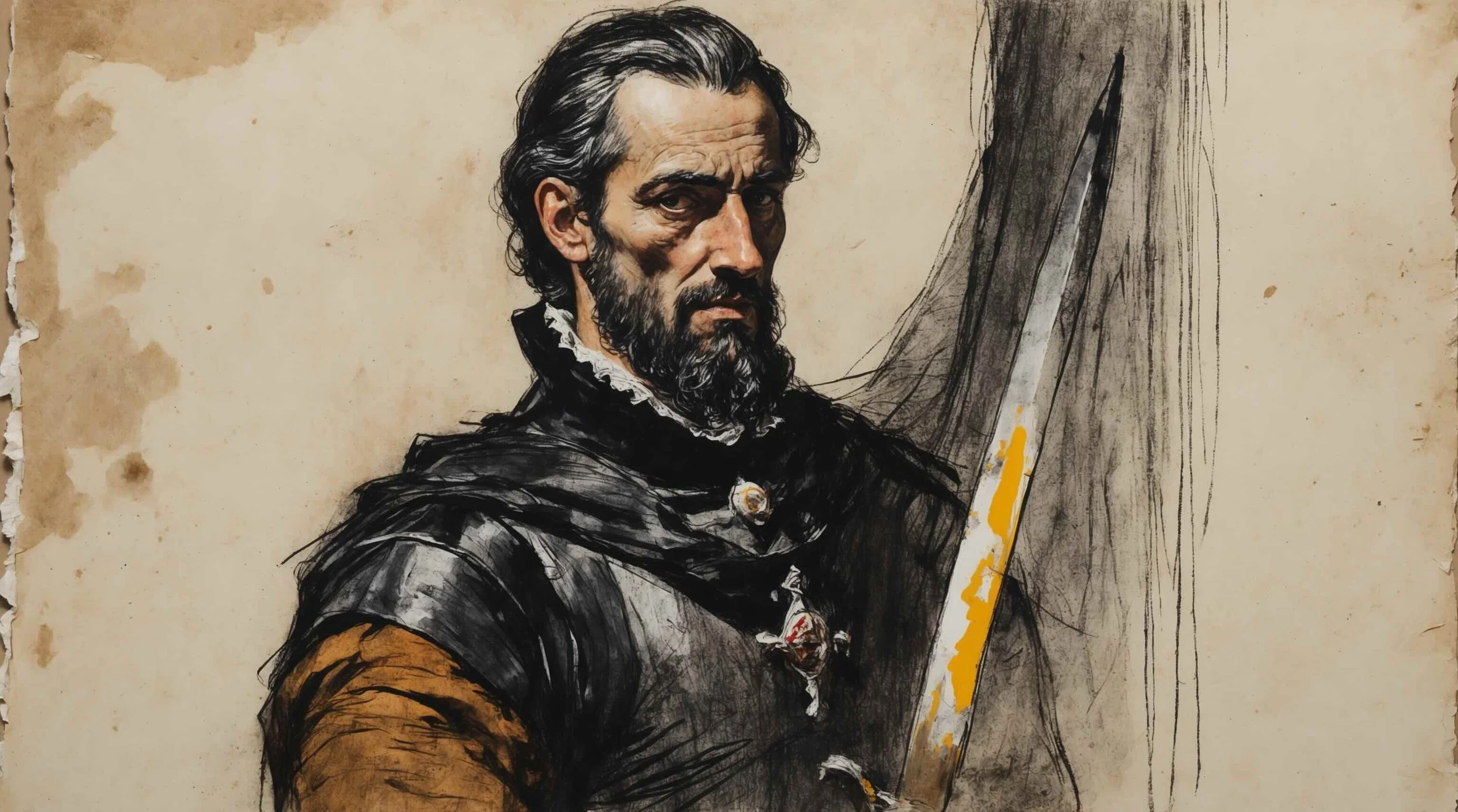
Character Profile – At a Glance
- Role: Prospero’s younger brother and the usurping Duke of Milan. Twelve years ago he took the dukedom his brother had left him to manage, with Alonso’s army, and put Prospero and the infant Miranda to sea in a rotten boat. On the island he tries to do it again.
- Key Traits: Witty, cold and entirely without remorse. The best talker in the court and the worst man in it. He never explains himself and never apologises.
- The Core Conflict: Antonio has got away with one usurpation and sees the chance of a second. Prospero’s magic stops the plot; nothing in the play stops the man.
- Key Actions: Abuses the boatswain in the storm (A1S1). Mocks Gonzalo’s every word on the island (A2S1). Talks Sebastian into murdering the sleeping king and his counsellor, and draws his sword to do it, until Ariel wakes them. Draws again on the harpy (A3S3). Is forgiven by Prospero, in words that make forgiveness sound like disgust, and says nothing in reply (A5S1). Speaks once more, to price Caliban as a fish.
- Famous Quote:
"Whereof what's past is prologue, what to come
In yours and my discharge."
(Act 2, Scene 1) - The Outcome: Forgiven and stripped of Milan, which he must restore to his brother. He does not repent, does not thank anyone, and sails home with his plot against the king known only to Prospero.
The Ivy That Hid My Princely Trunk
Antonio is described before he appears, and described by the man he wronged. Prospero’s account of the coup to Miranda is long and bitter, but it is also, if you listen, a study of how usurpation happens: not in a night but in years, by a deputy who learns the job better than the man who gave it to him.
Original
that now he was
The ivy which had hid my princely trunk,
And sucked my verdure out on't.
(Prospero, Act 1, Scene 2)
Shakespeare Retold (Modern Verse)
so that he now
Was like the ivy on my regal tree trunk,
That sucked the strength from me.
The image is exact. Ivy does not attack a tree; it grows on it, uses it for support, and slowly takes the light. Antonio learned how to grant suits and deny them, whom to promote and whom to cut back, and by the time Prospero looked up from his books the state answered to his brother’s tune. Prospero blames his own neglect as much as Antonio’s ambition, and the play lets both charges stand.
What is missing from the account is any word from Antonio himself. He never tells his side of the story; he never says what it was like to run Milan for a duke who preferred his library. The theme of power and control in The Tempest begins with a man who took what was left lying about, and the play is not interested in whether he had a point. It is interested in what he did with it, which was to put a child in a boat.
Twenty Consciences
The plot against Alonso in Act 2 is the coup against Prospero played again, with Antonio now the tempter and Sebastian the pupil. It is Antonio’s longest scene and the only one in which we hear him think, and what we hear is a man for whom conscience is a foot complaint.
Original
Ay, sir; where lies that? If 'twere a kibe,
'Twould put me to my slipper: but I feel not
This deity in my bosom: twenty consciences,
That stand 'twixt me and Milan, candied be they
And melt ere they molest!
(Act 2, Scene 1)
Shakespeare Retold (Modern Verse)
I do; where is it? If it were a chilblain,
I’d put my slippers on; but I don’t feel
This conscience in my heart; twenty consciences
Between me and the dukedom of Milan
Could melt before they stop me!
Sebastian has asked, almost as an afterthought, about his conscience. Antonio’s reply is one of Shakespeare’s great villain speeches, and it works by refusing the question. A conscience would be a chilblain, an inconvenience that made him change his shoes; he does not feel one; and if twenty of them stood between him and Milan he would let them melt like sugar. There is no argument here, only a temperature. Antonio is a man in whom the moral faculty is not defeated but absent.
The speech is also very funny, which is part of what makes it frightening. Antonio is the wittiest man in the play, and his wit is entirely at the service of the worst thing he does. The theme of nature and nurture runs through The Tempest as a question about whether goodness can be taught; Antonio is the play’s evidence that it cannot always be, since he was nurtured at a court, by a brother who loved him, and it made no difference at all.
The Tempter
Antonio needs Sebastian to kill his brother, and he needs him to want to. The persuasion takes a hundred lines and is a small masterpiece of the art. He begins with flattery, moves to arithmetic, and ends by putting the sword in Sebastian’s hand and telling him who is lying at his feet.
Original
Here lies your brother,
No better than the earth he lies upon,
If he were that which now he's like, that's dead;
Whom I, with this obedient steel, three inches of it,
Can lay to bed for ever...
(Act 2, Scene 1)
Shakespeare Retold (Modern Verse)
Here’s your brother,
Who’s worth no more than earth he lies upon,
If he were like he seems now, only dead;
Whom I – with just three inches of my sword, –
Can put to bed forever...
The method is to make murder sound like housekeeping. The king is no better than the earth he lies on; three inches of steel will put him to bed for ever; Sebastian can do the same to Gonzalo, this ancient morsel, this Sir Prudence; and the rest will take suggestion as a cat laps milk. Nothing is called by its name. It is the language of a man who has done this before and found that the trick is not to think about it.
Sebastian says yes, and both men draw. What stops them is not conscience but Ariel, who wakes Gonzalo, who wakes the king. The plotters are left explaining a roar of lions that nobody else heard. The theme of illusion and reality in this play usually means Prospero deceiving others; here it is the villains who are caught in the open and forced to improvise a lie, and Antonio, for once, sounds rattled.
The Silence
Antonio’s last scene is famous for what he does not say. Prospero forgives him, in language that makes clear how much the forgiveness costs, and demands the dukedom back. Antonio does not answer. He is then addressed once more, with Sebastian, and told that Prospero could expose their plot and will not. Again, nothing. His only words in the whole of Act 5 come when Caliban and the drunks are driven in.
Original
Very like; one of them
Is a plain fish, and, no doubt, marketable.
(Act 5, Scene 1)
Shakespeare Retold (Modern Verse)
Maybe; one of them
Is obviously a fish, hence can be sold.
A joke about selling the monster: that is the sum of Antonio’s contribution to the reconciliation. Actors and directors have to decide what the silence means, and the text gives them nothing to go on. He may be sullen, or stunned, or calculating, or simply the same man he was in Act 2, waiting for the next opportunity. Shakespeare, who could have written him a speech of repentance or defiance in five minutes, wrote neither.
The effect is to leave the play’s happy ending with a hole in it. Everyone else is accounted for: Alonso repents, Gonzalo rejoices, Ferdinand and Miranda are betrothed, Ariel is freed. Antonio stands at the side of the stage with Milan taken from him and his crimes known, and gives no sign of having learned anything. The theme of revenge and forgiveness is completed by Prospero. Antonio’s silence is the play’s admission that forgiveness does not require the forgiven to change.
"The Tempest is an extraordinarily obliging work of art. It will lend itself to almost any interpretation, any set of meanings imposed upon it: it will even make them shine."
— Anne Barton, The Tempest (New Penguin Shakespeare), Introduction, 1968
Key Quotes
Quote 1
Hang, cur! Hang, you whoreson, insolent noisemaker!
We are less afraid to be drowned than thou art.
(Act 1, Scene 1)
Shakespeare Retold (Modern Verse)
Go hang yourself, mongrel! You son of a bitch! Snotty shouter!
We’re less afraid of drowning than you are.
Quote Analysis: Antonio’s first words in the play, shouted at a sailor who is trying to save his life. The boatswain has told the passengers to keep below because they are hindering the crew; Sebastian calls him a blasphemous dog; Antonio goes further and wishes him hanged. The claim that the lords are less afraid of drowning than the boatswain is pure bravado, and it tells us what Antonio is: a man who answers competence with contempt and danger with abuse. It is also the first time in the play that rank meets reality, and rank loses.
And look how well my garments sit upon me;
Much feater than before: my brother's servants
Were then my fellows; now they are my men.
(Act 2, Scene 1)
Shakespeare Retold (Modern Verse)
And look how fine my clothes look on me now;
Much better than before. My brother’s servants
Were once my equals; now they work for me.
Quote Analysis: Sebastian has reminded him that he supplanted his brother. Antonio’s answer is that the clothes fit. His brother’s servants were once his fellows and are now his men; the dukedom sits on him "much feater", more neatly, than before. It is a speech without a trace of guilt and with a good deal of satisfaction, and it is offered as encouragement: this is what usurpation feels like afterwards, and it feels fine. The garment image runs through the play, from the courtiers’ unstained clothes to the stolen finery that distracts Stephano, and here it is the robe of office, worn by a thief who has grown into it.
They'll take suggestion as a cat laps milk;
They'll tell the clock to any business that
We say befits the hour.
(Act 2, Scene 1)
Shakespeare Retold (Modern Verse)
Do as we say, like cats that lap up milk;
They’ll set the clock to any time we tell them
If we say it’s the truth.
Quote Analysis: The end of the persuasion, and Antonio’s theory of politics. Once the king and Gonzalo are dead, the rest of the court will accept whatever they are told; they will lap it up like milk, and tell the clock any time the new rulers say. It is a contemptuous view of other people and a practical one, and Antonio has evidence for it: he has already run Milan on the same principle for twelve years. The lines are cynical, but the play does not prove them wrong. The lords do follow whoever is in charge. The only thing that saves Alonso is a spirit.
I'll believe both;
And what does else want credit, come to me,
And I'll be sworn 'tis true: travellers ne'er did lie,
Though fools at home condemn 'em.
(Act 3, Scene 3)
Shakespeare Retold (Modern Verse)
I think that too;
All myths that want believing, come to me
And I will swear they’re true: travellers don’t lie,
Though fools at home dismiss them.
Quote Analysis: Spirits have just served a banquet and vanished, and Sebastian says he will now believe in unicorns and the phoenix. Antonio caps him: he will believe both, and anything else that wants credit, and swear that travellers never lie. It is a joke about the tall tales that came back from the New World, and it is delivered by a man who has just tried to commit murder and is unimpressed by magic. Nothing on the island frightens Antonio for long. Within twenty lines he is reminding Sebastian that they will try again tonight.
Key Takeaways
- The Ivy: He took Milan slowly, as a deputy who learned the job, and then in a night, with Naples's army. Prospero blames his own neglect too.
- No Conscience: Asked about his conscience, he compares it to a chilblain and says he does not feel one. The play believes him.
- The Coup Repeated: He talks Sebastian into killing Alonso by the same method he used on Milan. Ariel, not conscience, stops it.
- The Silence: Forgiven and stripped of the dukedom, he says nothing. His only line in Act 5 is a joke about selling Caliban.
Study Questions and Analysis
Why does Antonio never repent?
The honest answer is that Shakespeare chose not to write it. Every other wrongdoer in the play is given a turn: Alonso repents, Caliban promises to seek grace, even Stephano and Trinculo are sent off to tidy up. Antonio is forgiven in a speech that names what he is and asks nothing of him:
You, brother mine, that entertained ambition,
Expelled remorse and nature; who, with Sebastian,
Whose inward pinches therefore are most strong,
Would here have killed your king; I do forgive thee,
Unnatural though thou art. Their understanding...
(Prospero, Act 5, Scene 1)
Shakespeare Retold (Modern Verse)
My brother, driven by your wild ambition,
You spurned remorse and kinship; with Sebastian –
Whose bruises are the worst because of this –
You would have killed your king; I do forgive you,
Despite your evilness. Their clarity...
And he does not reply. It is the most striking silence in Shakespeare, and it has been read three ways. The first is that Antonio is unreformable, and the play knows it: some natures cannot be taught. The second is that he is biding his time, and the reconciliation is temporary. The third is that he is ashamed beyond speech, which is the kindest reading and the one with least support in the text, since the only thing he says afterwards is a joke about a fish.
Frank Kermode (1954) took the first view, placing Antonio with Sebastian as the play’s representatives of an evil that Prospero’s art can defeat but not convert. Jan Kott, in Shakespeare Our Contemporary (1964), took the second, reading the island as a place where history repeats and Antonio as the proof that it will: the plot he hatched in Act 2 is the coup of twelve years ago, and his silence in Act 5 is the coup of next year. W. H. Auden, in The Sea and the Mirror (1944), gave Antonio a poem that interrupts every other character’s, insisting that his will remains his own and outside Prospero’s design; Auden had clearly decided that the silence was defiance. The play itself decides nothing. It forgives Antonio and moves on, and lets the audience watch him not move.
How does Antonio persuade Sebastian to murder Alonso?
By stages, and without ever using the word. The king and his court have been charmed to sleep by Ariel; Antonio and Sebastian are awake; and Antonio begins by saying that he sees a crown dropping on Sebastian’s head. Sebastian, who is lazy and knows it, treats this as sleep-talk. Antonio insists:
I am more serious than my custom: you
Must be so too, if heed me; which to do
Trebles thee o'er.
(Act 2, Scene 1)
Shakespeare Retold (Modern Verse)
I’m being far more serious than usual,
And so should you, and listen to me, by which
Your power will treble.
Then the arithmetic. Ferdinand is drowned; the next heir is Claribel, who is in Tunis, ten leagues beyond man’s life; the space between her and Naples is so great that the crown falls, by geography, to the man standing here. When Sebastian raises the matter of Antonio’s own usurpation, Antonio turns it into a recommendation: look how well the garments fit. When Sebastian raises conscience, Antonio makes a joke about chilblains. And then he draws.
The persuasion is modelled on the temptation scenes of Shakespeare’s earlier plays, and readers have noticed how much it resembles Lady Macbeth working on Macbeth: the same flattery, the same appeal to manhood, the same contempt for hesitation. But Antonio is colder than Lady Macbeth and has no need to be brave, because he is not going to strike the king himself. Jan Kott (1964) saw the scene as the play’s thesis in miniature: power is taken by whoever will take it, and the taking is always the same. Frank Kermode (1954) read it as the intrusion of the old world’s politics into Prospero’s island, the evil that came ashore with the court. Both agree on what Antonio is doing. He is teaching, and Sebastian is a quick pupil.
Is Antonio a Machiavellian villain?
He is the closest the play comes to one, and the type was well established on the English stage by 1611: the politician who treats power as a craft and morality as a story for other people. Antonio’s speeches in the plot scene have all the marks. He is contemptuous of the men he plans to kill, and of the men who will accept the killing:
Thus, sir:
Although this lord of weak remembrance, this,
Who shall be of as little memory
When he is earthed...
(Act 2, Scene 1)
Shakespeare Retold (Modern Verse)
Well, it is this, sir:
Although this lord has awful memory,
And no one will remember him at all
When he is dead...
Gonzalo, who is trying to keep the king’s spirits up, is a lord of weak remembrance who will be forgotten as soon as he is buried. It is the voice of a man who has measured everyone in the room and found them useful or not. What Antonio lacks, and what makes him less than Iago or Richard III, is any interest in explaining himself. He has no soliloquy. He never tells us why he wanted Milan or what he thinks of his brother. He simply acts, and jokes, and acts again.
Frank Kermode (1954) read him as the play’s figure for a nature that nurture has failed to touch: raised at a court, trusted by a loving brother, and none the better for it. E. M. W. Tillyard, in Shakespeare’s Last Plays (1938), placed the play’s villainy in the past, in the coup that happens before the action starts, and saw the plot on the island as its echo. Paul Brown (1985) noticed something the older critics did not: that Antonio’s usurpation and Prospero’s seizure of the island are structurally the same act, and that the play forgives one and calls the other government. Antonio is a Machiavel. Whether he is the only one on the island is the question the post-colonial critics asked.
What does "What’s past is prologue" mean?
That everything that has happened so far has only been the introduction, and the real action is about to begin, and it is theirs to write. Antonio says it to Sebastian at the height of the persuasion: the shipwreck, the deaths, the whole strange business of the island have been the prologue; what comes next is in "yours and my discharge", their hands. It is a line about seizing the moment, and it has escaped the play to become a proverb.
Out of context the phrase sounds wise, even noble, and it is carved on the front of the National Archives building in Washington. In context it is a murderer’s pitch. The past that Antonio is treating as prologue includes his own theft of Milan, and the future he is offering Sebastian is a stabbed brother. The play’s treatment of power and control is full of such moments, where fine language is used to make a crime sound like a destiny.
There is a further irony that the audience can see and Antonio cannot. He is right that the past is prologue, but wrong about whose play it is. Everything that has happened on the island has been arranged by Prospero, and the murder Antonio is planning has already been foreseen and will be prevented in the next twenty lines. Jan Kott (1964) made this the centre of his reading: the island is a stage on which the same drama of usurpation is rehearsed, and the actors think they are improvising. Antonio’s best line is his most deluded. He believes he is writing the future, and he is speaking a part.
What is Sebastian’s role, and how does he differ from Antonio?
Sebastian is Alonso’s brother, and for most of Act 2 he is Antonio’s echo, sharing the jokes at Gonzalo’s expense and adding nothing of his own. He is cruel to the grieving king, telling him the loss of Ferdinand is his own fault for marrying Claribel to an African. But he is idle rather than ambitious; he describes himself as standing water, and he needs Antonio to teach him how to flow. Once taught, he is an apt pupil:
Thy case, dear friend,
Shall be my precedent; as thou got'st Milan,
I'll come by Naples.
(Sebastian, Act 2, Scene 1)
Shakespeare Retold (Modern Verse)
What you have done, friend,
Will be my precedent; as you won Milan,
I’ll conquer Naples.
The difference is that Sebastian has to be talked into it, and Antonio never did. Sebastian asks about conscience; Antonio answers. Sebastian needs a precedent; Antonio is one. In the last scene both are silent under Prospero’s forgiveness, but Sebastian gets in one line first, that the devil speaks in Prospero, which is at least a reaction. Antonio has none.
Sebastian has no page of his own on this site because the play gives him no life apart from Antonio’s. He is the demonstration that Antonio’s kind of evil is teachable, which is the dark side of the play’s argument about nature and nurture: nurture works, and it can work in either direction. Jan Kott (1964) treated the pair as the mechanism by which history repeats on the island, the old usurper training the new one. Frank Kermode (1954) grouped them together as the men of sin whom Prospero’s art can restrain but not redeem. The harpy names three men of sin, but only two of them are unrepentant at the end, and they are standing together.
How does Prospero deal with Antonio at the end?
He forgives him, takes Milan back, and keeps his secret. The forgiveness is delivered in the coldest terms in the play: to call Antonio brother would infect his mouth. The demand for the dukedom follows in the same sentence. And then, addressing Antonio and Sebastian together, Prospero tells them what he knows:
But you, my brace of lords, were I so minded,
I here could pluck his highness' frown upon you
And justify you traitors: at this time
I will tell no tales.
(Prospero, Act 5, Scene 1)
Shakespeare Retold (Modern Verse)
But you two lords, if I were so inclined,
I now could make the king be angry with you
And prove to him you’re traitors: but for now
I’ll keep it to myself.
This is mercy with a blade in it. Prospero could denounce the two of them to Alonso for the plot against his life, and chooses not to; but he lets them know that he could, and that the choice is his. Antonio is forgiven and also, from this moment, controlled. He will go back to Italy as a man whose brother knows enough to hang him.
Stephen Orgel’s Oxford edition (1987) read the ending as a political settlement rather than a reconciliation: Prospero gets Milan back, binds Naples to it by marriage, and neutralises the one man who might undo it, all without requiring anyone to be sorry. Anne Barton (1968) noticed how much the play leaves unexplained, and Antonio’s future is the largest of the blanks. He is not punished, not reformed, not even really answered. The theme of revenge and forgiveness in The Tempest is usually described as forgiveness triumphing over revenge, and for Alonso it is. For Antonio it is something narrower and more practical: a brother deciding that a silent enemy under observation is safer than a dead one.
Why does Antonio mock Gonzalo so relentlessly?
Because Gonzalo is good, and Antonio’s wit exists to make goodness look ridiculous. The mockery begins the moment they land and does not stop: every attempt Gonzalo makes to comfort the king, every observation about the grass or the air or the miracle of their dry clothes, is turned into a joke by Antonio and Sebastian in turn. They even bet on it:
Which, of he or Adrian, for a good wager, first begins to crow?
(Act 2, Scene 1)
Shakespeare Retold (Modern Verse)
Which one of them, him or Adrian, for a decent bet, will start the crowing chitchat first?
The scene is very funny, and it is meant to be, but the laughter has a purpose. Antonio is discrediting the one man on the island who will stand between him and the king. When he draws his sword, Gonzalo is the second target, this Sir Prudence who should not upbraid their course. The jokes have been the preparation. A counsellor who has been made a fool of for a hundred lines is easier to kill.
There is also a clash of philosophies. Gonzalo’s commonwealth speech, borrowed from Montaigne, imagines an island without commerce, magistrates, letters or sovereignty, where nature provides and everyone is innocent. Antonio’s answer, that the latter end of his commonwealth forgets the beginning, is the sharpest thing said against it: Gonzalo would be king of a place with no kings. Frank Kermode (1954) identified the Montaigne source and read the exchange as the play’s debate between an ideal nature and a fallen one, with Antonio speaking for the fall. Jan Kott (1964) simply sided with Antonio: the utopia is nonsense, and the play knows it. The theme of nature and nurture is being argued here in jokes, and the villain has the best lines. He usually does.