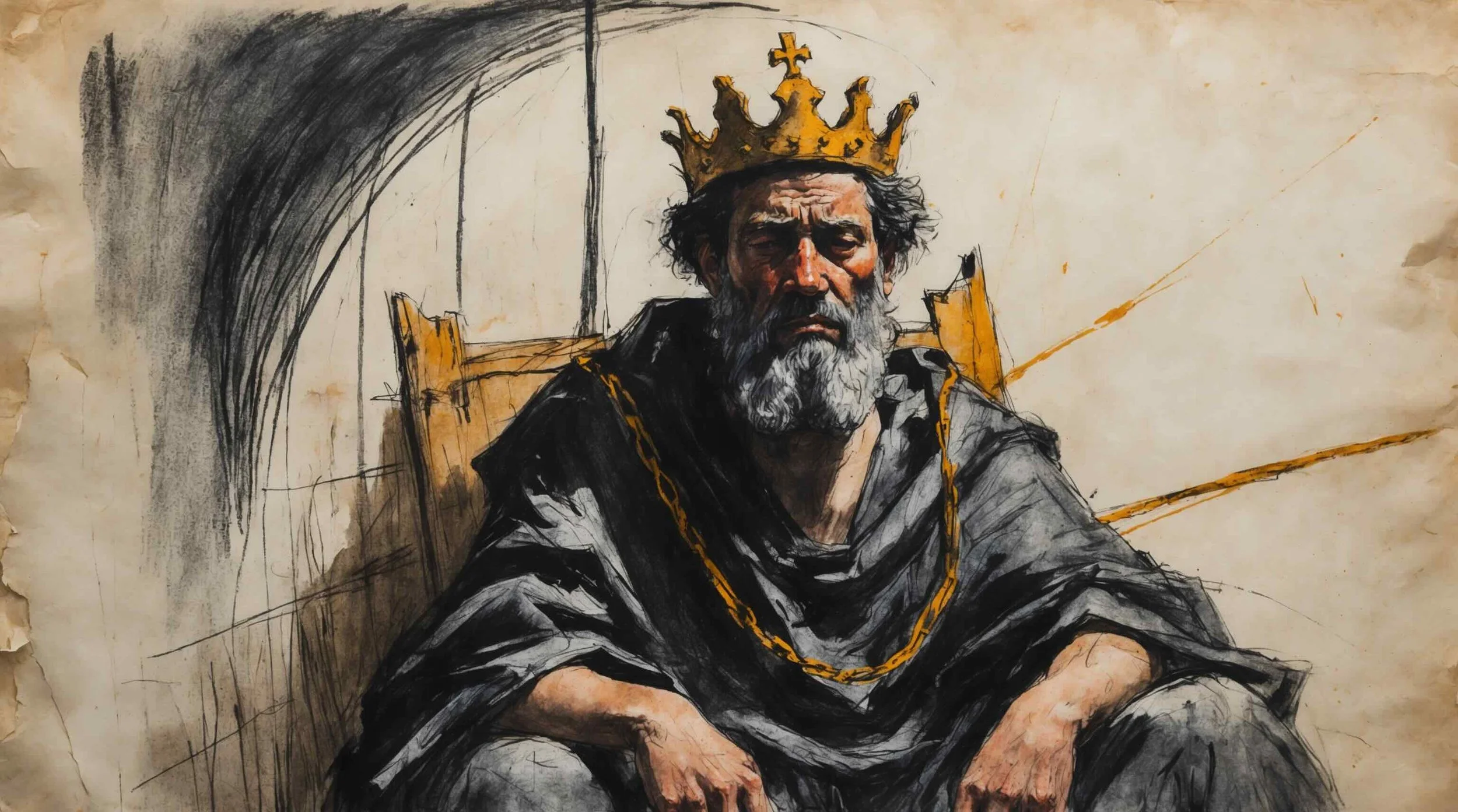
Character Profile – At a Glance
- Role: King of Naples, father of Ferdinand and Claribel. Twelve years ago he backed Antonio’s coup against Prospero in return for Milan’s homage. Now, sailing home from his daughter’s wedding in Tunis, he is wrecked on Prospero’s island and believes his son drowned.
- Key Traits: Grieving, guilty and tired. A king who has stopped giving orders. The only one of the three men of sin who repents, and he does it completely.
- The Core Conflict: Alonso has lost his son and does not yet know why. The play makes him understand that the loss is a judgement, and then gives the son back.
- Key Actions: Comes on deck in the storm and is told to keep below (A1S1). Refuses all comfort and blames himself for marrying Claribel to an African (A2S1). Sleeps while his brother Sebastian and Antonio plot to kill him. Gives up hope of finding Ferdinand (A3S3). Hears the harpy name his crime in the thunder and goes to drown himself. Meets the living Prospero, resigns his dukedom and asks pardon (A5S1). Sees Ferdinand alive at chess, and asks his child’s forgiveness.
- Famous Quote:
"O, it is monstrous, monstrous:
Methought the billows spoke and told me of it;
The winds did sing it to me, and the thunder,
That deep and dreadful organ-pipe, pronounced
The name of Prosper: it did bass my trespass."
(Act 3, Scene 3) - The Outcome: Reunited with Ferdinand, reconciled with Prospero, and father-in-law to the next Duchess of Milan. He sails home with the wrong he did undone, and his brother’s plot against him unspoken.
The King Who Would Not Be Comforted
For most of Act 2 Alonso says almost nothing. Gonzalo talks, Sebastian and Antonio mock, Adrian and Francisco fill in, and the king asks, three times, to be left alone. When he finally speaks at length it is to refuse the comfort he has been offered.
Original
You cram these words into mine ears against
The stomach of my sense. Would I had never
Married my daughter there! For, coming thence,
My son is lost and, in my rate, she too,
Who is so far from Italy removed
I ne'er again shall see her. O thou mine heir
Of Naples and of Milan, what strange fish
Hath made his meal on thee?
(Act 2, Scene 1)
Shakespeare Retold (Modern Verse)
You’re forcing me to hear these words although
I’ve no desire to hear them. I should never
Have had my daughter wed there! For, returning,
I’ve lost my son, and sort of lost my daughter,
For she is now so far from Italy
I won’t see her again. Oh, son and heir
Of Naples and Milan, what weird fish
Has eaten you?
This is the play’s picture of a man who has lost the thing he lived by. The wedding in Tunis, which should have been a triumph, has cost him both children: the daughter married out of reach, the son eaten by some strange fish. He does not rage or command. He asks why the words are being forced on him, and then he imagines the fish.
What Alonso cannot know is that the grief is being managed. Prospero arranged the wreck, Ariel landed Ferdinand alone, and the search on which the king has exhausted himself was never going to succeed. His son is a mile away, carrying logs and in love. The theme of illusion and reality in this play works on Alonso more cruelly than on anyone, because the illusion he is trapped in is his own bereavement.
Three Men of Sin
Alonso’s turning point comes at the banquet. Exhausted, he has just given up hope of finding Ferdinand when spirits bring in a feast; as he reaches for it, Ariel descends as a harpy, the food vanishes, and a voice names him one of three men of sin. It tells him what he did to Prospero twelve years ago, and it tells him that his son has been taken for it.
Original
Therefore my son i' the ooze is bedded, and
I'll seek him deeper than e'er plummet sounded
And with him there lie mudded.
(Act 3, Scene 3)
Shakespeare Retold (Modern Verse)
Because of that, my son lies in the ocean,
So I’ll go deeper now than any anchor
And lie there in the mud with him.
This is the reaction of a guilty man, not a frightened one. Sebastian and Antonio draw their swords on the air; Alonso hears his own crime in the thunder and goes to drown himself beside his son. The harpy’s speech was written by Prospero and performed by Ariel, and it is a lie in one respect: Ferdinand is alive. But the accusation is true, and Alonso is the only one of the three who receives it as true.
Gonzalo, watching, says that their great guilt, like poison given to work a great time after, has begun to bite. It is the play’s clearest statement of how conscience works: not at once, but when the body is worn down enough to feel it. The theme of revenge and forgiveness depends on someone being capable of remorse, and Alonso is the one the play chooses.
Thy Dukedom I Resign
When Prospero reveals himself, he does it to Alonso first, with an embrace and a welcome. The king’s response is astonishing in its speed. He does not yet believe this is Prospero; he does not know how it can be; but he gives back the dukedom before he has finished asking.
Original
Thy dukedom I resign and do entreat
Thou pardon me my wrongs. But how should Prospero
Be living and be here?
(Act 5, Scene 1)
Shakespeare Retold (Modern Verse)
I do resign my dukedom and I ask
That you forgive me for my wrongs. But how come
You’re living and you’re here?
Forgiveness in this play is Prospero’s to give, and the great speech about the rarer action is his. But the first act of restitution is Alonso’s, and it is made unprompted, to a man who might be a ghost. Everything Prospero has spent twelve years planning to recover is handed to him in a line and a half, by the one enemy who has learned what the plan was for.
It is worth comparing what Antonio does at the same moment, which is nothing. He is forgiven and does not thank his brother; he is told to restore the dukedom and does not answer. The play sets the two side by side. One king asks pardon before it is offered; one duke stays silent after it is given. The theme of power and control in The Tempest is not only about who holds it but about who can let it go, and Alonso is the only man on the island, apart from Prospero, who can.
A Glad Father
The reward comes at once. Prospero tells Alonso that he too lost a child in the tempest, lets him wish both children alive and ruling in Naples, and then opens his cell to show Ferdinand and Miranda at chess. Alonso’s response is the play’s happiest moment and also its most humbling.
Original
I am hers:
But, O, how oddly will it sound that I
Must ask my child forgiveness!
(Act 5, Scene 1)
Shakespeare Retold (Modern Verse)
I’m her father too, then.
But, oh, how strange it’s going to sound when I
Must ask my child forgiveness!
A king asking forgiveness of a child is a strange thing, and Alonso knows it: how oddly it will sound. He has just heard that Miranda is the daughter of the duke he helped depose; her marriage to his son means that the wrong he did is now inside his own family, and he cannot make it right without kneeling to the next generation. Prospero stops him. Let us not burden our remembrance with a heaviness that is gone.
The line completes the arc the harpy began. Alonso was told that lingering perdition would follow him unless he found heart-sorrow and a clear life; he has found the first, and the play gives him the second in the shape of a daughter-in-law. His last words in the play are a blessing on the couple and a curse on anyone who does not wish them joy. The man who refused all comfort in Act 2 ends by giving it.
"The Tempest is one of the most original and perfect of Shakespear’s productions, and he has shewn in it all the variety of his powers. It is full of grace and grandeur."
— William Hazlitt, Characters of Shakespear’s Plays, 1817
Key Quotes
Quote 1
Good boatswain, have care. Where's the master?
Play the men.
(Act 1, Scene 1)
Shakespeare Retold (Modern Verse)
Good bosun, take care. Where’s the master?
Put the men to work.
Quote Analysis: Alonso’s first words, and the first words of the court in the play. He comes on deck in a hurricane to ask where the master is and to tell the boatswain to make the men work, and the boatswain tells him to go below. It is a small scene and a large statement. On a sinking ship a king is a passenger, and his authority is worth nothing against the weather. The boatswain’s question, what cares these roarers for the name of king, hangs over the whole play, and Alonso is the first to hear it.
What, all so soon asleep! I wish mine eyes
Would, with themselves, shut up my thoughts: I find
They are inclined to do so.
(Act 2, Scene 1)
Shakespeare Retold (Modern Verse)
How come they’ve all dozed off so quickly! I wish
My eyes would shut and stop me thinking: I find
They want to close now.
Quote Analysis: The court has been charmed to sleep by Ariel, and Alonso, the last awake, wishes his eyes would shut up his thoughts as well. It is the wish of a man for whom consciousness has become a burden, and it is granted at once: he sleeps, and while he sleeps his brother draws a sword over him. The line also marks a pattern. Alonso spends much of the play wanting not to think, not to hear, not to be spoken to, and the play answers by making him hear the worst thing possible, his own name in the thunder.
Old lord, I cannot blame thee,
Who am myself attached with weariness,
To the dulling of my spirits: sit down, and rest.
Even here I will put off my hope and keep it
No longer for my flatterer: he is drowned
Whom thus we stray to find, and the sea mocks
Our frustrate search on land. Well, let him go.
(Act 3, Scene 3)
Shakespeare Retold (Modern Verse)
Old lord, I cannot blame you,
For I myself am feeling rather weary,
And downbeat: let’s all sit down here to rest.
Just here I’ll give up hope and won’t continue
To kid myself no longer: he has drowned
Whom we are looking for; the sea is laughing
At us for searching on the land. He’s gone.
Quote Analysis: Alonso gives up. Gonzalo has said his old bones can go no further, and the king agrees, and then goes further than agreement: he will put off his hope here and keep it no longer for his flatterer. Hope, in that phrase, is a courtier who has been telling him what he wanted to hear. The sea mocks their search on land. It is the lowest point of his part, and Shakespeare places the banquet and the harpy immediately after it, so that the man who has just let his son go is told, within a hundred lines, that the son was taken as a punishment.
A daughter?
O heavens, that they were living both in Naples,
The king and queen there! That they were, I wish
Myself were mudded in that oozy bed
Where my son lies. When did you lose your daughter?
(Act 5, Scene 1)
Shakespeare Retold (Modern Verse)
A daughter?
Oh God, I wish that they were both in Naples,
Ruling as king and queen! To do that, I wish
That I had drowned and lay within the seabed
Beside my son. When did you lose your daughter?
Quote Analysis: Prospero has told him that he too lost a daughter in the tempest, which is true in a sense Alonso cannot yet see: Miranda has been given to Ferdinand. Alonso’s response is to wish the two lost children alive and married and on the throne of Naples, and himself dead in their place. It is the wish Prospero has been waiting for. Everything the king asks for in these lines is about to be shown to him, and the speech works because the audience knows it and Alonso does not. He is offering to die for a thing that is already true.
Key Takeaways
- The Original Sin: He backed Antonio's coup for Milan's homage. The play makes him the one conspirator who is punished, because he is the one who can feel it.
- Grief as Judgement: He believes Ferdinand is drowned. The harpy tells him the drowning is a punishment for Prospero, and he accepts it.
- Restitution First: He resigns the dukedom before he is sure Prospero is alive. Antonio, offered forgiveness, says nothing.
- A Father Forgiven: He asks his child's forgiveness and blesses the marriage. The comfort he refused in Act 2 is the comfort he gives in Act 5.
Study Questions and Analysis
What is Alonso guilty of?
Of the coup. Twelve years before the play, Antonio could not take Milan alone; he needed an army, and he got one from the King of Naples in exchange for making Milan a tributary state. Prospero tells the story to Miranda in Act 1:
The King of Naples, being an enemy
To me inveterate, hearkens my brother's suit;
Which was, that he, in lieu o' the premises
Of homage and I know not how much tribute,
Should presently extirpate me and mine
Out of the dukedom and confer fair Milan
With all the honours on my brother...
(Prospero, Act 1, Scene 2)
Shakespeare Retold (Modern Verse)
The King of Naples, a sworn enemy
Of mine for ages, heard my brother’s plea;
Which was the King would offer in return
For my brother’s allegiance, and much money,
To soon eradicate me and my family
Out of the dukedom and award Milan
To be led by my brother...
Alonso did not depose Prospero himself, and he was not present when the duke and his crying child were put in a rotten boat. But he made the deposition possible, he profited from it, and he had, as Prospero says, been Prospero’s enemy for years. When the harpy names three men of sin, Alonso is named first, and he does not dispute it.
The guilt is old, and the play is interested in what old guilt does. E. M. W. Tillyard, in Shakespeare’s Last Plays (1938), saw the shape of all the late plays as prosperity, destruction and regeneration, with the destruction here happening before the play begins and reported rather than shown. Alonso’s crime belongs to that hidden first act. Frank Kermode (1954) noted that the play’s political plot, the usurpation and its reversal, is almost entirely in the past, and that what we watch is not the wrong but its consequences arriving. Alonso is the character through whom they arrive. His son is lost, his search fails, and the thunder tells him why.
Why is Alonso the only one of the three men of sin who repents?
Because he is the only one who has lost something. Antonio and Sebastian hear the same harpy and draw their swords; Alonso hears it and goes to drown himself. The difference is that the harpy speaks to him personally:
Thee of thy son, Alonso,
They have bereft; and do pronounce by me:
Lingering perdition, worse than any death
Can be at once, shall step by step attend
You and your ways...
(Ariel, Act 3, Scene 3)
Shakespeare Retold (Modern Verse)
That son of yours, Alonso,
The sea has taken; and it’s ordered me to
Inflict a drawn-out ruin, worse than death
Can ever be, and every step will happen
To you.
Antonio and Sebastian have nothing to lose but their lives, and they are told their swords cannot hurt the ministers of Fate. Alonso has already lost his son, and is now told why. Grief has prepared him for guilt in a way that fear could not prepare the others. Gonzalo says as much: their guilt is a poison given to work a great time after, and it is biting now because the body is worn down.
There is a second reason, which is structural. The play needs one repentant enemy for the reconciliation to mean anything, and Shakespeare chose the king rather than the brother. Jan Kott, in Shakespeare Our Contemporary (1964), read the island as a place where history is rehearsed and the same crimes repeat: the plot against Alonso in Act 2 is Antonio’s coup against Prospero played again, and Sebastian is Antonio’s apprentice. On that account Alonso’s repentance is the one thing that does not repeat. E. M. W. Tillyard (1938) would have called it regeneration, and placed it with the reunions of the other late plays. Either way, the play gives its remorse to the character who was, at the start, the least guilty of the three, and the most powerful. It is the king who kneels.
What is the significance of Claribel’s marriage to the King of Tunis?
It is the reason the court is at sea, and it is the wound Alonso is nursing when the play begins. He has married his daughter to an African king against, it seems, everyone’s advice, including hers, and Sebastian says so to his face:
Sir, you may thank yourself for this great loss,
That would not bless our Europe with your daughter,
But rather lose her to an African...
(Sebastian, Act 2, Scene 1)
Shakespeare Retold (Modern Verse)
It’s your fault that this tragedy occurred,
Holding your daughter from a European,
Wedding her to an African instead...
Sebastian goes on: they all knelt to him, the fair soul herself was torn between loathing and obedience, and Milan and Naples have more widows from the business than men to comfort them. It is a brutal speech to make to a grieving father, and Gonzalo says so. But Alonso does not deny it. He has already said he wishes he had never married his daughter there.
Claribel never appears, and she is one of the play’s three missing women. Stephen Orgel’s "Prospero’s Wife" (1984) grouped her with Prospero’s unnamed wife and the dead Sycorax as the absences around which the play’s men arrange themselves: the daughter given to Tunis is what makes Sebastian the next heir of Naples, and so what makes the murder plot possible. Ania Loomba, in Gender, Race, Renaissance Drama (1989), read Sebastian’s objection to "an African" as the play’s racial politics spoken aloud, the counterpart to Prospero’s contempt for Caliban. Alonso’s guilt about the marriage is, in the end, displaced: the harpy tells him he is being punished for Milan, not for Tunis. But the play lets him feel both, and it is the daughter he mourns first.
How does Alonso’s grief drive the plot?
It is the engine of the second act and the target of the third. Prospero has separated Ferdinand from his father so that each will believe the other drowned, and Alonso’s belief is the harder to shake. Francisco, who saw the prince swimming, tries:
Sir, he may live:
I saw him beat the surges under him,
And ride upon their backs...
(Francisco, Act 2, Scene 1)
Shakespeare Retold (Modern Verse)
He may still be alive:
I saw him fight the currents under him,
And surf upon the waves...
Alonso’s answer is three words: no, no, he’s gone. The refusal matters because everything that follows depends on it. It is grief that makes him refuse Gonzalo’s comfort, grief that makes him sleep while his brother plots, grief that makes him give up the search in Act 3, and grief that makes the harpy’s accusation land. A king who believed Francisco would have kept looking and might have found his son. Alonso does not, and so he is available to be judged.
E. M. W. Tillyard (1938) saw this as the mechanism of the late plays: a loss believed to be final, endured long enough to change the one who suffers it, and then reversed. Northrop Frye, in his 1959 introduction to the play, described the same movement in terms of comedy, with the apparent death as the low point from which a renewed society is built. What is unusual in The Tempest is that the loss is staged by a character inside the play. Prospero is doing to Alonso what the plot of Pericles or The Winter’s Tale does to its kings, and he is doing it on purpose. The grief is real. The cause of it is a trick.
What does Alonso’s meeting with Prospero reveal about him?
That he has stopped trusting his own senses, and that he is honest about it. Prospero presents himself as the wronged Duke of Milan and embraces him. Alonso’s reply begins with doubt:
Whether thou best he or no,
Or some enchanted trifle to abuse me,
As late I have been, I not know: thy pulse
Beats as of flesh and blood...
(Act 5, Scene 1)
Shakespeare Retold (Modern Verse)
If you’re him or not,
Or just another magic spell to trick me,
Which happened recently, I don’t know. Your pulse
Beats as a human heart...
He has been enchanted for three days, and he knows it: some enchanted trifle to abuse him, as late he has been. He checks the pulse. Then, still uncertain, he resigns the dukedom and asks pardon. The order of those actions is the point. Alonso restores what he took before he has established that the man in front of him is real, because the restitution is owed whether or not Prospero is alive to receive it.
Stephen Orgel’s Oxford edition (1987) read the final act as a political settlement, the restoration of Milan to its duke and the binding of Naples to it by marriage, and on that account Alonso’s resignation is a treaty. Anne Barton, in her New Penguin introduction (1968), was struck by how little the play explains: Alonso asks how Prospero can be living and here, and is told the story will keep for another time. The king’s next request is for the particulars of Prospero’s preservation; Prospero offers instead to show him a wonder. Alonso never does get the explanation, and does not seem to need it. He wanted to give the dukedom back. The rest is detail.
How does Alonso compare with Antonio and Sebastian?
They are the three men of sin, and the play gives them three different endings. Antonio, who did the wrong, is forgiven and says nothing. Sebastian, who tried to repeat it, is not forgiven at all, only warned. Alonso, who enabled it, repents, resigns, and is rewarded with his son. His last speech in the play is a blessing:
Give me your hands:
Let grief and sorrow still embrace his heart
That doth not wish you joy!
(Act 5, Scene 1)
Shakespeare Retold (Modern Verse)
Hold my hand:
Let sadness and unhappiness fall on him
That does not wish you joy!
The curse on anyone who does not wish the couple joy is aimed, whether Alonso knows it or not, at his own brother and the Duke of Milan, who are standing beside him and have just been sneering at Caliban. The king has crossed to Prospero’s side of the stage. Antonio and Sebastian have stayed where they were.
The contrast is the play’s argument about conscience. Frank Kermode (1954) saw Antonio and Sebastian as the play’s representatives of an evil that art cannot reform, and Alonso as the proof that it can reform some. Jan Kott (1964) was less hopeful, reading the two unrepentant lords as the sign that Prospero’s experiment has failed: history will repeat, and the next coup is already being planned by men who have been shown mercy and learned nothing. W. H. Auden, in The Sea and the Mirror (1944), gave each of the three a poem after the play, and Alonso’s is addressed to Ferdinand, a father’s advice to a son about how to hold a crown. Auden read him as the one who had learned something worth passing on. That is the difference the play draws. All three were told the same thing by the thunder. Only one of them was listening.
Is Alonso a weak king?
He is a king who has stopped ruling, which is not the same thing. In the storm he is told to go below and goes. On the island he asks to be left alone, sleeps while his brother plots, and lets Gonzalo do the talking. The old counsellor’s diagnosis is exact:
It is foul weather in us all, good sir,
When you are cloudy.
(Gonzalo, Act 2, Scene 1)
Shakespeare Retold (Modern Verse)
It makes us all feel sad, like awful weather,
When you are gloomy.
The court takes its weather from the king, and the king is cloudy. What has happened to Alonso is grief, and grief has made him passive. But passivity is what the play needs from him. A king who took charge on the island would have found his son, exposed his brother and never heard the harpy. Alonso’s weakness is what makes him available to be changed.
It is also, in the play’s scheme, a kind of strength. The men who act on the island, Antonio, Sebastian, Stephano, are all trying to seize something, and all of them fail. The men who wait, Alonso, Gonzalo, Ferdinand, are all rewarded. Jan Kott (1964) read that pattern darkly, as proof that on Prospero’s island nobody’s will counts but Prospero’s. Frank Kermode (1954) read it as the play’s moral: the good are those who submit to the discipline of art. Alonso submits. He gives the dukedom back without being asked, kneels to his own child, and blesses a marriage that joins his house to the man he wronged. The theme of power and control in The Tempest is finally about a king who learns that the one power left to him is to give things up, and uses it.