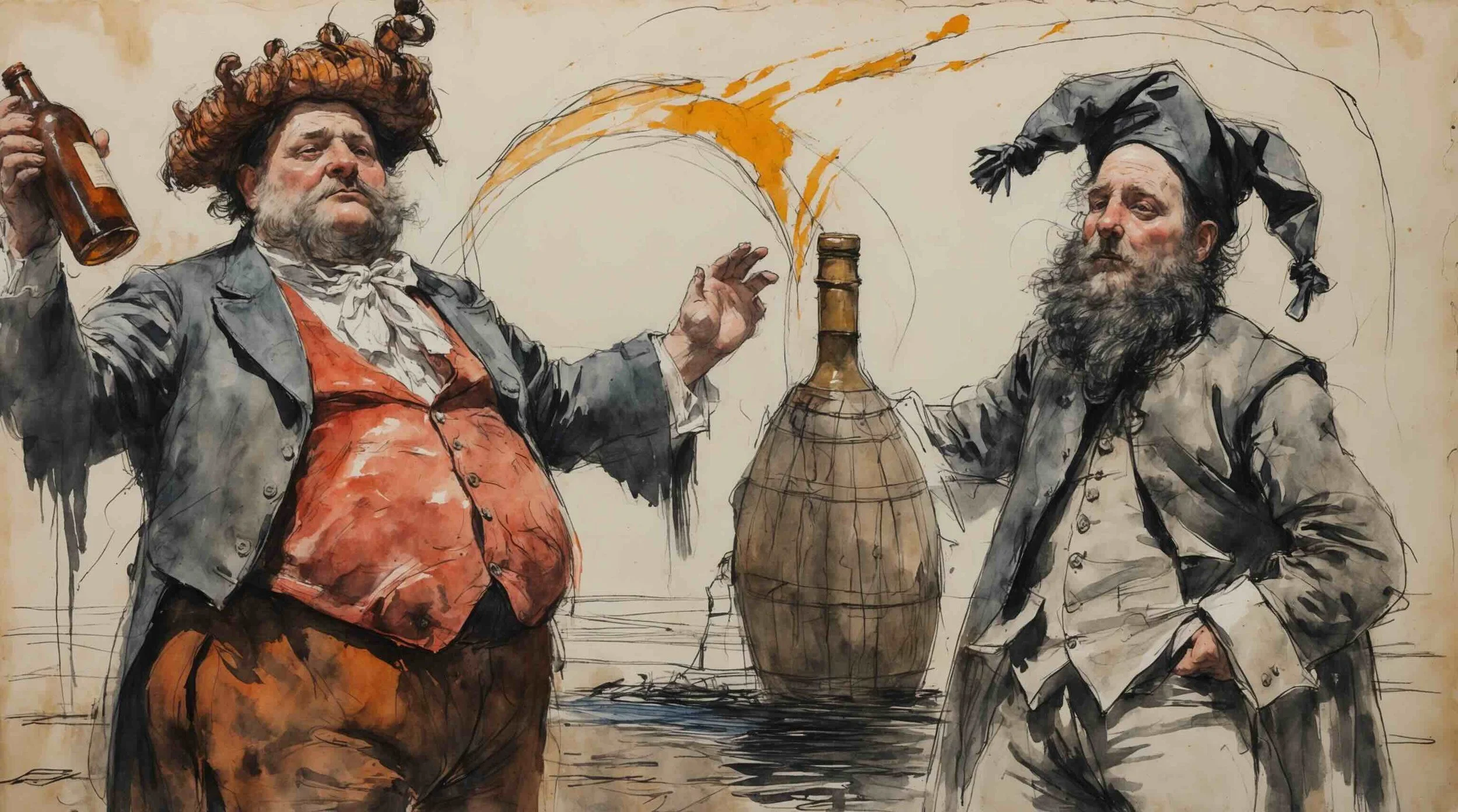
Character Profile – At a Glance
- Role: Alonso’s drunken butler and his jester, washed ashore separately and reunited under Caliban’s cloak. Stephano has a bottle and a barrel of wine; Trinculo has a sharp tongue. Between them they acquire a worshipper and a plan to murder Prospero and rule the island.
- Key Traits: Stephano: swaggering, greedy, easily crowned. Trinculo: cowardly, mocking, the one who sees the joke. Both drunk from their first scene to their last.
- The Core Conflict: A butler and a clown find themselves offered a kingdom by a monster who thinks they are gods. They take it seriously enough to plot a murder, and not seriously enough to stop for a wardrobe.
- Key Actions: Trinculo hides from the storm under what he takes to be a dead fish; Stephano arrives singing and pours wine into it (A2S2). They discover each other, and Caliban swears on the bottle to serve Stephano as his god. Stephano agrees to kill Prospero in his sleep and marry Miranda; Trinculo is beaten for saying what Ariel says (A3S2). They are led through briars into a stinking pool, distracted by glittering clothes, and hunted by spirit hounds (A4S1). Driven in before the court in their stolen finery, sore and reeling, and sent to tidy Prospero’s cell (A5S1).
- Famous Quote:
"misery acquaints a man with strange bed-fellows."
(Act 2, Scene 2) - The Outcome: Hunted, pinched, cramped and sobered. Alonso sends them to return the stolen clothes; Prospero sends them to trim his cell. They end the play as they began it, in service.
Two Neapolitans 'Scaped
The clowns enter one at a time, and each meets Caliban before he meets the other. Trinculo comes first, sheltering from a coming storm, and finds what looks like a dead islander under a cloak. He examines it as a showman would.
Original
What have we here? A man or a fish? Dead or alive? A fish: he smells like a fish...
(Act 2, Scene 2)
Shakespeare Retold (Modern Verse)
What have we here? Is it a man or a fish? Is it dead or alive? It’s a fish: he stinks like a fish...
The speech that follows is the play’s sharpest joke about England: at home, where nobody will give a coin to a lame beggar, they will pay ten to see a dead Indian, and this monster would make a man’s fortune. Trinculo is not being political, but Shakespeare is. The exhibiting of natives from the New World was a London entertainment, and the jester’s first instinct on finding one is to price him.
Then the thunder, and Trinculo crawls under the cloak beside the thing he has just been valuing. Stephano arrives singing a sea shanty, sees a creature with four legs and two voices, and pours wine into both mouths. The recognition scene, in which Trinculo is pulled out by the lesser legs and asked whether the moon-calf can vent Trinculos, is pure clowning, and it establishes the pair: Stephano acts, Trinculo comments, and neither is sober.
Kiss the Book
Stephano’s bottle is the play’s second magic. Prospero rules the island with a book and a staff; Stephano arrives with a bottle made of bark, and within a scene he has a subject who kneels to it. The parallel is exact, and the play makes it audible in the first thing Stephano says to the creature under the cloak.
Original
Come on your ways; open your mouth; here is that which will give language to you, cat: open your mouth; this will shake your shaking, I can tell you, and that soundly...
(Act 2, Scene 2)
Shakespeare Retold (Modern Verse)
Come along now, open your mouth; as the saying goes, ‘Some booze can make a cat talk’. Open your mouth; this will stop you shaking, I assure you, and it’s effective.
Something that will give language to you: it is what Prospero claimed to have done for Caliban in Act 1, and Stephano does it with sack. Caliban, who has never tasted wine, concludes that this is celestial liquor and the man who carries it a god dropped from the moon. Stephano, who is a butler and knows a good thing, accepts the worship and makes Caliban swear loyalty by kissing the bottle, as a witness kisses the Bible.
The theme of masters and servants is being played here as farce, and the farce is precise. Caliban exchanges a master who teaches him words for a master who gives him drink, and cannot see the difference; Stephano exchanges his post in Alonso’s cellar for a kingdom, and cannot see the joke. Trinculo can, and says so: a most ridiculous monster, to make a wonder of a poor drunkard. Nobody listens to Trinculo.
King Stephano
By Act 3 the joke has become a plot. Caliban proposes that Stephano kill Prospero in his afternoon sleep, take his books, and have his daughter, and Stephano, who has been drinking steadily since the wreck, thinks it over and agrees.
Original
Monster, I will kill this man: his daughter and I will be king and queen – save our graces! – and Trinculo and thyself shall be viceroys. Dost thou like the plot, Trinculo?
(Act 3, Scene 2)
Shakespeare Retold (Modern Verse)
Monster, I will kill this man. His daughter and I will be king and queen – God protect us! – and Trinculo and you will be viceroys. Do you like the plan, Trinculo?
The plan is a coup, with a royal marriage and a distribution of offices: Stephano king, Miranda queen, Trinculo and Caliban viceroys. It is, point for point, what Antonio and Sebastian are planning in the other half of the island, and what Antonio did to Prospero twelve years ago. The play runs the two conspiracies side by side, and the difference between them is that the lords are sober.
What keeps the scene from being merely silly is Ariel, invisible, saying "Thou liest" in Trinculo’s voice every time Caliban speaks. Stephano beats Trinculo for interrupting; Trinculo protests that he said nothing; the plot proceeds in a fog of misunderstanding that the audience can see through and the plotters cannot. The theme of illusion and reality in this play usually works through spectacle. Here it works through ventriloquism, and it turns a murder plot into a music-hall act.
The Frippery
The plot fails not because it is discovered but because the plotters cannot keep their minds on it. Ariel leads them through thorns into a filthy pool, they lose their bottles, and they arrive at Prospero’s cell wet and stinking. Then they see the clothes that Prospero has hung on a line as bait.
Original
O king Stephano! O peer! O worthy Stephano! Look what a wardrobe here is for thee!
(Act 4, Scene 1)
Shakespeare Retold (Modern Verse)
Oh, king Stephano! Oh noble, worthy Stephano! Look at all these clothes here for you!
Caliban begs them to leave the trash alone and do the murder first. They do not hear him. Stephano claims a gown, Trinculo puns about stealing by line and level, and both load Caliban with garments to carry off to the barrel. Then the hounds come. Prospero and Ariel set spirits in the shape of dogs on the three of them, with orders that goblins should grind their joints and cramp their sinews.
It is the most complete humiliation in the play, and it is also its most exact judgement. Stephano and Trinculo wanted a kingdom, and they were distracted from it by a jerkin. Caliban, who wanted his freedom, is the only one of the three who kept his eye on the object, and the play does not spare him either. The theme of power and control in The Tempest is finally about who is fit to hold it, and the answer the frippery scene gives is: not these.
"the delicate Ariel; the savage Caliban, half brute, half demon; the drunken ship’s crew — are all connected parts of the story, and can hardly be spared from the place they fill."
— William Hazlitt, Characters of Shakespear’s Plays, 1817
Key Quotes
Quote 1
The master, the swabber, the boatswain and I,
The gunner and his mate
Loved Mall, Meg and Marian and Margery,
But none of us cared for Kate;
For she had a tongue with a tang,
Would cry to a sailor, Go hang!
(Act 2, Scene 2)
Shakespeare Retold (Modern Verse)
‘The master, the deckhand, the bosun and I,
The gunner and his mate
Loved Mall, Meg and Marian and Margery,
But none of us cared for Kate;
For she spoke cruelly, with a tang,
And yelled at a sailor, ‘Go hang!’
Quote Analysis: Stephano’s entrance song, sung with a bottle in his hand on a shore he believes has drowned everyone he knows. It is a sailor’s catalogue of women and their tempers, and he calls it a scurvy tune to sing at a man’s funeral, and sings it anyway, and drinks. The song does two things. It tells us that Stephano is the kind of man who meets catastrophe with a chorus, and it brings into the play the world below decks, the swabber and the gunner and their girls in port, that the court never sees. Shakespeare gives the play’s first real music not to Ariel but to a drunk.
Were I in England now, as once I was, and had but this fish painted, not a holiday fool there but would give a piece of silver: there would this monster make a man; any strange beast there makes a man...
(Act 2, Scene 2)
Shakespeare Retold (Modern Verse)
If I was in England now, as once I was, and only had a painting of this fish, there’s not a silly fool there who wouldn’t give a silver coin to see it: in England, this monster would make me a fortune; any strange creature makes a man rich in England...
Quote Analysis: Trinculo’s reflection on finding Caliban, and the line in which the play looks straight at its own audience. In England, he says, a painted fish would draw a crowd and a strange beast makes a man’s fortune, though nobody there will give a small coin to a lame beggar. He is talking about the London of 1611, where Native Americans brought back by explorers were exhibited for money, and the joke is at the expense of the people paying to watch The Tempest. Trinculo is the clown, and the clown’s licence is to say what the play thinks about the house.
This will prove a brave kingdom to me, where I shall have my music for nothing.
(Act 3, Scene 2)
Shakespeare Retold (Modern Verse)
This will be a wonderful kingdom for me, where I shall have my music played for nothing.
Quote Analysis: Caliban has just delivered the most beautiful speech in the play, about an island full of noises and dreams of riches dropping from the clouds. This is Stephano’s response: what a fine kingdom, where the music is free. The gap between the two speeches is the whole of Stephano’s character. Caliban hears the island; Stephano hears the price. And the line points forward, because the music he is about to follow is Ariel’s, and it will lead him into a bog. Free music, on this island, is never free.
I have been in such a pickle since I saw you last that, I fear me, will never out of my bones: I shall not fear fly-blowing.
(Act 5, Scene 1)
Shakespeare Retold (Modern Verse)
I’ve been in such a state like this since I last saw you, and I fear now that I never will be sober: when dead, the flies won’t eat me.
Quote Analysis: Alonso asks how Trinculo came to be in such a pickle, meaning such a state, and Trinculo answers with the other meaning: he has been pickled in drink since the wreck, and is so well preserved that flies will not lay eggs in his corpse. It is the last joke in the play, and it is a good one, and it is made by a man who has been chased by dogs and cramped by goblins and is standing in stolen clothes in front of his king. Trinculo does not repent. He puns. That is what the play has always needed from him, and it lets him do it to the end.
Key Takeaways
- Butler and Jester: Stephano acts and Trinculo comments. Neither is sober, and the play never lets them be.
- The Bottle: Stephano's wine is the island's second magic. Caliban kneels to it as he once knelt to Prospero's words.
- A Coup in Miniature: Their plot to kill Prospero mirrors Antonio's against Alonso. The lords are sober; the outcome is the same.
- Distracted by a Jerkin: They lose the kingdom to a line of glittering clothes. Caliban, who kept his eye on the object, is punished with them.
Study Questions and Analysis
What is the function of Stephano and Trinculo in the play?
They are the play’s clowns, and like most of Shakespeare’s clowns they are doing serious work while appearing to do none. Their scenes with Caliban form a subplot that mirrors the main one: a conspiracy to seize the island, formed by men who have no right to it and no idea what to do with it. Trinculo, who is the cleverer of the two, sees the absurdity at once:
Servant-monster! The folly of this island! They say there's but five upon this isle: we are three of them; if th' other two be brained like us, the state totters.
(Act 3, Scene 2)
Shakespeare Retold (Modern Verse)
Servant-monster! This island is bonkers! They say there’s only five people on this island: we are three of them. If the other two are as daft as us, the country is in trouble.
Five people on the island, three of them drunk: the state totters. It is a joke, and it is also a description of every government in the play, since Antonio’s Milan and Alonso’s Naples were run by men no wiser. The clowns exist to say aloud what the court’s scenes only imply.
Frank Kermode (1954) read the subplot as a parody of the main action, with Stephano’s pretensions to kingship mocking Antonio’s and, at a further remove, questioning Prospero’s own. Jan Kott, in Shakespeare Our Contemporary (1964), took the parallel seriously: on his reading the island stages the same story of usurpation at three levels, Antonio’s, Sebastian’s and Stephano’s, and the clowns are not a comic relief from the pattern but its bottom rung. W. H. Auden, in The Sea and the Mirror (1944), gave each of them a poem, Stephano’s addressed to his own belly, and treated them as the play’s honest appetites. All three agree that the clowns are not decoration. They are what the play’s politics look like without the poetry.
How does the Stephano plot parody the main plot?
Point for point. Antonio deposed his brother with a borrowed army; Stephano will depose Prospero with a borrowed monster. Antonio and Sebastian plan to kill a sleeping king; Stephano plans to kill a sleeping magician. Both conspiracies are interrupted by Ariel, both end with the plotters at Prospero’s mercy, and both begin with a man deciding that the island is his by default:
Trinculo, the king and all our company else being drowned, we will inherit here...
(Act 2, Scene 2)
Shakespeare Retold (Modern Verse)
Trinculo, the king and everyone else on board have drowned, so this land is ours.
"We will inherit here": the king is drowned, so the butler is the heir. It is the same logic Antonio uses on Sebastian in the previous scene, when he works out that Ferdinand is dead and Claribel is too far away and the crown of Naples therefore falls to the man standing over the sleeper. The difference is that Antonio speaks in verse and means it. Stephano speaks in prose and is drunk.
The parody has a sharp edge. If Stephano’s claim to the island is absurd, so, the play quietly suggests, is everyone else’s: Caliban inherited it from a witch, Prospero took it from Caliban, and the lords would take it from Prospero. Paul Brown (1985) argued that the comic conspiracy is the play’s way of making rebellion ridiculous, so that the audience laughs at the one character, Caliban, who has a real grievance. Jan Kott (1964) read it the other way, as the play’s admission that all power on the island is a matter of who happens to have the bottle, or the book. The theme of colonialism and empire runs through the subplot as surely as the main one: Stephano, a Neapolitan servant, arrives on a foreign shore, is worshipped by the native, and immediately plans to own the place.
What is the significance of Stephano’s bottle?
It is the play’s counterfeit of Prospero’s book. Prospero’s power comes from a volume he prizes above his dukedom; Stephano’s comes from a bottle he made from bark with his own hands, and he swears by it as other men swear by scripture:
Swear by this bottle how thou camest hither. I escaped upon a butt of sack which the sailors heaved o'erboard, by this bottle...
(Act 2, Scene 2)
Shakespeare Retold (Modern Verse)
Swear on this bottle of wine how you got here. I escaped on a barrel of wine that the sailors threw overboard, I swear on this bottle...
Caliban takes the oath, kisses the book, and becomes a subject. Later the bottle is lost in the pool, and Stephano proposes to go back for it over his ears, since losing it is not only a disgrace but an infinite loss. Trinculo agrees that it is more to him than his wetting. For two acts the bottle is the only thing either man consistently wants, and it is the reason they fail: they are too drunk to plot and too distracted to murder.
William Hazlitt (1817) counted "the drunken ship’s crew" among the elements of the play that "can hardly be spared", and the bottle is why. It is the play’s figure for a power that works instantly, requires no study, and unmakes the man who holds it. Frank Kermode (1954) set it inside the play’s scheme of Art and Nature: Prospero’s magic is a discipline, Stephano’s is an appetite, and Caliban, offered both, chooses the one that tastes better. The theme of nature and nurture is being argued in the subplot with props. The book teaches; the bottle only gives language to a cat.
What does "misery acquaints a man with strange bed-fellows" mean?
Trinculo says it as he crawls under Caliban’s cloak to shelter from the storm. He has just decided that the thing under the cloak is a dead islander that smells of fish, and there is nowhere else to hide, so he lies down beside it. Misery, he observes, introduces a man to companions he would not otherwise choose. Then the thunder, and he stays.
The line has become a proverb, usually in the form "politics makes strange bedfellows", and the shift from misery to politics is the play’s own joke made general. Within a scene the strange bedfellows will be a monster, a butler and a jester, plotting to rule an island; within the play, the strangest bedfellows of all are the enemies Prospero has gathered on his shore and will make into a family. Nobody on the island chose their company. The tempest chose it.
The line also does something structural. It is the moment the subplot is born: under the cloak, Trinculo and Caliban are one creature with four legs and two voices, and Stephano’s bottle will soon give it a third. Samuel Johnson (1765) admired the play’s range of character, "the agency of airy spirits, and of an earthly goblin", and Trinculo’s bed-fellow is the goblin. The theme of masters and servants in The Tempest is about who serves whom; the cloak scene is where the question is asked of the play’s three lowest characters, and answered, for the moment, by the weather.
How are Stephano and Trinculo punished?
Twice, and both times with spectacle rather than sentence. First Ariel leads them, by the music they cannot resist, through toothed briars and sharp furzes into a pool of scum behind Prospero’s cell, where he leaves them dancing up to their chins. Then, when they reach the cell and stop to loot the clothes, Prospero and Ariel set spirit hounds on them and give the goblins their orders:
Go charge my goblins that they grind their joints
With dry convulsions, shorten up their sinews
With aged cramps...
(Prospero, Act 4, Scene 1)
Shakespeare Retold (Modern Verse)
Order my goblins they must make their joints grind
With spasms, and then make their muscles tighten
To give them cramp...
The punishments are physical, humiliating and temporary. Nobody is killed, nobody is imprisoned, and in Act 5 the three are driven in, sore and drunk, and sent to tidy up. Stephano says he is not Stephano but a cramp. It is the treatment Caliban has had for twelve years, applied to the clowns for a night, and the play does not suggest it will improve them.
Paul Brown (1985) read the hunting scene as the play’s clearest display of how colonial power keeps order: through fear, through the body, and through a show of force that the ruler stages for his own satisfaction. Prospero says as much: at this hour lie at my mercy all mine enemies. Jan Kott (1964) saw the same scene as the point at which the island’s comedy turns cruel, the dogs being the one thing in the play that is not an illusion. Both readings notice that the clowns are punished more visibly than Antonio, who planned a real murder and receives a cold forgiveness. The play is harder on appetite than on ambition. Stephano is chased by dogs for wanting a gown; Antonio, who wanted a kingdom, is asked to give one back.
What happens to Stephano and Trinculo at the end?
They are herded in by Ariel in their stolen clothes, to be laughed at by the court and identified by their king. Alonso knows them at once: his drunken butler, and Trinculo reeling ripe. Sebastian, who was plotting murder himself a day ago, asks where they got the wine. Stephano’s answer to the reunion is the play’s last word on him:
O, touch me not; I am not Stephano, but a cramp.
(Act 5, Scene 1)
Shakespeare Retold (Modern Verse)
Don’t touch me; I’m not Stephano, but cramped up.
Prospero asks whether he would be king of the isle; Stephano says he would have been a sore one. Then Alonso sends them to return the stolen luggage and Prospero sends them, with Caliban, to trim his cell. There is no forgiveness speech for the clowns, because none is needed. They were never taken seriously enough to be forgiven, and they leave the stage as they entered it, in service and in drink.
W. H. Auden, in The Sea and the Mirror (1944), imagined the pair after the curtain: Stephano still talking to his belly, Trinculo a clown who knows that his jokes are the only warmth he has. Anne Barton (1968) noticed how briskly the play tidies away everything it cannot resolve, and the clowns are tidied away in a dozen lines. What they leave behind is a question the play has raised and not answered. Stephano wanted to be king and was chased by dogs; Antonio was king and is forgiven. Between the two, the audience is left to decide what the difference between a butler and a duke amounts to on an island where a magician holds the book.
Why do Stephano and Trinculo speak in prose while Caliban speaks in verse?
Because Shakespeare gave the poetry to the monster and the prose to the men, and the choice is deliberate. In the plays generally, prose is the register of clowns and commoners and verse of the nobility; the surprise in The Tempest is that Caliban, the island’s savage, speaks the verse, while the two Neapolitans who take him for a subject speak like this:
Thou liest, most ignorant monster: I am in case to justle a constable. Why, thou deboshed fish thou, was there ever man a coward that hath drunk so much sack as I to-day?
(Act 3, Scene 2)
Shakespeare Retold (Modern Verse)
You lie, you ignorant monster: I’m brave enough to fight a policeman. Why, you debauched fish you, has there ever been a coward who has drunk as much wine as I have today?
Trinculo’s abuse is lively, and it is prose. Caliban’s answers, even when he is asking Stephano to bite Trinculo to death, are in pentameter. The effect on stage is that the monster sounds like a prince and the men sound like a tavern, and audiences feel the difference before they can name it.
Samuel Johnson (1765) was the first to insist that Caliban’s language was not a brutish dialect but ordinary English clouded by "the gloominess of his temper", and the observation applies in reverse to the clowns: their language is not low because they are low-born but because it is the play’s way of marking what they cannot hear. Samuel Taylor Coleridge (1811–12) made the point about Caliban directly: "all the images he uses are drawn from nature, and are highly poetical". Stephano’s images are drawn from the cellar. The theme of nature and nurture is written into the metre of the subplot. The creature nobody taught has the music; the men who were raised in a court have the jokes, and the play, which loves both, does not pretend they are the same thing.