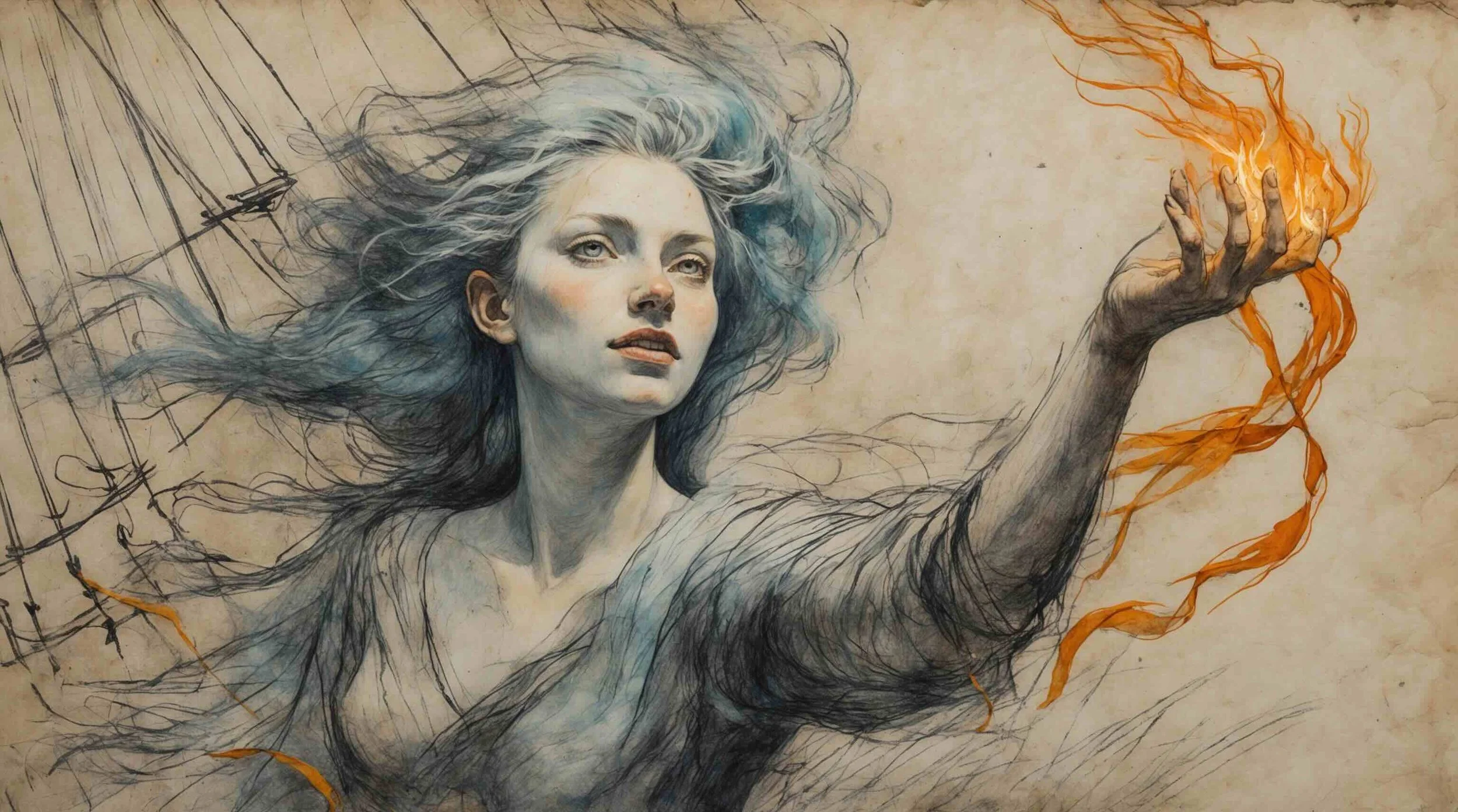
Character Profile – At a Glance
- Role: A spirit of the air, freed by Prospero from the pine tree in which the witch Sycorax had imprisoned him, and bound to serve Prospero until the day of the play. He raises the storm, sings the songs, and does everything else the magic requires.
- Key Traits: Quick, obedient and eager to please, but restless for the freedom he has been promised. Playful in his songs, terrible as the harpy. More tender, at the end, than his master.
- The Core Conflict: Ariel wants his liberty and Prospero keeps deferring it. He serves perfectly and reminds his master, at every turn, that the service is owed a wage.
- Key Actions: Performs the tempest to the letter and scatters the survivors around the island (A1S2). Asks for his freedom and is threatened with a second imprisonment. Leads Ferdinand to Miranda with his songs. Wakes Gonzalo in time to stop the murder of the king (A2S1). Spoils Caliban’s plot by ventriloquism (A3S2). Appears as a harpy to accuse the three men of sin (A3S3). Presents the masque and leads the conspirators into a bog (A4S1). Tells Prospero his affections would become tender, were he human (A5S1). Is set free.
- Famous Quote:
"Full fathom five thy father lies;
Of his bones are coral made;
Those are pearls that were his eyes:
Nothing of him that doth fade
But doth suffer a sea-change
Into something rich and strange."
(Act 1, Scene 2) - The Outcome: Freed by Prospero in the last lines of the play, with one final errand: calm seas and fair winds for the voyage home.
All Hail, Great Master
Ariel enters the play the moment Miranda falls asleep. Prospero has put her under so that he can talk to his other servant, and the servant arrives with a speech that is half greeting, half job application.
Original
All hail, great master! Grave sir, hail! I come
To answer thy best pleasure; be't to fly,
To swim, to dive into the fire, to ride
On the curled clouds, to thy strong bidding task
Ariel and all his quality.
(Act 1, Scene 2)
Shakespeare Retold (Modern Verse)
Greetings, great master! Sir, greetings! I’ve come
To do what you desire; be it to fly,
To swim, to dive into the fire, to ride
On floating clouds, to do whatever task
You give to me and my skills.
Everything about Ariel is in those five lines. He can fly, swim, dive into fire, ride on clouds; he exists to do things; and he calls Prospero "great master" and "grave sir" without a trace of irony. The report that follows, of how he boarded the king’s ship and "flamed amazement" from the topmast to the bowsprit, is one of the most exhilarating speeches in Shakespeare, and it is a description of a job well done.
What Ariel actually is has been argued about for four hundred years. He is called a spirit, a nymph of the sea, a harpy, a bird and a chick; he can be invisible, or take any shape; and he is fast enough to go round the world and back before Prospero’s pulse has beaten twice. The theme of magic and art in this play is mostly Ariel. Prospero has the book; Ariel does the work.
The Cloven Pine
The good servant has one demand, and he makes it in his first scene. Prospero has said there is more work to do. Ariel, very politely, raises the question of pay.
Original
Is there more toil? Since thou dost give me pains,
Let me remember thee what thou hast promised,
Which is not yet performed me.
(Act 1, Scene 2)
Shakespeare Retold (Modern Verse)
Is there more work? As you’re giving me jobs,
Let me remind you what you promised me,
Which I’ve not yet received.
Prospero’s response is out of all proportion. He calls Ariel a liar and a malignant thing, makes him recite the story of the witch Sycorax and the twelve years in the pine, reminds him that only his art could split the tree, and then threatens to peg him inside an oak until he has howled away twelve winters more. Ariel apologises. He will be correspondent to command and do his spiriting gently. Prospero, mollified, promises to discharge him in two days.
The scene is the play’s clearest picture of masters and servants. Ariel owes Prospero his freedom, and Prospero has turned the debt into a term of service that he alone can end. The freed prisoner is, for the length of the play, another kind of prisoner; and the theme of imprisonment and freedom runs from the pine to the last line of Act 5, when the term is finally served. It is worth noticing that Prospero is not cruel to Ariel in the way he is cruel to Caliban. He does not pinch him. He reminds him, once a month, what he has been.
Ministers of Fate
Ariel’s most terrifying entrance is in Act 3, when the court of Naples, exhausted and hungry, is shown a banquet by dancing spirits and then, as they reach for it, sees it vanish under a harpy’s wings. The harpy is Ariel, and he has a speech.
Original
You are three men of sin, whom Destiny,
That hath to instrument this lower world
And what is in't, the never-surfeited sea
Hath caused to belch up you...
(Act 3, Scene 3)
Shakespeare Retold (Modern Verse)
You three are sinners, men whom Destiny –
Which has control of everything on earth
And all that’s in it – made the quenchless sea
Spit out again...
The harpy is a creature from Virgil, a bird with a woman’s face that fouls the food of the men it visits, and Shakespeare uses it to turn Prospero’s private grievance into a judgement from the gods. Ariel does not say that Prospero is angry. He says that Destiny has caused the sea to vomit the three men up, and that the powers, delaying but not forgetting, have now remembered. Alonso hears the names of his crimes in the thunder and goes to drown himself. Antonio and Sebastian draw their swords on the air.
What is easy to miss is that the speech is a performance. Prospero, watching from above, congratulates his spirit afterwards on how bravely the figure of the harpy was performed and how nothing of the instruction was left out. Ariel is an actor, and the judgement of the gods is a script. The theme of illusion and reality in this play is never far from the theatre, and the harpy scene is where the play shows us how the trick is done.
Were I Human
The last thing Ariel does before he is freed is change Prospero’s mind. Asked how the king and his followers are faring, he describes them: charmed, weeping, Gonzalo’s tears running into his beard. Then he adds something that has not been asked for.
Original
ARIEL: Your charm so strongly works 'em
That if you now beheld them, your affections
Would become tender.
PROSPERO: Dost thou think so, spirit?
ARIEL: Mine would, sir, were I human.
(Act 5, Scene 1)
Shakespeare Retold (Modern Verse)
ARIEL: All your spells are so effective,
That if you saw them, all your feelings would
Become considerate.
PROSPERO: You really think so?
ARIEL: Mine would, if I were human.
Prospero takes the point at once and turns it into a resolution: if a spirit made of air can feel for them, a man of their own kind must feel more; the rarer action is in virtue than in vengeance. It is the hinge of the play, and it is Ariel’s doing. The theme of revenge and forgiveness is decided not by Prospero’s conscience but by his servant’s hint about what a conscience would feel like.
"Were I human" is the most quoted thing Ariel says, and it cuts both ways. Ariel has no human feelings, and says so; but he can see what they would be, and he prompts them in the one person on the island who has forgotten. Shakespeare gives the play’s mercy to the character who cannot feel it, and lets him teach it to the one who can.
"Ariel is imaginary power, the swiftness of thought personified."
— William Hazlitt, Characters of Shakespear’s Plays, 1817
Key Quotes
Quote 1
Full fathom five thy father lies;
Of his bones are coral made;
Those are pearls that were his eyes:
Nothing of him that doth fade
But doth suffer a sea-change
Into something rich and strange.
Sea-nymphs hourly ring his knell.
(Act 1, Scene 2)
Shakespeare Retold (Modern Verse)
Your father lies at thirty feet;
His bones are coral now;
His eyes have turned to pearls, complete;
He’s just the same somehow,
But the sea has made him change
Into something rich and strange.
Sea-nymphs hourly ring his death-bell.
Quote Analysis: Sung to Ferdinand, who is sitting on the shore weeping for the father he believes has drowned. The song tells him that the drowning is true, and then that it is beautiful: the bones have become coral, the eyes pearls, and nothing has decayed, only changed into something rich and strange. Alonso is alive, so the song is a lie; but it is a lie that comforts, and "sea-change" has passed into the language as the phrase for a transformation that leaves nothing as it was. The whole play is a sea-change, and Ariel announces it in its second scene.
I boarded the king's ship; now on the beak,
Now in the waist, the deck, in every cabin,
I flamed amazement...
(Act 1, Scene 2)
Shakespeare Retold (Modern Verse)
I boarded the king’s ship; upon the bow,
Then midships, then the deck, in every cabin,
I turned to fire, amazing them...
Quote Analysis: Ariel’s report on the tempest. He was the fire on the mast, St Elmo’s fire, the lightning the sailors saw running along the rigging; he divided and burned in several places at once, then met and joined. The Bermuda pamphlets of 1610 that Shakespeare read describe exactly this phenomenon on the wreck of the Sea Venture, and Ariel turns it into an account of a job done with flair. "I flamed amazement" is two words for what the whole play does: it sets things alight in order to astonish.
Where the bee sucks, there suck I:
In a cowslip's bell I lie;
There I couch when owls do cry.
On the bat's back I do fly
After summer merrily.
Merrily, merrily shall I live now
Under the blossom that hangs on the bough.
(Act 5, Scene 1)
Shakespeare Retold (Modern Verse)
Where the bee sucks nectar, so do I:
In a cowslip flower is where I lie;
I lie there when the owls cry.
On a bat’s back I do fly
After summer merrily.
Merrily, merrily shall I live now
Under the blossom that hangs on the bough.
Quote Analysis: Ariel’s last song, sung as he dresses Prospero in the clothes of the Duke of Milan. It is a song about what he will do when he is free: sleep in a cowslip, fly on a bat’s back, follow the summer. Everything in it is small and everything is pleasant, and nothing in it is a task. After a play spent flying, swimming and diving into fire on someone else’s orders, Ariel’s idea of liberty is to lie under a blossom. Prospero, listening, says that he will miss him.
Before you can say 'come' and 'go,'
And breathe twice and cry 'so, so,'
Each one, tripping on his toe,
Will be here with mop and mow.
Do you love me, master? No?
(Act 4, Scene 1)
Shakespeare Retold (Modern Verse)
Before you can say ‘come’ and ‘go,’
And breathe twice and shout ‘so, so,’
Each servant, tripping on his toe,
With silly faces, here will show.
Do you love me, master? No?
Quote Analysis: Ariel is sent to fetch the spirits for the masque, and answers in a jingle: they will be here before you can say come and go. Then, unexpectedly, a question. Do you love me, master? Prospero says he does, dearly, and moves on to the next instruction. It is the only time anyone in the play asks that question, and it is asked by a spirit who has been told, in Act 1, that he is a malignant thing. The little "No?" at the end is Ariel answering it for himself before Prospero can. Actors have played the line as teasing, as needy, and as heartbreaking, and the text supports all three.
Key Takeaways
- The Work of the Magic: Prospero has the book; Ariel does everything. The storm, the songs, the harpy and the masque are all his performances.
- Freedom Deferred: Prospero freed him from the pine and turned the debt into a term of service. Ariel asks for his liberty in his first scene and is threatened for asking.
- An Actor, Not a Judge: The harpy's judgement from the gods is a script Prospero wrote. Ariel performs it perfectly and is congratulated.
- Were I Human: He cannot feel pity, but he can see what it would look like, and his hint turns Prospero from vengeance to mercy.
Study Questions and Analysis
Is Ariel male or female?
The text calls Ariel "he", and Prospero calls him "my bird" after the bog and "chick" in the last scene, but Ariel has no fixed body and takes whatever shape the job needs. His first disguise is a female one:
Go make thyself like a nymph o' the sea: be subject
To no sight but thine and mine, invisible
To every eyeball else.
(Prospero, Act 1, Scene 2)
Shakespeare Retold (Modern Verse)
Disguise yourself to be a sea nymph; only
Be visible to me and you, invisible
To everybody else.
He is later a harpy, which in Virgil is female, and he presents the goddess Ceres in the masque. For most of the eighteenth and nineteenth centuries the part was played by actresses, usually with wings, and it was not until the twentieth century that male Ariels became the norm again. The question of gender is, in the end, a question about what kind of creature Ariel is, and the play declines to answer it.
Samuel Johnson, in his notes of 1765, placed Ariel among the fairies, "an order of Beings to which tradition has always ascribed a sort of diminutive agency, powerful but ludicrous, a humorous and frolick controlment of nature, well expressed by the Songs of Ariel". William Hazlitt (1817) called him simply "the delicate Ariel" and set him against "the savage Caliban, half brute, half demon". Neither critic thought the gender mattered much, and they were probably right. What matters is that Ariel is air. He can be anything, which is another way of saying he is nobody in particular, and the play’s treatment of illusion and reality depends on it.
Why does Ariel serve Prospero?
Because he owes him, and because he is afraid of him, and the play is honest about the mixture. Ariel was imprisoned by the witch Sycorax in a cloven pine for refusing to carry out her commands; she died and left him there; and twelve years later Prospero arrived, heard him groaning, and split the tree with his art. The rescue created a debt, and Prospero has been collecting on it ever since. When Ariel asks for his freedom, he is reminded of the pine and threatened with an oak, and his answer is submission:
Pardon, master;
I will be correspondent to command
And do my spiriting gently.
(Act 1, Scene 2)
Shakespeare Retold (Modern Verse)
Sorry, master.
I’ll be obedient and do my tasks
A gentle spirit.
It is not the answer of a free agent. But it is not simple fear either. Ariel serves well, takes pride in serving well, and asks Prospero whether he loves him. The relationship has the shape of a master and an indentured servant whose term is almost up, and the play gives both sides their due: Prospero’s power is real, and so is the affection.
Frank Kermode’s Arden edition (1954) placed the relationship inside the play’s scheme of Art and Nature, with Ariel as the instrument of Prospero’s legitimate magic, freed from a witch to serve a philosopher. That reading makes the service a kind of education. Paul Brown (1985) read it more coldly, as one of the play’s two colonial relationships, with Ariel the compliant native who is rewarded and Caliban the resistant one who is punished. Aimé Césaire dramatised exactly that split in Une Tempête (1969), where Ariel is "a mulatto slave" who hopes to change Prospero’s conscience by patience and Caliban a black slave who has stopped hoping. The play itself leaves the question of consent open. Ariel is promised freedom and gets it; but he is never asked whether he wanted the job.
What does "Full fathom five" mean?
A fathom is six feet, so the song tells Ferdinand that his father lies thirty feet down. What follows is a description of a body that has not rotted but been remade: bones into coral, eyes into pearls, everything that would fade transformed instead into something rich and strange. It is a song about death that contains no decay, and the sea-nymphs ring the bell for it every hour.
The first thing to say is that it is not true. Alonso is alive, wandering the island in grief for the son who is listening to the song. Ariel is singing a beautiful lie on Prospero’s orders, to keep Ferdinand from looking for his father and to lead him instead to Miranda. The second thing is that the lie tells the truth about the play. Everyone who came ashore in the tempest is going to be changed by it, and the change will be, in the end, into something better. "Sea-change" has become an English idiom because Shakespeare found the exact phrase for a transformation that is complete without being a loss.
Samuel Johnson (1765) thought the songs of Ariel showed the "humorous and frolick controlment of nature" that tradition gave to fairies, and "Full fathom five" is certainly a piece of control: it does to Ferdinand’s grief what the tempest did to the ship, taking it apart and putting it back in a new shape. Later readers have been more struck by its strangeness than its humour. It is the one moment in the play where death is looked at directly, and what the play sees there is not horror but pearls.
Does Ariel have feelings?
He says he does not, in the line everyone quotes: his affections would become tender if he saw the prisoners, were he human. But the play keeps showing him things that look very much like feelings. He is moody when refused his liberty. He is proud of the tempest. He asks Prospero whether he loves him. And after the masque, when Prospero asks where he left the conspirators, Ariel confesses to something like anxiety:
Ay, my commander: when I presented Ceres,
I thought to have told thee of it, but I feared
Lest I might anger thee.
(Act 4, Scene 1)
Shakespeare Retold (Modern Verse)
Yes, sir: while I performed the show with Ceres,
I thought I should have told you of it, but feared
That I might make you angry.
A spirit who is afraid of angering his master, and who thought about telling him something and decided not to, has an inner life, whatever he says about being made of air. The safest reading is that Ariel’s feelings are real but not human: he feels what a servant feels, and a musician, and a creature who wants to go home, but he does not feel pity, and he has to tell Prospero what pity would be like rather than feel it himself.
Samuel Taylor Coleridge, in his notes on the play from the 1818 lectures, observed that "Ariel has in everything the airy tint which gives the name", and that Shakespeare never lets him be compared directly with Miranda, "lest the natural and human of the one and the supernatural of the other should tend to neutralize each other". The distinction matters: Ariel is not a person with wings. W. H. Auden’s The Sea and the Mirror (1944) opens with Prospero saying goodbye to Ariel after the play is over, and treats their parting as the one real loss in the story; Auden evidently thought there was something on Ariel’s side to lose. The play does not decide. It gives Ariel the line about being human and then, in the last scene, has Prospero say that he will miss him.
Why is Ariel’s freedom so important to the ending?
Because it is the one promise in the play that is kept exactly. Prospero says in Act 1 that he will discharge Ariel after two days; he repeats the promise every time Ariel does something well; and in the last lines of Act 5, after one final errand, he does it:
My Ariel, chick,
That is thy charge: then to the elements
Be free, and fare thou well!
(Prospero, Act 5, Scene 1)
Shakespeare Retold (Modern Verse)
My Ariel,
Go make that happen, then fly on the wind
In freedom! So, farewell!
Everything else in the ending is qualified. Antonio is forgiven but does not repent. Caliban is acknowledged but not released from the cell he is sent to tidy. Prospero himself, in the Epilogue, is still confined and asking the audience to let him go. Ariel alone walks out of the play free, and the play makes him the measure of what freedom means: not power, which he has had all along, but the end of orders.
The theme of imprisonment and freedom is the play’s deepest structure. Every character is held somewhere: the court in the lime-grove, Ferdinand at his logs, Caliban in his rock, Ariel in his service, Prospero on his island. Jan Kott, in Shakespeare Our Contemporary (1964), read the island as a place where history is rehearsed in miniature and Prospero’s experiment in ruling it fails; on that account Ariel’s release is the one part of the experiment that works. W. H. Auden made the farewell to Ariel the opening of The Sea and the Mirror (1944), as if the whole poem had to begin with the one clean ending the play provides. Ariel’s liberty costs Prospero his magic, and the play treats that as a fair price.
How does Ariel compare with Caliban?
They are the island’s two natives, its two servants, and its two prisoners, and Shakespeare built them as opposites. Ariel is air; Caliban is earth. Ariel sings; Caliban curses. Ariel obeys and is rewarded; Caliban rebels and is pinched. Both were on the island before Prospero, and both were, in different ways, Sycorax’s. The play tells us how Ariel came to be Prospero’s:
Into a cloven pine; within which rift
Imprisoned thou didst painfully remain
A dozen years...
(Prospero, Act 1, Scene 2)
Shakespeare Retold (Modern Verse)
Within a fractured pine tree. In that gap
You then remained imprisoned painfully
For twelve years...
Caliban’s story is the mirror image. Where Ariel was rescued from imprisonment into service, Caliban was welcomed into service and then imprisoned. Ariel is promised freedom and gets it; Caliban is promised nothing and ends the play tidying his master’s cell. And where Ariel’s magic is Prospero’s, obedient and beautiful, Caliban’s inheritance from his mother is a set of curses that do not work.
Samuel Taylor Coleridge drew the contrast in his lecture of 1811–12: "Caliban gives us images from the earth, Ariel images from the air." William Hazlitt (1817) went further, suggesting that "Shakespear has, as it were by design, drawn off from Caliban the elements of whatever is ethereal and refined, to compound them in the unearthly mould of Ariel", so that the two characters are a single nature divided. The post-colonial critics kept the pairing and changed its meaning. Aimé Césaire’s Une Tempête (1969) made Ariel and Caliban two slaves with two strategies, patience and revolt, and let them argue it out; Roberto Fernández Retamar’s "Calibán" (1971) announced that Latin America’s symbol was "not Ariel, as Rodó thought, but rather Caliban", the servant who refuses. The play is kinder to Ariel than to Caliban, and it knows the difference between them is partly a difference in how they were treated.
Why does Ariel speak in songs and short lines?
Because he is not human, and Shakespeare marks the difference in the metre. Most of the play is in blank verse, ten syllables to the line with five beats. Ariel uses it when he is reporting to Prospero. But when he acts on his own account, singing to Ferdinand, waking Gonzalo, or promising the spirits will be here before you can say come and go, he drops into shorter lines with four beats or fewer, rhymed:
While you here do snoring lie,
Open-eyed conspiracy
His time doth take.
If of life you keep a care,
Shake off slumber, and beware:
Awake, awake!
(Act 2, Scene 1)
Shakespeare Retold (Modern Verse)
While you’re lying snoring here,
An evil plan did appear,
About to start.
If about your life you care,
Shake off slumber, and beware:
So, sleep depart!
The shift is audible in the theatre. The court and the lovers speak in the long, flexible line that carries argument and feeling; Ariel’s songs are quick and light and end almost as soon as they start. It is the same trick Shakespeare uses for the fairies in A Midsummer Night’s Dream and the witches in Macbeth: the supernatural has its own rhythm, and it is a rhythm made for spells rather than speeches.
Samuel Taylor Coleridge caught this when he said in his 1818 notes that "Ariel has in everything the airy tint which gives the name". The tint is in the verse as much as in the imagery. Ariel’s songs are also, on the evidence of the Folio, the most musical thing in the play; two of the settings, by Robert Johnson, the King’s Men’s lutenist, survive, and "Full fathom five" and "Where the bee sucks" have been set by composers ever since. When Ariel speaks in Prospero’s metre he is a servant. When he sings in his own, he is what he will be when he is free.