
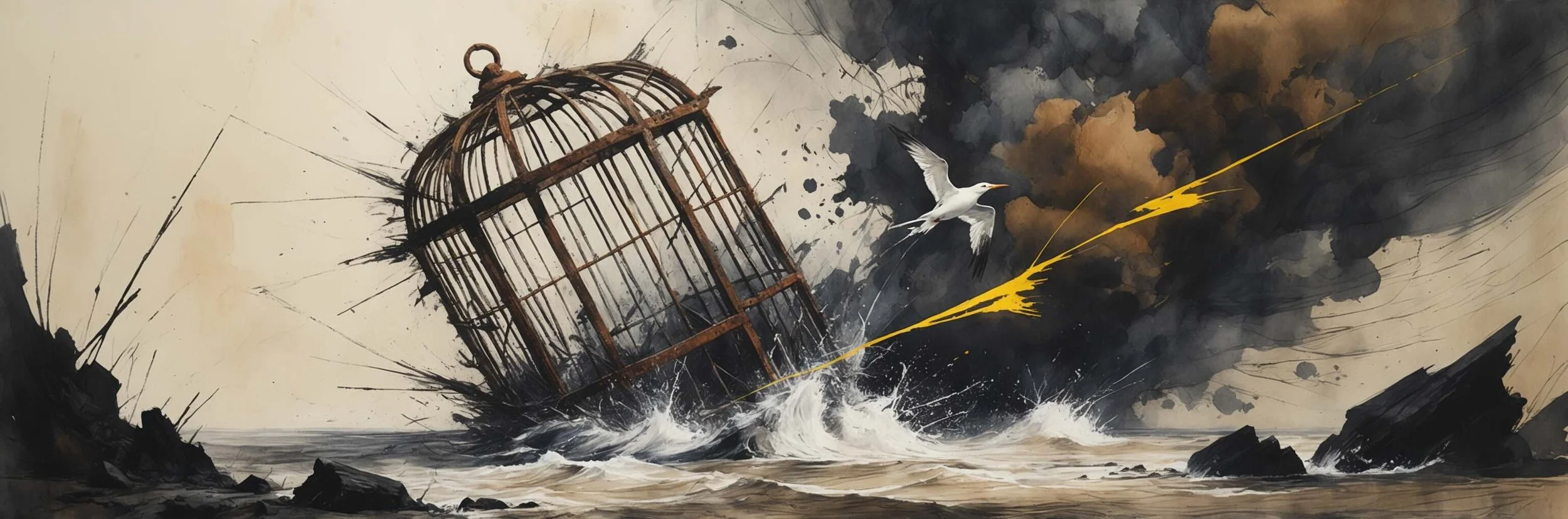
Theme Profile – At a Glance
- Focus: Everyone on the island is held somewhere: Ariel in his service, Caliban in his rock, Ferdinand at his logs, the court in a charmed grove, Prospero on the island itself. The play asks who is free, who has the keys, and what it costs to be let go.
- Key Characters: Ariel, Caliban, Prospero, Ferdinand, Miranda, Alonso, Stephano and Trinculo.
- The Core Tension: Prospero frees Ariel from a pine and binds him to a term of service; he welcomes Caliban and confines him to a rock; he imprisons Ferdinand so that love will feel earned. The jailer and the liberator are the same man, and at the end he asks to be released himself.
- Key Manifestations: Ariel’s story of the cloven pine and his plea for liberty (A1S2); Caliban confined to the rock (A1S2); Ferdinand charmed and manacled, and content in his prison (A1S2); Caliban’s freedom song (A2S2); the court spell-stopped in the lime-grove (A5S1); Ariel freed, Caliban sent indoors (A5S1); the Epilogue.
- Famous Quote:
"ARIEL: My liberty.
PROSPERO: Before the time be out? No more!"
(Act 1, Scene 2) - The Outcome: Ariel is set free in the last lines and flies to the elements. Caliban is sent to tidy the cell. The court sails home. Prospero, who held all the keys, stands in the Epilogue asking the audience for his.
The Cloven Pine
The play’s first prison is a tree. Ariel has asked for his freedom, and Prospero, furious, makes him remember where he was found: shut by the witch Sycorax in a split pine for refusing her orders, and left there when she died.
Original
she did confine thee,
By help of her more potent ministers
And in her most unmitigable rage,
Into a cloven pine...
(Prospero, Act 1, Scene 2)
Shakespeare Retold (Modern Verse)
she locked you up –
With help from her most powerful assistants
And in her most almighty, angry rage –
Within a fractured pine tree.
Twelve years in the tree, groaning as fast as mill-wheels strike, until Prospero’s art split it open. The story is told as a reminder of a debt, and it is followed at once by a threat: complain again and it will be an oak, for twelve winters more. The man who opened the pine is prepared to close the oak.
That is the shape of freedom in The Tempest. Release creates obligation, and the obligation is enforced by the threat of the prison it replaced. Ariel is free in every way but one, and the one is the term of his service, which only Prospero can end. The theme of masters and servants is this theme seen from the master’s side; from the servant’s, every promise of liberty is also a reminder that it has not yet come.
Here You Sty Me
The second prison is a rock. Caliban was, by his own account, welcomed into Prospero’s cell and taught the names of the sun and moon; then he tried to rape Miranda, and was put where he could do no harm. His complaint is about space.
Original
and here you sty me
In this hard rock, whiles you do keep from me
The rest o' the island.
(Caliban, Act 1, Scene 2)
Shakespeare Retold (Modern Verse)
you lock me in a pigsty,
In this hard rock, preventing me from going
Around the island.
A sty is where pigs are kept, and Caliban chooses the word himself. He was the island’s king and is now confined to a corner of it, and the rest, the springs and brine-pits he once showed Prospero, is kept from him. It is imprisonment on an open island, which is the cruellest kind: the prisoner can see everything he has lost.
Prospero’s answer is that Caliban deserved more than a prison, and the attempt on Miranda is not denied. But the play lets the prisoner describe his cell before the jailer explains it, and it gives Caliban, alone of all the characters, a freedom song. The theme of colonialism and empire runs through the rock: it is the native’s confinement on his own land, and the play knows it.
Space Enough Have I in Such a Prison
The third prison is chosen. Ferdinand has drawn his sword on Prospero and been charmed from moving; he is threatened with manacles, seawater and withered roots, and told he will be a prisoner. His reply turns the sentence into a wish.
Original
all corners else o' the earth
Let liberty make use of; space enough
Have I in such a prison.
(Ferdinand, Act 1, Scene 2)
Shakespeare Retold (Modern Verse)
All other spots on earth
Are free to use; for I’ll have all the space
I need in prison.
The whole earth can have its liberty; a cell with a daily sight of Miranda is space enough. It is a lover’s paradox and the play means it. Ferdinand is the one character who is imprisoned and does not mind, and he is also the one who is set free soonest, because Prospero’s prison for him was never anything but a test.
The scene is the counterweight to Caliban’s. Both young men are confined by the same master; one curses and one carries logs gladly; and the play uses the contrast to show that imprisonment is partly a matter of what the prisoner wants. The theme of nature and nurture is under this. Ferdinand’s contentment is what a court upbringing was supposed to produce, and Caliban’s fury is what a rock produces.
Let Your Indulgence Set Me Free
The last prison is the island, and the last prisoner is Prospero. He has freed Ariel, sent Caliban indoors, forgiven the court and drowned his book, and in the Epilogue he steps forward to explain what is left.
Original
Let me not,
Since I have my dukedom got
And pardoned the deceiver, dwell
In this bare island by your spell...
(Prospero, Epilogue)
Shakespeare Retold (Modern Verse)
Let me not –
For since I have my dukedom got
And forgave all my foes – remain
By magic in this sparse domain...
The dukedom is regained and the deceiver pardoned, and Prospero is still on the bare island, held there, he says, by the audience’s spell. The magician has become the charmed. He asks for release in the form of applause, and the play ends only when it is given.
It is a joke, a convention and a confession at once. The convention is the actor’s appeal for a hand; the joke is that a man who commanded a tempest needs one; the confession is that everything he did was done to please, and that a play, like an island, is a place you cannot leave without permission. The theme of illusion and reality arrives at its last turn here. The spell that held everyone else was Prospero’s. The spell that holds Prospero is ours.
"Call me X. That would be best. Like a man without a name. Or, to be more precise, a man whose name has been stolen."
— Aimé Césaire, Caliban in Une Tempête (trans. Richard Miller), A Tempest, 1969
Key Quotes on Imprisonment vs Freedom
Quote 1
Freedom, hey-day! Hey-day, freedom! Freedom, hey-day, freedom!
(Caliban, Act 2, Scene 2)
Shakespeare Retold (Modern Verse)
Freedom, hey-hey! Hey-hey, freedom! Freedom, hey-hey, freedom!
Quote Analysis: Caliban’s shout at the end of his song, having sworn on Stephano’s bottle to be his subject. It is the only time the word "freedom" is sung in the play, and it is sung by a creature who has just exchanged one master for another. Trinculo calls him a howling monster; Stephano tells him to lead the way. The audience is meant to hear the joke and the ache under it. Caliban wants liberty more than anyone on the island and understands it less, and the play does not pretend that the two things are unrelated.
Confined together
In the same fashion as you gave in charge,
Just as you left them; all prisoners, sir,
In the line-grove which weather-fends your cell;
They cannot budge till your release. The king...
(Ariel, Act 5, Scene 1)
Shakespeare Retold (Modern Verse)
They’re tied up
Together in the way that you instructed,
Just as you left them; they’re all prisoners, sir,
In the lime-grove that keeps rain out of your cave;
They can’t move till you free them. Now, the king...
Quote Analysis: Ariel’s report on the court at the start of Act 5. The king, his brother and Prospero’s brother are held in the lime-grove that shelters the cell, unable to move until they are released, and the rest are mourning over them. It is the play’s widest prison, an open grove where a whole court stands charmed, and it is the moment at which Prospero has everything he wanted. What Ariel adds, unasked, is that if Prospero saw them his feelings would soften. The prisoners are about to be let go because their jailer’s servant pitied them.
I'll manacle thy neck and feet together:
Sea-water shalt thou drink...
(Prospero, Act 1, Scene 2)
Shakespeare Retold (Modern Verse)
I’ll shackle up your neck and feet together;
You’ll drink the saltwater...
Quote Analysis: Prospero sentencing Ferdinand. Neck and feet manacled together, seawater to drink, mussels and roots to eat: it is the language of a dungeon, spoken to a prince the speaker has already chosen as a son-in-law. Nothing in the sentence is carried out. Ferdinand is set to carry logs, and Miranda visits him. The threat is theatre, and Prospero says as much in an aside; but the audience hears it before it hears the aside, and the play wants the dungeon in our minds when the logs arrive.
Merrily, merrily shall I live now
Under the blossom that hangs on the bough.
(Ariel, Act 5, Scene 1)
Shakespeare Retold (Modern Verse)
Merrily, merrily shall I live now
Under the blossom that hangs on the bough.
Quote Analysis: The last two lines of Ariel’s last song, sung as he dresses Prospero for the court. It is his description of freedom, and it contains no task: a cowslip to sleep in, a bat to ride, a blossom to lie under. After a play of flying, swimming and diving into fire on orders, liberty for Ariel is doing nothing in a pleasant place. Prospero, listening, says he will miss him. The song is the only account of freedom in the play that is not also an account of a new obligation.
Key Takeaways
- Release Creates Debt: Prospero split the pine and turned the rescue into twelve years of service, enforced by the threat of an oak.
- Prison on an Open Island: Caliban is confined to a rock and can see everything he has lost. The play lets him describe the cell before the jailer explains it.
- A Prison Chosen: Ferdinand calls a cell with a daily sight of Miranda space enough. He is the only prisoner who does not mind, and the first freed.
- The Jailer's Own Cell: Prospero frees everyone and stands in the Epilogue asking the audience to free him. The last spell is ours.
Study Questions and Analysis
Who is imprisoned in The Tempest?
Almost everyone, at one time or another, and by the same man. Ariel is bound to a term of service; Caliban is confined to a rock; Ferdinand is charmed from moving and set to logs; the sailors are stowed under hatches for the whole play; and in Act 5 the court itself stands in a charmed circle in front of Prospero’s cell:
There stand,
For you are spell-stopped.
(Prospero, Act 5, Scene 1)
Shakespeare Retold (Modern Verse)
Stand there,
For you are spell-bound.
Spell-stopped: unable to move or understand until their captor chooses. Prospero walks among them, addressing each in turn, while they cannot hear. It is the play’s most complete image of imprisonment, and it lasts only until the charm dissolves, which it does within the scene.
Jan Kott, in Shakespeare Our Contemporary (1964), read the island as a laboratory in which Prospero holds every subject in place while he runs his experiment, and the charmed circle as the experiment’s final stage. Frank Kermode (1954) saw the same confinements as the instruments of Art, the means by which a disciplined mind suspends the undisciplined until they are ready to be released. Both readings notice the one prisoner the list leaves out. Prospero has been on the island for twelve years, and cannot leave it without the ship he has just wrecked. The jailer is also the longest-serving inmate.
Why does Prospero keep Ariel in service after freeing him?
Because the freeing created a debt, and Prospero collects on it. He rescued Ariel from the pine; the rescue is the ground of everything he asks afterwards; and when Ariel wants his liberty early, the answer is a question:
Dost thou forget
From what a torment I did free thee?
(Prospero, Act 1, Scene 2)
Shakespeare Retold (Modern Verse)
Have you forgotten
The torment I released you from?
The reminder is delivered, Prospero says, once a month, and it is followed by the threat of an oak. Ariel serves because he owes, and because the alternative is a tree. The play does not hide the pressure, and it does not apologise for it either: Prospero has promised freedom in two days, and he keeps the promise.
Paul Brown, in "This thing of darkness I acknowledge mine" (1985), read the arrangement as colonial: the master rescues the native from a worse master and calls the rescue a claim on his labour, rewarding him with a liberty that the master alone can grant. Stephen Orgel’s Oxford edition (1987) noticed that Ariel is never asked whether he wanted the job, and that his consent is not something the play thinks to include. Against both stands the ending. Ariel is freed exactly when promised, and Prospero says he will miss him. The debt is real, the pressure is real, and so is the release; the play holds all three together and calls the result service.
Is Ferdinand really a prisoner?
Yes and no, and the play is precise about which. The charm that stops him is real; he draws his sword and cannot move it, and Prospero describes the condition to Miranda as a fact:
Thy nerves are in their infancy again
And have no vigour in them.
(Prospero, Act 1, Scene 2)
Shakespeare Retold (Modern Verse)
Your muscles are all childlike again
And have no strength in them.
But the manacles and the seawater are threats that are never carried out, and the log-carrying that replaces them is a test with a prize at the end. Ferdinand is a prisoner whose captor has already decided to free him and marry him to his daughter. The prison is a rehearsal for the marriage, and Ferdinand, without knowing it, is passing.
Frank Kermode (1954) read the trial as part of the play’s discipline: the young man learns patience under a master who is testing whether he deserves what he wants. Lorie Jerrell Leininger’s "The Miranda Trap" (1980) noticed that the prize in this test is a person, and that Miranda’s own confinement, to her father’s plans, is never called a prison at all. The contrast with Caliban, who carries the same logs, is the point the play makes hardest. One prisoner is being tested for a reward; the other is being punished without one; and the difference between them is what the master intends. Ferdinand is free the moment Prospero says so. Caliban is still waiting.
What does Caliban’s freedom song mean?
That he has changed masters and calls it liberty. Caliban has just tasted wine, taken Stephano for a god, and sworn on the bottle to be his subject. The song that follows renounces his old duties and announces a new lord:
A plague upon the tyrant that I serve!
I'll bear him no more sticks, but follow thee,
Thou wondrous man.
(Caliban, Act 2, Scene 2)
Shakespeare Retold (Modern Verse)
I curse that tyrant whom I work for now!
I’ll not bring wood for him; I’ll follow you,
You wondrous man.
No more sticks for the tyrant, and a promise to follow the wondrous man instead. Then the song proper: no more dams for fish, no more firewood, a new master, get a new man, and the shout of freedom. Every line of it is about service. Caliban’s idea of being free is being somebody else’s.
Paul Brown (1985) argued that the play makes rebellion ridiculous at exactly the moment the rebel has a real grievance, so that the audience laughs at the one character who says the island was stolen. The writers of the decolonising world took the song more seriously. Roberto Fernández Retamar’s "Calibán" (1971) claimed the figure as the symbol of Latin America, the servant who curses in the master’s tongue; Aimé Césaire’s Une Tempête (1969) rewrote the play so that it ends with Caliban’s cry of "FREEDOM HI-DAY!" ringing out over Prospero on the island, the song’s words made into a real ending. Shakespeare’s Caliban is led by the song into a bog and a pack of hounds. Whether that is a judgement on him or on the play is the question the later writers asked.
Why is Ariel freed at the end and Caliban not?
The play gives no reason, and the omission is the most discussed silence in it after Antonio’s. Ariel is released in the last lines with a blessing; Caliban is sent to trim the cell with a pardon dependent on how well he does it. The only freeing Caliban gets is from a spell:
Set Caliban and his companions free;
Untie the spell.
(Prospero, Act 5, Scene 1)
Shakespeare Retold (Modern Verse)
Set Caliban and his companions free;
Undo the spell.
The charm is untied, the cramps end, and Caliban is driven in to be laughed at and sent to work. Nothing is said about whether he stays on the island or goes to Milan, whether he is Prospero’s servant still, or whose the island is once the ship sails.
Stephen Orgel’s Oxford edition (1987) noticed that the play restores every order but the island’s, and that Caliban’s future is the one thing the ending declines to arrange. Jan Kott (1964) read Ariel’s release as the single part of Prospero’s experiment that works, and Caliban’s non-release as the proof that the rest did not. Paul Brown (1985) read the difference as the play’s politics laid bare: the compliant native is rewarded and the resistant one is left where he was found. The theme of revenge and forgiveness ends with everyone forgiven. The theme of freedom ends with one servant flying to the elements and the other carrying the luggage back to where he stole it, and the play walks away before we can ask why.
In what sense is Prospero himself a prisoner?
In two. He has been marooned on the island for twelve years, unable to leave it, and the tempest is his one chance to get home. And in the Epilogue, with the magic gone, he describes himself as a man who cannot move without help:
Now I want
Spirits to enforce, art to enchant,
And my ending is despair,
Unless I be relieved by prayer...
(Prospero, Epilogue)
Shakespeare Retold (Modern Verse)
Now I lack
Spirits, nor have my magic back,
And so I’ll end up in despair,
Unless I am helped out by prayer...
No spirits, no art, and an ending in despair unless the audience prays for him. It is the plainest confession of weakness in the play, and it comes from the man who held every key. Prospero was imprisoned by his brother, on the island, in his own project; and when the project is done he is imprisoned by the play, until the audience lets him go.
G. Wilson Knight’s The Crown of Life (1947) read the Epilogue as Shakespeare’s own release from the theatre, the dramatist asking to be excused from making any more worlds. W. H. Auden’s The Sea and the Mirror (1944) starts after the applause, with Prospero packing to leave and talking to Ariel about what it will be like to be an ordinary old man in Milan. Frank Kermode (1954) kept to the convention: the actor asks for a hand, and Prospero’s "project" is the play’s. All three agree that the last prisoner released in The Tempest is its magician, and that the audience is the one who releases him. The theme of power and control ends with the most powerful man on the stage unable to leave it.
What does freedom mean by the end of the play?
Gonzalo gives the official answer. Counting up what the voyage has produced, he says that everyone has found what they were looking for, and ends with the strangest item on the list:
Prospero his dukedom
In a poor isle and all of us ourselves
When no man was his own.
(Gonzalo, Act 5, Scene 1)
Shakespeare Retold (Modern Verse)
Prospero got his dukedom
Upon a desert isle, and all of us found
Ourselves when we were mesmerised.
All of them found themselves when no man was his own. Freedom, on this account, is self-possession: the court came to the island out of its own control, charmed, grieving or mad, and leaves it restored. It is the shape of a romance, and Gonzalo reads it as Providence.
Northrop Frye, in his introduction of 1959, read the ending as the release of a renewed society from the disorder it passed through, the standard close of Shakespearean comedy. E. M. W. Tillyard (1938) called it regeneration. Anne Barton (1968) was more cautious, noticing how many people Gonzalo’s list leaves out: Antonio, who found nothing; Sebastian, who is not forgiven; and Caliban, who is not mentioned. The play’s three freedoms are of different kinds. Ariel’s is complete, Prospero’s is conditional on applause, and Caliban’s is not granted. Freedom in The Tempest is what the master gives, and the play is honest that he does not give it to everyone.
