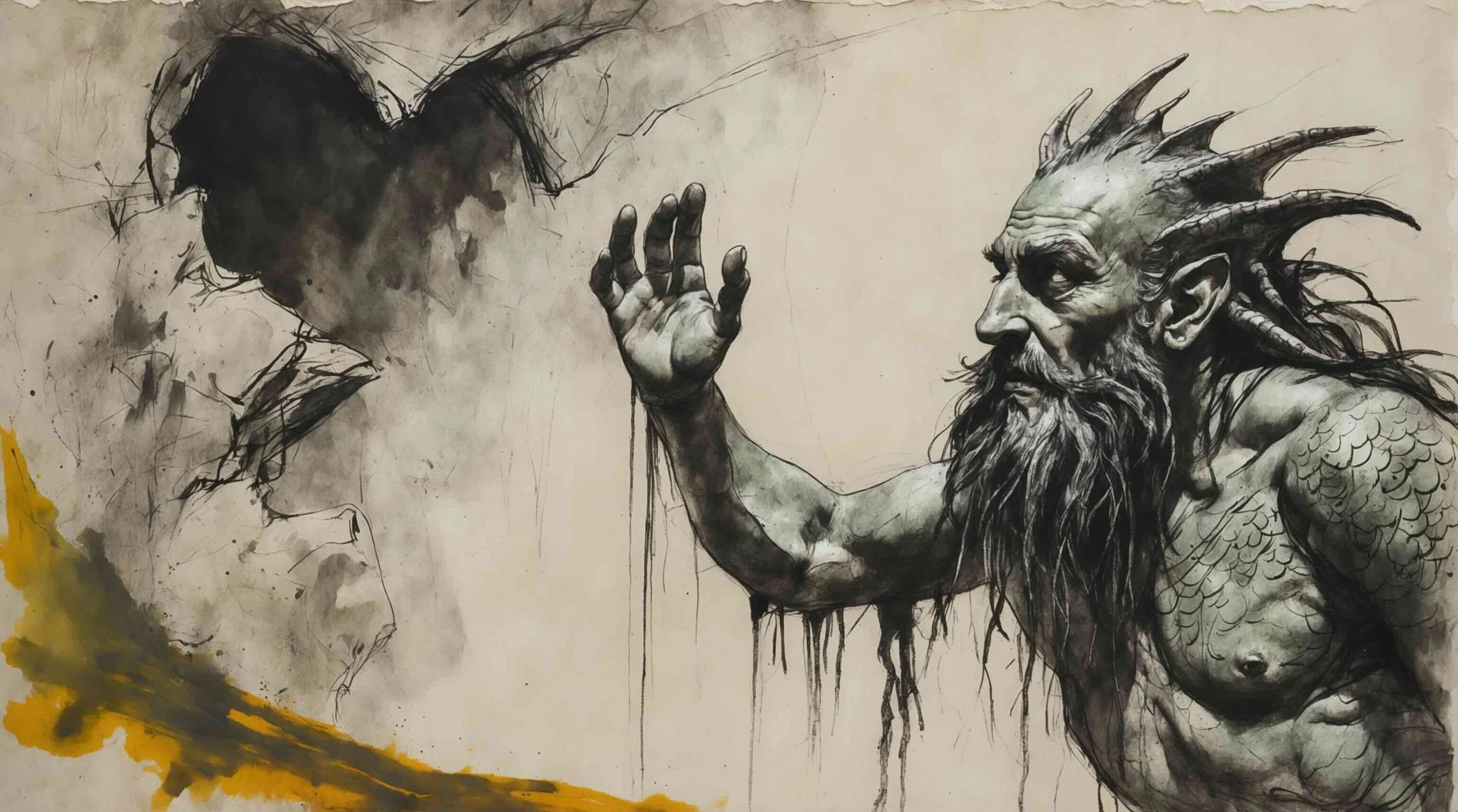
Character Profile – At a Glance
- Role: The island’s only native, son of the witch Sycorax, and Prospero’s slave. He showed Prospero the island when he arrived, was taught to speak, tried to rape Miranda, and has been confined to a rock and tormented with cramps ever since.
- Key Traits: Bitter, resentful and eloquent. Capable of the most beautiful poetry in the play and the crudest plotting. Childlike in his worship of a drunk with a bottle.
- The Core Conflict: Caliban believes the island is his by inheritance and that Prospero stole it. He wants his master dead and his freedom back, and he is prepared to serve a fool to get it.
- Key Actions: Curses Prospero and is threatened with cramps (A1S2). Claims the island as his mother’s and his. Mistakes Stephano for a god, swears loyalty on a wine bottle, and sings for his freedom (A2S2). Plots Prospero’s murder in his afternoon sleep, and tells the conspirators to burn his books first (A3S2). Leads them to the cell, begs them to ignore the stolen clothes, and is hunted off by spirit hounds (A4S1). Is acknowledged by Prospero as his own, and resolves to be wise hereafter (A5S1).
- Famous Quote:
"You taught me language; and my profit on't
Is, I know how to curse. The red plague rid you
For learning me your language!"
(Act 1, Scene 2) - The Outcome: Sent to tidy Prospero’s cell in the hope of pardon. Whether he is left on the island or taken to Milan, the play does not say.
This Island's Mine
Caliban’s first full speech is a claim of title. Prospero has just called him a poisonous slave got by the devil on a witch, and Caliban, having cursed him back, tells the story of how they met.
Original
This island's mine, by Sycorax my mother,
Which thou takest from me. When thou camest first,
Thou strokedst me and madest much of me, wouldst give me
Water with berries in't, and teach me how
To name the bigger light, and how the less,
That burn by day and night: and then I loved thee
And showed thee all the qualities o' the isle,
The fresh springs, brine-pits, barren place and fertile:
Cursed be I that did so!
(Act 1, Scene 2)
Shakespeare Retold (Modern Verse)
My mother, Sycorax, left me this island
Which you have taken from me. When you first came,
You petted and fussed over me; you’d give me
Water with berries in it, and you’d teach me
The sun’s name, and by night, you’d name the moon:
They shine by day and night. And then I loved you
And showed you all the best parts of the island:
Fresh water springs, saltwater pits, the best spots.
I curse myself for doing that!
It is a story of hospitality repaid with dispossession. Prospero arrived, stroked him, gave him water with berries in it, taught him the names of the sun and moon; Caliban loved him for it and showed him every spring and salt-pit on the island. Then Prospero took the island and put him in a rock. The speech is so plainly a grievance, and so plainly true, that Prospero does not deny it. He changes the subject to the attempted rape of Miranda, which Caliban does not deny either.
The two facts sit together in the scene and the play refuses to make one cancel the other. Caliban was wronged and Caliban did wrong. The theme of colonialism and empire begins with this speech, because it is the first time in English drama that a native of a colonised place is given the chance to describe, in his own words, what it felt like to be colonised. That he is also a would-be rapist is the play’s way of making sure the audience cannot simply take his side.
The Isle Is Full of Noises
The most beautiful speech in the play is given to its ugliest character, and it is given to him in the middle of a drunken plot to murder Prospero. Stephano and Trinculo have heard Ariel’s invisible music and are frightened. Caliban is not.
Original
Be not afeard; the isle is full of noises,
Sounds and sweet airs, that give delight and hurt not.
Sometimes a thousand twangling instruments
Will hum about mine ears, and sometime voices
That, if I then had waked after long sleep,
Will make me sleep again: and then, in dreaming,
The clouds methought would open and show riches
Ready to drop upon me that, when I waked,
I cried to dream again.
(Act 3, Scene 2)
Shakespeare Retold (Modern Verse)
Don’t be afraid; the isle is full of noises,
Sounds and sweet tunes that bring delight, not pain.
Sometimes a thousand plucking instruments
Will hum around my ears, and sometimes voices
That, if I’d woken from a slumberous sleep,
Would put me back to sleep again. Then, dreaming,
I’d think the clouds would open, showing gold
To drop upon me, so that when I woke up,
I cried to have the dream again.
Everything Caliban knows about the island is in this speech, and none of it is about fresh springs or pignuts. It is about sound: a thousand instruments humming, voices that put him to sleep and then show him, in dreams, riches ready to fall from the clouds, so that when he wakes he cries to dream again. It is a description of the island as a place of enchantment, offered by the one person on it who has been enchanted against his will for twelve years.
The speech changes what an audience thinks Caliban is. A creature who cries to dream again is not a beast, whatever Prospero calls him. The theme of nature and nurture runs through the whole play, and this speech is Caliban’s answer to it: his nature, uneducated by anyone, produced this. Prospero’s nurture produced the curses.
A New Master
Between the claim of title and the dream speech comes the scene that makes Caliban ridiculous. Hiding from what he takes to be one of Prospero’s spirits, he is discovered by Trinculo and then by Stephano, who pours wine into his mouth. Caliban has never tasted wine. He concludes that Stephano is a god and swears on the bottle to be his subject.
Original
No more dams I'll make for fish
Nor fetch in firing
At requiring;
Nor scrape trencher, nor wash dish
'Ban, 'Ban, Cacaliban
Has a new master: get a new man.
(Act 2, Scene 2)
Shakespeare Retold (Modern Verse)
I won’t build dams again to fish
Nor fetch firewood
When told I should;
Nor scrape a plate, nor wash a dish
‘Ban, ‘Ban, Ca-Caliban
Has a new master, find a new man.
The song is a freedom song, and it is the saddest thing in the scene, because what Caliban has done is exchange one master for another. He will no longer fetch wood for Prospero; he will fetch crabs and pignuts for Stephano instead. He offers to kiss Stephano’s foot. He calls him a wondrous man. The theme of masters and servants is the play’s whole structure, and Caliban is its clearest example: he cannot imagine liberty except as the choice of a better lord.
Trinculo, who is a fool, sees the joke at once and says it: a most ridiculous monster, to make a wonder of a poor drunkard. Caliban does not hear him. By the last act he will have heard, and will call himself a thrice-double ass for it. The play lets him learn, which is more than it lets Antonio do.
Seek for Grace
Caliban’s last speech is a promise to reform, and the play gives no clear sign of whether to believe it. Prospero has presented him to the court as a thing of darkness, sent him to tidy the cell, and told him that a pardon depends on how well he does it. Caliban agrees.
Original
Ay, that I will; and I'll be wise hereafter
And seek for grace. What a thrice-double ass
Was I, to take this drunkard for a god
And worship this dull fool!
(Act 5, Scene 1)
Shakespeare Retold (Modern Verse)
Yes, I’ll do that; and I’ll be smart from now on
And seek forgiveness. What a stupid ass
Was I to think this drunkard was a god
And worship this dull fool!
"Seek for grace" is a phrase with a religious edge, and some readers have taken the line as a conversion: the savage finally civilised, the natural man accepting nurture. Others notice that what Caliban actually regrets is not the murder plot but the choice of accomplice. He was an ass to take a drunkard for a god. That is a lesson in judgement, not in morals, and the promise to be wise hereafter may mean only that next time he will choose better.
What is certain is that the play ends with Caliban still on the island and still Prospero’s. Nothing is said about freeing him. Ariel is released in the last lines; Caliban is sent indoors. The theme of imprisonment and freedom closes for the spirit of the air and stays open for the creature of the earth, and Shakespeare does not tell us what to make of the difference.
"Still, Caliban is in some respects a noble being: the poet has raised him far above contempt: he is a man in the sense of the imagination: all the images he uses are drawn from nature, and are highly poetical; they fit in with the images of Ariel."
— Samuel Taylor Coleridge, Lectures on Shakespeare, 1811–12
Key Quotes
Quote 1
As wicked dew as e'er my mother brushed
With raven's feather from unwholesome fen
Drop on you both!
(Act 1, Scene 2)
Shakespeare Retold (Modern Verse)
I wish a poison dew – like mother gathered
From boggy swamps, using a raven’s feather –
Would fall upon you both!
Quote Analysis: Caliban’s first curse, and a sample of his inheritance. Sycorax gathered poisonous dew from a marsh with a raven’s feather; her son wishes it on Prospero and Miranda. The curse is specific, physical and useless, since Prospero’s magic works and Sycorax’s does not. But it establishes the register Caliban will keep for the whole play. He does not argue with his master. He wishes things on him: dew, blisters, toads, beetles, bats. The only weapon he has is language, and Prospero gave it to him.
All the infections that the sun sucks up
From bogs, fens, flats, on Prosper fall and make him
By inch-meal a disease!
(Act 2, Scene 2)
Shakespeare Retold (Modern Verse)
May all infections rising in the air
From boggy swamps taint Prospero and make him
Be inch-by-inch diseased!
Quote Analysis: The opening of Act 2, Scene 2, and the second of Caliban’s curses. He wants Prospero infected by inches, and he says it knowing that Prospero’s spirits can hear him and will pinch him for it. He curses anyway; he "needs must". The speech that follows describes the pinching in detail, apes that bite, hedgehogs that roll into his path, adders that hiss him into madness, and it is a catalogue of punishments delivered by a man who has stopped expecting anything else. Then Trinculo enters, and Caliban, taking him for a spirit, lies down flat and hopes not to be noticed.
Remember
First to possess his books; for without them
He's but a sot, as I am, nor hath not
One spirit to command: they all do hate him
As rootedly as I. Burn but his books.
(Act 3, Scene 2)
Shakespeare Retold (Modern Verse)
Remember
To get his books; for if he doesn’t have them,
He’s just a fool, like me, and doesn’t have
A single spirit to command. They hate him
As much as I do. Go and burn his books.
Quote Analysis: The centre of the murder plot, and the one part of it that shows real understanding. Caliban has explained how Prospero might be killed in his afternoon sleep, with a log or a stake or a knife; but first, he says, take the books. Without them Prospero is a sot like himself, and the spirits who hate him would not obey. Caliban has watched his master for twelve years and knows exactly where the power lives. The instruction is repeated three times in five lines, and it is the instruction Prospero himself will follow in Act 5, when he drowns the book of his own accord.
O ho, O ho! Would't had been done!
Thou didst prevent me; I had peopled else
This isle with Calibans.
(Act 1, Scene 2)
Shakespeare Retold (Modern Verse)
Ha ha! I wish I’d done it!
You stopped me; if you hadn’t, I’d have fathered
This island full of Calibans.
Quote Analysis: Prospero has just said that Caliban tried to violate Miranda’s honour. This is the reply, and there is no way to soften it: Caliban wishes he had succeeded, and says he would have filled the island with his children. The line has been the chief obstacle to sympathetic readings of Caliban for four hundred years, and it is meant to be. It is also, in its own terms, a political statement. Caliban wanted heirs on his own island, and Prospero prevented him. That does not excuse the intention, but it explains why the play puts the claim of title and the confession of the crime in the same scene: they are the same argument, seen from two sides.
Key Takeaways
- Hospitality Repaid: He showed Prospero the island's springs and was taught to speak. Then he was enslaved. Both facts are true, and so is the attempted rape.
- The Poet of the Island: The dream speech, the most beautiful in the play, belongs to its ugliest character, spoken in the middle of a murder plot.
- A Better Lord: His freedom song celebrates a change of master. He cannot imagine liberty except as serving someone else.
- Burn the Books: He alone understands where Prospero's power lives. Prospero drowns the book himself in Act 5.
Study Questions and Analysis
Is Caliban a monster or a victim?
He is called a monster forty times in the play, mostly by two drunks, and a victim by nobody; and yet the case for the victim is made in the text with a force the case for the monster never quite matches. Prospero’s own summary of their history gives both:
Thou most lying slave,
Whom stripes may move, not kindness!
(Prospero, Act 1, Scene 2)
Shakespeare Retold (Modern Verse)
You’re a lying slave,
Who acts when whipped, not cared for!
He then explains: he treated Caliban with human care and lodged him in his own cell until the attempt on Miranda. So Caliban is a creature who responds to whipping and not to kindness, and the proof is that he betrayed kindness. Caliban’s answer, that he was king of the island and is now its only subject, is not an answer to the charge. The two of them are having different arguments, and the play lets both stand.
The critics have divided along the same line. William Hazlitt (1817) thought the character "one of the author’s masterpieces" and wrote that "it is the essence of grossness, but there is not a particle of vulgarity in it"; Samuel Taylor Coleridge, lecturing in 1811–12, called him "a sort of creature of the earth" who is nonetheless "in some respects a noble being". Both were describing a monster with a poet inside him. The victim reading came later. Paul Brown (1985) argued that Prospero needs Caliban to be a monster, because the monster’s savagery is what justifies the master’s rule; on that account the word is a political tool, not a description. Alden T. Vaughan and Virginia Mason Vaughan’s Shakespeare’s Caliban (1991) traced the figure through four centuries of production, from fish to missing link to American Indian to African slave, and concluded that Caliban has always been whatever his age needed him to be. The text supports every one of those readings, because it made him a monster who was wronged and a victim who wanted to do wrong, and declined to say which came first.
What does "You taught me language, and my profit on’t is, I know how to curse" mean?
It is Caliban’s reply to the speech in which Prospero claims to have taught him to speak out of pity, and it turns the gift inside out. The only thing he has gained from language is the ability to curse; so may the red plague, the bubonic plague with its red sores, take the teacher for the lesson. It is a curse about cursing, and it is delivered in perfect blank verse.
The line has become the most quoted in the play because it says something about colonisation that took the world three centuries to catch up with. A language imposed on a conquered people does not make them grateful. It gives them the words to say what was done to them. Stephen Greenblatt’s essay "Learning to Curse" (1976) made this the centre of the modern reading of the play, arguing that Caliban’s retort has a "devastating justness" and amounts to "an absolute if intolerably bitter moral victory" over the man who taught him. Roberto Fernández Retamar, in "Calibán" (1971), had already claimed the line for Latin America: Prospero taught Caliban his language, and what else can Caliban do but use it to curse him?
The older critics read it differently. Samuel Johnson (1765) was answering earlier commentators who thought Shakespeare had invented a special brutish language for Caliban, and he denied it flatly: Caliban "had learned to speak of Prospero and his daughter", and his diction is "somewhat clouded by the gloominess of his temper and the malignity of his purposes", but it is ordinary English. Johnson’s point stands. The curse is not the speech of a beast. It is the speech of a man who has understood exactly what he was given and exactly what it cost him. The theme of colonialism and empire in the play is largely a matter of who gets to speak, and Caliban’s answer is that he does, now, and not in the way his master intended.
Did Caliban really try to rape Miranda?
Yes. The play does not leave it in doubt. Prospero makes the accusation and Caliban, rather than denying it, says he wishes he had succeeded and would have peopled the island with Calibans. Nothing in the text suggests the charge is false, and no critic who has looked at it closely has argued that it is. The question is what the play does with it.
I have used thee,
Filth as thou art, with human care, and lodged thee
In mine own cell, till thou didst seek to violate
The honour of my child.
(Prospero, Act 1, Scene 2)
Shakespeare Retold (Modern Verse)
I have treated
You kindly, even though you’re filth, and kept you
In my own home, until you tried to rape
My honourable daughter.
The attempt is Prospero’s justification for everything that follows, and it is a strong one. But it comes in the middle of a scene that has just heard Caliban’s account of being dispossessed, and it is followed at once by Caliban’s account of being taught language and getting nothing from it but curses. Shakespeare arranged the three speeches so that no one of them can be the whole story. Caliban was wronged, then did wrong, then was punished, and the play refuses to say which of the three should weigh most.
Ania Loomba, in Gender, Race, Renaissance Drama (1989), argued that the rape charge does a particular kind of work: it makes Caliban’s sexual violence a fact of his nature rather than a fact about him, and so ties the play’s racism to its sexism in a single knot. Lorie Jerrell Leininger’s "The Miranda Trap" (1980) made a related point from Miranda’s side: she is the innocent who must be protected, and her need for protection is what licenses Caliban’s slavery. Meredith Anne Skura (1989) resisted reading the episode only politically, and suggested that the play is as interested in the private failure of a foster-father who took a child into his home and could not make him good. Students should not soften the attempt. They should notice that the play does not soften it either, and still gives Caliban the best poetry in the play.
Why does Caliban worship Stephano?
Because Stephano has wine and Caliban has never tasted it. That is the joke, and the play plays it for all it is worth. But there is more to the worship than the bottle. Caliban has just been describing, in his first speech of the scene, the spirits that pinch and bite him on Prospero’s orders. He is looking for a power strong enough to stand against Prospero, and a man who pours fire down your throat and claims to have fallen from the moon looks like one:
These be fine things, an if they be not sprites.
That's a brave god and bears celestial liquor.
I will kneel to him.
(Act 2, Scene 2)
Shakespeare Retold (Modern Verse)
These are fine things, assuming they’re not spirits.
He is a strong god, bringing magic liquor.
I will pray to him.
The worship is also a repeat. Caliban tells us in Act 1 that when Prospero first arrived he loved him and showed him all the qualities of the isle. In Act 2 he promises Stephano every fertile inch of it. The same generosity, the same instinct to serve, and the same result. Caliban does not learn from the first betrayal in time to avoid the second, and the play lets us see why: he has never had a choice between masters and no master, only between one master and another.
William Hazlitt (1817) saw the scene as tender rather than cruel: "The poet here shews us the savage with the simplicity of a child, and makes the strange monster amiable." Frank Kermode’s Arden edition (1954) read Caliban as the play’s natural man, and the Stephano scenes as a demonstration of what nature does without nurture: it kneels to the first thing that impresses it. The colonial critics turned the scene over. On Paul Brown’s reading (1985) the drunken conspiracy is the play’s way of making rebellion look absurd, so that the audience laughs at the only character who says the island was stolen. All three readings agree that the scene is funny. They disagree about who the joke is on.
Why is Caliban given such beautiful poetry?
It is the paradox at the centre of the character. Prospero calls him a thing of darkness, Stephano and Trinculo call him a monster, and he calls himself, at the end, a thrice-double ass; and he speaks better verse than any of them. Even his bribes are lovely:
I prithee, let me bring thee where crabs grow;
And I with my long nails will dig thee pignuts;
Show thee a jay's nest and instruct thee how
To snare the nimble marmoset...
(Act 2, Scene 2)
Shakespeare Retold (Modern Verse)
Please, let me take you where you’ll find some crabs;
And with my long nails, I’ll dig up some groundnuts;
I’ll take you to a jay’s nest, and I’ll teach you
To catch a nimble monkey...
Crabs, pignuts, a jay’s nest, a marmoset, filberts, scamels from the rock: this is the island seen by someone who knows it, and it is offered to a drunk in exchange for a drink. The dream speech in Act 3 is the same knowledge turned to wonder. Caliban is the only character who describes the island as a place rather than a stage, and Shakespeare gave him the words to do it.
Samuel Taylor Coleridge was the first to make the point at length, in his lecture of 1811–12: "all the images he uses are drawn from nature, and are highly poetical; they fit in with the images of Ariel. Caliban gives us images from the earth, Ariel images from the air." Samuel Johnson (1765) had already refused the idea that Caliban’s speech was a special brutish dialect; the diction is "clouded by the gloominess of his temper", but it is the poet’s own. The best explanation is the simplest. Shakespeare could not write a character he did not, in some measure, inhabit, and having decided to give the island a native, he gave him the native’s eye. The theme of nature and nurture depends on it: if Caliban’s nature produced this poetry, then nurture is not the only source of value in the play, and Prospero’s contempt is not the last word.
How has Caliban been read as a colonised figure?
For most of the play’s history he was not. Eighteenth- and nineteenth-century audiences saw a monster, a fish, a missing link; Darwin’s century was especially fond of the last. The colonial Caliban belongs to the twentieth century, and he was discovered first not by critics but by writers from the colonies, who recognised the situation. The claim they seized on is the simplest thing he says:
I say, by sorcery he got this isle;
From me he got it.
(Act 3, Scene 2)
Shakespeare Retold (Modern Verse)
I say, he won this island using magic;
He stole it from me.
Aimé Césaire’s Une Tempête (1969) rewrote the play for a black theatre, with Caliban as "a black slave" who enters shouting "Uhuru!", tells Prospero to call him X, "a man whose name has been stolen", and ends the play with a cry of freedom. Roberto Fernández Retamar’s "Calibán" (1971) declared that Latin America’s symbol was "not Ariel, as Rodó thought, but rather Caliban", the servant who curses in the master’s tongue. Academic criticism followed in the 1980s. Paul Brown (1985) read the play as "a limit text in which the characteristic operations of colonialist discourse may be discerned"; Francis Barker and Peter Hulme (1985) argued that English colonialism provides the play’s "dominant discursive con-texts"; and Stephen Greenblatt’s Shakespearean Negotiations (1988) set the play beside the Bermuda pamphlets and the Virginia colony’s problems of discipline.
The reaction came from Meredith Anne Skura, whose "Discourse and the Individual" (1989) accepted that the New World material was there but warned that the colonial reading had begun to flatten the play as badly as the readings it replaced. The island is in the Mediterranean; Prospero is a duke, not a governor; Caliban is a witch’s son, not a tribe. Alden T. Vaughan and Virginia Mason Vaughan’s Shakespeare’s Caliban (1991) took the long view: every century has made Caliban in its own image, and the colonial Caliban is the latest and, so far, the most persuasive. The theme of colonialism and empire is now the first thing most students meet when they open the play. It is worth remembering that for three hundred years nobody noticed it was there.
What happens to Caliban at the end of the play?
He is driven in by Ariel with Stephano and Trinculo, all three in stolen clothes, and presented to the court. His first reaction is not fear of punishment but wonder at the sight of his master dressed as a duke:
O Setebos, these be brave spirits indeed!
How fine my master is! I am afraid
He will chastise me.
(Act 5, Scene 1)
Shakespeare Retold (Modern Verse)
God Setebos, these are most lovely spirits!
How smart my master looks! I am afraid
He’ll discipline me.
Prospero tells the lords that this mis-shapen knave’s mother was a witch, that the three of them plotted his death, and that "this thing of darkness" he acknowledges his own. Then he sends Caliban to tidy the cell, with the promise of pardon if he does it well. Caliban goes, saying he will be wise hereafter and seek for grace, and calling himself an ass for having taken a drunkard for a god. He does not speak again. Nothing is said about whether he will be freed, or taken to Milan, or left alone on the island he claimed as his.
Frank Kermode (1954) took the promise of grace at face value, as the natural man at last accepting the discipline of art. Stephen Orgel, in his Oxford edition (1987), was more struck by what the ending leaves out: the play restores every other order, Milan to Prospero, Naples to its heir, freedom to Ariel, and says nothing about the island’s native. W. H. Auden gave Caliban the last and longest speech of The Sea and the Mirror (1944), a prose address to the audience delivered after the play is over, as if the one voice Shakespeare had not finished with was his. That seems right. The theme of revenge and forgiveness is completed for everyone else in Act 5. Caliban is forgiven conditionally, by a man who is leaving, and the play walks away before we learn what the condition was worth.