
Home → Plays → Hamlet → Act 1 Scene 3 → Scene Analysis
Hamlet: Act 1, Scene 3 – analysis
A domestic interlude where patriarchal control tightens around Ophelia and Polonius offers famous counsel.
Scene Profile – At a Glance
Location: A room in Polonius’s house (within Elsinore Castle).
Characters: Laertes, Ophelia, Polonius.
Key Event: Laertes departs for France after warning Ophelia about Hamlet; Polonius forbids her from seeing the Prince.
The Atmosphere: Domestic, controlled, lecturesome, and suffocating.
Key Quote: "This above all: to thine own self be true."
Significance: Establishes the family dynamic of the Polonius household and the external pressures that will eventually contribute to Ophelia's madness.
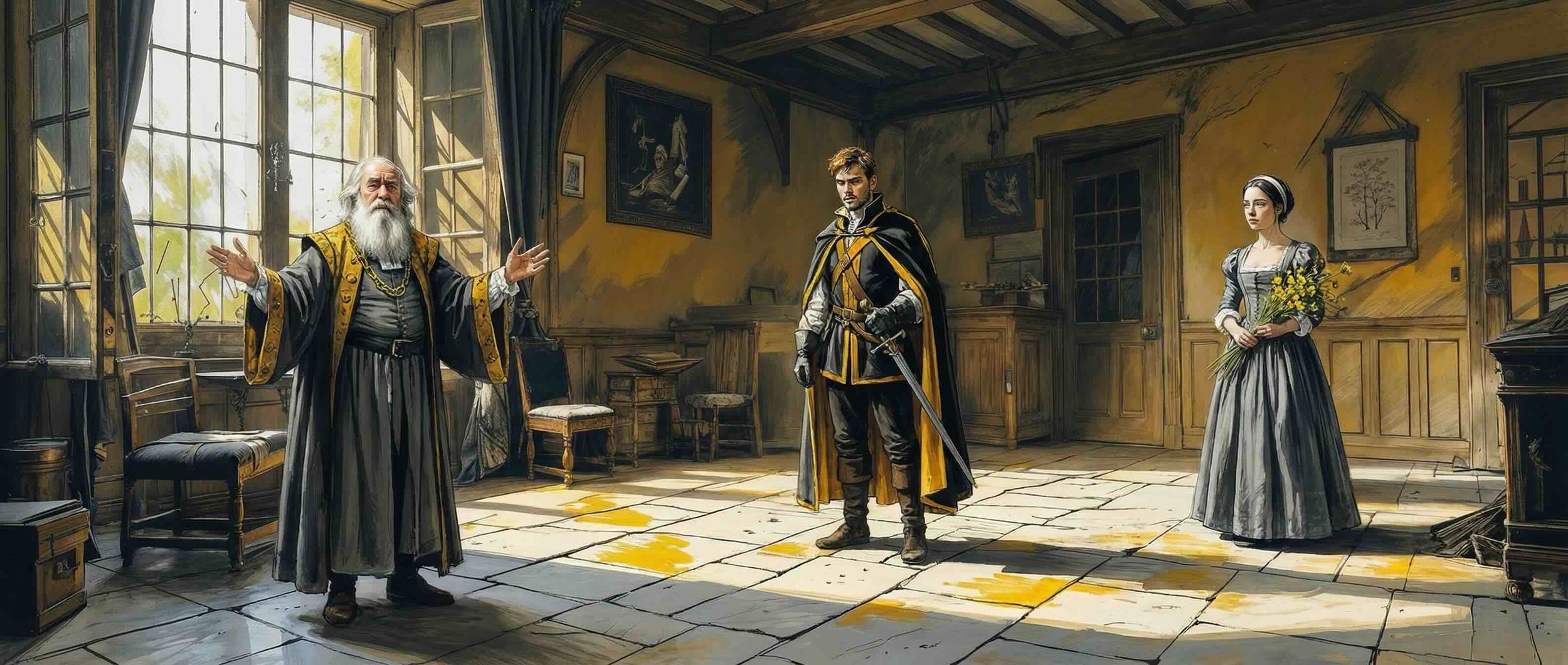
Scene Summary
Laertes is packing to return to France. Before he leaves, he speaks privately with his sister, Ophelia, regarding her relationship with Hamlet. He warns her that Hamlet’s affection is merely a "violet in the youth of primy nature"—sweet but temporary. He explains that as a Prince, Hamlet’s "will is not his own" and he cannot marry for love, but only for the state. Ophelia promises to keep his advice, but playfully warns Laertes not to be a hypocrite who preaches virtue while treading the "primrose path of dalliance" himself. Polonius enters to hurry Laertes along but delays him further by delivering a long list of moral precepts (aphorisms) for his conduct abroad. Once Laertes exits, Polonius questions Ophelia. Upon hearing she has accepted "tenders" of affection from Hamlet, Polonius mocks her naivety ("green girl"). He orders her to cut off all contact with the Prince, and Ophelia submissively obeys.
Context
The Foil Family: The Polonius family serves as a foil (contrast) to the Royal family. While the King’s court is tense and dangerous, this family unit appears domestic and concerned with social propriety.
Patriarchy and Agency: This scene highlights the limited agency of women in the play. Ophelia is lectured by both her brother and father, her own feelings dismissed as "green" or dangerous. Her body and behaviour are treated as property of the family reputation.
Political Marriage: Laertes’ speech highlights the reality of Elizabethan monarchy: a Prince’s marriage was a diplomatic tool, not a romantic choice.
Character Focus
Ophelia: The Obedient Daughter
We meet Ophelia not in isolation, but defined entirely by the men around her. In this scene, she displays a flash of spirit and wit when she teases Laertes about his own behaviour. However, this spark is quickly extinguished by Polonius. Her final line, "I shall obey, my lord," captures her tragic flaw: absolute submission to authority. She suppresses her own heart to please her father, a decision that leaves her defenceless when he is later killed.
Language and Technique
Commercial Metaphor: Polonius uses the language of commerce to discuss his daughter’s chastity. He speaks of "tenders" (offers), "sterling" (currency), and "investments." This objectifies Ophelia, treating her virginity as a commodity to be traded or hoarded, rather than a personal attribute.
Sententiae (Aphorisms): Polonius speaks almost entirely in proverbs ("Neither a borrower nor a lender be"). This rhetorical technique portrays him as a man of received wisdom rather than original thought—pompous, rehearsed, and perhaps a bit outdated.
Nature Imagery: Laertes describes Hamlet’s love using flower imagery ("violet," "canker," "contagious blastments"). This establishes a motif of fragile nature that is prone to corruption, foreshadowing Ophelia’s eventual breakdown and her symbolic distribution of flowers in Act 4.
Key Quotes
Original:
For Hamlet and the trifling of his favour,
Hold it a fashion and a toy in blood,
A violet in the youth of primy nature,
Forward, not permanent, sweet, not lasting,
The perfume and suppliance of a minute;
No more. (Laertes)
Shakespeare Retold (Modern Verse):
For Hamlet and his foolish faux affection,
Think of it as a passing amorous phase,
A springtime violet blooming whilst it’s young,
A short-lived show, though sweet, it won’t endure;
Its smell will last no longer than a minute;
No more.
Analysis: Laertes dismisses Hamlet's feelings as a "toy in blood" (a sexual whim). The violet imagery suggests something beautiful but short-lived, implying that Hamlet's love will wither as soon as the "summer" of passion fades.
_____
Original:
This above all: to thine own self be true,
And it must follow, as the night the day,
Thou canst not then be false to any man. (Polonius)
Shakespeare Retold (Modern Verse):
But most of all: be true unto yourself,
And if you do, as night will follow day,
You can’t be false to any other man.
Analysis: One of Shakespeare's most famous lines, yet deeply ironic in context. Polonius advises sincerity, yet he is the play’s primary schemer and spy. Furthermore, he explicitly prevents Ophelia from being "true" to her own self by forcing her to reject the man she loves.
_____
Original:
Affection! Pooh! You speak like a green girl,
Unsifted in such perilous circumstance...
Marry, I will teach you: think yourself a baby;
That you have ta'en these tenders for true pay,
Which are not sterling. (Polonius)
Shakespeare Retold (Modern Verse):
Affection? Crap! You’re wet behind the ears, girl,
Not used to times as perilous as this…
Well, let me teach you: think that you’re a baby
For thinking that these offers were for real,
For they’re not real.
Analysis: Polonius mocks Ophelia’s innocence ("green girl"). The shift to financial metaphors ("tenders," "pay," "sterling") reveals his cynicism. He views relationships as transactions and fears that Ophelia is making a bad deal that will devalue her (and his) social standing.
Study Prompts (with suggested answers)
-
Benchmark Points:
Laertes' advice is specific to Ophelia's safety and reputation.
Polonius's advice is general, worldly wisdom regarding social advancement.
Both men preach at Ophelia rather than listening to her.
Suggested Answer: Laertes warns Ophelia about a specific danger (Hamlet’s position), showing brotherly concern mixed with condescension. Polonius gives a generic list of maxims to Laertes, concerned with social climbing and appearance. Both men, however, preach at Ophelia rather than listening to her, establishing the patriarchal control that defines her life.
-
Benchmark Points:
The concept of the Body Politic (the King is the State).
The difference between a private man and a Prince.
The safety of the state relying on royal marriage.
Suggested Answer: He means that as heir apparent, Hamlet belongs to the state. His marriage determines the future of Denmark, so he cannot choose a wife based on personal love if it endangers the country’s alliances or stability. He is bound by his royal birthright to put Denmark before his own desires.
-
Benchmark Points:
Ophelia’s "primrose path" retort.
Polonius’s permissive attitude toward Laertes.
Strictness with Ophelia regarding chastity.
Suggested Answer: Laertes is free to go to France and likely indulge in the "primrose path of dalliance" (sexual freedom), while Ophelia is guarded at home. Ophelia points this out, asking him not to be a "reckless libertine" while telling her to live like a nun. It highlights the gendered expectations of the era.
-
Benchmark Points:
The wisdom of his advice to Laertes.
His harshness and mockery toward Ophelia.
His concern for family honour over his children's feelings.
Suggested Answer: It is ambiguous. His advice to Laertes is sound and famous for its wisdom ("to thine own self be true"). However, he is cruel and dismissive to Ophelia, prioritizing his own political caution over her happiness. He treats his children as extensions of his own ego and reputation.
-
Benchmark Points:
Her isolation from support systems.
The removal of her lover (Hamlet).
The departure of her brother (Laertes).
Total reliance on her father.
Suggested Answer: By forcing Ophelia to reject Hamlet, Polonius removes her lover. By sending Laertes away, he removes her brother. Ophelia is left entirely dependent on Polonius. When Polonius dies later, she has no male authority left to define her or guide her, leading to her psychological fragmentation.