
Home → Plays → Hamlet → Act 1 Scene 5 → Scene Analysis
Hamlet: Act 1, Scene 5 – analysis
The Ghost reveals the horrific truth of the murder, setting Hamlet on his path of revenge.
Scene Profile – At a Glance
Location: The battlements of Elsinore.
Characters: Hamlet, The Ghost, Horatio, Marcellus.
Key Event: The Ghost reveals he was poisoned by Claudius and demands Hamlet avenge him; Hamlet swears his friends to secrecy.
The Atmosphere: Horrific, supernatural, and emotionally shattering.
Key Quote: "The serpent that did sting thy father's life / Now wears his crown."
Significance: This is the catalyst for the entire tragedy; the abstract suspicion of "rottenness" becomes a concrete crime that demands action.
Scene Summary
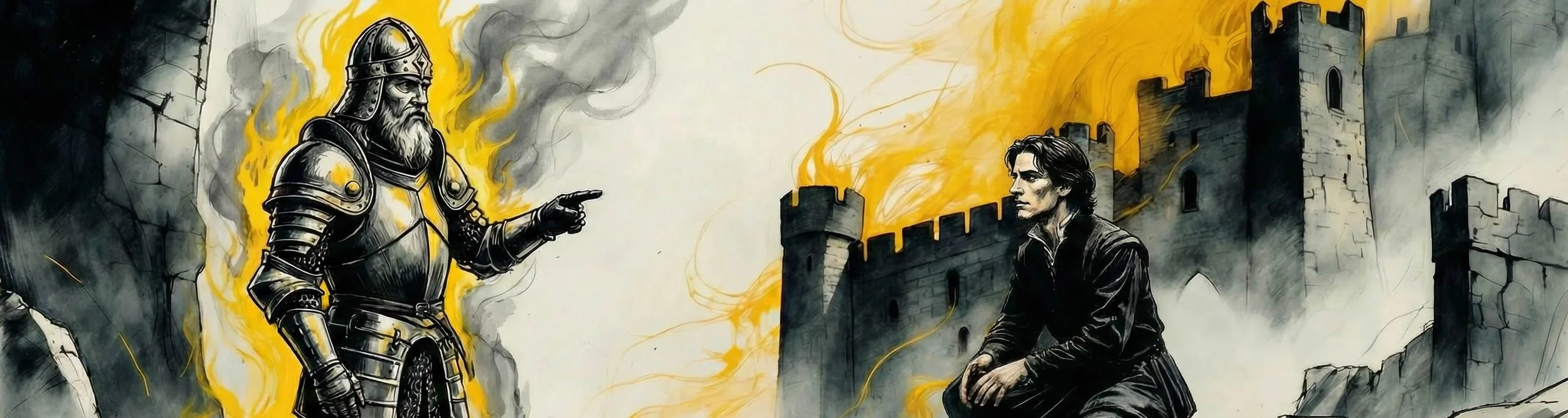
Alone with Hamlet, the Ghost confirms his identity as Hamlet's father, doomed to walk the night and burn in purgatory during the day until his sins are purged. He reveals the shocking truth: he was not bitten by a snake, but poisoned by Claudius, who poured "leprous distilment" into his ear while he slept. This robbed him of his life, his crown, and his queen all at once. The Ghost commands Hamlet to "revenge his foul and most unnatural murder" but specifically orders him not to harm his mother, leaving her judgment to heaven. As dawn breaks, the Ghost vanishes. Hamlet, verging on hysteria, vows to wipe his memory of all trivial knowledge and keep only this command. When Horatio and Marcellus catch up, Hamlet behaves wildly ("antic disposition") and forces them to swear upon his sword—three times, with the Ghost echoing from beneath the earth—that they will never reveal what they have seen.
Context
The Old Law vs. The New: The Ghost represents the old, feudal world of blood feuds and "an eye for an eye." Hamlet belongs to a newer, university-educated world of philosophy and reason. This scene forces the two worlds to collide.
Purgatory: The Ghost’s description of his "prison-house" is distinctly Catholic (Purgatory), whereas England at the time was Protestant (which rejected Purgatory). This adds to Hamlet's confusion about whether the spirit is "honest" or a devil.
The Ear: Poisoning through the ear is symbolic. Just as the King was physically poisoned through the ear, the whole of Denmark is now being "poisoned" by Claudius’s lies (words) poured into the "ears" of the public.
Character Focus
Hamlet: The Burden of Knowledge
This is the moment Hamlet’s life splits in two. Before this, he was a grieving son; now, he is a burdened avenger. We see his mind fracture under the weight of the revelation. His language becomes erratic, he jokes inappropriately with the Ghost ("old mole"), and he immediately adopts the "antic disposition" (feigned madness) as a defence mechanism. He realises that to survive in a corrupt world, he must hide his "true self" completely.
Language and Technique
Synecdoche (The Ear): The ear is the central motif. The Ghost describes the "leperous distilment" entering the "porches of my ears." Later, Hamlet will try to "poison" Claudius with a play that enters his ears. It represents vulnerability to both poison and manipulation.
Repetition (Remember Me): The Ghost’s final command is "Adieu, adieu, adieu! Remember me." Hamlet repeats this ("Remember thee!") obsessively. It shifts the play from a plot of action to a plot of memory—Hamlet is haunted not just by a ghost, but by the past.
Stichomythia: When Horatio and Marcellus arrive, the dialogue becomes rapid-fire and broken. This breathless rhythm mimics Hamlet’s racing heart and fragmented state of mind.
Key Quotes
Original:
I am thy father’s spirit,
Doomed for a certain term to walk the night,
And for the day confined to fast in fires,
Till the foul crimes done in my days of nature
Are burnt and purged away. (The Ghost)
Shakespeare Retold (Modern Verse):
I am your father’s spirit,
Doomed for a certain time to walk the night;
By day I starve, confined to purgatory
Until the crimes committed whilst I lived
Are cleansed and purged away.
Analysis: The Ghost establishes his suffering immediately. The imagery of fire and purging confirms he is in Purgatory. This emphasises that he died "unhouseled" (without last rites), adding spiritual horror to the physical murder.
_____
Original:
The serpent that did sting thy father's life Now wears his crown. (The Ghost)
Shakespeare Retold (Modern Verse):
The snake who killed your father with a bite
Now wears his crown.
Analysis: A revelation of biblical proportions. By calling Claudius a "serpent," the Ghost invokes the imagery of Satan in the Garden of Eden. It frames the murder not just as a crime, but as a "Fall of Man" that ruined the paradise of Denmark.
_____
Original:
Yea, from the table of my memory
I’ll wipe away all trivial fond records...
And thy commandment all alone shall live
Within the book and volume of my brain. (Hamlet)
Shakespeare Retold (Modern Verse):
Yeah, from the place my memory is stored,
I’ll clear away all sweet but trivial thoughts,
The reams of books, the documents, the stories
I’ve picked up and observed along the way,
Analysis: Hamlet uses the metaphor of a "table" (notebook). He vows to erase his education, his philosophy, and his past to make room for revenge. It is a tragic intellectual suicide—he sacrifices his mind to serve the Ghost.
Study Prompts (with suggested answers)
-
Benchmark Points:
The Ghost's lingering love for her.
The concept of divine judgment ("leave her to heaven").
The pain of her conscience ("thorns that in her bosom lodge").
Suggested Answer: The Ghost forbids violence against Gertrude, partly due to a lingering affection, but mostly because he believes her punishment should be left to God ("heaven") and her own guilt ("thorns"). He views her as weak and seduced rather than the architect of the crime.
-
Benchmark Points:
To gain freedom of speech.
To distract Claudius from his true motives.
To process his own trauma safely.
Suggested Answer: Hamlet adopts the "antic disposition" as a tactical disguise. It allows him to speak dangerous truths and observe the court without arousing suspicion of a coup. It also serves as a psychological safety valve, allowing him to express his intense emotions under the mask of insanity.
-
Benchmark Points:
The auditory hallucination (Ghost beneath the stage).
The binding of the three men in secrecy.
Hamlet's erratic behaviour ("old mole").
Suggested Answer: The scene creates a claustrophobic atmosphere where the supernatural invades the physical world—the Ghost is literally under their feet. Hamlet's mockery of the Ghost ("truepenny," "old mole") suggests he is trying to master his fear. Swearing on the sword (a cross) binds them in a holy pact of silence.
-
Benchmark Points:
From domestic drama to Revenge Tragedy.
Introduction of the "blood duty."
The inevitability of violence.
Suggested Answer: Before this scene, the play is a drama about grief and remarriage. The Ghost's command transforms it into a Revenge Tragedy (a popular Elizabethan genre). It imposes a "blood duty" on Hamlet, meaning the play can now only end in violence and the death of the antagonist.
-
Benchmark Points:
Denmark as an Eden.
Claudius as the Serpent.
The fall from grace.
Suggested Answer: The Ghost describes his murder occurring in his "orchard" (garden), evoking the Garden of Eden. Denmark was a paradise under King Hamlet, but Claudius (the Serpent) has poisoned it, leading to the "Fall" of the state into corruption and sin.