
Home → Plays → Hamlet → Act 2 Scene 1 → Scene Analysis
Hamlet: Act 2, Scene 1 – analysis
The surveillance state tightens as Polonius spies on his son and misinterprets Hamlet's madness.
Scene Profile – At a Glance
Location: A room in Polonius’s house.
Characters: Polonius, Reynaldo, Ophelia.
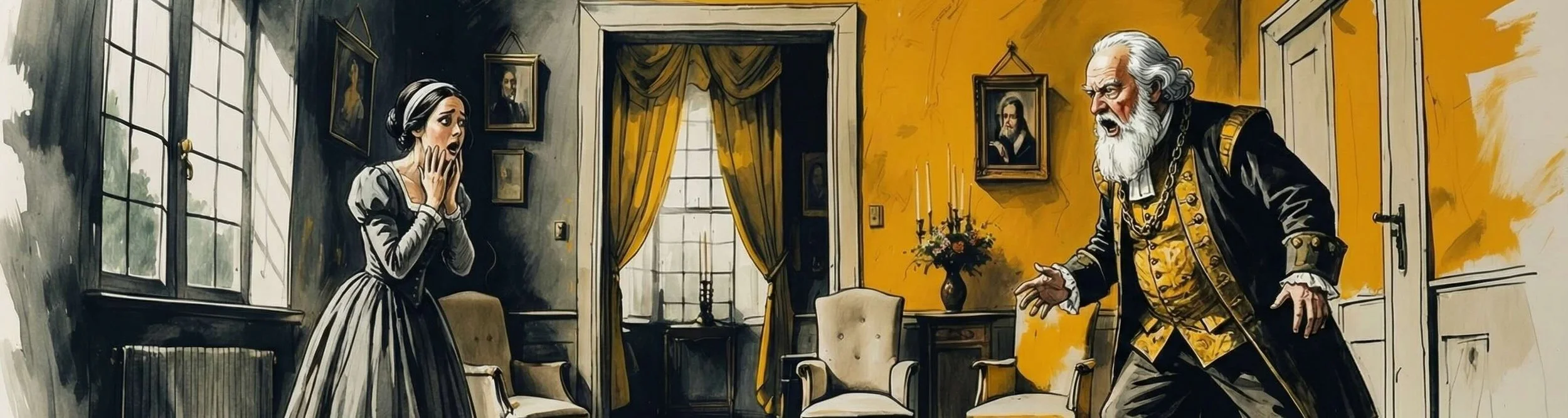
Key Event: Polonius hires a spy to watch Laertes; Ophelia reports Hamlet’s silent, dishevelled intrusion into her room.
The Atmosphere: Conspiratorial, domestic yet uneasy, and fraught with confusion.
Key Quote: "By indirections find directions out."
Significance: Establishes the theme of universal surveillance in Elsinore; provides the first description of Hamlet’s "madness" in action.
Scene Summary
Polonius gives money and notes to his servant, Reynaldo, instructing him to go to Paris to spy on Laertes. He teaches Reynaldo a devious method of gathering intelligence: Reynaldo is to lightly slander Laertes (accusing him of gaming or drinking) to see if the locals confirm the rumours ("put on him what forgeries you please"). After Reynaldo leaves, Ophelia enters in a state of terror. She tells her father that as she was sewing in her closet (private room), Hamlet appeared looking like a man "loosed out of hell"—his jacket unfastened, no hat, and stockings around his ankles. He held her wrist hard, stared at her face intensely without speaking, sighed piteously, and then backed out of the room. Polonius immediately interprets this as the "very ecstasy of love" caused by Ophelia rejecting Hamlet’s letters. He decides they must inform King Claudius immediately.
Context
The Surveillance State: This scene cements Elsinore as a place where no one is trusted. Fathers spy on sons (Polonius/Laertes) just as uncles spy on nephews (Claudius/Hamlet). It mirrors the Elizabethan network of spies under Walsingham—privacy is extinct.
The "Closet": In Elizabethan architecture, a closet was a small, private room for prayer or sewing. Hamlet’s intrusion here is a violation of Ophelia’s most private sanctuary, emphasising the invasive nature of the court.
Love Melancholy: Polonius interprets Hamlet’s dress (dishevelled) and behaviour (sighing, silence) as standard symptoms of "love sickness," a recognised medical condition in Shakespeare's time. This misdiagnosis drives the plot for the next two acts.
Character Focus
Polonius: The Machiavellian Father
Polonius reveals his true colours here. He is not just a "tedious old fool" but a manipulative strategist. His instruction to Reynaldo to use "forgeries" (lies) to find the truth shows he has no moral compass—reputation is a game to be managed, not a virtue to be upheld. He treats his children as assets; Laertes is a liability to be monitored, and Ophelia is a tool to be used to curry favour with the King.
Language and Technique
Oxymoron / Paradox: Polonius's method is defined by the phrase "By indirections find directions out." This paradox sums up the political method of Elsinore: one must lie to find the truth, and walk a crooked path to go straight.
Visual Imagery (reported): We do not see Hamlet in this scene; we only hear Ophelia’s vivid description of him ("Doublet all unbraced," "pale as his shirt"). This ekphrasis (detailed description of a visual work) allows the audience to imagine a horror greater than could be staged, and leaves us questioning if Hamlet is acting or truly desperate.
Irony: Polonius claims "I am sorry that with better heed and judgment / I had not quoted him." He believes his mistake was underestimating Hamlet’s love. The audience knows his mistake is far greater: he is underestimating Hamlet’s sanity and motive.
Key Quotes
Original:
See you now;
Your bait of falsehood takes this carp of truth;
And thus do we of wisdom and of reach,
With windlasses and with assays of bias,
By indirections find directions out. (Polonius)
Shakespeare Retold (Modern Verse):
You see now,
This small white lie helps you reveal the truth,
So we can know precisely what’s occurring
By testing roundabout hypotheses,
And indirectly know the direct truth;
Analysis: Polonius uses a fishing metaphor ("bait," "carp"). He admits that he uses lies ("bait of falsehood") to catch the truth. The terms "windlasses" and "bias" are from hunting and bowls, suggesting that truth is something to be trapped or hunted, not simply asked for.
_____
Original:
Lord Hamlet, with his doublet all unbraced,
No hat upon his head, his stockings fouled,
Ungartered, and down-gyved to his ankle,
Pale as his shirt, his knees knocking each other,
And with a look so piteous in purport
As if he had been loosed out of hell
To speak of horrors—he comes before me. (Ophelia)
Shakespeare Retold (Modern Verse):
Lord Hamlet, with his jacket all unbuttoned,
No hat upon his head, and filthy socks
Left scrunched like prisoners’ shackles ’round his ankles,
Pale as his shirt, his knees knocking together,
And with a ghastly, pitiful expression,
As if he’d just escaped the grasp of hell
To share its horror, stood in front of me.
Analysis: This is the classic image of the "mad" Hamlet. The "ungartered" stockings were a specific Elizabethan code for a lover crazed by rejection. However, the description "loosed out of hell" connects Hamlet back to the Ghost—suggesting his madness is rooted in the supernatural trauma, not just romance.
_____
Original:
This is the very ecstasy of love,
Whose violent property fordoes itself
And leads the will to desperate undertakings
As oft as any passion under heaven… (Polonius)
Shakespeare Retold (Modern Verse):
This is the madness of besotted love
That self-destructs through violent behaviour,
Leading the person into desperate actions,
Just like the other passions of the heart…
Analysis: Polonius is confident he has diagnosed the problem: "ecstasy" here means madness/frenzy. He views love as a "violent property" that is self-destructive ("fordoes itself"). This diagnosis gives him power; he now has information the King needs.
Study Prompts (with suggested answers)
-
Benchmark Points:
Establishes the theme of spying/surveillance.
Shows Polonius's lack of trust in his own son.
Highlights the corruption of the older generation.
Suggested Answer: It establishes the pervasive atmosphere of surveillance in Denmark. Polonius is willing to slander his own son's reputation ("bait of falsehood") just to spy on him. It mirrors the King’s later spying on Hamlet, suggesting that the older generation maintains control through deceit and manipulation.
-
Benchmark Points:
Symptoms of "Love Melancholy" (dishevelled clothes).
Connection to the Ghost ("loosed out of hell").
The ambiguity of performance vs. reality.
Suggested Answer: Hamlet’s appearance serves two purposes. To Polonius, the "ungartered" stockings signify love-madness (antic disposition working). To the audience, his pale face and "knees knocking" reflect the genuine trauma of seeing the Ghost. It is a performance rooted in real terror.
-
Benchmark Points:
His inability to communicate his secret.
A test of Ophelia's loyalty.
A non-verbal farewell.
Suggested Answer: Hamlet's silence suggests he is testing Ophelia to see if she can look past his "madness" to the truth, or he is mutely saying goodbye to her because he knows his mission of revenge ("wipe away all trivial fond records") means he can no longer be her lover.
-
Benchmark Points:
The political method of Elsinore.
The impossibility of direct truth.
Theme of appearance vs. reality.
Suggested Answer: It serves as a motto for the entire play. In Elsinore, direct questions are dangerous (as seen in Scene 1). Truth can only be found through spying, "mousetraps" (the play-within-a-play), and feigned madness. It highlights the crooked, corrupt nature of the state.
-
Benchmark Points:
Her fear and passivity.
Her immediate obedience to her father.
Her lack of agency.
Suggested Answer: Ophelia is terrified but passive. Instead of comforting Hamlet or keeping his secret, she immediately runs to her father and reports every detail. This confirms her total submission to patriarchal authority, positioning her as a pawn in the conflict between Hamlet and the Court.