
Home → Plays → Hamlet → Act 3 Scene 1 → Scene Analysis
Hamlet: Act 3, Scene 1 – analysis
Hamlet debates the value of life in his soliloquy and violently rejects Ophelia while the King and Polonius spy on them.
Scene Profile – At a Glance
Location: A Hall in the Castle.
Characters: King Claudius, Queen Gertrude, Polonius, Ophelia, Rosencrantz, Guildenstern, Hamlet.
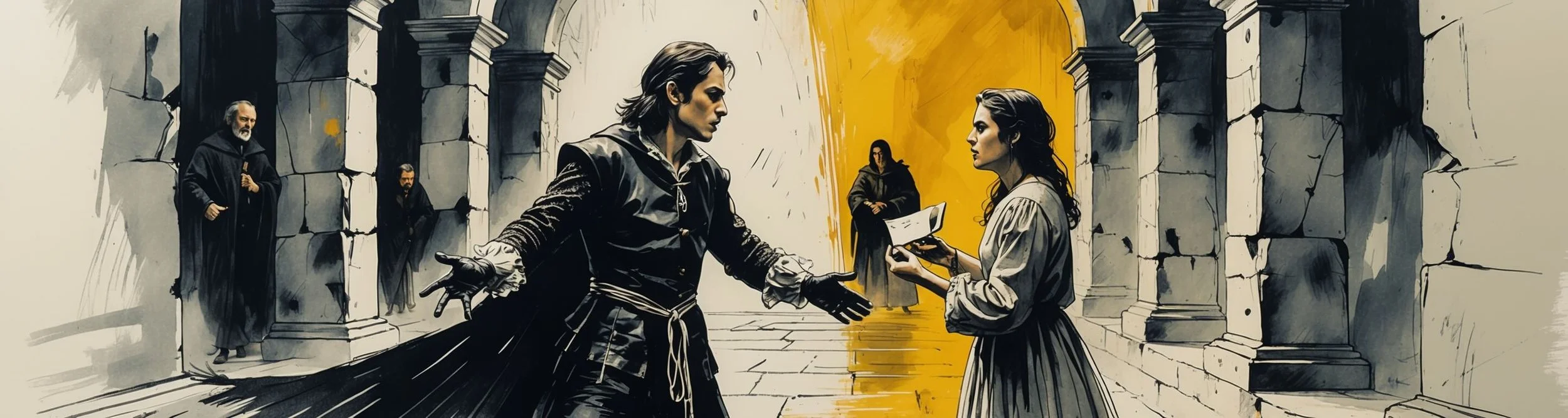
Key Event: Hamlet delivers the "To be or not to be" soliloquy and brutally rejects Ophelia while the King and Polonius spy on them.
The Atmosphere: Tense, eavesdropping, philosophically heavy, and emotionally violent.
Key Quote: "To be, or not to be: that is the question."
Significance: Hamlet’s philosophical peak turns into misogynistic rage; the King realises Hamlet is not mad for love, but dangerous.
Scene Summary
Claudius questions Rosencrantz and Guildenstern, who admit they cannot find the cause of Hamlet’s madness but report his excitement about the Players. Claudius and Polonius then execute their plan: they place Ophelia in the hall as bait, armed with a prayer book, while they hide behind an arras (tapestry) to spy. Hamlet enters and delivers his soliloquy on suicide and the nature of existence ("To be, or not to be"). He then notices Ophelia. She attempts to return his love letters ("remembrances"), but Hamlet denies giving them. He attacks her virtue, famously ordering her to "Get thee to a nunnery" to avoid breeding sinners. His rage escalates, likely realizing he is being watched, and he threatens the King ("all but one, shall live"). After he storms out, Ophelia laments his fall from nobility. Claudius emerges, convinced Hamlet is not love-sick but harbouring a dangerous secret, and decides to send him to England.
Context
The Nunnery: In Elizabethan slang, a "nunnery" could mean a convent, but ironically also a brothel. Hamlet’s command is a double entendre: he is telling her to remain chaste to avoid birthing sinners, but also insulting her as if she were a prostitute.
Spying: The scene is staged with the King and Polonius visible to the audience (and possibly Hamlet) but hidden from Ophelia. This dramatic irony adds cruelty to the scene; Ophelia is forced to act naturally while knowing her father is watching her humiliation.
The Soliloquy: "To be or not to be" is technically a general philosophical debate, not a personal confession. Unlike his other soliloquies, Hamlet does not use "I" or "me." He discusses the human condition abstractly, distancing himself from his own pain.
Character Focus
Ophelia: The Pawn
This is the breaking point for Ophelia. She is forced by her father to betray the man she loves, and as a result, she is verbally abused by him. Her soliloquy at the end of the scene ("O, what a noble mind is here o'erthrown!") is one of the few times she speaks her own thoughts. It reveals her deep intelligence and sorrow, showing she understands exactly what Denmark has lost in Hamlet’s madness.
Language and Technique
Antithesis: The "To be" soliloquy is built on binary opposites: be/not to be, noble/suffer, sleep/dream. This rhetorical structure mirrors Hamlet’s paralysis; he is trapped between two opposing forces (action vs. inaction, life vs. death) and cannot choose.
Misogyny/Generalization: Hamlet transfers his anger at his mother onto Ophelia ("God has given you one face, and you make yourselves another"). He generalizes all women as deceptive ("jig, amble, and lisp"), revealing how Gertrude’s actions have poisoned his view of sexuality and gender.
Euphemism: Hamlet speaks of death as a "quietus" (settlement of a debt) and a "consummation." He avoids the word "death" directly, intellectualising it to make the terrifying concept manageable.
Key Quotes
Original:
To be, or not to be: that is the question:
Whether ’tis nobler in the mind to suffer
The slings and arrows of outrageous fortune,
Or to take arms against a sea of troubles,
And by opposing end them? (Hamlet)
Shakespeare Retold (Modern Verse):
Shall I live on, or take my life? I wonder.
Would I find greater honour if I suffered
The stinging pain wrought by my wretched luck
Instead of fighting back against my troubles,
Which, doing so, would kill me?
Analysis: The central question of the play. Hamlet weighs the passive Christian virtue of "suffering" against the active Stoic virtue of "taking arms" (suicide/action). The metaphor "sea of troubles" suggests the futility of fighting; one cannot defeat a sea with a sword, implying resistance is suicide.
_____
Original:
Thus conscience does make cowards of us all;
And thus the native hue of resolution
Is sicklied o’er with the pale cast of thought. (Hamlet)
Shakespeare Retold (Modern Verse):
And so, awareness turns us into cowards;
And thus our natural drive to solve a problem
Recedes and fades through over-contemplation.
Analysis: "Conscience" here means "consciousness" or "over-thinking," not just moral guilt. Hamlet diagnoses his own flaw: his intellect ("pale cast of thought") is a disease that "sicklies" (infects) his natural will to act ("native hue of resolution").
_____
Original:
Get thee to a nunnery: why wouldst thou be a breeder of sinners? (Hamlet)
Shakespeare Retold (Modern Verse):
Resettle in a convent! Why become a mother of more sinners?
Analysis: Hamlet rejects the cycle of life itself. By calling children "sinners," he expresses a nihilistic view that existence is inherently corrupt. He wants Ophelia to remove herself from the gene pool so she doesn't create more "rascals" like him.
_____
Original:
O, what a noble mind is here o’erthrown!
The courtier’s, soldier’s, scholar’s, eye, tongue, sword;
The expectancy and rose of the fair state...
Now see that noble and most sovereign reason,
Like sweet bells jangled, out of tune and harsh. (Ophelia)
Shakespeare Retold (Modern Verse):
Oh no, his gracious mind is now bewitched,
Confusing strengths of prince, soldier and scholar!
He is our cherished heir to rule our country…
Now see the mind incomprehensible,
Like sweet bells jangled, out of tune and harsh.
Analysis: Ophelia describes the ideal Renaissance Man Hamlet used to be (soldier/scholar). The simile "sweet bells jangled" perfectly captures madness not as silence, but as chaos—the notes are still there (the intellect remains), but the order is destroyed.
Study Prompts (with suggested answers)
-
Benchmark Points:
The pain of life vs. the fear of death.
The "undiscovered country" (afterlife).
Why humans choose to suffer rather than commit suicide.
Suggested Answer: Hamlet argues that life is a series of "calamities" (oppressor's wrong, pangs of despised love). The only reason humans don't commit suicide ("quietus") is the fear of what comes after death—the "dread of something after death." Thus, fear of the unknown forces us to endure the known misery of life.
-
Benchmark Points:
The shift in his tone from gentle to aggressive.
The question "Where is your father?"
The threat against the King ("all but one shall live").
Suggested Answer: It is highly likely. His sudden question "Where is your father?" implies suspicion. When Ophelia lies ("At home"), Hamlet’s rage explodes. He performs for the spies, threatening the King indirectly ("those that are married already... shall live") to warn Claudius without revealing his actual plan.
-
Benchmark Points:
Rejection of Polonius's "love-madness" theory.
Recognition of the danger in Hamlet's melancholy.
The decision to send him to England.
Suggested Answer: Claudius, a shrewd politician, realizes Polonius is wrong. He notes that what Hamlet spoke "was not like madness." He sees a "danger" incubating in Hamlet’s depression and immediately decides to exile him to England to protect his own crown.
-
Benchmark Points:
"I never gave you aught."
Rejection of his past self.
Distrust of Ophelia's motives.
Suggested Answer: He claims he never gave them because the Hamlet who gave them (the lover/courtier) no longer exists; he is now only the Avenger. Additionally, seeing her return them formally (likely part of Polonius’s script) makes him realize she is part of the trap, causing him to reject the emotional connection entirely.
-
Benchmark Points:
"God has given you one face..."
Deception and artificiality of women.
Connection to the theme of "painting" over rot.
Suggested Answer: Hamlet attacks women for using makeup ("paint"). He sees it as a symbol of female deception—hiding the reality God created with a false, pleasing appearance. This links to the wider theme of the state hiding its corruption (Claudius’s smile) behind a mask of propriety.