
Home → Plays → Hamlet → Act 3 Scene 2 → Scene Analysis
Hamlet: Act 3, Scene 2 – analysis
Hamlet stages the play to catch the King's conscience, Claudius flees in guilt, and Hamlet prepares to confront his mother.
Scene Profile – At a Glance
Location: The Hall of Elsinore Castle (set up for a performance).
Characters: Hamlet, Horatio, The Players, King Claudius, Queen Gertrude, Polonius, Ophelia, Rosencrantz, Guildenstern.
Key Event: The performance of "The Mousetrap" causes Claudius to panic and storm out, confirming his guilt.
The Atmosphere: A public spectacle concealing intense private tension, culminating in chaotic panic.
Key Quote: "Give me some light. Away!"
Significance: This is the turning point of the play (the climax of the investigation); Hamlet gains the proof he needs to act.
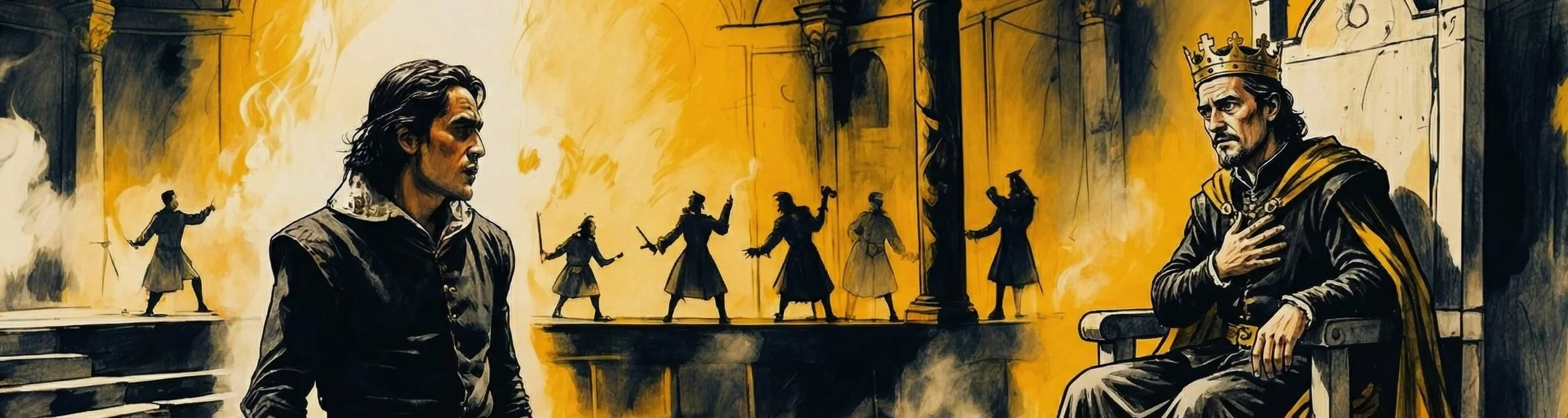
Scene Summary
Hamlet advises the Players on acting, urging them to perform naturally ("suit the action to the word") rather than over-acting. He confides in Horatio, asking him to watch Claudius’s face during the performance for signs of guilt. The court arrives for the play. Hamlet is manic and aggressive, engaging in sexually suggestive banter with Ophelia ("country matters") while refusing to sit near his mother. The Players perform a "dumb show" (silent mime) of the murder, which Claudius strangely ignores. The play, The Murder of Gonzago (which Hamlet calls "The Mousetrap"), then begins with dialogue. When the stage-villain pours poison into the Player King’s ear, Claudius suddenly rises, calls for light, and rushes out. The play halts in chaos. Left alone with Horatio, Hamlet celebrates his victory—he now believes the Ghost. Rosencrantz and Guildenstern arrive to summon Hamlet to his mother; Hamlet accuses them of trying to "play" him like a recorder. Finally, Polonius tells Hamlet the Queen wishes to see him. Hamlet delivers a soliloquy vowing to speak "daggers" to her but use none.
Context
The Dumb Show: It is a critical debate in Shakespearean scholarship: why does Claudius not react to the silent mime of the murder, but reacts to the spoken version later? He may have been distracted by Gertrude or Hamlet, or perhaps he has the strength to withstand the visual, but the spoken word breaks his nerve.
Meta-Theatre: This is the ultimate meta-theatrical moment. Hamlet acts as director, critic, and chorus. Shakespeare uses the "play within a play" to comment on the power of theatre to reveal truth—suggesting that fiction is sometimes more honest than reality.
The Recorder: Hamlet’s extended metaphor with the recorder challenges the idea of the "simple" man. He argues that if his friends cannot make a simple pipe make music, they certainly cannot manipulate the complex "heart" of a prince.
Character Focus
Hamlet: The Man of Action
For the first time, Hamlet is in control. He dominates the stage, directing the actors, orchestrating the seating, and manipulating the reactions of the court. His "antic disposition" shifts from melancholy to manic energy. However, his cruelty toward Ophelia (public sexual humiliation) shows the darker side of his transformation; in his pursuit of the King, he is willing to destroy the innocent.
Language and Technique
Double Entendre: Hamlet’s dialogue with Ophelia is laden with sexual innuendo ("Do you think I meant country matters?"). The pun on "country" (cunt-ry) and "nothing" (slang for female genitalia) is aggressive and degrading, treating Ophelia as an object of lust to shock the court.
Imperatives: When Claudius breaks, his language fractures into short, panicked commands: "Give me some light. Away!" The iambic pentameter collapses, symbolizing the breakdown of his composed facade.
Imagery of Witchcraft: In his final soliloquy, Hamlet invokes "the very witching time of night," "churchyards," and "hell." This dark imagery signals a shift from the intellectual philosopher to the potential avenger capable of violence.
Key Quotes
Original:
Suit the action to the word, the word to the action; with this special observance, that you o’erstep not the modesty of nature. (Hamlet)
Shakespeare Retold (Modern Verse):
Match your actions to the words and words to actions, but pay close attention: don’t over-act the subtlety of nature.
Analysis: Hamlet’s advice to the actors serves as Shakespeare’s own manifesto on drama. He rejects the melodramatic "strutting and bellowing" of older plays in favour of "nature" (realism). It is ironic, as Hamlet himself is constantly acting a part that is unnatural to him.
_____
Original:
The lady doth protest too much, methinks. (Gertrude)
Shakespeare Retold (Modern Verse):
I think the lady witters on too much.
Analysis: One of the most famous lines in the play. Gertrude criticises the Player Queen’s repeated vows of loyalty. It is ambiguous whether Gertrude realises the play is attacking her own hasty remarriage, or if she simply finds the writing bad.
_____
Original:
Give me some light. Away! (King Claudius)
Shakespeare Retold (Modern Verse):
Turn up the lights: I’m leaving!
Analysis: The climax of the "Mousetrap." Claudius calls for "light," symbolising his desperate need to escape the moral darkness of his crime that has just been illuminated by the play. His flight confirms his guilt to Hamlet and Horatio.
_____
Original:
‘Sblood, do you think I am easier to be played on than a pipe? Call me what instrument you will, though you can fret me, yet you cannot play upon me. (Hamlet)
Shakespeare Retold (Modern Verse):
By God’s blood, do you think I’m easier to play on than a pipe? So, call me any instrument you like, but don’t think you can play me for a fool.
Analysis: Hamlet destroys Rosencrantz and Guildenstern with this metaphor. He exposes their manipulation: they are trying to "sound" his secrets like a musician fingers a flute ("fret" is a musical term). It is a declaration of intellectual superiority.
_____
Original:
‘Tis now the very witching time of night,
When churchyards yawn and hell itself breathes out
Contagion to this world: now could I drink hot blood. (Hamlet)
Shakespeare Retold (Modern Verse):
It’s now the time of night when witches rise,
And graveyards open with the breath of hell
To curse the world. Right now, I’d drink hot blood.
Analysis: This soliloquy marks a tonal shift to the gothic and macabre. The reference to "hot blood" suggests Hamlet is finally ready for violence. However, he immediately restrains himself regarding his mother ("I will speak daggers to her, but use none"), maintaining the Ghost’s command.
Study Prompts (with suggested answers)
-
Benchmark Points:
Public humiliation.
Projection of anger at Gertrude.
Maintaining the "antic disposition."
Suggested Answer: Hamlet uses crude sexual innuendo ("lie in your lap") to humiliate Ophelia and perform his madness for the court. However, it also reflects his genuine disgust with female sexuality, sparked by his mother’s incestuous marriage. He projects the "whore" archetype onto Ophelia, treating her as a vessel of corruption.
-
Benchmark Points:
A silent summary of the plot.
The mystery of Claudius's non-reaction.
Creating dramatic tension.
Suggested Answer: The dumb show serves as a prelude, summarizing the murder silently. Its primary function in the text is to create tension and ambiguity: why does Claudius not react? It suggests he might be distracted, or tough enough to withstand the visual, requiring the spoken word ("poison in the ear") to finally break him.
-
Benchmark Points:
Metaphor for manipulation.
Hamlet's rejection of Rosencrantz and Guildenstern.
Intellectual dominance.
Suggested Answer: The recorder is a metaphor for the human soul. Hamlet argues that if Guildenstern cannot master a simple wooden pipe, he has no right to try and "play" the complex instrument of Hamlet’s mind. It signifies the end of their friendship; Hamlet sees them purely as the King's spies.
-
Benchmark Points:
Shift from suspicion to certainty.
The Ghost is validated.
The inevitable path to conflict.
Suggested Answer: Before this scene, Hamlet is paralysed by doubt regarding the Ghost's honesty. Claudius's reaction provides objective proof of his guilt ("I'll take the ghost's word for a thousand pound"). This removes Hamlet’s excuse for delay; he now has a mandate to kill the King, and the King knows Hamlet is a threat.
-
Benchmark Points:
The Ghost's command (leave her to heaven).
The power of words.
Hamlet's internal conflict regarding his mother.
Suggested Answer: Hamlet is preparing to confront Gertrude. He is filled with the urge to "drink hot blood" (violence), but consciously restrains himself from physically harming his mother, adhering to the Ghost's command. He resolves to use verbal violence ("speak daggers") to force her to face her own guilt.