
Home → Plays → Hamlet → Act 3 Scene 3 → Scene Analysis
Hamlet: Act 3, Scene 3 – analysis
Claudius confesses his guilt in solitude, while Hamlet misses his perfect opportunity for revenge in a moment of theological cruelty.
Scene Profile – At a Glance
Location: A Room in the Castle (or the Royal Chapel).
Characters: King Claudius, Rosencrantz, Guildenstern, Polonius, Hamlet.
Key Event: Hamlet catches Claudius praying but decides not to kill him lest he send the King's soul to heaven.
The Atmosphere: Quiet, spiritual, deeply ironic, and suffocating with guilt.
Key Quote: "My words fly up, my thoughts remain below: / Words without thoughts never to heaven go."
Significance: This is the structural climax of the play; Hamlet’s refusal to act here leads directly to the death of Polonius and the tragic unraveling of the finale.
Scene Summary
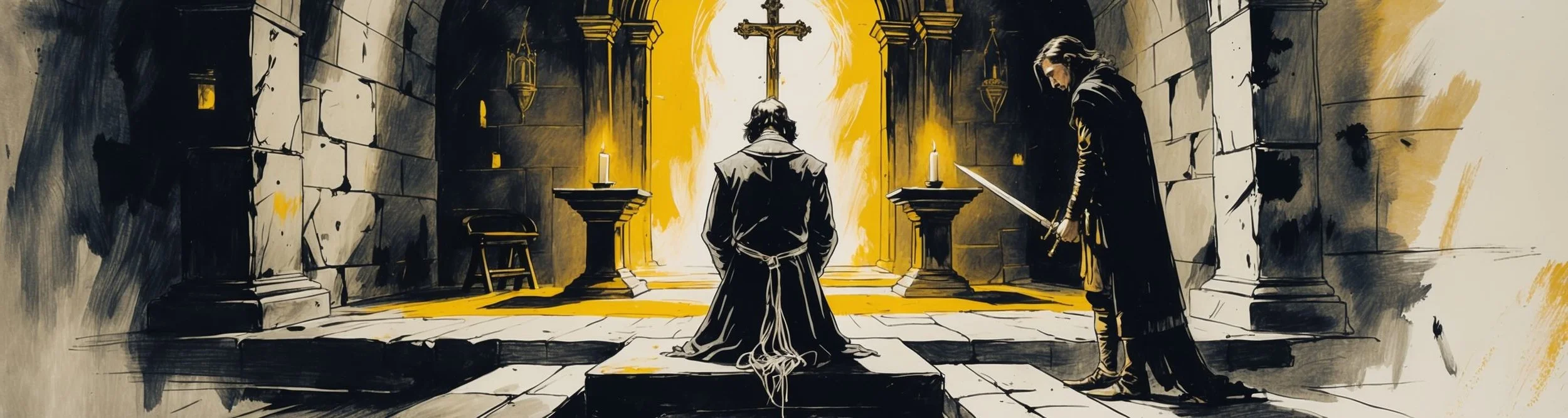
Claudius orders Rosencrantz and Guildenstern to prepare for England immediately, taking Hamlet with them, declaring that "we will fetters put upon this fear." Polonius enters to announce he is going to hide behind the arras in Gertrude’s room to overhear her conversation with Hamlet. Left alone, Claudius falls to his knees. He attempts to pray but is paralyzed by guilt ("O, my offence is rank"). He realises he cannot be forgiven while he still possesses the "effects" of his crime: the crown, the ambition, and the queen. Hamlet enters unseen and finds Claudius vulnerable. He draws his sword ("Now might I do it pat") but stops. He reasons that killing a praying man would send him to heaven, which would be a "benefit" rather than revenge. He resolves to kill Claudius when he is sinning (drunk or angry) to ensure his damnation. Hamlet leaves. Claudius rises, admitting his prayer was hollow.
Context
The Theology of Repentance: Claudius’s speech outlines the Protestant doctrine of repentance: one must confess and make restitution. He knows that "words without thoughts" (prayer without intent to change) are useless. He is trapped because he is unwilling to give up the Crown.
The Revenger's Dilemma: In traditional Revenge Tragedy, the hero simply kills the villain. Shakespeare complicates this by adding a theological dimension. Hamlet wants to kill the soul, not just the body. This "refinement" of revenge turns it into an act of supreme cruelty.
Divine Right of Kings: Rosencrantz delivers a famous speech about the "cease of majesty," arguing that the King is the hub of the wheel and his death drags the whole nation down. This emphasises the high political stakes of Hamlet’s potential regicide.
Character Focus
Claudius: The Hollow Penitent
This is the only time we see Claudius’s internal life. Far from being a cartoon villain, he is a man possessed of a "limed soul"—the more he struggles, the more he is stuck. He possesses a keen moral intelligence; he knows exactly why he is damned. This humanises him but also makes him more terrifying: he fully understands the evil of his actions and chooses to continue anyway for the sake of power.
Language and Technique
Biblical Allusion: Claudius refers to the "primal eldest curse," linking his crime to Cain killing Abel (the first murder in the Bible). This elevates the play from a political thriller to a cosmic spiritual drama.
Visual Irony: The audience sees a tableau of a praying man and an avenger standing over him. The irony is twofold: Hamlet thinks Claudius is purifying his soul, while Claudius admits his soul is "black as death." Hamlet spares him for a reason that turns out to be false.
Metaphor (The Trap): Claudius describes his soul as a bird caught in a trap ("O limed soul, that struggling to be free / Art more engaged!"). This imagery of sticky entrapment perfectly captures the psychology of addiction to power.
Key Quotes
Original:
O, my offence is rank it smells to heaven;
It hath the primal eldest curse upon’t,
A brother’s murder. (King Claudius)
Shakespeare Retold (Modern Verse):
This crime of mine now stinks to highest heaven!
It’s cursed like Cain who executed Abel,
So murdering his brother.
Analysis: “Rank" means foul-smelling or rotten. Claudius accepts that his corruption is so potent it has physically ascended to Heaven. The "primal eldest curse" connects him to Cain, marking him as an enemy of God and the fundamental order of the family.
_____
Original:
My words fly up, my thoughts remain below:
Words without thoughts never to heaven go. (King Claudius)
Shakespeare Retold (Modern Verse):
I say my prayers, but thoughts still contravene them;
And God won’t hear my words unless I mean them.
Analysis: This rhyming couplet closes the scene with a devastating ironic twist. After Hamlet leaves—thinking he has spared a man destined for heaven—Claudius reveals he was never actually praying. Hamlet missed his perfect chance due to over-thinking.
_____
Original:
Now might I do it pat, now he is praying;
And now I’ll do’t. And so he goes to heaven;
And so am I revenged. That would be scanned. (Hamlet)
Shakespeare Retold (Modern Verse):
So I could kill him now, but he is praying.
I’ll do it now! And then he’ll go to heaven,
And I’ll have my revenge.
Analysis: "Pat" means easily or perfectly. The monosyllabic line "And so he goes to heaven" sounds disappointed. Hamlet realises that physical death is not enough; true revenge requires spiritual destruction.
_____
Original:
He took my father grossly, full of bread;
With all his crimes broad blown, as flush as May. (Hamlet)
Shakespeare Retold (Modern Verse):
He killed my father, eating, unprepared,
Without repenting for his sins in life;
Analysis: Hamlet justifies his delay by recalling his father's death. King Hamlet was killed "full of bread" (worldly pleasures/sins), without a chance to fast or repent. Hamlet argues that sending Claudius to death with a "cleansed" soul would be "hire and salary" (a reward), not revenge.
Study Prompts (with suggested answers)
-
Benchmark Points:
The physical vulnerability of Claudius.
The theological concern (sending him to heaven).
The desire for "perfect" revenge.
Suggested Answer: Hamlet decides against it because he believes killing a man at prayer will send his soul straight to heaven. Since Claudius killed King Hamlet without allowing him to repent (sending him to Purgatory), Hamlet feels it would be unfair ("hire and salary") to let Claudius die in a state of grace. He wants to ensure Claudius suffers eternal damnation.
-
Benchmark Points:
His admission of guilt.
His refusal to give up the "effects" (crown/queen).
The final couplet ("words without thoughts").
Suggested Answer: It is genuine in its recognition of guilt, but hollow in its execution. Claudius understands he is wrong ("my offence is rank"), but he admits he cannot be forgiven because he is not willing to give up the rewards of his crime. He wants absolution without restitution, which he knows is impossible.
-
Benchmark Points:
Hamlet's assumption vs. Claudius's reality.
The audience knowing what Hamlet does not.
The futility of Hamlet’s mercy.
Suggested Answer: The irony lies in Hamlet sparing Claudius because he thinks the King is purging his soul. The audience hears Claudius admit that his thoughts "remain below" and he cannot pray. Therefore, Hamlet spared him for a false reason; he could have killed him and sent him to hell, as Claudius was not actually in a state of grace.
-
Benchmark Points:
"Rank" offence.
"Corrupted currents" of the world.
"Physic" (medicine) prolonging sickness.
Suggested Answer: Claudius uses the language of disease ("rank," "smells to heaven") to describe his crime. He notes that in the corrupt world, "offence's gilded hand may shove by justice," meaning money hides rot. Hamlet later calls his delay "physic" (medicine) that only prolongs Claudius's "sickly days," continuing the metaphor of the state as a diseased body.
-
Benchmark Points:
The ease of the opportunity.
The complexity of his reasoning.
Modern vs. Elizabethan interpretations.
Suggested Answer: It is ambiguous. A modern audience might see it as cowardice or procrastination—finding an excuse to avoid the brutal act of murder. However, an Elizabethan audience might view it as a terrifying, cold-blooded calculation. Hamlet isn't afraid of blood; he is afraid of insufficient revenge. He is playing god with Claudius's soul.