
Home → Plays → Hamlet → Act 3 Scene 4 → Scene Analysis
Hamlet: Act 3, Scene 4 – analysis
Hamlet accidentally kills Polonius and forces his mother to confront her own conscience.
Scene Profile – At a Glance
Location: The Queen’s Closet (private chamber).
Characters: Hamlet, Queen Gertrude, Polonius, The Ghost.
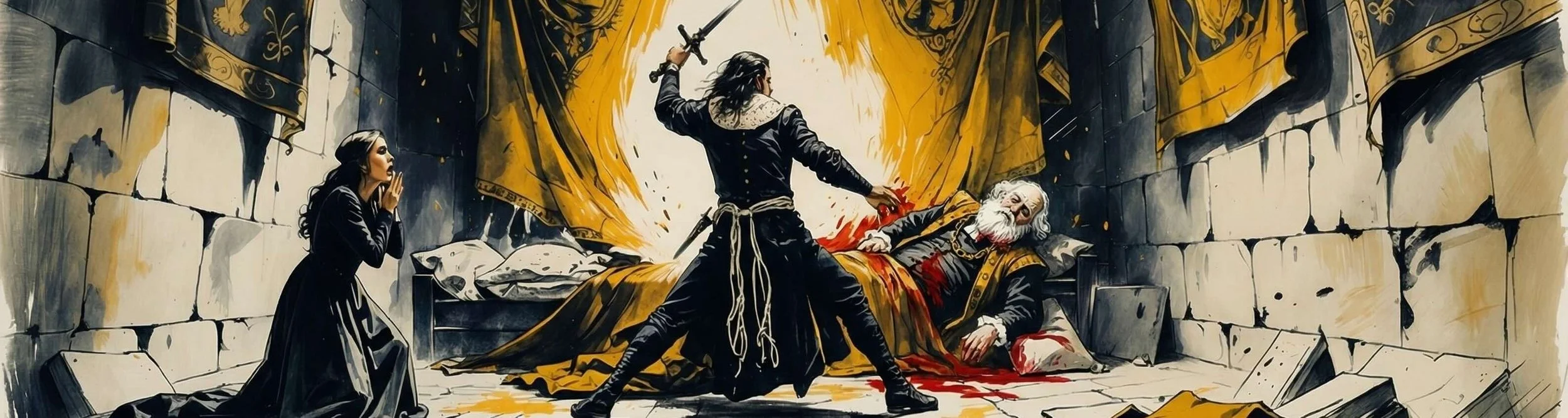
Key Event: Hamlet kills Polonius (thinking he is the King) and confronts Gertrude about her marriage; the Ghost intervenes.
The Atmosphere: Claustrophobic, violent, hysterical, and psychologically raw.
Key Quote: "I must be cruel only to be kind."
Significance: This is the point of no return. Hamlet has committed murder, staining his cause and giving Claudius a legitimate reason to exile (and kill) him.
Scene Summary
Polonius hides behind the arras (tapestry) in Gertrude’s room to spy. Hamlet enters, and he and his mother exchange sharp words. When Gertrude attempts to scold him, Hamlet aggressively forces her to sit ("You shall not budge"), intending to make her look into her own soul. Terrified, she cries for help. Polonius echoes the cry from behind the arras. Thinking it is the King, Hamlet draws his rapier and stabs through the fabric, killing Polonius instantly. Discovering his mistake, Hamlet shows little remorse, calling Polonius a "wretched, rash, intruding fool." He then turns back to Gertrude, showing her two portraits: one of his noble father and one of the "mildewed ear" Claudius, demanding to know how she could switch from one to the other. As Hamlet’s rage peaks, the Ghost appears to remind him of his mission ("whet thy almost blunted purpose"). Gertrude, unable to see the Ghost, believes Hamlet is hallucinating ("This is the very coinage of your brain"). Hamlet begs her to repent, refrain from sleeping with Claudius, and drags Polonius's body out of the room.
Context
The Closet: In the Elizabethan era, a 'closet' was a private room for prayer, reading, or dressing. It was the only place a Queen could be truly private. Hamlet’s aggressive intrusion with a weapon is a violation of domestic and royal sanctuary.
The Two Pictures: Staging tradition often has Hamlet holding a miniature of his father while pointing to a miniature of Claudius worn by Gertrude. This visual aid turns the abstract comparison of the brothers into a concrete physical confrontation.
The Visibility of Ghosts: In Act 1, the soldiers saw the Ghost. Here, only Hamlet sees it. This ambiguity is crucial: is the Ghost real, or is this now a projection of Hamlet’s "ecstasy" (madness)? The text leaves it open, but the Ghost’s intervention saves Gertrude from physical harm.
Character Focus
Gertrude: The Ambiguous Mother
This scene is central to understanding Gertrude. Her shock at Hamlet's accusation ("As kill a king?") strongly suggests she knew nothing of the murder. She appears weak and pliable, moved to guilt by Hamlet’s words ("Thou turn’st mine eyes into my very soul"). However, her inability to see the Ghost marks her spiritual blindness; she is too connected to the flesh and the material world to perceive the supernatural.
Language and Technique
Stichomythia: The opening dialogue is a rapid-fire exchange of one-liners ("Hamlet, thou hast thy father much offended" / "Mother, you have my father much offended"). This verbal parrying sets up the conflict as a duel of wits before it becomes physical.
Imagery of Infection: Hamlet uses visceral images of disease to describe Gertrude’s sin ("mildewed ear," "rank corruption," "ulcerous place"). He views her sexuality not just as immoral, but as a physical rot spreading through the family tree.
Paradox: "I must be cruel only to be kind." Hamlet justifies his harsh treatment of his mother (and the murder of Polonius) as necessary evils to save her soul and the state. It highlights the moral confusion that revenge forces upon the hero.
Key Quotes
Original:
How now! A rat? Dead, for a ducat, dead! (Hamlet)
Shakespeare Retold (Modern Verse):
What’s that? A rat? I bet you that he’s dead!
Analysis: Contrasts sharply with the previous scene. There, Hamlet hesitated to kill a known enemy. Here, he kills an unknown figure instantly on a reflex. The "rat" imagery dehumanises the victim, showing how the "antic disposition" is desensitising Hamlet to violence.
_____
Original:
Look here upon this picture and on this,
The counterfeit presentment of two brothers.
See what a grace was seated on this brow...
Here is your husband, like a mildewed ear
Blasting his wholesome brother. (Hamlet)
Shakespeare Retold (Modern Verse):
Look at this picture first, then look at this one:
A copy imitation of two brothers.
Look at the dignity on this man’s face…
Here’s your new man, a mouldy ear of corn,
That blights his wholesome brother.
Analysis: Hamlet forces Gertrude to compare the brothers visually. The simile "mildewed ear" refers to a diseased ear of corn that infects the healthy ones around it. It also ironically references the method of the murder (poison in the ear), though Hamlet uses it here to describe Claudius's corrupted character.
_____
Original:
Do not forget. This visitation
Is but to whet thy almost blunted purpose. (The Ghost)
Shakespeare Retold (Modern Verse):
Do not forget! My visit here today
Is just to sharpen up your fading purpose.
Analysis: The Ghost interrupts Hamlet’s tirade against his mother. "Whet" means to sharpen (like a knife). The Ghost realises Hamlet is wasting his energy attacking Gertrude rather than killing Claudius. It is a reminder of the true mission and the promise to "leave her to heaven."
_____
Original:
Confess yourself to heaven;
Repent what’s past, avoid what is to come;
And do not spread the compost on the weeds
To make them ranker. (Hamlet)
Shakespeare Retold (Modern Verse):
Confess your sins;
Repent your past; adjust your future plans;
And do not spread the compost on the weeds
To make them worse.
Analysis: Hamlet assumes the role of a priest or confessor. The gardening metaphor ("compost on the weeds") suggests that ignoring the sin or continuing the incestuous relationship will only feed the corruption. He demands abstinence as the only cure.
Study Prompts (with suggested answers)
-
Benchmark Points:
Contrast with the Prayer Scene (Act 3 Scene 3).
High emotional state/adrenaline.
The belief that it might be the King.
Suggested Answer: Hamlet is in a state of extreme agitation after the play and his aborted attempt to kill Claudius. Hearing the cry from behind the arras, he reacts on instinct ("dead for a ducat"), hoping it is the King ("I took thee for thy better"). It shows that Hamlet is capable of decisive action when he acts on impulse rather than intellect.
-
Benchmark Points:
"Nothing at all; yet all that is I see."
The difference between Act 1 and Act 3.
Gertrude’s spiritual state.
Suggested Answer: Gertrude does not see the Ghost, unlike the guards in Act 1. This suggests either that the Ghost is choosing to be selective to protect her, or that Gertrude’s spiritual guilt creates a blindness that prevents her from seeing the supernatural reality. It isolates Hamlet, making him appear truly mad in her eyes.
-
Benchmark Points:
Her reaction to the accusation ("As kill a king?").
Her focus on her own guilt regarding the remarriage.
The Ghost's attitude toward her.
Suggested Answer: The text implies she is innocent of the murder. Her shock ("As kill a king?") seems genuine. She admits to the "black and grained spots" of her soul, but this refers to her hasty and incestuous marriage to Claudius, not complicity in the poisoning. She is an adulteress, but likely not a murderer.
-
Benchmark Points:
The paradox of saving someone by hurting them.
Hamlet's treatment of his mother.
The role of the Scourge and Minister.
Suggested Answer: Hamlet believes he must break his mother’s heart verbally to save her soul from damnation. He acts as a "scourge and minister"—an agent of divine justice who must perform harsh acts (cruelty) to restore moral order (kindness/salvation).
-
Benchmark Points:
Hamlet becomes a hunted man.
Justification for Claudius to act.
The catalyst for Laertes' revenge and Ophelia's madness.
Suggested Answer: Polonius's death turns Hamlet from a victim into a perpetrator. It gives Claudius a legitimate political excuse to ship Hamlet away (and plan his execution). It also creates a parallel revenge plot: Laertes must now avenge his father, mirroring Hamlet’s own mission.