
Home → Plays → Hamlet → Act 4 Scene 2 → Scene Analysis
Hamlet: Act 4, Scene 2 – analysis
Hamlet taunts his former friends, refusing to surrender Polonius's body and exposing their subservience to the King.
Scene Profile – At a Glance
Location: Another Room in the Castle.
Characters: Hamlet, Rosencrantz, Guildenstern, (Gentlemen/Guards).
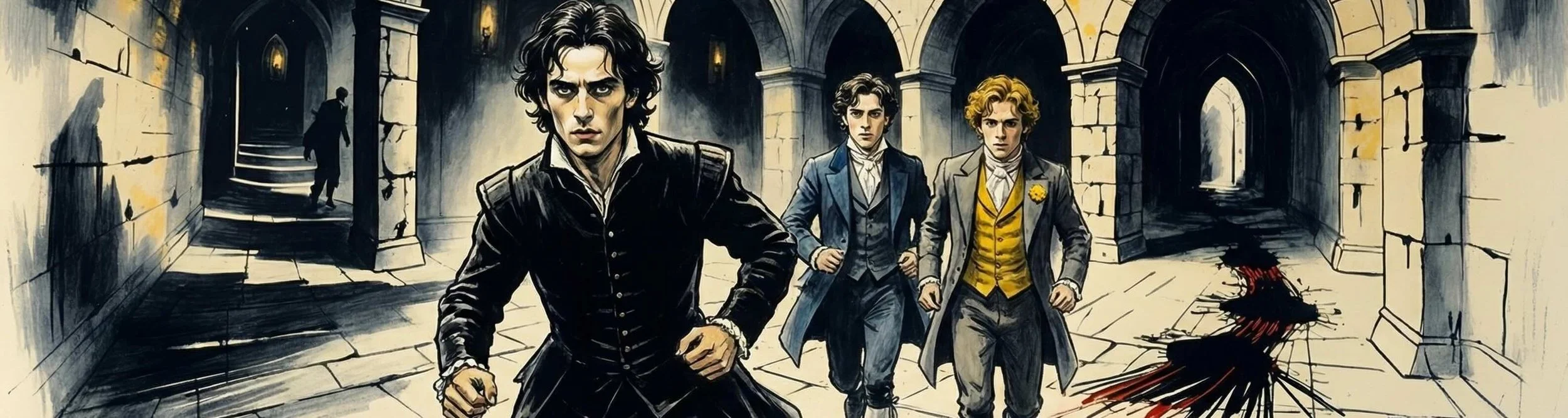
Key Event: Rosencrantz and Guildenstern demand to know where Polonius is buried; Hamlet runs rings around them with insults.
The Atmosphere: Manic, dark comedy, and fast-paced.
Key Quote: "The body is with the King, but the King is not with the body."
Significance: Shows Hamlet’s complete intellectual dominance over the King’s agents and his transition into a darker, more cynical form of madness.
Scene Summary
Rosencrantz and Guildenstern catch up with Hamlet and demand to know where he has hidden Polonius’s corpse. Hamlet refuses to answer directly, instead mocking them. He calls Rosencrantz a "sponge" that soaks up the King’s rewards ("countenance") and authority. He warns that when the King is done with them, he will simply squeeze them dry and cast them aside. When they persist in asking for the body, Hamlet replies with a riddle: "The body is with the King, but the King is not with the body. The King is a thing... of nothing." He then runs off ("Hide fox, and all after"), forcing them to chase him like children in a game.
Context
The "Sponge" Metaphor: This was a recognizable political trope in the Renaissance. Courtiers who grew rich by flattering the monarch were often warned that they were merely temporary vessels for royal wealth, easily discarded when empty.
Hide and Seek: Hamlet’s exit line ("Hide fox, and all after") refers to a children’s game similar to hide-and-seek. By turning the hunt for a corpse into a playground game, Hamlet emphasises his "antic disposition" (madness) while simultaneously mocking the seriousness of the King's agents.
Legal Theory: The riddle about the King and the body likely references the legal concept of the "King's Two Bodies"—the body natural (the mortal man, Claudius) and the body politic (the divine office of Kingship).
Character Focus
Rosencrantz & Guildenstern: The Disposable Men
This scene marks the point where they lose all sympathy. In Act 2, they were old friends; now, they are functioning purely as agents of the state ("what have you done with the dead body?"). They are out of their depth, unable to understand Hamlet’s intellect or his insults, proving they are indeed "sponges"—passive, unthinking tools of power.
Language and Technique
Prose: The entire scene is written in prose, not verse. This lowers the tone, making the interaction feel gritty, informal, and "mad" rather than noble. It fits the grotesque subject matter (a hidden corpse).
Extended Metaphor: Hamlet sustains the "sponge" image for several lines, detailing exactly how the King uses his courtiers. This rhetorical control proves he is not rambling madly but delivering a calculated critique.
Chiasmus/Riddle: "The body is with the King, but the King is not with the body." This linguistic knot traps his friends in confusion. It could mean: Polonius (the body) is with the old King (in death), but Claudius (the current King) is not yet dead.
Key Quotes
Original:
Safely stowed.
Shakespeare Retold (Modern Verse):
Safely hidden.
Analysis: Hamlet’s opening line refers to the corpse of Polonius. The phrase "stowed" suggests luggage or cargo, not a human being. It reflects Hamlet’s desensitisation to death and his lack of respect for the man he just killed.
_____
Original:
Ay, sir, that soaks up the King’s countenance, his rewards, his authorities... When he needs what you have gleaned, it is but squeezing you, and, sponge, you shall be dry again. (Hamlet)
Shakespeare Retold (Modern Verse):
I do: you soak up all the king declares, his gifts and mandates…When he is done with you, and squeezed the knowledge from you like a sponge, you’ll then be dry again.
Analysis: Hamlet dehumanises Rosencrantz, calling him a tool ("sponge") rather than a man. He predicts their eventual downfall: once they have served Claudius's purpose, they will be discarded. It is a prophetic warning that they are too blind to hear.
_____
Original:
The body is with the King, but the King is not with the body. The King is a thing... (Hamlet)
Shakespeare Retold (Modern Verse):
The body’s with the king, although the king is not there with the body. The king’s a thing…
Analysis: A complex riddle. It may mean: Polonius is with King Hamlet (in the afterlife), but King Claudius is not yet with Polonius (dead). Or, it mocks the legal theory of the "King's Two Bodies"—the office of Kingship remains, even if the man (Claudius) is worthless.
_____
Original:
A thing of nothing. (Hamlet)
Shakespeare Retold (Modern Verse):
A worthless thing.
Analysis: Hamlet completes the insult. By calling the King "a thing of nothing," he dismisses Claudius’s authority and perhaps even his humanity. "Nothing" was also Elizabethan slang for the female genitalia (or "no-thing"), adding a layer of bawdy disrespect.
Study Prompts (with suggested answers)
-
Benchmark Points:
Soaking up rewards.
Being squeezed dry by the King.
Lack of independent thought.
Suggested Answer: Hamlet uses the metaphor to describe Rosencrantz’s subservience. He "soaks up" the King’s approval ("countenance") and authority. Hamlet warns that once Claudius has extracted the information ("gleaned what you have"), he will "squeeze" Rosencrantz dry and cast him aside, highlighting the disposable nature of sycophants.
-
Benchmark Points:
The distinction between the body natural and body politic.
Polonius being with King Hamlet (death).
Claudius not yet being dead.
Suggested Answer: The riddle is deliberately ambiguous to confuse the spies. It likely suggests that Polonius's body is with the true King (Hamlet's father, in death), but the current usurper King (Claudius) is not yet with the body (dead). It serves to threaten Claudius while maintaining the guise of madness.
-
Benchmark Points:
Use of prose.
Playful running ("Hide fox").
Disrespect for the dead.
Suggested Answer: Hamlet uses a frantic, mocking energy to confuse his pursuers. By turning a murder investigation into a game of hide-and-seek ("Hide fox, and all after") and speaking in riddles, he performs madness effectively enough to prevent them from getting a straight answer, whilst insulting them to their faces.
-
Benchmark Points:
Low status of the conversation.
Madness/informality.
Speed of the dialogue.
Suggested Answer: Shakespeare typically uses verse for noble characters and prose for lower-class characters or madness. Here, prose reflects Hamlet’s "mad" state and his lack of respect for Rosencrantz and Guildenstern. It also allows for a faster, more chaotic rhythm suited to the chase.
-
Benchmark Points:
"Safely stowed."
Lack of prayer or solemnity.
Focus on mocking the living rather than mourning the dead.
Suggested Answer: No. His language ("safely stowed," "sponge") is cold and pragmatic. He treats the body as an object or a piece of luggage. This lack of remorse signals a hardening of his character.