
Home → Plays → Hamlet → Act 4 Scene 4 → Scene Analysis
Hamlet: Act 4, Scene 4 – analysis
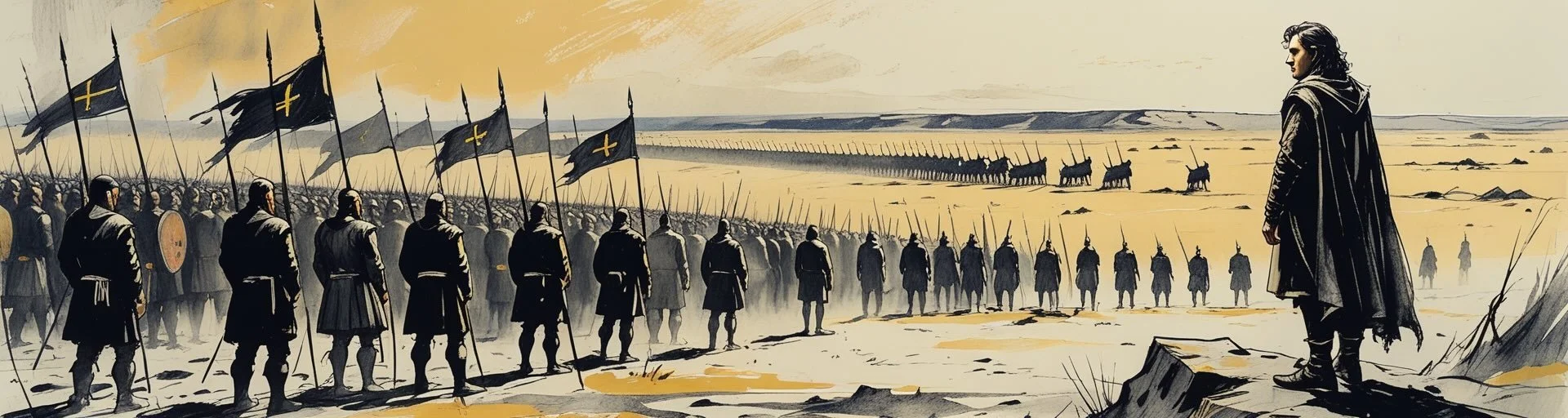
Hamlet witnesses Fortinbras’s army marching for a worthless piece of land and shames himself into a final resolve for revenge.
Scene Profile – At a Glance
Location: A plain in Denmark (near the harbour).
Characters: Hamlet, Rosencrantz, Guildenstern, A Captain, (Fortinbras passes over the stage).
Key Event: Hamlet learns that thousands of men are marching to die for a tiny, worthless patch of land.
The Atmosphere: Open, military, cold, and expansive.
Key Quote: "My thoughts be bloody, or be nothing worth!"
Significance: The structural turning point for Hamlet’s psychology; he stops debating the morality of revenge and decides to surrender to his violent "fate."
Scene Summary
On his way to the ship for England, Hamlet watches the Norwegian army march by. He questions a Captain, asking what they are fighting for. The Captain admits they are marching against Poland to capture a "little patch of ground" that has no profit in it but the name; he wouldn't pay five ducats to farm it. Hamlet is stunned that twenty thousand men are willing to go to their graves "like beds" for such a trivial "straw" of honour. He sends Rosencrantz and Guildenstern ahead so he can be alone. He delivers his final soliloquy ("How all occasions do inform against me"), berating himself for his "bestial oblivion" (forgetfulness). He compares his own inaction—despite having a father killed and a mother stained—to the massive action of Fortinbras. He concludes that from this moment on, he will abandon complex thought for bloody action.
Context
Fortinbras as a Foil: Fortinbras ("Strong-in-arm") is the mirror opposite of Hamlet. Where Hamlet is all thought and no action, Fortinbras is all action and no thought. He is willing to sacrifice thousands of lives for a point of "honour," contrasting with Hamlet’s paralysis over the morality of one death.
The Textual History: This scene is present in the Second Quarto but completely missing from the First Folio. This suggests that even Shakespeare (or his acting company) felt the play might be too long or that Hamlet’s "delay" was becoming repetitive. However, thematically, it is crucial for showing Hamlet’s final psychological shift.
The Cost of War: Shakespeare offers a cynical view of military glory. The "patch of ground" is worthless; the war is an "imposthume" (abscess) of too much peace and wealth. It questions whether "honour" is worth the human cost.
Character Focus
Hamlet: The Shamed Prince
Hamlet is shamed by the sight of the army. He realises that his intellect ("god-like reason") has become a liability. He stops looking for external proof (like the Mousetrap) and starts looking inward, diagnosing his problem as "thinking too precisely on the event." His resolution to have "bloody" thoughts marks the end of the Philosopher Prince and the birth of the Avenger, although ironically, he is currently a prisoner being shipped away from his target.
Language and Technique
Metaphor (Eggshell/Straw): Hamlet describes the object of the war as an "egg-shell" and a "straw." These symbols of fragility and worthlessness highlight the absurdity of the conflict, yet simultaneously elevate the concept of "honour"—if men will die for a straw, surely Hamlet should kill for a father.
Rhetorical Questions: The soliloquy is driven by questions ("What is a man...?", "market of his time?"). Unlike "To be or not to be," which sought universal answers, these questions are self-accusatory, demanding an answer for his own failure.
Imagery of Disease: Hamlet describes the war as an "imposthume" (an internal abscess or cyst) that breaks inward. It suggests that Fortinbras's aggression is not a sign of health, but a symptom of a society that has grown too fat and peaceful, needing to bleed itself to relieve the pressure.
Key Quotes
Original:
We go to gain a little patch of ground
That hath in it no profit but the name.
To pay five ducats, five, I would not farm it. (The Captain)
Shakespeare Retold (Modern Verse):
We’re targeting a tiny patch of land
That’s worthless, yet it has a worthy name.
I wouldn’t farm it if it cost five gold coins.
Analysis: The Captain serves as a voice of grim reality. He acknowledges the economic futility of the war. This highlights the irrationality of human conflict—men fight not for material gain ("profit"), but for abstract concepts like "name" and reputation.
_____
Original:
How all occasions do inform against me,
And spur my dull revenge! What is a man,
If his chief good and market of his time
Be but to sleep and feed? A beast, no more. (Hamlet)
Shakespeare Retold (Modern Verse):
All these events denounce my own inaction
And spur me to revenge! What is a man
If all he ever did throughout his life
Was sleep and eat? For then, he’s just a beast.
Analysis: Hamlet sees the external world ("occasions") as a personal accusation. He defines humanity by the ability to use "god-like reason" (looking before and after), arguing that failing to use this reason to act makes a man no better than livestock ("beast").
_____
Original:
Rightly to be great
Is not to stir without great argument,
But greatly to find quarrel in a straw
When honour’s at the stake. (Hamlet)
Shakespeare Retold (Modern Verse):
But being great
Does not require a monumental reason
When honour is at stake.
Analysis: A complex definition of greatness. Hamlet argues that while it is wrong to fight for no reason, true greatness involves fighting over even a "straw" (something tiny) if honour is involved. He adopts the chivalric code here, abandoning his Christian/humanist hesitation.
_____
Original:
O, from this time forth,
My thoughts be bloody, or be nothing worth! (Hamlet)
Shakespeare Retold (Modern Verse):
Now, from this moment on
My thoughts will all be violent, or be gone!
Analysis: The final couplet of his final soliloquy. Note that he resolves his thoughts will be bloody, not necessarily his deeds. However, it signals a psychological closure; he has shut the door on mercy and conscience.
Study Prompts (with suggested answers)
-
Benchmark Points:
Action vs. Inaction.
Decisiveness vs. Philosophy.
The "tender prince" leading an army vs. the scholar.
Suggested Answer: Fortinbras is everything Hamlet is not: decisive, active, and unburdened by conscience. While Hamlet hesitates to kill one guilty man to avenge a father, Fortinbras is willing to send twenty thousand men to their deaths for a "straw." He represents the pure, martial masculinity that Hamlet feels he lacks.
-
Benchmark Points:
Forgetfulness.
Living like an animal ("sleep and feed").
Failure to use "god-like reason."
Suggested Answer: Hamlet accuses himself of "oblivion" (forgetting his father/duty) or "cowardice." By "bestial," he means living only for physical needs (sleeping and eating) rather than using the intellect and memory that God gave humans. He fears he has ignored his higher purpose.
-
Benchmark Points:
Symbol of futility.
Contrast between value and cost.
Irony of Hamlet's inaction.
Suggested Answer: The "patch of ground" symbolises the absurdity of war—it is too small to even bury the men who will die fighting for it. However, it also highlights the magnitude of Hamlet's shame: if these men will die for nothing, why can he not act for everything (his father, mother, and throne)?
-
Benchmark Points:
The shift in language (bloody thoughts).
The context (he is still being shipped away).
The difference between Act 5 Hamlet and Act 1-3 Hamlet.
Suggested Answer: Psychologically, yes. He stops questioning the morality of revenge. However, structurally, there is irony: he resolves to act exactly at the moment he has lost his agency (he is a prisoner of Rosencrantz and Guildenstern). The "change" is internal; we will not see the external results until he returns in Act 5.
-
Benchmark Points:
Fighting for "straws" when honour is at stake.
Rejection of pure reason if it leads to paralysis.
The Aristocratic/Chivalric code.
Suggested Answer: Hamlet redefines greatness not as moral goodness or logical restraint, but as the defence of honour at all costs. He concludes that "rightly to be great" means being willing to fight over a trivial matter if one’s reputation is threatened. This marks his return to the feudal values of his father, King Hamlet.