
Home → Plays → Hamlet → Act 5 Scene 1 → Scene Analysis
Hamlet: Act 5, Scene 1 – analysis
Hamlet returns to Denmark and confronts mortality in the graveyard, leading to a violent clash at Ophelia's funeral.
Scene Profile – At a Glance
Location: A Churchyard (Graveyard).
Characters: Hamlet, Horatio, Two Clowns (Gravediggers), King Claudius, Queen Gertrude, Laertes, (Priest/Doctor).
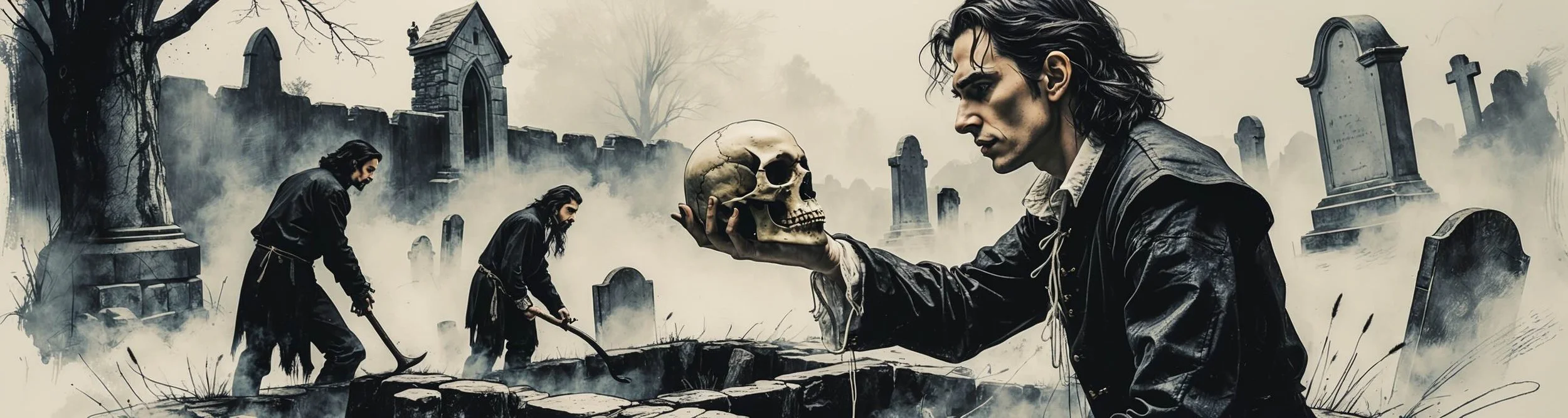
Key Event: Hamlet speaks to the skull of Yorick; Ophelia’s funeral procession arrives; Hamlet and Laertes fight in the grave.
The Atmosphere: Earthy, philosophical, grotesque, and tragic.
Key Quote: "Alas, poor Yorick! I knew him, Horatio."
Significance: Hamlet accepts the physical reality of death, moving from fear ("to be or not to be") to acceptance ("let be"), preparing him for the finale.
Scene Summary
Two Gravediggers (Clowns) dig a grave, debating whether Ophelia deserves a Christian burial given her suspicious death ("self-slaughter"). They conclude she is only getting one because she is a gentlewoman. Hamlet and Horatio enter. Hamlet watches the First Gravedigger singing while tossing up skulls, and is appalled by the lack of respect for the dead. He speculates on whose skulls they might be (a politician, a lawyer). He asks the Gravedigger whose grave it is; the man replies with riddles. The Gravedigger unearths the skull of Yorick, the King’s jester. Hamlet holds it, famously meditating on the transience of life ("Where be your gibes now?"). The funeral procession arrives. Hamlet realises the "maimed rites" imply a suicide. When Laertes leaps into the grave to hold Ophelia one last time, Hamlet bursts forward, declaring "This is I, Hamlet the Dane!" They fight in the grave until separated. Hamlet claims he loved Ophelia more than "forty thousand brothers," then storms off.
Context
The Gravediggers (Clowns): In Shakespeare’s company, these roles were played by the lead comic actors (like Will Kempe or Robert Armin). Their function is "comic relief," but also to ground the play in the reality of dirt and bones, contrasting with the high philosophy of the court.
Christian Burial: Suicide was a mortal sin. Those who killed themselves were usually buried in unsanctified ground (crossroads) with no prayers. The "maimed rites" (limited ceremony) Ophelia receives are a compromise bought by Claudius's influence, infuriating Laertes who wants full honours.
Memento Mori: The skull is a classic Renaissance symbol (Memento Mori - "Remember you must die"). Hamlet holding the skull is the visual emblem of the play’s obsession with death vs. life.
Character Focus
Hamlet: The Fatalist
Hamlet has changed. He is no longer the frantic, suicidal man of Act 3. He is calmer, detached, and philosophical. Holding Yorick's skull, he stares death in the face and accepts it as a physical inevitability ("to this favour she must come"). This acceptance prepares him for his own death in the final scene. His explosion at the funeral ("I loved Ophelia") is a final burst of the old, passionate Hamlet, triggered by Laertes' theatrical grief.
Language and Technique
Prose vs Verse: The first half (Gravediggers/Hamlet) is in prose, signifying the "low" setting and the grounded reality of death. The second half (Funeral) switches to blank verse, returning to the "high" tragedy of the court.
Riddles and Puns: The Gravedigger outwits Hamlet with literalism. When Hamlet asks "Who is to be buried in't?", the man says "One that was a woman, sir; but, rest her soul, she's dead." This wordplay forces Hamlet to stop over-intellectualising and face simple facts.
Grotesque Imagery: Hamlet imagines the noble Alexander the Great returning to dust and stopping a "bunghole" (beer barrel). This reduction of greatness to functional dirt highlights the theme of the "leveller"—death makes everyone equal.
Key Quotes
Original:
Alas, poor Yorick! I knew him, Horatio: a fellow of infinite jest, of most excellent fancy... Here hung those lips that I have kissed I know not how oft. (Hamlet)
Shakespeare Retold (Modern Verse):
Oh no, poor Yorick! I knew him, Horatio. He was so funny, always making jokes…His lips were here that I have kissed so often.
Analysis: This is the moment Hamlet connects the abstract idea of "death" to a specific person he loved. It is intimate and tactile ("lips," "kissed"). He realises that death is not just a "sleep," but a physical erasure of personality and joy.
_____
Original:
Imperious Caesar, dead and turned to clay,
Might stop a hole to keep the wind away. (Hamlet)
Shakespeare Retold (Modern Verse):
Imperious Caesar, dead and turned to clay,
Might plug a hole to keep the wind away.
Analysis: Hamlet traces the body of Caesar (the greatest ruler) to a lump of clay used to patch a wall. It is the ultimate statement of materialist nihilism: no matter how powerful you are, you end up as useful dirt.
_____
Original:
I loved Ophelia: forty thousand brothers
Could not, with all their quantity of love,
Make up my sum. (Hamlet)
Shakespeare Retold (Modern Verse):
I loved Ophelia. Forty thousand brothers
Could not, if all their love was added up,
Exceed my love.
Analysis: Hamlet’s declaration of love comes too late. The hyperbole ("forty thousand") suggests he is trying to out-do Laertes in a contest of grief. It confirms he did love her, but his "antic disposition" and revenge mission destroyed their chance at happiness.
_____
Original:
This is I,
Hamlet the Dane. (Hamlet)
Shakespeare Retold (Modern Verse):
It is me,
Hamlet the Dane!
Analysis: This is the first time Hamlet refers to himself as "The Dane" (the King). It is a proclamation of his royal identity and his return to claim his birthright. He is no longer "Prince," but the rightful monarch challenging the usurper.
Study Prompts (with suggested answers)
-
Benchmark Points:
Comic relief.
Highlighting the social injustice of burial (rich vs. poor).
Grounding the play in physical reality.
Suggested Answer: The Gravediggers provide comic relief after the intensity of Ophelia’s death, but they also offer a cynical "commoner’s" view of the court. They argue that if Ophelia hadn't been a "gentlewoman," she wouldn't have received a Christian burial, highlighting the corruption of religious law by money and class.
-
Benchmark Points:
Shift from fear ("dread of something after death") to acceptance.
The physical reality of the skull.
The realisation that death is universal.
Suggested Answer: In Act 3 ("To be or not to be"), Hamlet feared the spiritual unknown of death. In Act 5, holding Yorick's skull, he confronts the physical known of death: decay. He realises death is inevitable and biological ("Alexander returneth into dust"), which cures his fear and paralysis, allowing him to face the finale with calm fatalism.
-
Benchmark Points:
Competitive grief.
Laertes' anger at Hamlet (the killer of his father).
Hamlet's shock at the "bravery" (showiness) of Laertes' grief.
Suggested Answer: The fight is a physical manifestation of their conflict. Laertes blames Hamlet for Polonius’s death and Ophelia’s madness. Hamlet, unaware Ophelia is dead until this moment, is disgusted by Laertes' theatrical display of sorrow ("phrase of sorrow"). He jumps in to prove his own love is truer and deeper, turning the funeral into an ego contest.
-
Benchmark Points:
Memento Mori (symbol of death).
Contrast between past joy and present decay.
Personal connection for Hamlet.
Suggested Answer: Yorick's skull is the play's most potent symbol. It represents the finality of death and the loss of the "merry" past of Hamlet’s childhood. Unlike the Ghost (a spiritual terror), the skull is a physical object that proves even the funniest, most lively people turn to hollow bone. It is the catalyst for Hamlet's acceptance of mortality.
-
Benchmark Points:
Suspicion of suicide.
Religious doctrine.
Laertes' conflict with the church.
Suggested Answer: The Priest states that her death was "doubtful" (likely suicide). Under church law, suicides were damned and denied burial in consecrated ground. He claims giving her the full requiem would "profane the service of the dead." This creates conflict with Laertes, who views his sister as an "angel" and the priest as "churlish."